
AI in anti-aging skincare product innovation is no longer just a packaging phrase. The strongest computational work now reports external AUROC values around 0.85–0.95 for some well-characterized peptide bioactivity classes, and one recent polypharmacological screen reported that more than 70% of 22 tested compounds extended lifespan in C. elegans.[1][2] Those are not trivial signals. They also do not mean that an AI-found ingredient has been shown to improve wrinkles, firmness, barrier function, or sensitivity in human skin.
That tension is the useful place to start. Machine learning is beginning to make the discovery side of anti-aging R&D more systematic: it can search peptide sequence space, prioritize candidates with predicted functions, and look for compounds likely to act across more than one biological pathway. The clinical side is less mature. Human skin validation is still often small, sponsor-funded, or only partly public, and the evidence ladder between a prediction and a defensible cosmetic efficacy claim still has missing rungs.

What “AI-discovered ingredient” usually means here
In this setting, AI is not the same thing as an app estimating skin age from a selfie, and it is not the dermatology AI used for lesion triage. The relevant work is closer to ingredient discovery and early translational biology. Three approaches matter most for anti-aging skincare:
- Supervised peptide bioactivity prediction: models learn from labeled peptide datasets and estimate whether a new sequence is likely to have a specific activity.
- Sequence-to-function peptide engineering: models help select or design peptide sequences with desired biological behavior before laboratory testing.
- Polypharmacological screening: models search for candidates expected to affect several receptors, pathways, or aging-related mechanisms rather than one isolated target.
That distinction matters because the evidence standards are different. A skin-analysis algorithm can be judged against image labels or diagnostic outcomes. An ingredient-discovery model has to survive a longer chain: prediction, synthesis or sourcing, stability, penetration or local availability, biological testing, safety, formulation compatibility, and human outcome measurement. A high-performing model is a discovery accelerator, not an efficacy endpoint.
Why peptide prediction is the most credible starting point
Peptides are a natural test bed for AI-assisted cosmetic discovery because sequence is already a compact data structure. A model can treat amino acid order, length, charge, hydrophobicity, and derived descriptors as inputs, then associate those features with known activities. That does not make biology simple, but it gives computational systems something cleaner to learn from than a vaguely defined botanical extract.
The reported benchmark performance is therefore worth taking seriously, especially where the bioactivity class is well populated. A review of AI methods for bioactive peptides describes external AUROC values of 0.85–0.95 for models predicting ACE-inhibitory and DPP-IV-inhibitory peptides.[1] AUROC is not a clinical effect size. It measures how well a model ranks positives above negatives across thresholds. Still, an external AUROC in that range suggests that, for certain peptide classes, the model is learning patterns that generalize beyond its training set rather than merely memorizing examples.
The phrase “for certain peptide classes” does a lot of work. Prediction quality depends on the density and reliability of the training data. Peptide functions with many curated examples are a different problem from cosmetic endpoints such as perceived firmness, wrinkle appearance, or sensitivity, where biological mechanisms are indirect and outcome measures are less standardized. Class imbalance also matters: if a dataset contains many more inactive than active peptides, or overrepresents a narrow family of sequences, a model can look useful while missing rarer but important candidates. Readers who evaluate healthcare AI more broadly will recognize the same concerns around validation design and dataset bias that appear in diagnostic AI evidence reviews and discussions of algorithmic bias in healthcare AI.
| Evidence layer | What it can show | What it cannot show by itself |
|---|---|---|
| External peptide model performance | The model ranks likely active sequences well for a defined peptide class | That the sequence improves visible skin aging in a finished product |
| In vitro testing | A candidate affects cells, enzymes, inflammatory signals, or matrix-related markers under controlled conditions | That it reaches the right site in human skin at an effective concentration |
| Ex vivo skin testing | Activity in skin tissue architecture closer to human use conditions | Durable clinical improvement in living users |
| Pilot human study | Early signal on tolerability or selected skin outcomes | Robust, generalizable efficacy without larger independent validation |
The peptide evidence chain is promising, but uneven
The most directly relevant peer-reviewed skincare evidence here is Zhou et al. (2020) in the International Journal of Cosmetic Science, which discussed AI-identified natural peptides with measurable anti-aging effects across in vitro, ex vivo, and pilot clinical work.[3] That combination is more informative than an isolated cell-culture result. It shows that the field is trying to move candidates through progressively more relevant test systems rather than stopping at a prediction score.
But the study type matters. Zhou et al. is described as a narrative review, not an original meta-analysis, and the quality of the underlying studies varies.[3] Narrative reviews can assemble a useful map of mechanisms and candidate classes, but they do not resolve heterogeneity in the way a systematic review or pooled analysis might. If one peptide has in vitro antioxidant activity, another has ex vivo matrix effects, and a third appears in a small pilot study, those observations should not be blended into a single claim that AI peptides are clinically proven anti-aging ingredients as a category.
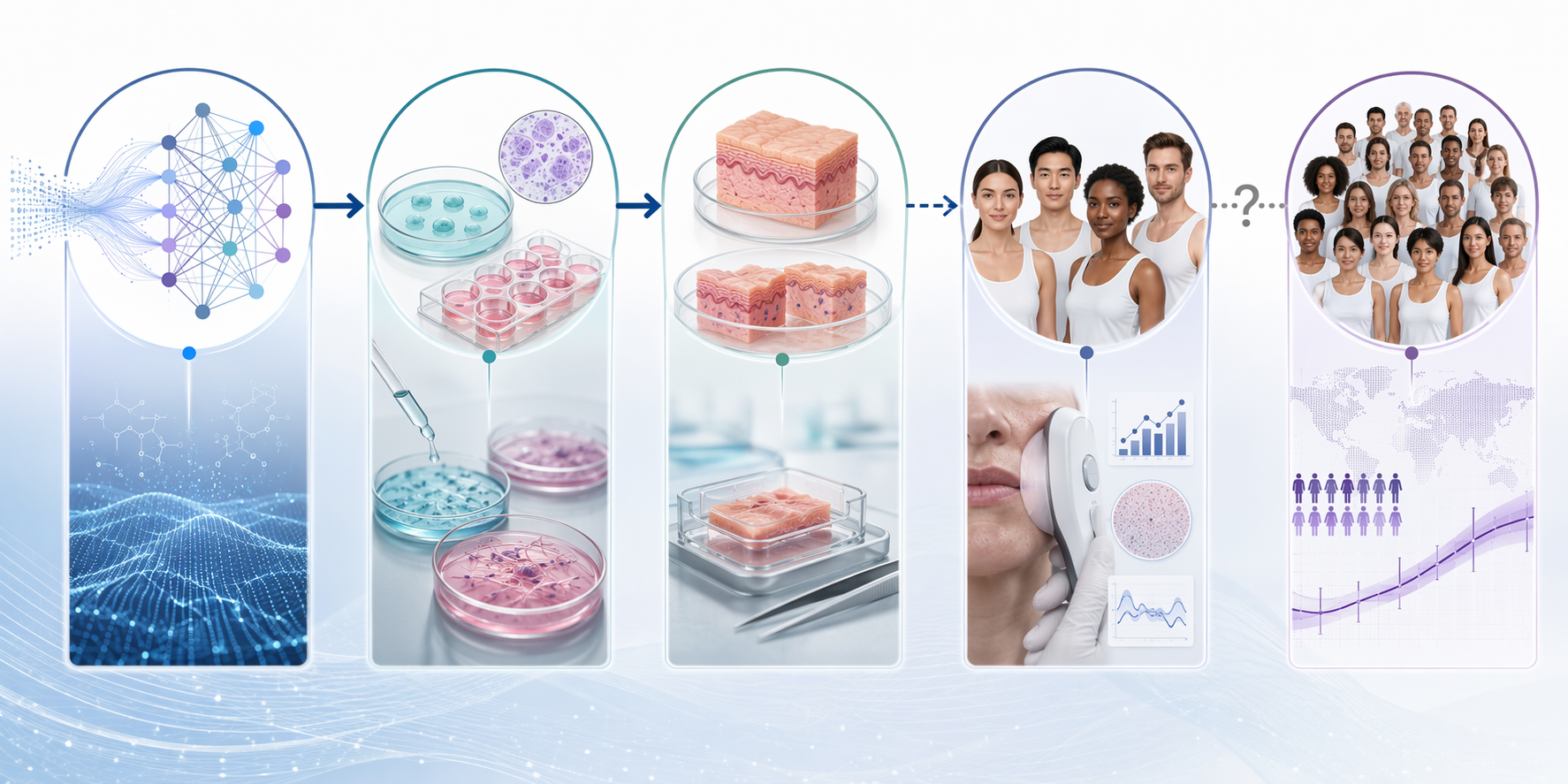
A cleaner reading is narrower and more useful: AI can help generate peptide candidates with plausible anti-aging relevance, and some candidates have advanced into biological testing and early human evaluation. The remaining question is not whether the computational step can produce candidates. It can. The harder question is whether those candidates repeatedly produce meaningful changes in human skin when formulated, applied, and measured under conditions that would satisfy a clinical or healthcare-professional audience.
What in vitro and ex vivo results add
In vitro assays are useful because they can show whether a predicted peptide changes a relevant biological signal: inflammatory mediators, extracellular matrix markers, oxidative stress pathways, or other cell-level endpoints. They are also easy to overread. A cell exposed to a peptide in a controlled assay is not the same as a peptide moving through a vehicle, crossing the stratum corneum, surviving local degradation, and acting in a living tissue environment.
Ex vivo skin models sit one rung higher. They preserve more tissue architecture and can make a candidate feel more plausible for topical use. They still do not answer adherence, repeated-use tolerability, interindividual variability, or whether a measured biomarker shift corresponds to visible improvement. This is where a translational pipeline earns trust: not by pretending each rung is definitive, but by making clear what each rung contributes.
What a pilot clinical study can and cannot carry
Pilot human studies are valuable when they test tolerability, feasibility, and directional skin outcomes. They become less useful when their language outruns their design. A small pilot can suggest that a candidate deserves larger testing; it cannot usually establish broad anti-aging efficacy across skin types, age groups, product vehicles, and real-world use patterns. Sponsorship does not invalidate a study, but it does increase the need for transparent endpoints, prespecified analysis, comparator choice, and independent replication.
Polypharmacology is where AI starts to change the search strategy
The more interesting shift is not that AI can find one peptide for one marker. It is that models can be used to search for candidates with several predicted biological effects at once. Aging biology is redundant, compensatory, and pathway-rich. A discovery system that treats inflammation, receptor signaling, matrix turnover, oxidative stress, and barrier-relevant biology as searchable spaces is closer to the problem than a single-target screen dressed up with broader language.
The Scripps Research and Gero study is a vivid example, although not a skincare efficacy study. Researchers used an AI approach to identify compounds predicted to target dopamine, serotonin, and histamine receptors simultaneously; when 22 compounds were tested in C. elegans, more than 70% extended lifespan, and one novel compound produced a 74% increase.[2] That hit rate is striking because it suggests the model was not simply generating a long wish list for low-yield screening. It was enriching the candidate pool for biological activity.
It is also a clean demonstration of why translation has to be contained. C. elegans is an important aging model, but a nematode lifespan extension result is not evidence that a topical ingredient improves photoaging, dermal density, wrinkle depth, or barrier function in humans. The study supports the power of AI-assisted multi-target screening in aging biology. It does not support a human cosmetic claim without additional skin-specific and clinical work.
That distinction should not make the result less interesting. In fact, it makes it more useful. The Scripps/Gero work shows how AI can increase the yield of mechanistically motivated screening. For anti-aging skincare R&D, the lesson is not to borrow the lifespan claim. It is to ask whether similar multi-target search strategies can identify candidates that survive skin-relevant validation: keratinocyte and fibroblast assays, reconstructed or ex vivo skin models, irritation and sensitization work, formulation stress testing, and controlled human endpoints.
Commercial launches are evidence signals, not proof of the category
AI-identified ingredients are already moving into commercial skincare. BASF’s PeptAIde 4.0 is described in trade coverage as an AI-identified set of four peptides targeting silent inflammation, with clinical claims related to dry skin, loss of firmness, and sensitive scalp.[4][5] Crown Laboratories’ Alpha-3 Peptide is described as an AI-designed peptide intended to target collagen, elastin, and hyaluronic acid production simultaneously.[6][7] These examples matter because they show that AI discovery is no longer confined to computational papers or early academic screens.
They should also be read in the correct evidence tier. A company-sponsored clinical study may be well designed, but public claim language rarely gives the same visibility into protocol, endpoint hierarchy, statistical handling, comparator selection, and replication that a peer-reviewed clinical paper would. “Clinically proven” can mean several different things in cosmetics: an instrumental measurement, an expert grading scale, a consumer perception endpoint, a short-duration study, or a controlled trial with stronger design features. Without those details, the phrase is a starting point for appraisal rather than a conclusion.
The Crown example also illustrates the appeal and hazard of multi-target language. Collagen, elastin, and hyaluronic acid are all biologically relevant to skin aging, and a peptide designed around more than one pathway is scientifically more interesting than a generic “boosting” claim. But simultaneous targeting needs evidence at each level: prediction, cell or tissue response, dose relevance, topical delivery, and human outcome. A pathway map is not the same as demonstrated clinical performance in a finished product.
The bottleneck is no longer only discovery
For formulation scientists, the AI model is near the beginning of the work, not the end. A predicted peptide may be difficult to stabilize, incompatible with a preferred vehicle, poorly available at the intended site of action, or biologically active at concentrations that do not make practical sense in a consumer product. It may also interact with preservatives, packaging, pH, enzymes, or other actives. None of those problems is solved by a high AUROC.
This is why the evidence chain is more persuasive than any single result. A credible AI-identified anti-aging ingredient should have a traceable path: the model’s training and validation strategy, the reason the selected target biology matters, the laboratory assays used to confirm activity, the relevance of the skin model, the formulation context, the safety work, and the human endpoints. If one link is missing, the claim may still be interesting, but it should become narrower.
| Claim type | Evidence needed to support it | Typical weakness in current public evidence |
|---|---|---|
| AI identified a candidate | Transparent model objective, validation design, and candidate-selection rationale | Training data and negative sets are often insufficiently described |
| The candidate has biological anti-aging relevance | In vitro or ex vivo effects on defined pathways or markers | Marker effects may not translate to visible skin outcomes |
| The ingredient works in skin | Topical delivery, formulation stability, and skin-relevant biological testing | Ingredient activity may be shown outside the final formulation context |
| The product improves anti-aging outcomes | Controlled human studies with meaningful endpoints and replication | Studies are often small, sponsor-funded, or incompletely public |
Regulation does not close the validation gap
Current AI regulatory discussions do not solve this problem for cosmetics. FDA activity around AI has focused on areas such as medical devices and drug manufacturing, not on validating AI-discovered cosmetic ingredients.[8][9] A skincare ingredient does not become clinically validated because the discovery method used machine learning, and existing medical AI frameworks should not be treated as a proxy endorsement for cosmetic efficacy.
For healthcare professionals and R&D teams, the practical standard remains evidence-chain appraisal. The relevant questions are familiar from other AI-in-health contexts: Was the model externally validated? Were the datasets representative and sufficiently curated? Were the endpoints biologically and clinically meaningful? Did the candidate work outside the setting in which it was discovered? Are conflicts of interest and sponsorship visible enough for the reader to judge the claim?
Where the defensible claim stands in Q3 2026
The defensible claim is now stronger than “AI might someday help skincare R&D.” It already is helping candidate generation. Peptide bioactivity models show meaningful performance for some well-characterized classes, AI-guided peptide work has entered skin-relevant testing, and multi-target screening has produced unusually concrete hit rates in aging-model research.[1][2][3] Commercial activity from BASF and Crown Laboratories suggests the method is moving into product pipelines rather than staying in computational demonstrations.[4][5][6][7]
The claim that should still be resisted is broader: that AI-discovered anti-aging ingredients, as a class, are proven to improve human skin aging. That conclusion would require larger, more transparent, independently replicated clinical studies tied to specific ingredients and formulations. Until then, AI in anti-aging skincare product innovation is best understood as a credible discovery accelerator, especially for peptide prediction and polypharmacological screening, not as a shortcut around human skin validation.
References
- AI and bioactive peptides. PMC.
- AI identifies novel anti-aging compounds that extend lifespan. Scripps Research. 2025-05-29.
- Zhou et al. (2020), AI-identified natural peptides and anti-aging skincare effects. International Journal of Cosmetic Science. 2020.
- Active ingredients: AI-identified peptides. Personal Care Insights.
- BASF PeptAIde 4.0 coverage. Cosmetics Business.
- Crown Laboratories Alpha-3 Peptide coverage. Cosmetics Business.
- Crown Laboratories Alpha-3 Peptide coverage. HPC Today.
- AI in Dermatology: FDA-Cleared Devices for Skin Cancer Detection. ClinicalMind.
- Top AI Healthcare Companies in 2026 — A Category-Based Analysis. ClinicalMind.
Comments
Join the discussion with an anonymous comment.