
Sample Swapping Is the Cleanest Win
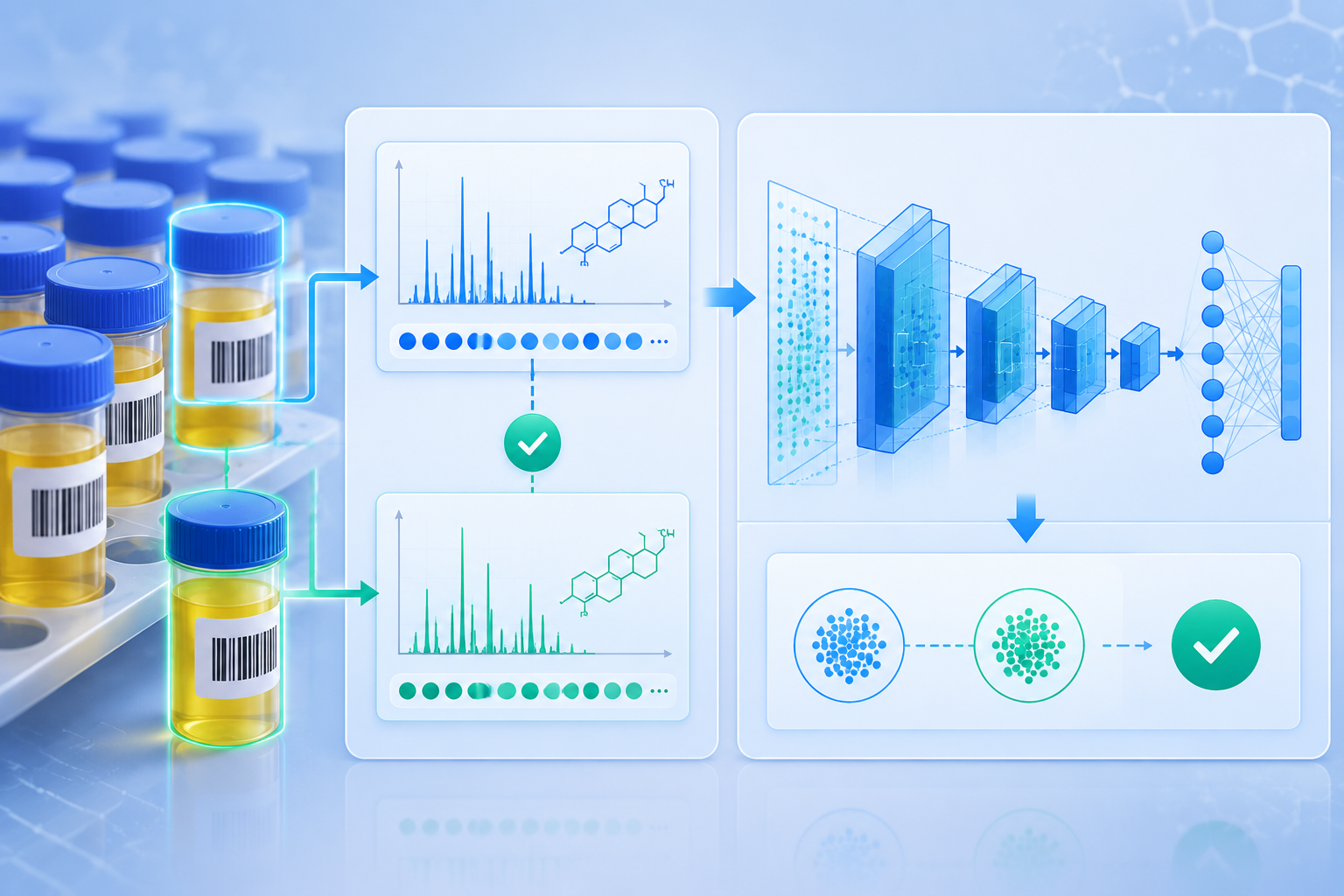
The most convincing use of AI in doping detection is the one that starts with a concrete laboratory problem: spotting reused urine profiles. Rahman et al. trained a convolutional similarity detector on 67,651 steroid profiles collected between 2021 and 2023 and reported 0.99 accuracy and 0.99 AUC for identifying identical or reused samples, outperforming SVM, random forest, and XGBoost baselines. That is not a theoretical flourish; it is the kind of result that can shorten review queues in a chain-of-custody dispute without pretending the machine has replaced the analyst. [1]
EPO Screening Has to Separate Biology From Evasion
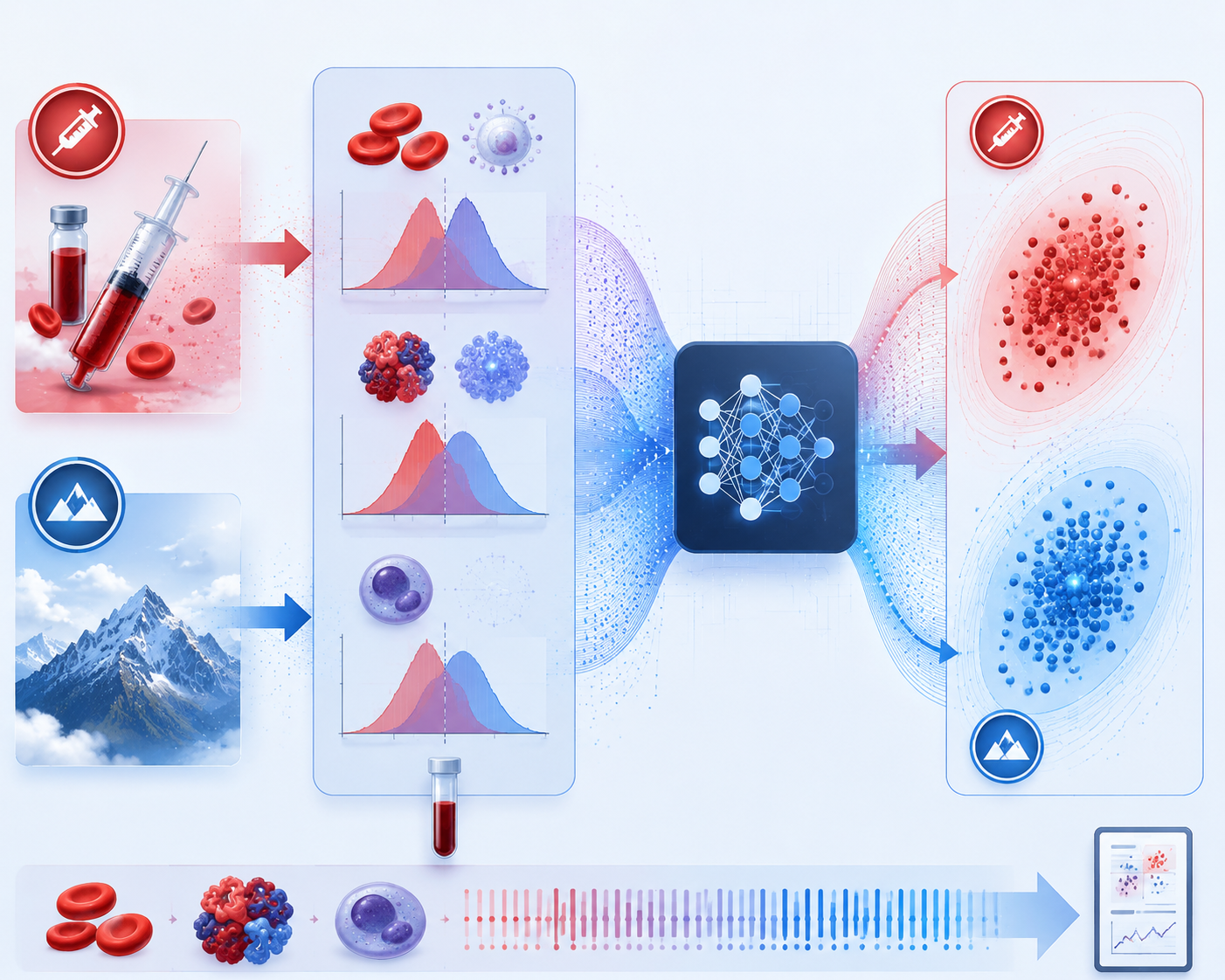
The EPO pathway work is more interesting because it asks the model to do something harder than pattern matching: separate a doping signal from a legitimate physiological confounder. A SelectScience report on Wolfgang Maass's DFKI/Saarland University collaboration with WADA says the team has pursued three projects since 2015, including a 50-subject controlled study in which AI identified EPO doping from blood markers while distinguishing it from altitude training effects. That is a real operational hint, but it is also a reminder that controlled studies are not the same thing as broad field validity, especially when athlete physiology is heterogeneous and constantly changing. [2]
Broader Screening Gets Weak Fast
The Athlete Performance Passport literature shows how quickly the ceiling drops once the task expands from a narrow anomaly check to a broader screening problem. Ryoo et al. combined XGBoost and a multilayer perceptron on 17,058 female weightlifter records spanning 1998 to 2020 and reported 53.8% accuracy for predicting doping sanctions across three Olympic Games. The single most predictive feature was body weight, which is useful less as a triumph and more as a warning: the model may be leaning on proxy structure rather than a stable biological signature that would travel cleanly to new settings. [3]
The Field Is Already Adversarial
That is the context for WADA's AR.I.E.T.T.A. project, which is meant to flag athletes with abnormal hematological and performance patterns for targeted testing. It also explains why Francesco Botrè's warning matters: athletes using PEDs are likely already using AI to evade detection, while anti-doping systems have to publish and validate their methods in public. In that kind of asymmetric arms race, a strong retrospective score is only useful if the model can survive exposure, review, and adaptation. [4][5]
What the Evidence Supports
The evidence supports a narrow judgment. AI is already useful in targeted anti-doping workflows where the job is pattern recognition over large operational records, especially sample-swapping detection and selective screening tied to known biological markers. It is less convincing as a general replacement for conventional testing, because the field still lacks large prospective comparisons in true operational settings, and the adaptation problem is hidden on the other side of the contest. That leaves anti-doping AI in the same evidence category as other sports-medicine AI systems: promising when the task is bounded, and still dependent on real-world validation before anyone should trust broad deployment.
References
- Deep learning-based similarity detection for identifying sample swapping in anti-doping tests. Scientific Reports, 2026.
- How artificial intelligence can help in the fight against doping. SelectScience.
- Machine learning model for doping sanction prediction in female weightlifters. Frontiers in Physiology, 2024.
- AR.I.E.T.T.A. - Artificial Intelligence Evoking Target Testing in Antidoping. WADA.
- Can AI help detect doping in sports? | Euronews Tech Talks. Euronews, 2025-07-09.
Comments
Join the discussion with an anonymous comment.