
The relevant question starts on the line, not in the procurement deck: when a caller is frightened, the audio is poor, and the ambulance has not moved, can AI help a dispatcher recognize out-of-hospital cardiac arrest or stroke early enough to matter?
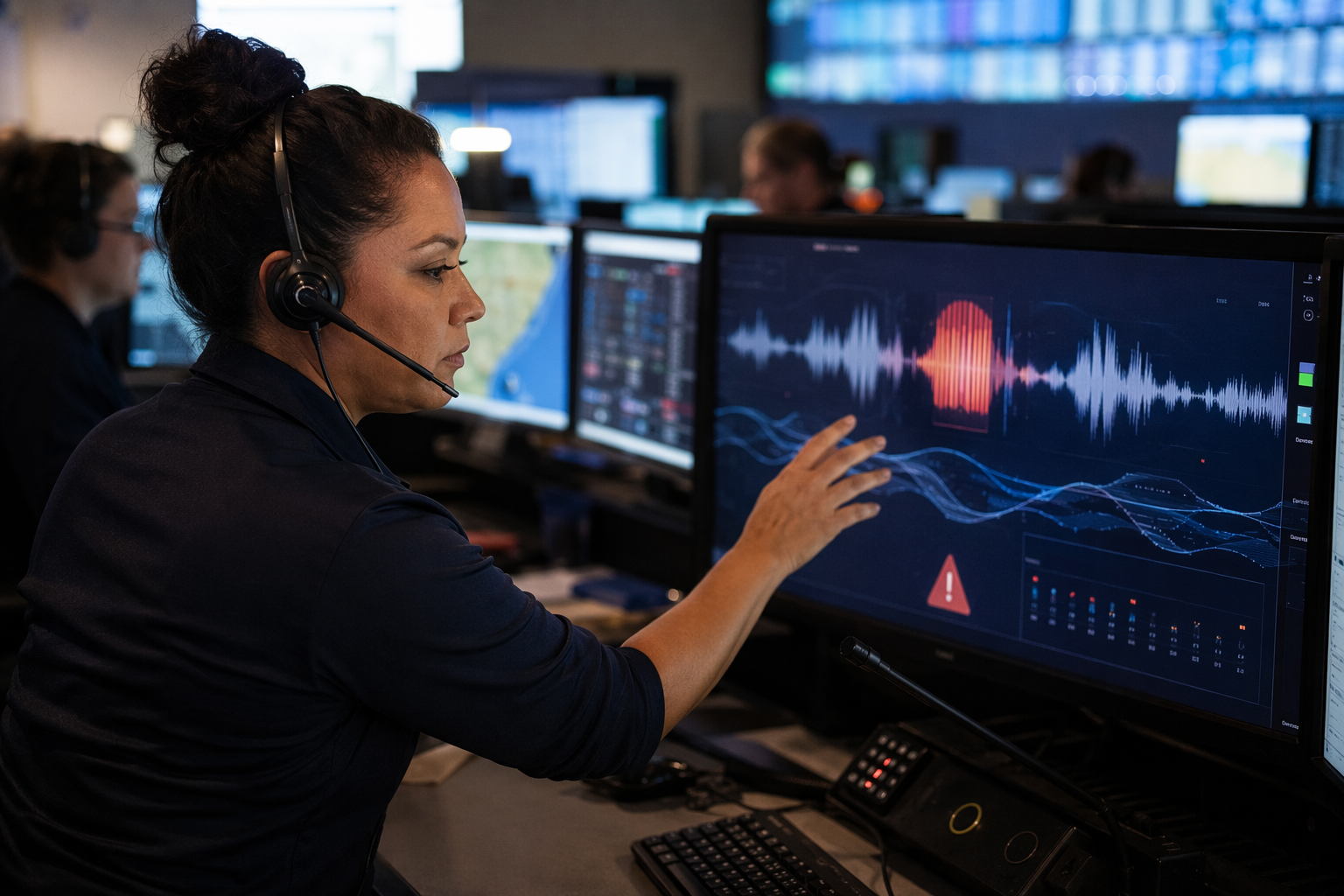
The answer is not the same for every tool. The best-studied system in this literature is Corti AI, which sits inside the dispatch workflow as decision support rather than a replacement for the dispatcher; in the broader emergency and disaster-response space, adjacent systems such as RapidSOS and MDGo solve different problems, so performance from one product does not transfer automatically to another [5].
Retrospective OHCA data looked strong
In the retrospective Copenhagen analysis, Blomberg and colleagues reviewed 714,528 emergency calls from 2013 to 2016. With AI assistance, sensitivity for out-of-hospital cardiac arrest rose from 72.5% with dispatchers alone to 84.1%, and median recognition time fell from 54 seconds to 44 seconds [1].
The trade-off was a drop in specificity from 98.8% to 97.3% [1]. That is not trivial in a low-prevalence setting, where a small fall in specificity can produce many more false alerts for the center to absorb. Even so, this remains the cleanest signal that the model can surface arrests the human ear misses and do it faster.
Prospective deployments changed the verdict
Once the system moved into real-time use, the result changed. In a prospective study of 7,308 calls, dispatchers could override the AI suggestion, and OHCA detection did not improve; the investigators attributed the gap to dispatcher choices not to follow the suggestion rather than algorithm failure [2].
A larger prospective evaluation in 29,297 calls reached the same practical conclusion: machine-learning assistance did not improve recognition when dispatchers retained override authority [3]. That is the fact that matters for procurement, because it shows how easily a strong retrospective result can disappear once the call center becomes a live human system again.
Stroke evidence is narrower, and still modeled
Stroke is the more conditional extension. Scholz and colleagues modeled ASR-based stroke detection and estimated sensitivity could rise from about 52.75% to 61.19%, with a possible 5% increase in thrombolysis among patients who called within the 4.5-hour treatment window [4].
The same analysis flagged lower recognition in female callers, younger patients, weekend calls, and calls made through non-emergency helplines [4]. That does not prove the model fixes disparity; it does mean the remaining misses are unlikely to be evenly distributed, and that bias is still a live operational question rather than a solved one.
What the evidence supports today
No study here has shown better survival or 90-day neurological outcome. That is not a defect of the review; it is where the evidence stops. In disaster response and emergency healthcare, the meaningful claim is narrower: AI-assisted dispatch can improve detection in retrospective review, but real-world benefit depends on whether the dispatcher accepts the alert, how much friction the interface adds, and whether the center can live with the false-positive load long enough for the tool to matter.
At present, it looks like a potentially useful second set of ears, not a proven outcome-changing layer of care.
References
- Can artificial intelligence improve the recognition of out-of-hospital cardiac arrest during emergency calls? — Resuscitation, 2019 — full text
- Prospective evaluation of artificial intelligence support for out-of-hospital cardiac arrest recognition during emergency calls — Resuscitation, 2021 — full text
- Machine-learning assistance for out-of-hospital cardiac arrest recognition during emergency medical dispatch calls — JAMA Network Open, 2021 — full text
- Can automatic speech recognition improve the recognition of stroke during emergency calls? — Scand J Trauma Resusc Emerg Med, 2022 — full text
- How AI is changing our approach to disasters — RAND, 2025-08 — commentary
Comments
Join the discussion with an anonymous comment.