
AI-assisted triage for shooting victims has one attractive promise: help responders identify, sort, and communicate casualty priority before the scene becomes orderly enough for anyone to feel confident. In simulations, that promise is not empty. A 2024 systematic review of 19 studies found that AI triage systems improved accuracy and reduced triage time across emergency and disaster scenarios, with deep neural networks reaching an AUC as high as 0.89 for survival prediction.[1]
That is the good news, and it matters. In a mass shooting, triage is not a quiet diagnostic exercise. It is a visible operational judgment made amid fear, noise, partial access, and incomplete information. If a tool can shorten the time between first contact and a defensible priority decision, it deserves attention.
The harder part is that the same evidence base has a boundary that procurement conversations often blur. The published evidence does not show that AI triage systems have improved outcomes in actual mass shooting events. It shows that they perform better than conventional approaches in simulations and controlled emergency or disaster scenarios. That distinction is not academic; it is the line between preparedness evaluation and operational proof.
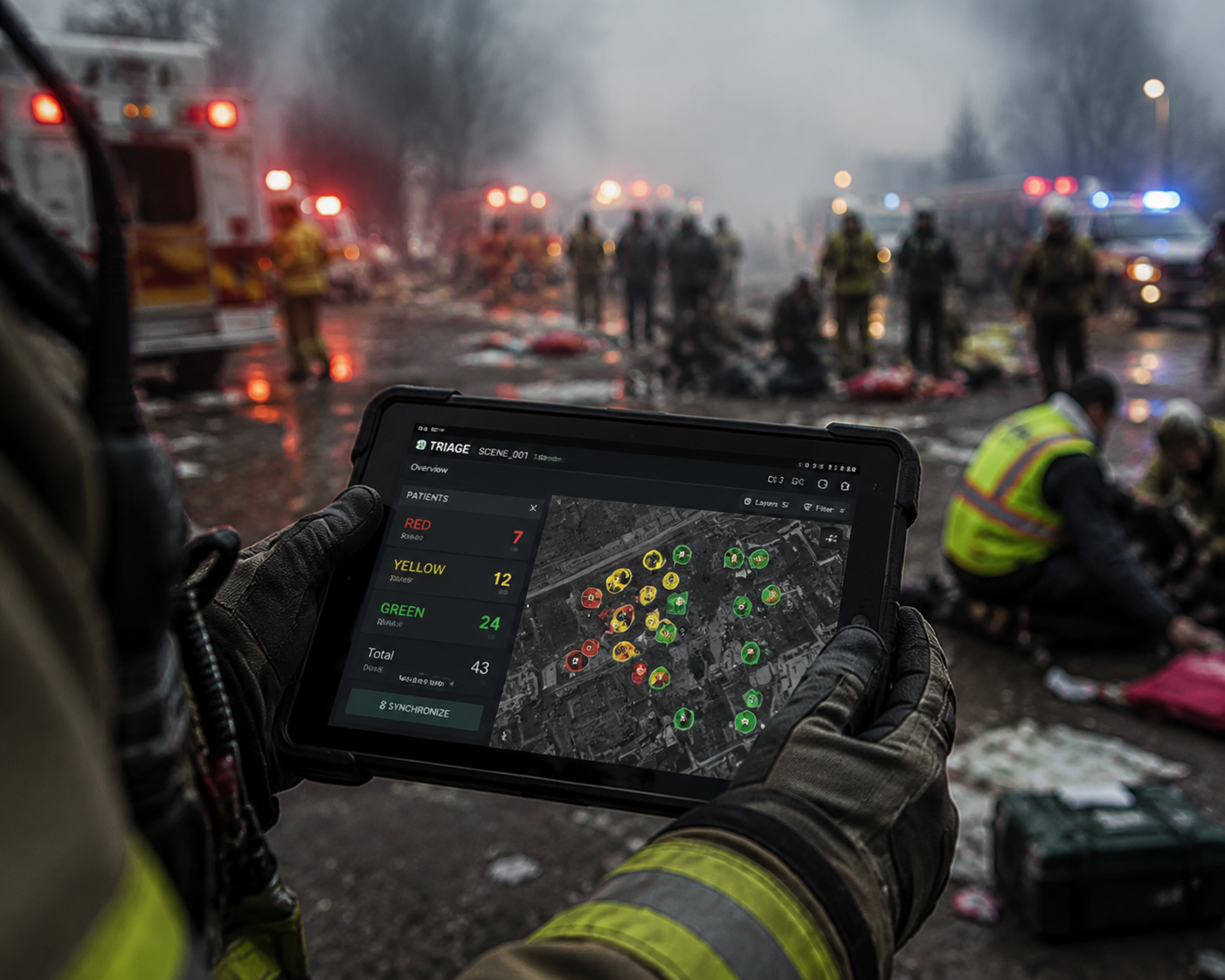
What “better triage” means in the evidence
The strongest available synthesis is the 2024 systematic review, because it keeps the discussion from becoming a catalog of devices. Across the reviewed studies, AI-supported triage was associated with improved classification accuracy and faster triage in emergency and disaster contexts. Some systems used machine learning to classify casualty priority; others used deep neural networks for survival prediction or automated support in mass casualty incident workflows.[1]
Those endpoints are not interchangeable. Faster triage time means a responder spends less time reaching a category. Improved accuracy means the assigned category more closely matches a reference standard used in the study. Survival prediction, including the reported AUC up to 0.89, measures discrimination between patients with different survival outcomes; it does not by itself prove that scene decisions changed survival in the field.[1]
The review also matters because many emergency systems still train around START or SALT-style workflows. Conventional triage algorithms are useful precisely because they are simple enough to teach, repeat, and defend under pressure. AI systems are being tested against that standard: can they sort more accurately, move faster, or reduce cognitive load without creating a new failure point?
| Evidence signal | What it supports | What it does not prove |
|---|---|---|
| Reduced triage time in simulations | AI may help responders reach priority decisions faster | That the same time savings will occur during an active shooting scene |
| Improved triage accuracy in reviewed studies | AI can classify casualties more closely to study reference standards | That field responders will trust or follow the recommendation |
| AUC up to 0.89 for survival prediction | Some models discriminate survival risk well in tested datasets | That survival prediction improves operational handoff or patient outcomes |
| Comparison with START/SALT-style workflows | AI can be evaluated against familiar disaster triage structures | That agencies can deploy it without training, governance, or liability planning |
For an EMS medical director or hospital emergency preparedness coordinator, the useful reading is therefore narrow but meaningful: AI triage systems are not merely speculative. In controlled tests, they repeatedly show speed and accuracy advantages. The unresolved question is whether those advantages survive the conditions that make mass shooting triage different from classroom triage.
Where the tested systems fit in the response chain
The response chain is longer than the triage label. Someone has to detect or locate victims, reach them or observe them, assign priority, communicate that priority, move patients, update receiving hospitals, and preserve a record that can be reviewed later. The current evidence is strongest for pieces of that chain, not for the entire sequence from scene detection through hospital handoff.
AID-N is a useful example of the e-triage pathway. In simulated tests, responders triaged approximately three times more patients than with paper-based methods, and the system used eight times less energy than prior embedded systems.[1] Those findings speak directly to throughput and device efficiency, two practical concerns when responders are trying to clear a casualty collection area or transmit patient priority under time pressure.
But AID-N’s strongest numbers still come from simulation. That does not make them irrelevant. It means they are best treated as evidence that the workflow can be accelerated under tested conditions, not as proof that the same gain appears when responders are working around law enforcement perimeters, uncertain threat status, bystanders recording the scene, or patients who cannot be safely reached.
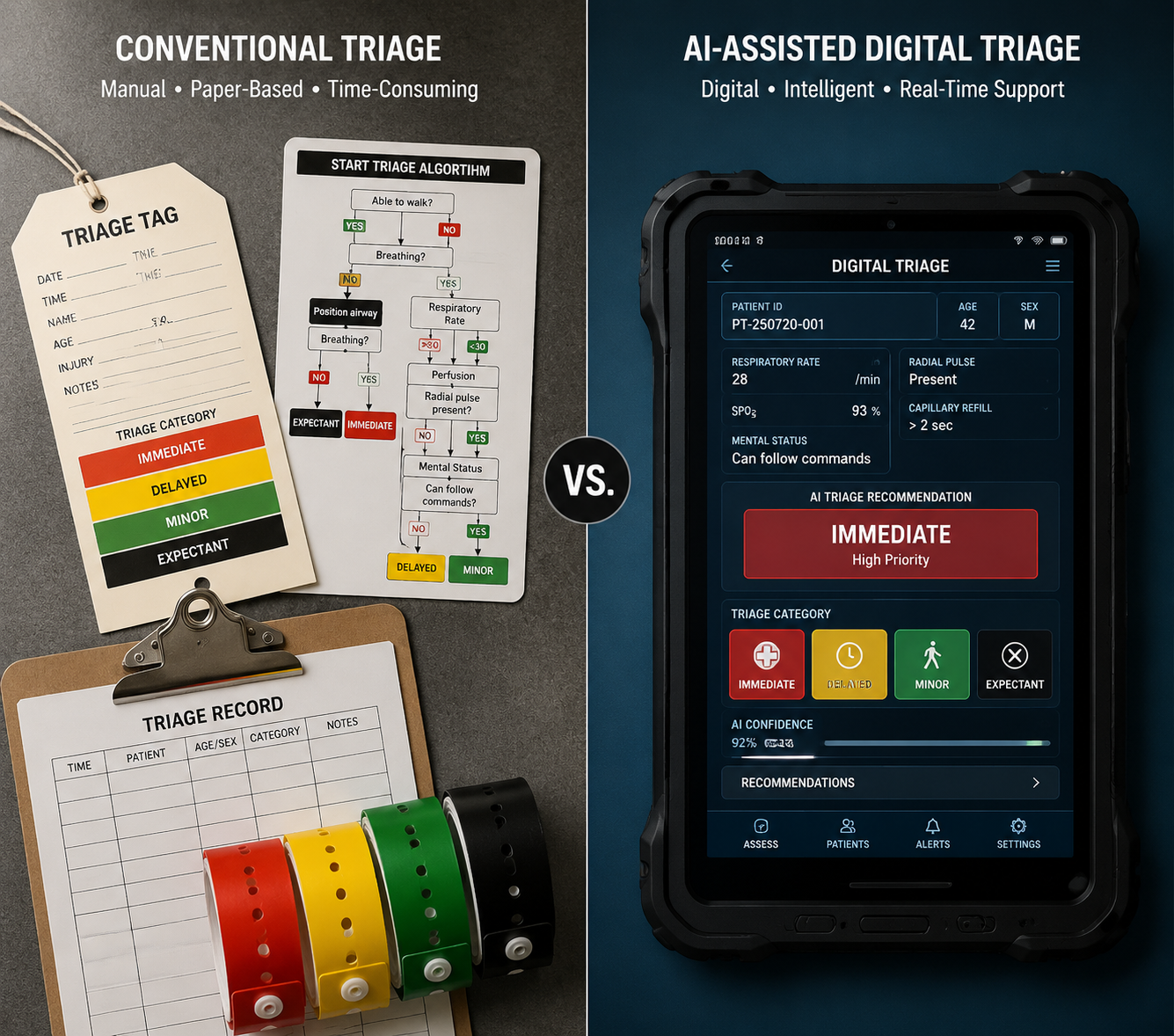
ERTRIAGE sits closer to the device-based autonomous triage model. Its disaster response materials describe an AI triage platform aligned with START/SALT frameworks and designed to operate without cloud connectivity.[2] That offline capability is not a minor feature. In a mass casualty incident, communications failure is not an edge case; radio congestion, damaged infrastructure, blocked cellular service, and overloaded networks are routine planning assumptions.
The same ERTRIAGE page presents an example deployment scenario claiming more than 80 patients triaged in the first hour of an MCI.[2] That figure should be read as vendor-sourced scenario material, not as a peer-reviewed effectiveness estimate. It may be useful for imagining staffing and throughput, but it should not carry the same evidentiary weight as an independently evaluated drill or field study.
UAV-based triage systems represent the more ambitious remote-sensing path. One study describes an unmanned aerial vehicle system using 5G and AI, with OpenPose for posture recognition and YOLO for object detection, to identify victims and support triage classification in simulated MCI scenarios.[3] The operational appeal is obvious: if responders cannot immediately enter an unsafe zone, overhead sensing might help identify where victims are and which casualties appear most urgent.
That path also carries the most visible field dependencies. A UAV system needs conditions in which victims can be seen, the platform can fly, data can move, and the model can interpret body position despite occlusion, smoke, darkness, cover, crowd movement, or ongoing evacuation. The cited UAV work demonstrates feasibility in simulated conditions, not validated performance during live mass shooting response.[3]
The simulation gap is the central evidence problem
Simulation is necessary in disaster medicine. No one should wait for real shootings to begin learning whether a tool can help. Tabletop exercises, moulage drills, and controlled MCI scenarios let agencies compare workflows without putting patients at risk. The problem begins when a simulation metric is spoken about as if it were field readiness.
Actual mass shooting scenes add variables that most controlled exercises can only approximate. The threat may not be fully neutralized. Victims may be hidden behind furniture, vehicles, smoke, or debris. Responders may hear conflicting reports about a second shooter. Patients may move after being assessed. Bystanders may interfere, flee through the scene, or try to self-transport. Communications may degrade exactly when patient counts and priority categories need to be transmitted.
Those conditions matter because AI triage performance depends on inputs. A model that uses vital signs, visual posture, injury cues, or responder-entered observations can only be as reliable as the information it receives. In a drill, missing information is often structured. In the field, missing information has causes: a patient is inaccessible, a monitor is unavailable, the responder has seconds rather than minutes, or the scene commander has redirected movement for safety reasons.
The 2024 review itself notes that most studies were simulation-based and identifies trust, training, and workflow integration as unresolved barriers.[1] That is a sober limitation. An accurate recommendation that responders do not understand, cannot explain, or cannot fit into incident command practice may slow the scene rather than speed it. A system that classifies well on a tablet but fails to communicate clearly to transport officers or receiving emergency departments leaves the hardest handoff untouched.
The missing end-to-end test
The current literature does not appear to include a published evaluation of a complete AI pipeline for a shooting incident: scene detection, casualty identification, triage classification, responder confirmation, transport prioritization, hospital notification, and post-event review. That absence is not a technical footnote. It is the difference between a promising component and a response system.
A tool can perform well at one link and still fail operationally. A drone may identify likely victims but provide no usable triage priority to EMS. A handheld device may generate a priority label but not integrate with transport tracking. A receiving hospital may get a patient count without enough acuity detail to activate the right trauma, operating room, or blood bank response. The value of AI-assisted triage is ultimately measured across these handoffs, not only at the first classification point.
This is where emergency medicine’s broader AI experience is relevant. Readers familiar with AI at the ED triage desk, sepsis prediction, or stroke detection will recognize the pattern: a model’s statistical performance is only one layer of evidence. The more consequential question is whether it changes decisions safely inside a real workflow. For broader context, see ClinicalMind’s reviews of AI in emergency medicine and peer-reviewed evidence for AI stroke detection in ERs.
What adoption would require before field use
For now, AI triage for mass shooting response belongs in controlled preparedness evaluation. That does not mean agencies should ignore it. It means they should test it the way they would test any tool that can change patient priority under pressure: inside incident command practice, EMS transport decisions, emergency department surge planning, and after-action review.
A useful evaluation would ask operational questions before accepting performance claims:
- Can responders use the system while wearing gloves, moving quickly, and communicating over radio traffic?
- Does it still function when cellular or cloud connectivity is unavailable?
- Can the recommendation be overridden, documented, and explained during review?
- Does the output map cleanly to local START/SALT training, transport categories, and receiving hospital alerts?
- What happens when the casualty is obscured, moving, uncooperative, or unreachable?
- Who is accountable when the AI recommendation conflicts with responder judgment?
Regulatory status also keeps the adoption question unsettled. None of the systems discussed here appear to have FDA clearance for MCI triage decision support. That creates a liability environment in which agencies should be careful about presenting AI recommendations as clinical authority rather than decision support under a defined training and governance plan.
Equity and bias questions should not be deferred until deployment. If an AI triage system relies on visual recognition, vital sign interpretation, injury patterns, or training datasets that do not match the population or scene conditions it will face, performance may vary in ways that are hard to detect during small exercises. ClinicalMind’s discussion of AI bias in emergency medicine is a useful parallel for agencies evaluating triage algorithms.
A conditional yes, not a deployment verdict
Can AI-assisted triage improve mass shooting response? The evidence supports a conditional yes for casualty sorting under simulated MCI conditions. AI systems have repeatedly shown faster triage and improved accuracy compared with conventional methods in the available studies, and some designs address real operational pain points, including offline function and rapid throughput.[1][2]
The evidence does not yet support a stronger claim. There are no published real-world evaluations from actual mass shooting incidents, and no end-to-end evidence showing that AI can function reliably across detection, classification, responder confirmation, transport coordination, hospital handoff, and review. UAV-based systems add useful possibilities for unsafe or inaccessible scenes, but their dependence on visibility, flight conditions, and connectivity makes field validation especially important.[3]
The next meaningful threshold is not another impressive simulated benchmark. It is credible real-world or high-fidelity field evaluation showing that the system can work across the full response chain, under degraded conditions, with responders who must act quickly and defend their decisions afterward.
Comments
Join the discussion with an anonymous comment.