
The evidence for AI in bear encounter prevention is already more substantial than a novelty-technology story would suggest. There are peer-reviewed or publicly documented systems using edge computer vision, cloud image recognition, radar plus AI classification, predictive mapping, and individual bear identification. Some report strong technical performance. Some have been placed in real landscapes where people and bears cross paths.
The safety claim is narrower. As of Q3 2026, the published evidence supports detection, alerting, deterrent triggering, and short-window deployment feasibility better than it supports reduced attack rates. No system in the available literature has shown a controlled, full-season reduction in bear attacks.
That distinction matters for readers used to evaluating clinical AI warning systems. A triage model, a sepsis alert, or a stroke decision-support tool can look impressive on discrimination or detection metrics and still fail to improve patient outcomes if the alert reaches the wrong person, arrives too late, creates too many false alarms, or changes workflow in untested ways. The same evidence discipline applies here. The question is not only whether an AI system can classify a bear. It is whether the warning or deterrent changes what happens next.
The public safety need is not hypothetical. Japan reported 219 bear-related casualties in fiscal year 2023, and Akita Prefecture saw bear encounters rise from 800 in 2022 to 3,910 in 2023.[1] Those numbers explain why local governments, utilities, and researchers are testing automated warning systems. They do not prove that any AI intervention works.
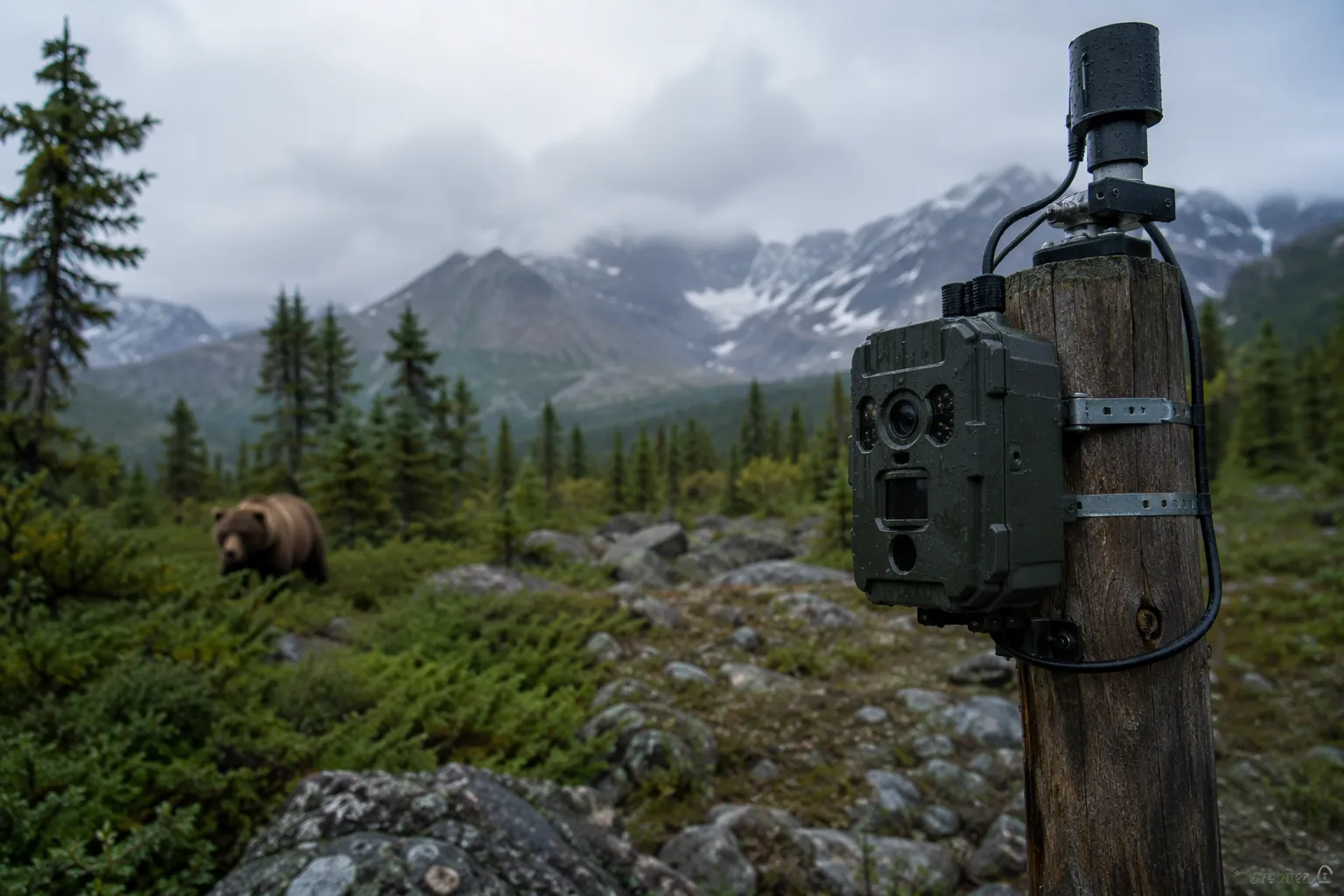
What counts as AI bear encounter prevention
AI bear encounter prevention covers several different jobs. Treating them as one category makes the evidence look cleaner than it is. A camera trap that identifies a bear, a radar that distinguishes a polar bear from blowing snow, and a map that forecasts where encounters may occur are not interchangeable safety tools.
| System type | Immediate function | Closest safety endpoint | Evidence boundary |
|---|---|---|---|
| Computer-vision deterrent | Detect bear and trigger deterrent or alert | Bear deterred before reaching people, livestock, or property | Technical validation plus short field observation |
| Camera/cloud early warning | Classify wildlife images and notify officials | Warning reaches responders earlier | Operational deployment with vendor-stated performance |
| Radar-based early warning | Detect bear movement in difficult visibility conditions | Earlier warning in polar bear settings | Calibration and field data collection still developing |
| Encounter prediction | Forecast likely encounter locations | Targeted patrols, advisories, or resource allocation | Moderate precision-recall performance, not event prevention |
| Facial recognition | Identify individual bears across images | Population monitoring and management decisions | Adjacent to prevention, not a direct warning tool |
This is why evidence hierarchy matters. Detection accuracy is not the same as deployment reliability. Deployment reliability is not the same as reduced harm. Reduced harm, in this setting, would mean fewer attacks, fewer dangerous close encounters, fewer emergency removals, or some other outcome close enough to the prevention claim to be credible.
Clinical readers have seen the same problem in early-warning AI. A model can improve recognition of deterioration while still leaving open whether the alert changes clinician behavior or patient outcomes. That broader pattern is familiar from AI emergency medicine systems and sepsis-alert evaluations, including the distinction between model performance and measured safety impact discussed in AI in Emergency Medicine: Triage, Sepsis Prediction, and Stroke Decision Support and in the Epic Sepsis Model v2 critical appraisal. Bear-warning systems deserve the same separation of endpoints.
The strongest technical case: Chen et al.’s edge vision deterrent
Chen et al.’s intelligent bear prevention system is the most useful anchor for the current evidence base because it reports the pieces that safety reviewers need to see together: model architecture, device constraints, detection metrics, deterrent-trigger performance, cost, and a limited field deployment. The system was designed for the Tibetan Plateau and used a YOLOv5-MobileNet computer-vision model running on a K210 edge processor.[2]
The edge design is not a cosmetic detail. In remote or mountainous settings, sending every image to a cloud service may be slow, expensive, or impossible. A low-power local processor that can detect a bear and activate a response without depending on continuous connectivity is closer to the operational problem than a laboratory classifier alone. The reported unit cost was about $66, which also matters if the intended users are village officials, rangers, farms, or conservation teams that may need multiple units across a landscape.[2]
The reported technical metrics are strong for a low-cost field device: 91.4% mean average precision, 93.6% recall, 94.7% F1 score, and a 3.79% false-positive rate.[2] The spray-trigger component, which is closer to an action than image classification, was reported at 97.2% accuracy.[2] Those are the kinds of measurements that move the system beyond a concept demonstration.
They still do not answer the attack-prevention question. Mean average precision describes model detection performance. Recall tells us how often the system detects target events in the evaluated dataset. F1 balances precision and recall. False positives tell us something about nuisance alarms. Spray-trigger accuracy tells us whether the system’s response mechanism functioned when evaluated. These are necessary pieces for prevention, but they sit upstream from the endpoint people care about: fewer dangerous encounters.
The field evidence is encouraging but thin. Chen et al. reported a 30-day field test with three deterrence events.[2] A 30-day deployment can show that a unit survives outdoors, detects animals in context, and triggers deterrence at least sometimes. It cannot establish population-level effectiveness, seasonal durability, or whether bears learn the location and route around it.
This is the point at which a clinical AI reviewer would resist the easy sentence. “The system detected bears and triggered spray” is supported. “The system prevents bear attacks” is not yet supported. The available evidence is closer to a promising device-validation and feasibility study than to an outcomes trial.
Why the false-positive rate is not a side issue
A 3.79% false-positive rate sounds small in isolation.[2] In a real deployment, its meaning depends on how many images or sensor events the system processes, who receives the alarm, and what response is required. A false positive that activates a local deterrent at an empty site is different from a false positive that wakes a ranger, sends a village official to inspect a location, or causes residents to distrust future alerts.
This does not weaken the Chen et al. system; it clarifies what the next evidence layer should measure. Useful deployment studies would report not only detection performance but alert volume, missed detections, maintenance burden, device downtime, human response time, and whether people changed behavior because of the warning.
Operational warning systems: B Alert and the appeal of faster notification
B Alert, developed by Hokuriku Electric Power and Hokutsu in Japan, occupies a different evidence category. It uses heat-detection cameras and cloud AI trained on 60,000 wildlife images, and it has reportedly been deployed in more than five prefectures.[3] Its practical promise is not an automatic deterrent but faster notification: reports described warnings arriving more than 30 minutes earlier than conventional approaches.[3]
For safety operations, 30 minutes can be meaningful. It can give a school, municipal office, utility crew, or patrol team time to warn people, delay outdoor work, redirect foot traffic, or inspect a route. The relevant endpoint is therefore not only image accuracy; it is whether the earlier warning reaches someone with authority, equipment, and time to act.
The main caution is evidentiary. The 99.9% identification accuracy reported for B Alert is vendor-stated, attributed in coverage to a deputy section chief, and should not be read as independently audited performance.[3] That does not make the number false. It means the number should be placed in the vendor-disclosure column until outside validation reports the denominator, image conditions, species mix, false positives, false negatives, and operational consequences.
Radar for polar bear early warning: Bear-dar is testing a harder environment
Bear-dar, developed by Polar Bears International with Spotter Global, addresses a setting where camera-only assumptions can become fragile: polar bear country. The system combines medium-range radar with AI classification, was calibrated at Assiniboine Park Zoo in 2024, was wild-tested along the Hudson Bay coast, and was installed at Eureka, Nunavut, in 2025 with data collection continuing through 2026.[4]
Radar changes the safety proposition. It may support detection in darkness, poor visibility, or open terrain where a camera has difficulty maintaining a useful view. For field workers and northern communities, the operational value is early warning before a bear is close enough to force an emergency response.
The evidence is still in the collection phase. Calibration and wild testing show seriousness of development, but they are not the same as a completed assessment of alert accuracy, response time, false alarms, missed bears, or reductions in dangerous encounters across a season. Bear-dar is one to track, especially because it is being tested in polar bear conditions rather than only in convenient image datasets.
Prediction maps answer a different operational question
The Sophia University model reported by Fukazawa et al. is not an encounter alarm in the same sense as a camera or radar device. It predicts Asiatic black bear encounter risk at 1-km² grid resolution in Akita Prefecture, using 1,736 appearance cases and 2,078 non-appearance cases.[1] Reported performance was 63.5% precision and 63.6% recall.[1]
Those numbers describe a moderate forecasting tool, not a definitive hazard map. A precision of 63.5% means a substantial fraction of predicted high-risk signals would not correspond to observed appearances in the evaluated data. A recall of 63.6% means a substantial fraction of observed appearances would not be captured by the model’s positive predictions. The model may still be useful if the decision is where to concentrate patrols, signage, public advisories, or temporary precautions.
The endpoint is resource allocation. A prediction grid can help officials decide where to look; it does not warn a hiker that a bear is approaching a trail bend. That distinction should shape both evaluation and procurement. A municipality buying a prediction model should ask how many areas it can realistically patrol after a high-risk signal, not whether the model can be described as “AI prevention” in a general sense.
Identification systems are valuable, but prevention-adjacent
BearID is a strong example of AI for bear identification rather than immediate encounter prevention. Clapham et al. reported a multispecies facial detector with average precision ranging from 0.91 to 1.00 across eight ursid species, and 0.929 average precision on wild brown bear transfer.[5] That level of performance is relevant for population monitoring, individual histories, and management decisions.
Its prevention role is indirect. Knowing which individual bears frequent a site can help agencies understand patterns, evaluate conflict histories, or select management responses. It is not, by itself, an alarm system that keeps a worker, resident, or tourist out of harm’s way in the next few minutes.
A practical deployment note from the Carpathians
The Q42 Carpathian system in Romania is useful because it reports mundane constraints that often decide whether a safety system survives contact with the field. The system used YOLOv5, LoRaWAN communication, and a 0.06 W standby mode; it processed roughly 250 images per day and produced about one to two detections per week.[6]
Those details are less glamorous than an accuracy headline, but they are closer to implementation reality. Low-power operation affects battery replacement. Network choice affects where the system can be placed. Detection frequency affects how often someone must review, respond, or maintain trust in the device. The available material is not a major proof point for attack prevention, but it usefully grounds the engineering side of deployment.
The habituation problem belongs in the main evidence assessment
Expert caution about habituation is not a generic caveat to paste at the end. Dave Garshelis of the IUCN Bear Specialist Group has warned that bears may learn to avoid the device location while continuing to visit the broader area.[7] That concern directly challenges the leap from “the device deterred a bear at this point” to “the area became safer.”
Habituation can also distort short field tests. In a 30-day observation window, a deterrent event may look successful because the bear leaves the sensor zone. Over a season, the more important question is whether the bear stops entering the human-use area, shifts to a different path, returns at a different time, or becomes less responsive to the stimulus. The available Chen et al. field test was not long enough to answer that.[2]
This is where wildlife safety evidence and clinical safety evidence converge. A monitor can fire correctly and still fail if the target adapts, the human response decays, or the workflow around the warning is not maintained. In clinical AI, that problem is often discussed as implementation drift, alert fatigue, or endpoint mismatch. In bear prevention, it may look like animals learning the perimeter.
What the current evidence supports
The systems can be compared most fairly by endpoint rather than by headline accuracy.
| System | Best-supported claim | Less-supported claim |
|---|---|---|
| Chen et al. edge vision deterrent | Low-cost edge detection and spray triggering can work in a short field deployment with strong reported technical metrics. | The system reduces bear attacks or dangerous encounters across a full season. |
| B Alert | Operational camera/cloud warning can deliver earlier notifications in deployed Japanese settings, with vendor-stated high accuracy. | The claimed 99.9% accuracy has been independently audited or translated into reduced casualties. |
| Bear-dar | Radar plus AI is being calibrated and field-tested for polar bear early warning in relevant environments. | The system has completed outcome evidence showing fewer dangerous encounters. |
| Sophia/Fukazawa prediction model | 1-km² encounter prediction may help target patrols or public advisories with moderate precision and recall. | The model provides individual real-time protection or has proven attack prevention. |
| BearID | AI facial identification can support monitoring and management across ursid species. | Facial recognition alone functions as a direct encounter-prevention system. |
| Q42 Carpathian system | Low-power edge detection with LoRaWAN is feasible enough to generate field detections under practical constraints. | The deployment establishes population-level safety impact. |
This evidence base is real. It is also not yet outcome-grade. The strongest measurements are technical: mAP, recall, F1, trigger accuracy, precision, radar calibration, and image-identification performance. The thinner measurements are operational: who receives the alert, how quickly they respond, how often hardware fails, how many false alarms are tolerable, and whether behavior changes. The missing measurements are safety outcomes: controlled pre-post or randomized evidence showing fewer attacks or dangerous encounters across a full season.
For healthcare-adjacent readers, this is the same appraisal problem covered in broader reviews of what AI medical research evidence actually shows: controlled validation can be necessary, well executed, and still insufficient for a safety claim.
What better evidence would need to measure
A stronger study would not need to mimic a drug trial, but it would need to move closer to harm prevention. For a camera or radar warning system, the useful outcomes would include warning lead time, proportion of alerts acknowledged, time to field response, missed detections later confirmed by other sources, false-alarm burden, maintenance failures, and dangerous encounters before and after deployment. For an automatic deterrent, the study would need to track repeat visits, route-shifting, habituation, and seasonal persistence.
The comparison group matters. A village, worksite, trail system, or utility corridor with AI devices should be compared against similar areas using standard practices, or against its own prior seasons with enough care to avoid mistaking changes in bear activity for intervention effects. Descriptive before-and-after counts can be informative, but they are vulnerable to weather, food availability, reporting intensity, and human behavior changes.
The human side should be measured directly. An alarm that reaches a cloud dashboard but not the person closing a trail is a weak safety intervention. A warning that arrives early but is too frequent to trust may decay over time. A low-cost device that village staff can repair is different from a technically superior system that fails after the first maintenance gap.
By Q3 2026, the fair reading is that AI bear encounter prevention systems are promising enough to track and structured enough to compare. Chen et al. provide the most complete technical and early field evidence; B Alert shows operational appetite for faster warning; Bear-dar is testing a difficult polar bear use case; prediction maps may help allocate attention; BearID strengthens monitoring; and low-power deployments show that field engineering is improving. The evidence boundary remains clear: no published system has yet demonstrated a full-season reduction in bear attacks, and habituation is an unresolved real-world limitation rather than a theoretical footnote.
References
- Sophia University bear encounter prediction model coverage, Mainichi / SCMP, 2025, link
- Intelligent Bear Prevention System Based on Computer Vision, arXiv / Ursus, 2025/2026, link
- B Alert bear detection system coverage, Kyodo News / The Straits Times, link
- Bear-dar, Polar Bears International, link
- BearID Project: bear face detection and individual identification, Mammalian Biology / PMC, 2022, link
- Bear detection on the edge, Q42 Engineering, link
- IUCN SSC Bear Specialist Group expert commentary on bear habituation risk, IUCN, link
Comments
Join the discussion with an anonymous comment.