The question behind AI in patient identification to prevent hospital errors is not whether a camera, iris scanner, or voice model can recognize a person. The harder question is whether a hospital can trust that identity signal at the exact moment a wrong match would otherwise move downstream: into a chart, a medication order, a specimen label, a transfusion check, a procedure timeout, or an incident report that no one has time to read closely until after harm has already occurred.
Patient identification errors sit higher in the safety stack than they are usually allowed to sit. A systematic review on artificial intelligence and patient safety notes that patient misidentification has been linked to 10 of 17 categories of medical errors, while medical errors have been associated with approximately 195,000 deaths per year in the United States.[1] Those numbers should not be used to imply that misidentification causes every fatal error. They do show why identity is not clerical housekeeping. It is safety infrastructure.
A hospital can recover from many registration mistakes if they are caught early. The problem is that a bad identity link rarely stays politely at registration. A duplicate chart fragments history. A wrong overlay merges two people’s allergies, diagnoses, or lab trends. A copied demographic field makes the next search look plausible. A nurse scanning a wristband may still be working inside the wrong record if the upstream match was wrong. A downstream AI tool trained or triggered on that data inherits the error as if it were fact.
Where identity actually fails
Most patient identification programs still depend on a fragile chain of human-readable fields, wristbands, barcodes, and verbal confirmation. These are necessary controls, but they are exposed to the ordinary conditions of care: interruption, fatigue, language barriers, emergent treatment, similar names, newborn naming conventions, patients who cannot speak, temporary registrations, and EHR screens that make two records look more alike than anyone wants to admit.
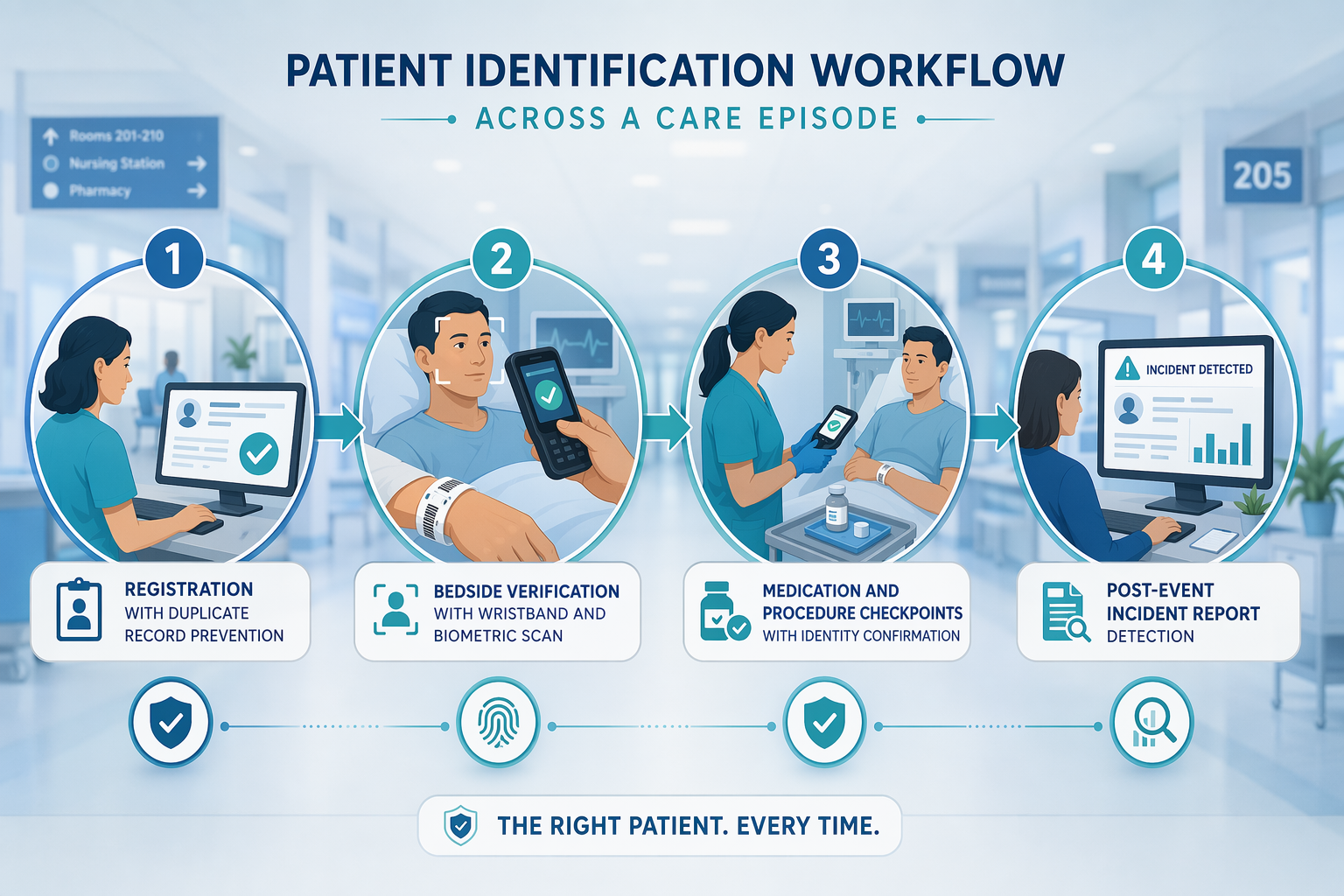
The current process is not one process. It is a sequence of handoffs:
- At registration, staff try to determine whether the person in front of them is new to the system, already known, or accidentally represented by more than one chart.
- At the bedside, clinicians verify that the patient, wristband, EHR chart, medication, specimen label, or procedure order all refer to the same person.
- At medication, transfusion, imaging, phlebotomy, and procedure checkpoints, barcode scanning and verbal confirmation are supposed to interrupt wrong-patient actions.
- After an event or near miss, safety teams depend on incident reports, chart review, and reconciliation work to find patterns that were not visible in real time.
AI biometrics only matter if they improve one of those handoffs. A general claim that a biometric model is “accurate” is not enough. The useful evidence names the point of use, the comparator, the population, the integration, and the failure mode: did it prevent a duplicate record, catch a wrong patient at the bedside, reduce repeated manual checks, or identify misidentification signals buried in narrative incident reports?
Registration is where the first wrong assumption becomes durable
The most tempting use case for biometric identification is also the least glamorous: stopping duplicate records and wrong overlays before clinicians begin documenting. At registration, AI-assisted facial recognition, iris recognition, palm or other biometric matching, and multimodal systems can compare a live biometric capture against an existing identity record. If the match is reliable and governed correctly, the registrar does not have to rely only on name, date of birth, address, phone number, or a patient’s memory of where they were last seen.
That is where a biometric system can be helpful: not as a replacement for registration judgment, but as a second identity signal that is hard to mistype and harder to borrow accidentally. It can surface a likely existing record when demographic search fails. It can warn when a patient appears to match a different medical record than the one being opened. It can reduce the amount of manual reconciliation that health information management teams perform after the visit has already generated orders, results, and billing events.
But the registration use case also exposes the first serious constraint. A false positive at this point is not a small inconvenience. It can attach one patient to another patient’s record and give every downstream user a confident-looking error. A false negative can create yet another duplicate chart. The acceptable balance between those failure modes depends on workflow design. A high-confidence match may support faster registration. A lower-confidence match should route to human review, not silently decide identity.
At the bedside, passive confirmation has to earn its place
Bedside identity checking is where the promise of AI biometrics becomes more concrete. Barcode medication administration, wristband scanning, verbal identifiers, and procedure timeouts already exist because hospitals know that memory and visual recognition are unsafe as primary controls. The argument for AI biometrics is not that those practices are obsolete. It is that some checks could be strengthened by a passive or semi-passive identity signal that travels with the patient through the encounter.
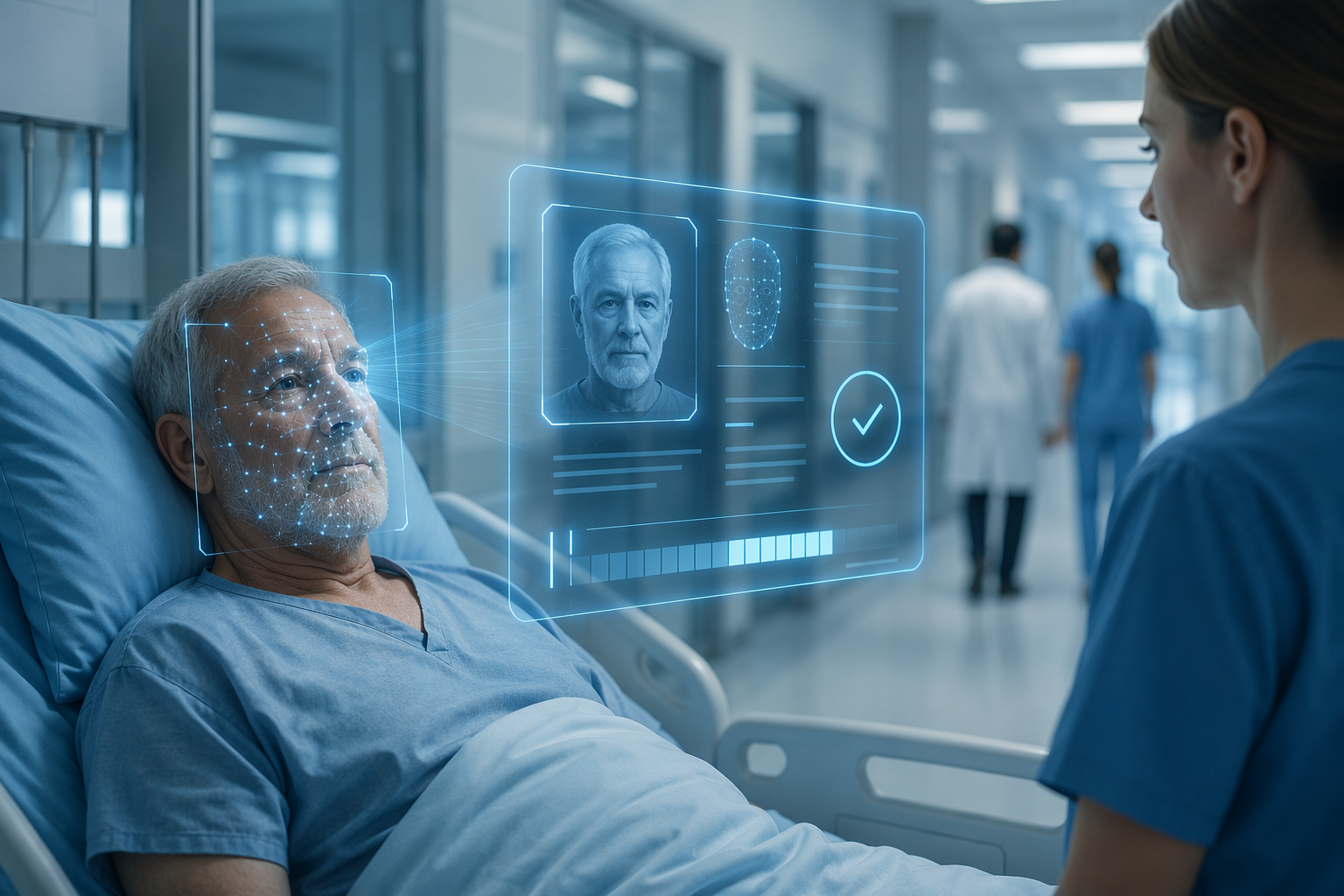
Facial recognition receives the most attention because it is fast, familiar, and does not require the patient to touch a device. In a clinical setting, that matters. A patient may be in pain, isolated for infection control, sedated, confused, or unable to speak. A nurse preparing a medication pass may not have time for another modal dialog that demands manual search. If a facial recognition system can confirm that the person at the bedside matches the open chart or the scanned wristband, it can become a quiet cross-check rather than another task.
Clinical trial evidence indicates that deep learning-based facial recognition systems have demonstrated safety and acceptability for patient identification in trial settings. That is encouraging, but the words “trial settings” matter. Acceptability shows that patients and clinical environments may tolerate the method under study conditions. It does not prove that every hospital deployment will reduce wrong-patient medication, transfusion, or procedure events.
A bedside biometric check also has to fit the physical reality of care. Facial recognition may be affected by positioning, lighting, masks, swelling, trauma, age-related changes, or staff working from an angle. Iris scanning can offer a more distinctive biometric pattern, but may demand closer alignment and cooperation. Voice recognition may help in telehealth or call-center identity workflows, but it is less dependable for patients who are intubated, aphasic, hoarse, distressed, or in noisy care areas. Multimodal systems can reduce dependence on any one signal, but they also increase system complexity, data sensitivity, and integration work.
| Workflow point | What AI biometrics can add | Main failure to control |
|---|---|---|
| Registration | Match the person to an existing identity record when demographic search is uncertain | Wrong overlay or missed duplicate |
| Bedside verification | Confirm that the person present matches the open chart, wristband, or scanned medication context | Alert fatigue, poor capture conditions, or silent mismatch |
| Medication, specimen, transfusion, and procedure checkpoints | Add an identity signal before irreversible or high-risk actions | Workflow bypass when the signal is slow, unavailable, or poorly integrated |
| Post-event review | Detect misidentification patterns in incident reports and safety narratives | Treating detection as prevention without closing the loop |
The evidence is strongest when AI is tied to a safety task
The broader patient-safety literature supports cautious interest in AI, not blanket confidence. AHRQ’s patient safety perspective describes AI as promising but implementation-dependent, with risks around validation, monitoring, workflow fit, equity, and regulatory oversight.[2] That framing is useful for biometric identification because the technology can look deceptively simple at the front end. The hard part is not capturing a face or iris. The hard part is making the output safe enough to act on.
Older AI work on misidentification also helps separate detection from prevention. The systematic review reports that Ong and colleagues used a support vector machine text classifier to identify patient misidentification in clinical incident reports with 96.4% accuracy.[1] That result is historically important because it showed that AI could find identity-related safety signals in unstructured reporting data. It should not be quoted as though modern biometric systems prevent wrong-patient events at that rate. The model was classifying incident-report text, not verifying a live patient at the bedside.
That distinction is more than academic. A classifier that helps a safety officer find misidentification reports can improve surveillance and learning. It can reveal clusters, recurring departments, confusing workflows, or documentation language that manual review misses. But it acts after the near miss or event has been reported. A biometric identity check acts earlier, inside the care process. Both can belong in the same safety program, but they should not be measured or purchased as if they do the same job.
Evidence around traditional patient identification interventions also argues for workflow specificity. A review of interventions to reduce hospital patient identification errors describes patient identification as a recurring safety problem requiring process-level controls rather than one-time education.[3] AI biometrics can strengthen those controls only if the hospital knows which part of the process it is trying to change: registration matching, bedside verification, specimen collection, medication administration, procedure confirmation, or post-event detection.
Bias is not a public-relations issue; it is a safety issue
A biometric system that performs unevenly across demographic groups can redistribute risk while appearing to improve aggregate performance. If facial recognition is less reliable for some skin tones, ages, facial structures, disability-related features, or clinical presentations, then the hospital has not solved patient identification. It has created a quieter version of unequal verification.
Aggregate accuracy is a poor procurement metric for this reason. A system can look excellent overall and still fail too often for newborns, older adults, patients with facial trauma, patients wearing religious coverings, or patients whose images are underrepresented in the training data. The safety question is not only “How accurate is it?” It is “For whom, under which care conditions, and what happens when it is uncertain?”
Hospitals evaluating AI biometrics should expect subgroup validation in the intended population, not only vendor-reported benchmark performance. They should also define the fallback path before go-live. If the model cannot confidently verify a patient, the workflow should degrade to established identification practice with clear escalation. It should not encourage staff to improvise, ignore the signal, or create workarounds that become invisible to safety review.
Privacy is harder because biometrics are persistent
Biometric data is not just another identifier. A medical record number can be retired, merged, or reissued under policy. A password can be reset. A face, iris pattern, or voiceprint is more persistent and more personal. In healthcare, that persistence intersects with clinical vulnerability: patients may be seeking emergency care, psychiatric care, reproductive care, infectious disease care, or treatment under circumstances where consent and trust already require care.
A safe biometric program needs governance that is specific to biometric data. That includes deciding whether the system stores raw images, mathematical templates, or both; how templates are encrypted; who can access them; how long they are retained; how patients are informed; what happens if a patient declines; and whether biometric data can be used for any purpose beyond patient identification. A vague privacy notice is not adequate for a system whose identifier cannot meaningfully be changed after exposure.
The privacy risk also changes with passive use. A patient who knowingly places a finger on a scanner experiences the exchange differently from a patient whose face is checked in the background during care. Passive confirmation may reduce staff burden, but it raises the obligation to make the system visible, bounded, and auditable.
EHR integration decides whether the signal becomes safety work
A biometric identity match that lives outside the EHR is usually not a safety control. It is another screen. To prevent wrong-patient errors, the identity signal has to meet the workflow at the point where action is about to happen: opening a chart, printing a wristband, administering a medication, collecting a specimen, releasing blood, transporting a patient, or documenting a timeout.
Integration should answer practical questions before implementation. Does the biometric result update the enterprise master patient index, or only the local registration system? Does it create a hard stop, a soft warning, or a reconciliation task? Can staff see why a match is uncertain? Does the result follow the patient across inpatient, emergency, ambulatory, and imaging systems? Who reviews possible duplicate or overlay events generated by the model? How are overrides documented?
This is where hospitals often underestimate the work. The biometric device may be new, but the safety burden lands on familiar people: registrars who must resolve conflicting records, nurses who must decide whether to trust a warning during medication administration, phlebotomists who cannot wait indefinitely at the bedside, informaticians who must tune alerts, and safety officers who must interpret overrides after the fact.
For downstream AI, identity quality becomes even more important. Predictive models, clinical decision support tools, and medication-error risk models depend on the record representing the right patient. A 2024 Scientific Reports study describes a machine-learning clinical predictive tool to identify patients at high risk of medication errors, illustrating the broader move toward AI models that depend on reliable clinical data inputs.[4] If the record is fragmented or merged incorrectly, the downstream model can be technically sophisticated and still reason from the wrong patient story.
Regulatory readiness is still a brake on broad claims
The regulatory picture should make hospitals careful about how they describe these systems internally and in procurement. A 2025 systematic review in Frontiers in Medicine found that the AI patient-safety applications it reviewed had not reached formal FDA or EU Medical Device Regulation approval for clinical risk management.[5] That does not mean AI tools are useless. It means a hospital should not treat research evidence, pilot performance, or vendor validation as the same thing as cleared clinical risk-management infrastructure.
For biometric patient identification, the regulatory question can be easy to blur because the system may be presented as an administrative identity tool rather than a clinical safety tool. But if the intended use is to prevent wrong-patient medication administration, transfusion error, wrong-procedure error, or unsafe chart access, the hospital is relying on it inside clinical risk management. That reliance should trigger more than an IT security review.
The appropriate review should include patient safety, clinical operations, legal, privacy, information security, health information management, informatics, and equity expertise. It should define intended use, excluded use, acceptable failure modes, monitoring metrics, retraining or update procedures, downtime behavior, and patient opt-out handling. A system that cannot support that level of governance may still be a useful pilot. It should not be sold to clinicians as a mature safety net.
What a credible hospital evaluation looks like
The strongest evaluation of AI biometrics starts with the hospital’s actual wrong-patient risks, not the vendor’s modality. A facility with frequent duplicate records may need registration and enterprise matching support. A children’s hospital may have different risks around newborn identity, guardianship, and name similarity. An emergency department may care most about rapid identity under incomplete demographics. A perioperative service may care about identity confirmation at high-consequence handoffs.
The evaluation should then compare the biometric workflow against current practice. If the current process is wristband scan plus verbal identifiers, the study should show whether the biometric signal catches errors that those controls miss, reduces staff burden without increasing bypasses, or improves duplicate-record prevention without creating overlays. If the system only improves convenience, that may still have operational value, but it is a different claim from preventing hospital errors.
- Validate in the intended patient population, including age, skin tone, language, disability, acuity, and care-setting variation relevant to the hospital.
- Measure false positives, false negatives, uncertain matches, overrides, downtime events, and staff workarounds rather than relying only on aggregate accuracy.
- Connect the result to the EHR, master patient index, barcode medication administration, specimen collection, transfusion, or procedure workflow where it is supposed to reduce risk.
- Govern biometric templates and images as sensitive persistent identifiers, with explicit limits on access, retention, secondary use, and patient choice.
- Monitor equity and safety after go-live, because model performance and workflow behavior can drift when patient mix, devices, lighting, staffing, or software versions change.
AI biometrics can be credible safety tools when they are validated in the intended population, connected to patient-matching and EHR workflows, governed as biometric data systems, and monitored for bias and failure modes. They are not a blanket substitute for established verification practices. They should not be marketed as regulatory-ready clinical risk-management infrastructure without appropriate clearance and real-world evidence. The useful future is not a hospital with more impressive scanners. It is a hospital where identity is treated as safety-critical infrastructure, and every automated check is judged by whether it prevents the next wrong patient from becoming the official record.
References
- Role of Artificial Intelligence in Patient Safety Outcomes: Systematic Literature Review — PMC7414411
- Artificial Intelligence and Patient Safety: Promise and Challenges — AHRQ PSNet
- Interventions to Reduce Patient Identification Errors in the Hospital Setting — ScienceDirect / Open Nursing Journal
- A machine learning-based clinical predictive tool to identify patients at high risk of medication errors — Nature Scientific Reports, 2024
- Artificial intelligence in healthcare: transforming patient safety with intelligent systems — A systematic review — Frontiers in Medicine, 2025
Comments
Join the discussion with an anonymous comment.