Traditional incident response plans know what to do with malware, stolen credentials, and PHI exfiltration. They are much less prepared for the moment an AI system in a hospital workflow hallucinates a diagnosis, drifts after a model change, accepts poisoned input, or nudges staff into automation bias. In this article, ai breach response in healthcare settings means response to AI system failures and compromises inside clinical and operational workflows, including vendor-managed algorithms. AI-enabled phishing and ransomware still matter, but they sit beside this problem rather than defining it.

The Classification Gap
A conventional incident response playbook is built around clear categories: unauthorized access, malware, outage, or data theft. AI failures in healthcare do not fit that neatly. A diagnostic suggestion can be wrong without being obviously malicious. A model can drift without tripping the usual security alarms. A poisoned dataset can create harm long before anyone labels the event a breach. That is why a dedicated AI incident response plan has to start with classification, not with a generic "AI risk" banner.
Censinet's 2026 playbook says AI incidents in healthcare rose 56.4% from 2023 to 2024, 67% originated from internal model errors, and detection took 4.5 days on average versus 2.3 days for traditional IT issues.[1] The operational lesson is not that every AI alert is a crisis; it is that organizations need predefined thresholds before staff are forced to improvise under pressure.
The patient-safety side of this is not abstract. ECRI ranked misuse of AI chatbots as the top health technology hazard in 2026, tying the risk to automation bias and noting that more than 40 million people use ChatGPT for health information each day.[2] That is a reminder that some AI incidents begin as trust failures long before they look like security events.
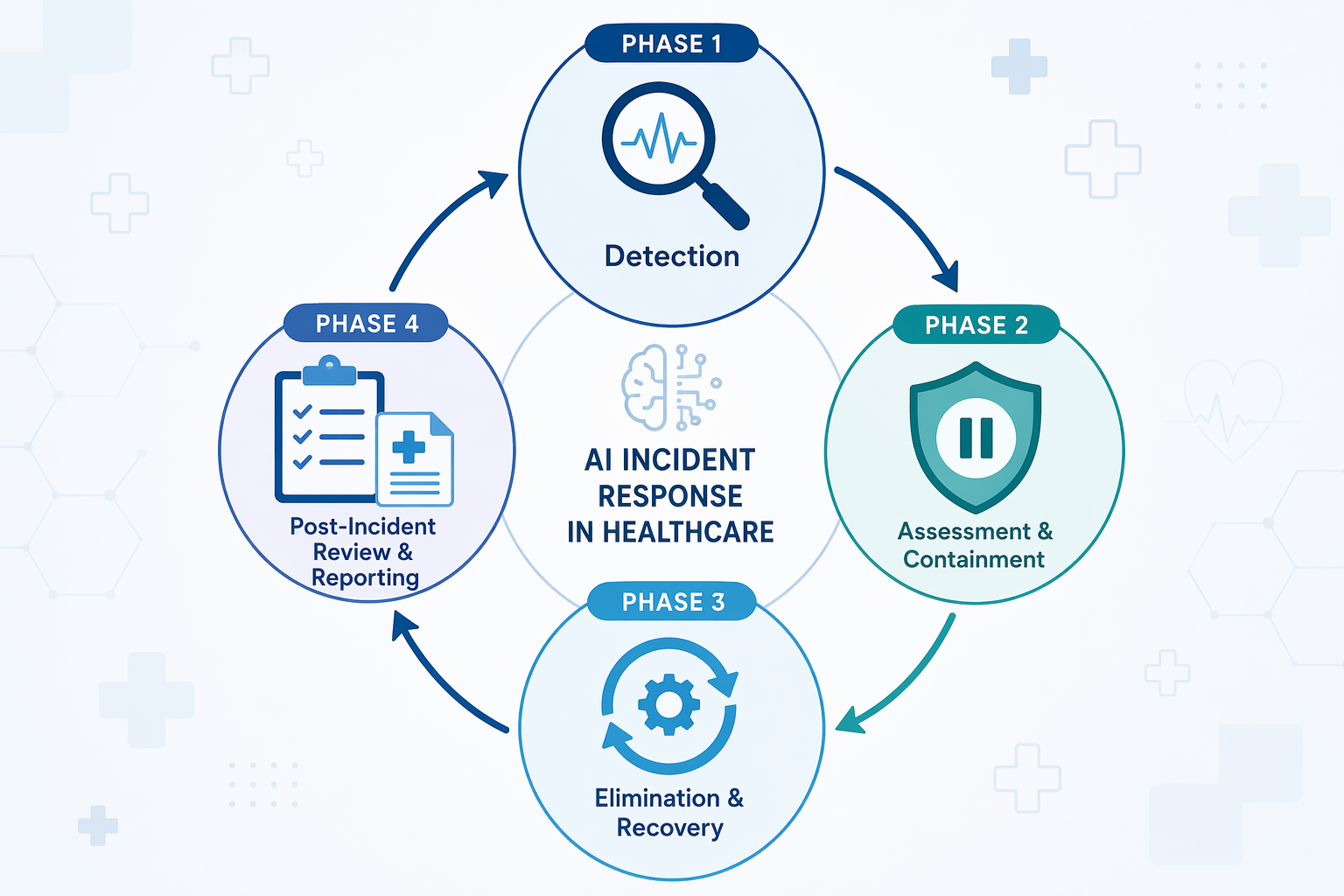
The Four-Phase AIRP
| Phase | What the plan has to cover |
|---|---|
| Detection | Telemetry, drift indicators, hallucination triggers, user reports, audit logs, and threshold-based escalation |
| Assessment and containment | Scope the failure, pause or degrade automation, invoke human fallback, notify the vendor, preserve evidence |
| Elimination and recovery | Quarantine poisoned data, roll back or retrain the model, validate performance, authorize return to service |
| Post-incident review and reporting | Root-cause analysis, contractual fixes, regulator reporting, and control updates |
Detection is where healthcare teams usually lose time. AI-specific monitoring needs more than uptime checks. It should watch for model drift, unusual output patterns, unsafe or contradictory recommendations, sudden changes in confidence behavior, and reports from nurses, physicians, analysts, or patients who saw the system behave badly. Those signals need predefined thresholds, a named fallback owner, and a logging standard that captures the model version, input context, output, and downstream user action.
- Model telemetry and drift indicators should be reviewed alongside ordinary system alerts.
- Unsafe-output or hallucination triggers should be specific enough to stop a workflow, not just create another dashboard item.
- User reports from clinicians need a route that reaches security, informatics, and the clinical owner at the same time.
- Audit logs should preserve the evidence needed to reconstruct what the model saw, said, and changed.
Containment needs to read like a clinical safety decision, not a purely technical one. If the model is embedded in triage, dosing, documentation, or routing, the response may need a kill switch, temporary suspension of automated recommendations, or a human-in-the-loop fallback that staff can actually use. The person who owns that call should be named in advance. So should the vendor notification path, because waiting until the postmortem to contact the model provider wastes the window when logs, configs, and version history still exist.
- Define when a model is paused, degraded, or taken offline.
- Specify who can activate the fallback workflow after hours.
- Preserve logs, prompts, outputs, and version data before they roll over.
- Tell the vendor early enough that they can support containment instead of arguing about it later.
Elimination and recovery are narrower than a full rebuild, but they still require discipline. If the problem involved poisoned data, that data has to be quarantined and removed from the training or inference path. If the model version changed, the team may need to roll back to a last known safe release before retraining anything. Recovery should not mean "restart and hope." It should mean that performance is validated against the use case that failed, the fallback owner signs off, and the model only returns to service when the organization can explain why the unsafe behavior is unlikely to repeat.
Vendor Contracts Are Part Of Response
The vendor question cannot be treated as a procurement footnote. Censinet says 80% of healthcare breaches in 2025 originated with third-party vendors rather than direct hospital compromise.[6] That figure does not prove AI incidents are mostly vendor-caused, but it does explain why BAAs and service contracts need to carry incident-response weight. If the model is hosted, tuned, or monitored by someone else, your plan has to assume that the evidence, the logs, and the answer to "what changed?" may live in their environment.
- Incident notification timelines that are shorter than the general legal minimums whenever possible.
- Access to telemetry, version history, and audit artifacts needed to assess model behavior.
- A duty to cooperate during containment, rollback, and root-cause review.
- Advance notice of model changes, retraining, feature updates, or guardrail edits.
- Evidence support for regulatory reporting, not just a promise to investigate later.
That is the practical difference between a policy and an operating contract. A policy says the vendor must cooperate. A BAA spells out what cooperation looks like when the model is already affecting care.
Reporting Pressure Is Rising
The reporting environment is moving even if the final rule text is still being confirmed. The available research points to proposed 2026 HIPAA Security Rule updates that would require 72-hour incident reporting for breaches affecting critical infrastructure, and HSCC's AI Cybersecurity Task Group previewed an AI Governance Maturity Model in November 2025 with 115 participating organizations.[4][5] Those are regulatory tailwinds, not a finished playbook, so organizations should verify final HHS and Federal Register status before treating any specific deadline as settled.
The useful takeaway is narrower: post-incident review cannot be separated from reporting. If the event touches PHI, patient safety, or a vendor-managed workflow, the AIRP should already identify who decides whether the matter is cyber, clinical, privacy, or all three. That decision affects who gets notified, what evidence is preserved, and which clock starts first.
A 90-Day Build Path
A workable build can be compressed into four blocks over 90 days.[3] The point is not to make every week feel equally important; it is to finish the parts that decide whether the plan will actually work when a clinician questions a model output at 2 a.m.
- Weeks 1-2: inventory every AI system in clinical and operational use, including vendor-managed tools, data sources, and business owners.
- Weeks 3-6: define escalation roles, trigger thresholds, fallback workflows, and the log fields that need to survive an incident.
- Weeks 7-10: fold AIRP clauses into BAAs, align response ownership with security and informatics, and train frontline staff on what to do when the model is wrong.
- Weeks 11-12: run tabletop exercises that force the organization to pause a system, involve the vendor, preserve evidence, and make a reporting decision under time pressure.
If the plan only exists as a policy memo, it is not an AIRP. It becomes real when the organization can identify an AI-specific failure, stop or degrade the system safely, pull the vendor into the response under contract, preserve evidence, report when required, and learn from the event without pretending the model was just another endpoint.
References
- AI Incident Response Playbook: Detection & Recovery — Censinet / GLACIS, April 2026
- Misuse of AI Chatbots Tops Annual List of Health Technology Hazards — ECRI, January 2026
- Building an AI Incident Response Plan for Healthcare Businesses — Holt Law
- Healthcare Data Breach Statistics — HIPAA Journal
- HSCC Previews 2026 AI Cybersecurity Guidance Highlighting Best Practices for Healthcare Organizations — Industrial Cyber, November 2025
- Medical AI Breach: Healthcare Cyber Attacks — Censinet
Comments
Join the discussion with an anonymous comment.