Cancer patients are more willing to use AI than many clinics may assume, but willingness is not the same as readiness. In a survey of 154 radiation oncology patients at a single German center, 79% said they would agree to AI use, yet only 16% felt adequately informed; 27% feared AI mistakes, 65% preferred a doctor-plus-AI combination, and no one trusted AI alone.[1]

That gap matters because it changes the real question from whether patients accept AI to whether they can use it without being left behind. In the same survey, only 16.2% reported using digital support tools, which suggests that interest alone does not produce practical readiness.[1]
What patients are saying
The survey signal is useful because it is not a cheerleading story. Patients were not rejecting AI; they were cautious, underinformed, and much more comfortable with AI as a support to a clinician than as a standalone source of guidance. That is a narrow but important distinction for AI in cancer treatment and patient support: the promise is not replacement, it is assistance that still depends on human explanation.[1]
Where the strongest evidence sits
The clearest trial evidence comes from a randomized study of 122 breast cancer patients in Egypt. The intervention was a rule-based chatbot, not a generative system, and it produced large improvements in breast cancer knowledge and attitudes: mean knowledge scores were 20.3 versus 17.9 with p<0.001 and d=0.82, while attitude scores were 82.4 versus 72.6 with p<0.001 and d=1.15. The trial also reported better patient empowerment.[2]
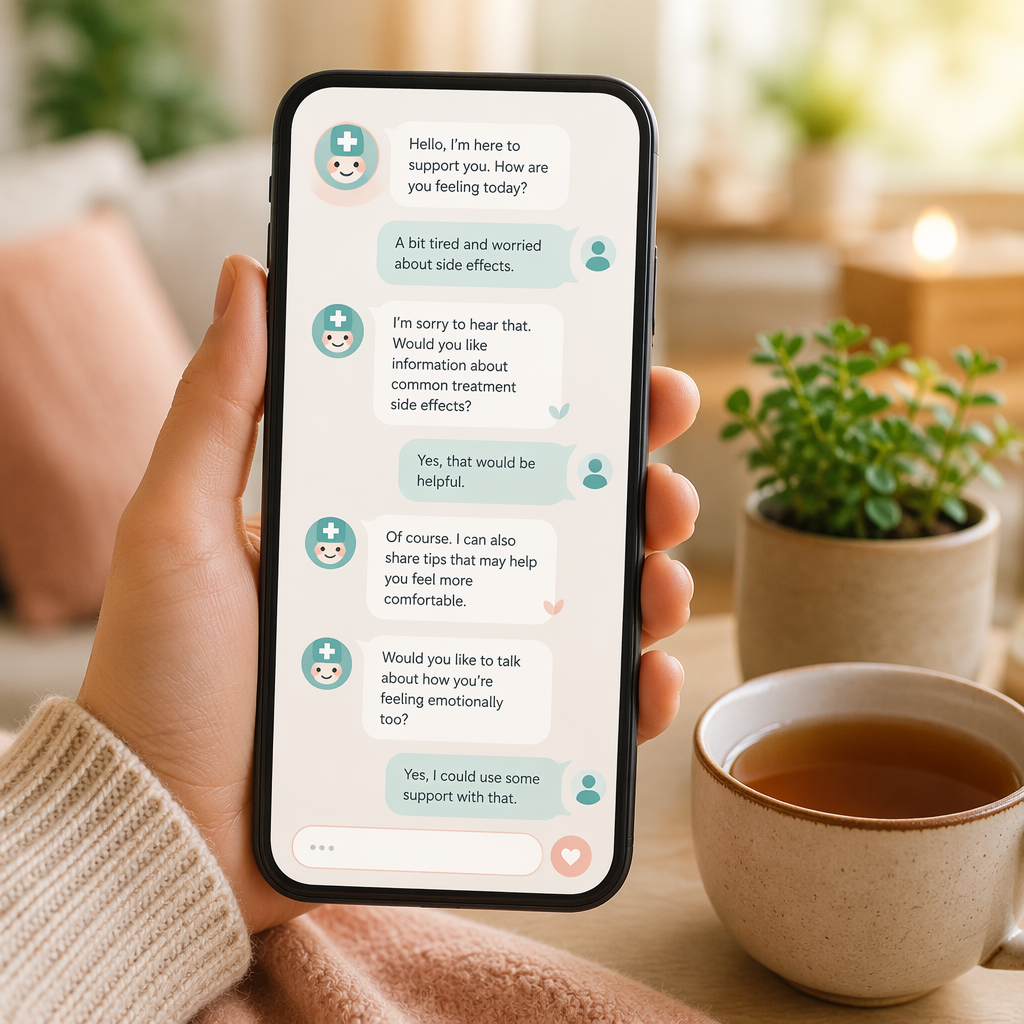
That result deserves attention precisely because the tool was bounded. It answered a defined set of questions and improved what patients knew and how they felt about AI-assisted support. It does not prove that every chatbot will work, and it does not tell us much about large language models in U.S. oncology clinics, but it does show that patient education and empowerment can move when the tool is specific enough to be usable.[2]
The practical lesson is less glamorous than the headlines suggest. A chatbot helps when it reduces uncertainty, repeats information without fatigue, and gives patients a place to ask the question they were embarrassed to raise in clinic. It is not the same as replacing a nurse, a physician, or a care navigator; it is a way of extending them.

Who actually benefits
The hardest part is not proving that AI can help; it is deciding who gets the help first. In the German survey, age 65 or older, lower education, and low digital health literacy were significant negative predictors of digital tool use.[1] Those are the patients most likely to be missed if deployment assumes that everyone can read, navigate, and trust a new interface at the same pace.
That is where institutions have to do the unglamorous work: onboarding, plain-language guidance, backup pathways to staff, and careful placement of AI inside existing care rather than around it. If the preferred model is doctor plus AI rather than AI alone, then the implementation has to reflect that preference instead of treating it as a marketing detail.[1]
Comments
Join the discussion with an anonymous comment.