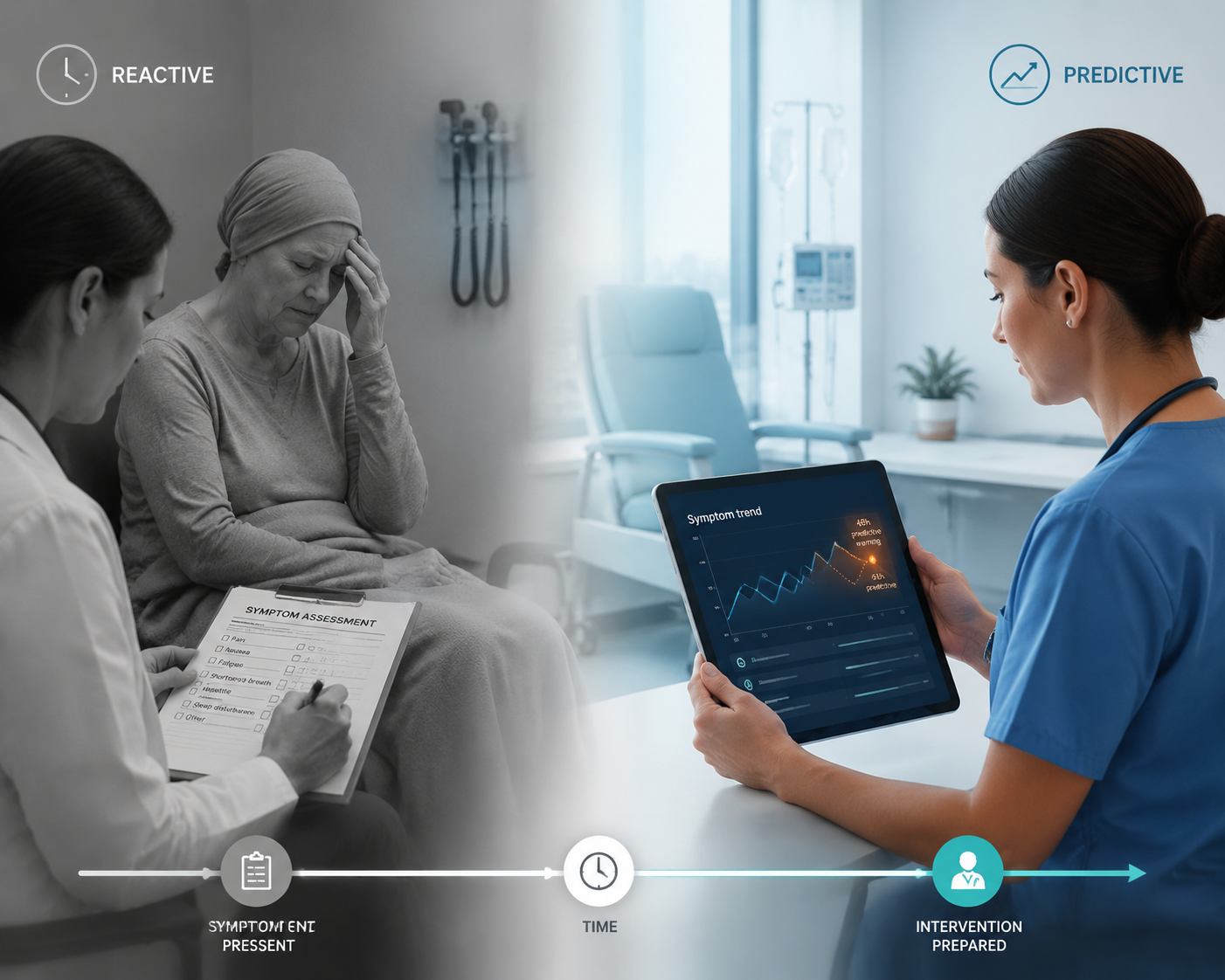
The useful promise of AI for disease symptom tracking in cancer care is not that it can produce another graph. It is that a patient’s pain, fatigue, nausea, sleep disruption, activity change, or reported distress may start shifting before anyone would normally document a deterioration. If the signal reaches the right person early enough, the care team may have time to adjust medication, call the patient, change hydration or antiemetic plans, or decide that the symptom pattern needs urgent review.
That is a different clinical posture from asking patients how bad the week was after the damage is already done. In oncology, symptom worsening is often managed between visits by patients, caregivers, nurses, and palliative care teams who are already balancing toxicity, disease progression, treatment schedules, and limited clinic capacity. A prediction window only matters if someone can act inside it.
What AI Symptom Tracking Means in Oncology
In this setting, AI symptom tracking usually means using patient-reported symptoms, clinical data, free-text notes, chatbot interactions, wearable signals, or combinations of these inputs to identify current symptom burden or predict near-term worsening. The target is not cancer diagnosis or prognosis. It is the lived, operationally messy space between treatment encounters, where a patient may be deciding whether nausea is manageable, whether pain is becoming unsafe, or whether fatigue is crossing from expected toxicity into deterioration.
The best current map of this field is a 2024 systematic review in JCO Clinical Cancer Informatics that examined 41 studies of artificial intelligence for symptom monitoring in adult cancer survivorship.[1] That review matters because it keeps the discussion anchored. It shows where the literature is accumulating, what symptoms researchers are actually trying to track, which methods dominate, and how much of the evidence still comes from observational designs rather than trials that test implementation at scale.
| What the 2024 review measured | Reported finding |
|---|---|
| Number of included studies | 41 studies |
| Most common symptom target | Pain, addressed in 34.2% of studies |
| Other common symptom targets | Fatigue and nausea, each addressed in 17.1% of studies |
| Most common AI approach | Machine learning, used in 43.9% of studies |
| Other approaches | Natural language processing in 29.3%, chatbots in 17.1%, and decision support systems in 9.8% |
| Dominant study design | Cohort designs, representing 80.5% of studies |
| Mean sample size | 617 patients |
| Geographic concentration | 39% of studies from the United States and 14.6% from Japan |
The distribution of targets is clinically unsurprising but important. Pain, fatigue, and nausea are not peripheral symptoms in oncology; they are common reasons patients lose function, interrupt treatment, call after hours, or end up in acute care. The fact that pain appears in 34.2% of studies, while fatigue and nausea each appear in 17.1%, suggests that AI work is clustering around symptoms that are both frequent and consequential.[1]
The methods also show different levels of clinical closeness. Machine learning models can use structured inputs such as symptom scores, activity metrics, or clinical variables. Natural language processing can pull symptom information from text, where important details often live but do not fit neatly into a checkbox. Chatbots can collect symptoms directly from patients, potentially reducing dependence on scheduled visits. Decision support systems sit closest to the clinical workflow, where a prediction may become a recommendation, a triage flag, or a prompt for review.
Those categories should not be treated as interchangeable. A model that classifies symptom language in a note does not create the same clinical burden as a chatbot that asks a patient about worsening pain every day, and neither is the same as a decision support alert landing in an oncology nurse’s queue. The evidence base becomes more useful when the method is tied to the person who must respond.
The Evidence Is Growing, but It Is Still Mostly Cohort-Level
The systematic review supports a cautious conclusion: AI is being applied to oncology symptom monitoring across multiple approaches, but the maturity of the evidence is limited. Cohort designs accounted for 80.5% of the included studies, and the mean sample size was 617 patients.[1] Those numbers do not make the work unimportant. They do mean that many results are still better read as feasibility, model development, association, or early performance signals rather than proof that a tool improves outcomes when deployed across ordinary oncology services.
This distinction is easy to lose in AI discussions. A cohort study can show that a model detects a pattern associated with symptom burden or impending worsening. It usually cannot show, by itself, that acting on the model reduces hospital use, improves quality of life, avoids treatment disruption, or does so without worsening inequities. For that, the question shifts from prediction to intervention.
The geographic distribution adds another boundary. In the review, 39% of studies came from the United States and 14.6% from Japan.[1] That concentration raises practical questions for broader adoption: whether symptom language, care access, wearable use, reporting behavior, oncology staffing models, and baseline risk patterns are similar enough elsewhere for models to travel without careful local validation.
The current material also does not identify which cancer types have the strongest or weakest evidence for AI symptom tracking. That absence matters because symptom trajectories are not uniform across cancers, treatments, or survivorship phases. A tool that performs well in one population should not be assumed to work equally well for another unless the supporting data actually show it.
The 48-Hour Warning Is Clinically Attractive
The strongest deployment story in the available evidence comes from Mass General Brigham pilots described as integrating wearable data with AI to predict symptom flares up to 48 hours ahead. The same source reports that unplanned admissions dropped by approximately 25% in some programs.[2] These are the kinds of numbers that make clinicians pause, because they describe a possible change in timing: from reacting after escalation to seeing enough of a pattern to intervene before the patient arrives in crisis.
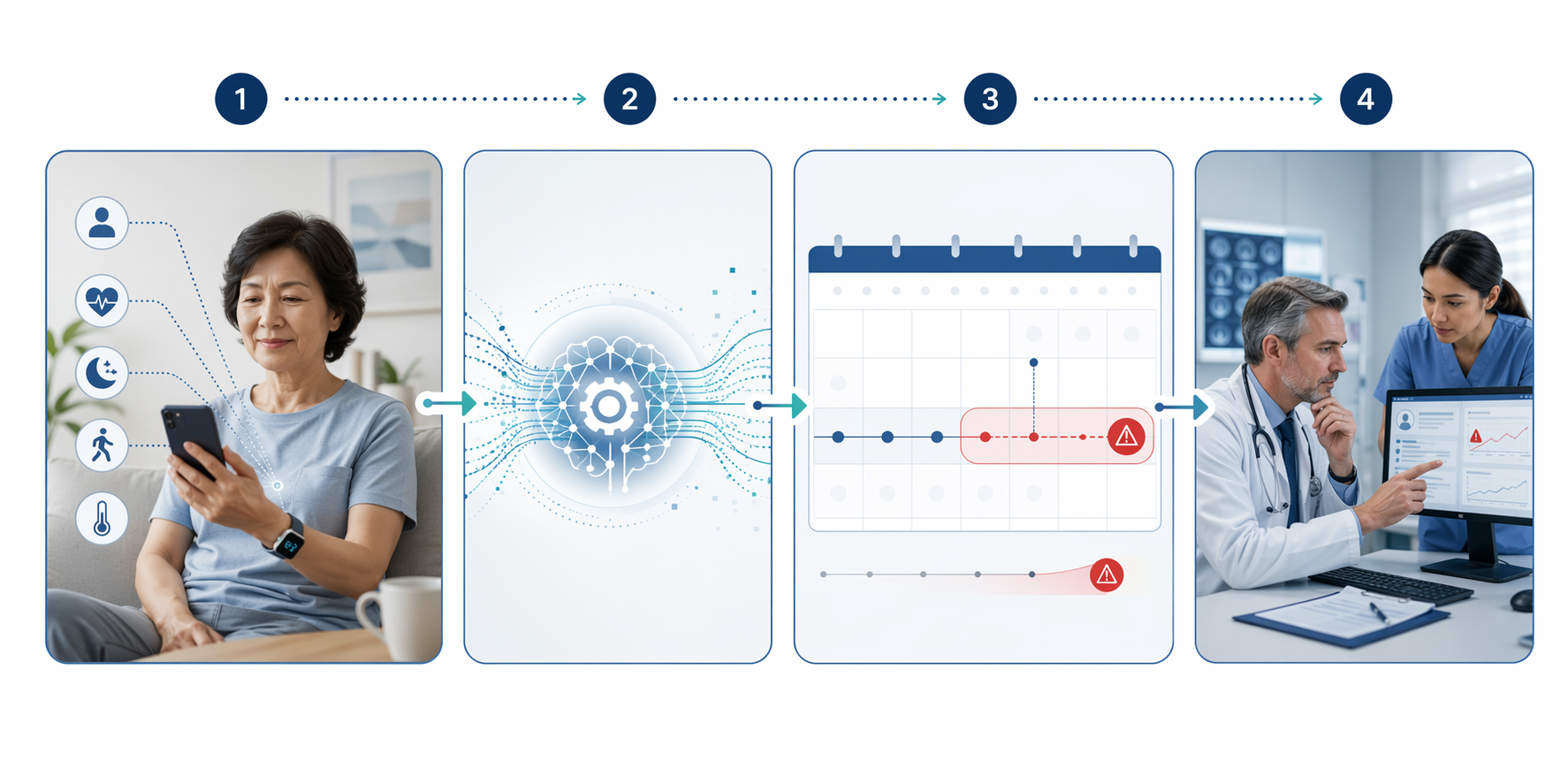
A 48-hour window is also just long enough to expose the operational problem. Someone has to review the signal. Someone has to decide whether the alert is actionable, whether it reflects a true deterioration, and whether the response should be a phone call, a medication change, a same-day visit, home support, or emergency evaluation. If the alert arrives late Friday afternoon, the model’s performance is only one part of the story.
The reported admissions reduction should therefore be read as promising pilot evidence, not as generalizable proof. The available source describes pilot programs, not multi-center randomized trials.[2] The difference is not academic. Pilots often include closer monitoring, motivated teams, selected workflows, and a level of implementation attention that can fade when a tool becomes routine.
Prediction Is Not the Same as Care
For oncology symptom tracking, the clinical chain has several links: the patient must generate usable data, the system must detect a meaningful change, the alert must reach the appropriate team member, the team must respond in time, and the response must change the patient’s trajectory. Weakness in any one link can turn a predictive tool into another monitoring burden.
- If patients underreport symptoms, the model may receive a clean-looking but misleading signal.
- If wearable data are inconsistent, the alert may reflect missingness or behavior rather than clinical deterioration.
- If alerts are not triaged, oncology nurses inherit another queue without protected time.
- If interventions are not standardized, two patients with similar warnings may receive different levels of care.
- If the benefit is measured only inside a carefully supervised pilot, the result may not survive routine deployment.
This is where symptom tracking differs from more distant AI claims in oncology. The value is not hidden in a speculative future. It is visible in whether fewer patients deteriorate at home without help, whether nurses can prioritize the right calls, and whether palliative care teams receive signals early enough to adjust symptom plans before a crisis.
What the Literature Emphasizes and What It Leaves Underdeveloped
The review’s method mix shows an active field, but not a settled one. Machine learning represented 43.9% of the studies, natural language processing 29.3%, chatbots 17.1%, and decision support systems 9.8%.[1] That spread suggests researchers are still testing where AI best fits: in extraction, prediction, patient interaction, or clinician-facing decision support.
Each approach answers a different practical need. Natural language processing may help recover symptom information already buried in clinical notes. Chatbots may increase the frequency of symptom capture, especially between visits. Wearable-linked models may detect physiologic or activity changes that patients would not describe as symptoms yet. Decision support tools may help teams decide what to do with the information.
The underdeveloped part is not the ambition. It is the standardization around data capture, analytics infrastructure, and end-user experience. The available evidence identifies these as significant barriers, but does not provide detailed specifications for what standardization should look like or which groups are solving it. That uncertainty should remain visible because symptom tracking depends heavily on repeated, comparable inputs.
A pain score collected through a clinic portal, a chatbot message about worsening pain, an oncology note describing breakthrough opioid use, and a wearable-derived activity decline may all point toward the same clinical problem. They are not the same data. Before an AI system can reliably support triage, institutions need to know which inputs are required, how often they must be captured, how missing data are handled, and what threshold triggers action.
Commercial Pressure Is Moving Faster Than Validation
The commercial context helps explain why health systems are hearing more about oncology AI tools. The AI in oncology market was valued at $1.7 billion in 2024 and is projected to reach $9.1 billion by 2035, with a reported compound annual growth rate of 14.1%.[2] Those figures describe market momentum, not clinical effectiveness.
For clinical leaders, the more relevant question is narrower: does a symptom tracking system improve a defined care process for a defined patient population, with acceptable workload and safety tradeoffs? A tool that performs well in a vendor demonstration still needs to show how it handles false alarms, nonresponse, device nonuse, language differences, comorbid symptoms, and staffing constraints.
This is also where adoption and effectiveness must be kept separate. A hospital can adopt AI-enhanced symptom monitoring because it aligns with remote care strategy or patient engagement goals. That adoption does not prove that the tool reduces admissions, improves symptom control, or generalizes beyond the setting where it was first tested.
What Readiness Would Need to Look Like
The evidence now supports continued clinical development, especially for high-burden symptoms such as pain, fatigue, and nausea. It does not yet support treating AI symptom tracking as a mature oncology standard across settings. The gap is not only whether models can predict. It is whether prediction reliably leads to timely, equitable, and sustainable care.
A stronger adoption case would include prospective validation in diverse oncology populations, clearer reporting by cancer type and treatment context, standardized symptom and wearable data capture, and outcome measures that follow the intervention pathway rather than stopping at model performance. Reduced unplanned admissions would be meaningful, but so would better symptom control, fewer urgent calls, fewer avoidable emergency visits, and less unmanaged distress at home.
Workflow evidence should sit beside accuracy evidence. Clinical teams need to know who receives alerts, how many arrive per patient, how many require action, how often alerts are wrong, and what happens when no one can respond immediately. Patients need to know whether reporting symptoms will bring help, not just surveillance.
AI for disease symptom tracking in oncology is plausible, clinically close to patient experience, and supported by a growing body of research. Its strongest current role is as an early-warning approach under careful implementation. Broader adoption still depends on stronger validation, standardized data capture, usable workflows, and proof that benefits extend beyond early pilots.
References
- Application of Artificial Intelligence in Symptom Monitoring in Adult Cancer Survivorship: A Systematic Review, JCO Clinical Cancer Informatics, 2024.
- AI Predicts Cancer Symptoms: Revolutionizing Palliative Care, CHPCA.
Comments
Join the discussion with an anonymous comment.