
Accuracy in a cause of death medical investigation is not a clean leaderboard problem. A preliminary impression may be written before toxicology returns. A post-mortem CT stack may show hemorrhage without explaining why it happened. A prosection note may be revised after histology, microbiology, scene information, or a drug level changes the weight of the findings. In one Northern California series of 952 forensic autopsy prosections by a single experienced pathologist, 17% of cases had an unexpected change between the prosection diagnosis and the final report, most often because of toxicology results.[1] Another death-certification study reported that more than 85% of death certificates contained more than one error.[2]
That is the setting in which AI has to be judged. The useful question is not whether an algorithm can look impressive in forensic pathology. It is whether it can help a strained death-investigation office find, classify, estimate, or draft something more consistently without turning a model output into a legally overconfident conclusion.
The short answer is cautious but not dismissive: AI now shows measurable performance across several forensic subtasks, including post-mortem CT detection, wound and ballistic classification, diatom testing for drowning, microbiome-based postmortem interval estimation, and draft cause-of-death reporting. The evidence does not support replacing the forensic pathologist. It supports supervised assistance in bounded tasks where the model’s job is clear and the human reviewer remains responsible for reconciling imaging, autopsy, toxicology, scene context, and legally defensible language.
The Evidence Base Is Promising, But Still Thin
The most useful organizing point is the 2025 systematic review by Orsini and colleagues, which identified 18 studies on AI applications in forensic pathology. That review is important not because 18 studies settle the field, but because they show how uneven the field still is. Only 23% of included studies used datasets exceeding 1,000 samples, and fewer than 15% implemented explainable-AI techniques validated for legal contexts.[3]
Those two figures should sit beside every accuracy number. A model trained on a modest research dataset may be excellent at a defined classification problem and still be unready for routine medicolegal work. The question is not only “How accurate was it?” but also “On whose cases, with what ground truth, under what exclusions, with what artifacts, and in which legal reporting environment?”
| Forensic task | Reported AI performance | What the result does and does not prove |
|---|---|---|
| Post-mortem CT neurological detection | 70–92.5% accuracy for traumatic head injury detection; 94% accuracy for cerebral hemorrhage detection | Shows useful image-pattern recognition; does not determine the full cause or manner of death by itself.[3] |
| Gunshot, shooting-distance, and stab-wound classification | 87.99% gunshot wound classification accuracy; 98% shooting-distance prediction; 93% stab-wound classification accuracy | Supports constrained pattern classification in controlled settings; does not resolve circumstance, intent, or legal manner.[3] |
| AI-enhanced diatom testing for drowning | Precision 0.9 and recall 0.95, with a CNN matching five experienced forensic pathologists | Can reduce microscopy workload and improve consistency; does not replace full drowning diagnosis or scene correlation.[4] |
| Microbiome-based postmortem interval estimation | Postmortem interval within ±55 accumulated degree days; microbial fingerprinting up to 90% accuracy | Adds a biological interval estimate; remains dependent on sampling, environment, and validation.[3] |
| Multi-agent LLM draft reporting | Draft reports in under 10 minutes; Δ+3.2% long-form accuracy and Δ+10.7% short-form conclusion accuracy over strong baselines | Shows workflow potential for structured drafting; validation is tied to Chinese medicolegal contexts.[5] |
Post-Mortem CT: Useful Detection Is Not the Same as Final Attribution
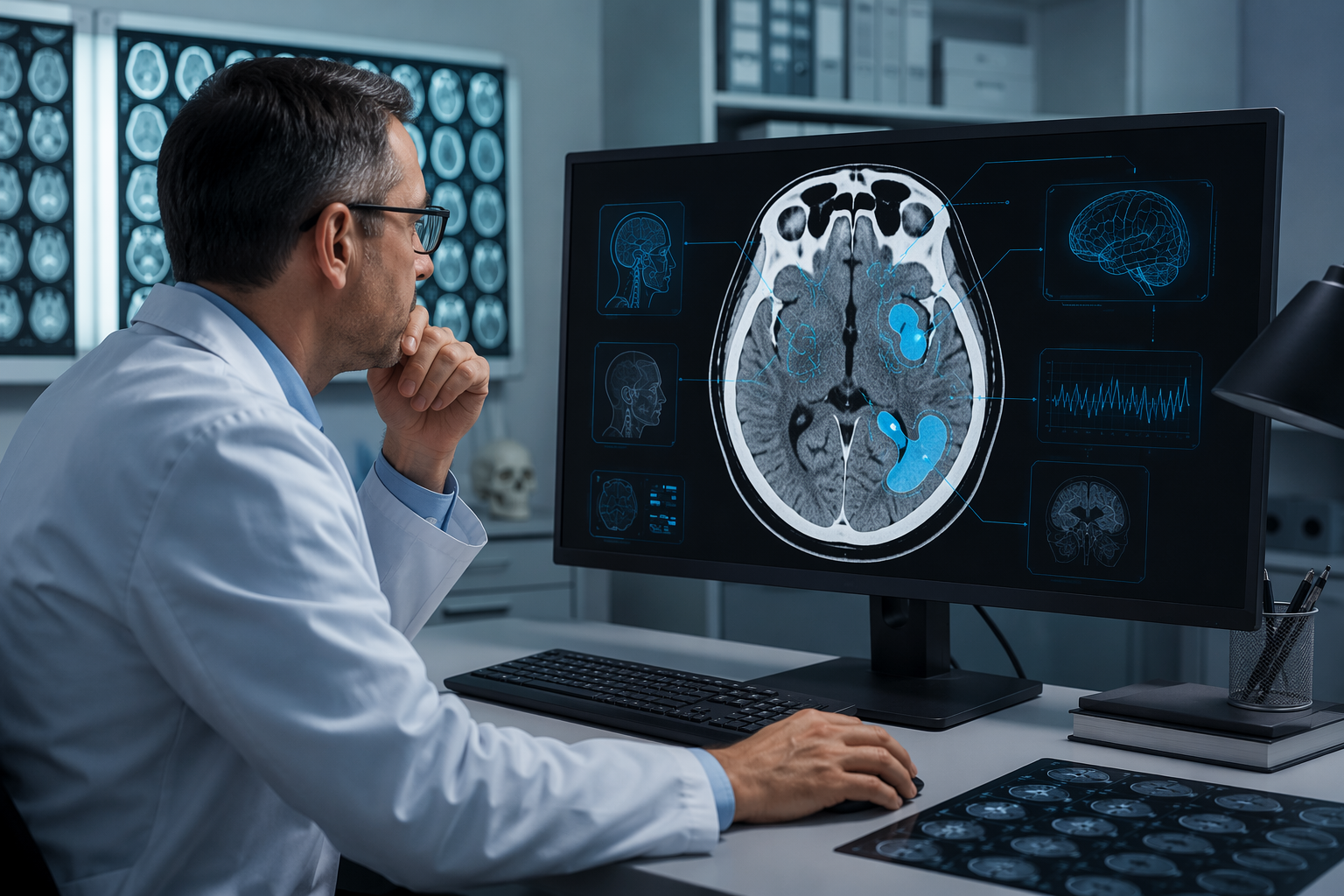
Post-mortem CT is a sensible place for AI to enter the case stream. It generates large image volumes, often before all ancillary results are available, and it asks repetitive detection questions: hemorrhage, fracture, gas distribution, foreign bodies, projectile paths, and other findings that can be missed when a reviewer is moving through stack after stack.
In neurological applications, the reported numbers are respectable rather than magical. Garland and colleagues reported 70–92.5% accuracy for traumatic head injury detection on post-mortem CT using a convolutional neural network, while Zirn and colleagues reported 94% CNN accuracy for cerebral hemorrhage detection.[3] Those results suggest that AI can function as a second reader or triage signal, especially when the task is “find this radiologic pattern” rather than “explain the death.”
The distinction matters. A cerebral hemorrhage on post-mortem CT may be central to the cause of death, incidental, traumatic, natural, anticoagulant-related, or part of a longer causal chain. Imaging can narrow the field. It cannot, by itself, absorb the medical record, the scene, the toxicology, the autopsy findings, and the phrasing required in a final certificate or report.
Wounds and Ballistics: Strong Pattern Recognition Inside Narrow Walls
Wound and ballistic applications are some of the more intuitively attractive AI uses in forensic pathology because the visual signal can be bounded. A model may be asked to classify gunshot wound features, estimate shooting distance from wound or residue patterns, or distinguish stab-wound characteristics. These are narrower tasks than cause-of-death certification, and the published performance reflects that narrower scope.
The reviewed evidence includes 87.99% accuracy for gunshot wound classification, 98% accuracy for shooting-distance prediction, and 93% accuracy for stab-wound classification.[3] In a controlled research setting, those figures are high enough to take seriously. They imply that AI may help standardize the first pass through wound photographs or flag cases where a second look is warranted.
They do not imply that an algorithm can decide manner of death. Cause of death is the medical disease or injury process that produces death. Manner of death is a medicolegal classification that depends on circumstances: accident, homicide, suicide, natural, or undetermined in many U.S. systems. A gunshot-pattern classifier may help describe the injury. It does not know intent. It does not know witness reliability. It does not know whether the scene reconstruction is complete.
Diatom Testing: A Good Example of Workload Relief
Diatom testing is a better example of AI as practical assistance than AI as forensic replacement. In suspected drowning, diatom analysis can be laborious and observer-dependent. A system that screens images consistently has obvious appeal: it may reduce microscope time, make the first pass less variable, and give the pathologist a cleaner set of findings to interpret.
Yu and colleagues reported an AI-enhanced diatom approach with precision of 0.9 and recall of 0.95, with a CNN matching five experienced forensic pathologists.[4] Precision here speaks to how often positive AI calls were correct; recall speaks to how many true positives the system captured. In a workload-heavy visual task, high recall is particularly meaningful because missed positives can change the evidentiary weight of the test.
Even then, drowning diagnosis is not made from diatoms alone. The finding has to be weighed against decomposition, contamination risk, water environment, autopsy findings, toxicology, and scene information. The AI can improve one tray of evidence. It does not carry the whole case.
Microbiome PMI Estimation Adds a Number, Not Certainty
Postmortem interval estimation is another attractive AI target because it is already probabilistic, biologically messy, and often important to investigators. Microbial succession after death can be modeled, and machine learning can detect patterns too complex for ordinary visual inspection. The result, however, is still an estimate shaped by sampling, temperature, environment, body condition, and local validation.
Johnson and colleagues reported postmortem interval estimation within ±55 accumulated degree days, and He and colleagues reported microbial fingerprinting accuracy up to 90%.[3] Accumulated degree days are not clock hours; they combine time and temperature exposure. That makes the metric biologically sensible, but it also means the estimate has to be translated carefully before it is useful to an investigator or admissible in a contested setting.
A microbiome model may help bound an interval or compare whether a proposed timeline is biologically plausible. It should not be written as if it has solved time of death with a precision the underlying biology does not support.
FEAT and the Appeal of Draft Reports
The FEAT system deserves separate attention because it moves from image or laboratory classification toward report-level assistance. Shen and colleagues described a multi-agent large language model system for automated cause-of-death analysis built on a 7,748-case corpus. The system generated draft reports in under 10 minutes and improved long-form accuracy by Δ+3.2% and short-form conclusion accuracy by Δ+10.7% over strong baselines, with expert-level quality reported across six geographically distinct cohorts.[5]
That is not a trivial result. Anyone who has watched a backlog form around report drafting can see the attraction. A system that assembles a structured draft, keeps terminology consistent, and surfaces missing pieces could be useful even if every line still requires review. In offices with too few forensic pathologists, shaving drafting time without lowering quality is not cosmetic; it changes where expert attention can be spent.
The caveat is large. FEAT was designed and validated in Chinese medicolegal contexts.[5] Language, report conventions, legal categories, autopsy practices, and institutional expectations differ across jurisdictions. A strong result in that setting does not automatically mean readiness for U.S. medical examiner offices or European forensic institutes. It means report-generation systems are now plausible enough to evaluate seriously, preferably with local ground truth, local legal review, and real workflow testing.
Why Benchmark Accuracy Falls Short of Forensic Readiness
Forensic pathology raises the bar because the output does not stay in the lab. It may enter a death certificate, an amended report, a criminal file, an insurance dispute, a public health dataset, or a family’s final explanation. The system therefore has to be judged on more than internal accuracy.
- Dataset size: the systematic review found that only 23% of studies used more than 1,000 samples, limiting confidence in generalization across case mix, decomposition, imaging protocols, and institutional practice.[3]
- External validation: a model tested mainly where it was developed may fail when scanner settings, autopsy thresholds, wound photography, or reporting language change.
- Explainability: fewer than 15% of reviewed studies used explainable-AI methods validated for legal contexts, leaving a gap between technical performance and courtroom defensibility.[3]
- Workflow behavior: most evidence still comes from research or evaluation settings, not routine deployment where interruptions, incomplete information, and local review habits shape performance.
- Jurisdictional fit: cause and manner terminology, certification rules, and reporting expectations differ enough that a model cannot be assumed portable.
These concerns are not arguments against AI. They are the normal burden of using it in a setting where an error can become official. Governance frameworks such as the NIST AI Risk Management Framework are relevant here because forensic AI needs traceability, monitoring, and role definition, not just impressive validation tables.
The Workforce Argument Is Real, But It Cannot Carry the Science
There is a legitimate workload reason to want AI help in cause-of-death investigation. A 2022 review of U.S. forensic pathology reported about 700 board-certified forensic pathologists against more than 1,200 needed by National Association of Medical Examiners standards.[6] FEAT’s authors also noted Chinese workforce pressure, including about 12,000 certified pathologists for 1.4 billion people and an annual 250-autopsy threshold associated with accuracy decline.[5]
Shortage explains the appetite for assistance; it does not validate a model. A tired office may benefit from AI triage, image screening, diatom recognition, structured report drafting, or a consistency check before sign-out. But workforce pressure is exactly why the boundary has to be explicit. The busier the office, the easier it is for an assistive output to become a shortcut.
That deployment gap is familiar across clinical AI. Controlled-study performance often does not predict how a tool behaves after it meets real queues, incomplete inputs, user workarounds, and local accountability. The same caution that applies to AI clinical deployment realities applies with extra force in medicolegal death investigation.
What AI Can Reasonably Do Now
The most defensible current role for AI is bounded assistance. It can flag possible findings on post-mortem imaging, classify constrained wound patterns, screen diatom images, generate microbiome-based interval estimates, and draft structured text for expert review. Those tasks can reduce variability and cognitive load if the system is validated for the local population, monitored after deployment, and kept subordinate to professional judgment.
What AI cannot yet do is assume responsibility for the final medicolegal synthesis. The forensic pathologist still has to decide whether a radiologic finding is causal or incidental, whether toxicology explains death or complicates it, whether decomposition limits interpretation, whether the report language overstates certainty, and whether the medical cause of death is being confused with the legal manner of death.
The evidence is strong enough to justify careful pilots and task-specific validation. It is not strong enough to justify replacement. The field has useful accuracy signals, but it also has small datasets, limited legal explainability, thin real-world deployment evidence, and jurisdiction-specific reporting requirements. In cause-of-death medical investigation, that leaves AI in a valuable but supervised position: a second reader, classifier, estimator, and drafting aid, not the person who signs the case.
References
- Accuracy and validity of determined cause of death and manner of death following forensic autopsy prosection, Journal of Clinical Pathology, 2024.
- Death certificate errors and the effect on mortality statistics, PubMed, 2020.
- The application of artificial intelligence in forensic pathology: a systematic literature review, PubMed Central, 2025.
- Artificial Intelligence in Forensic Medicine and Toxicology: The Future of Forensic Medicine, PubMed Central.
- FEAT: Forensic Expert Agent Technology for Automated Cause-of-Death Analysis, arXiv, 2025.
- Death Investigation in the United States: Forensic Pathology, PubMed Central, 2022.
Comments
Join the discussion with an anonymous comment.