The practical question around AI in addiction treatment and mental health is no longer whether patients will use chatbots. They already have reason to: long waits, after-hours distress, reluctance to disclose substance use, and an intake system that often asks people to hold themselves together until a slot opens. The harder question is what should count as care when a tool can answer immediately, sound reassuring, and still operate outside the authorization structures used for medical devices.
That tension is visible in the regulatory numbers. At a November 2025 FDA Digital Health Advisory Committee discussion, the agency had authorized no AI-enabled devices for mental health treatment, while more than 1,200 AI-enabled devices had been authorized in other clinical areas. The same discussion placed the unmet need beside the gap: approximately 58 million U.S. adults had been diagnosed with mental illness, a 39.8% increase from 2019 to 2023, and many chatbot products remained positioned as unregulated wellness apps rather than authorized treatment devices.[1]

That does not make the tools useless. A patient who opens a chatbot at 2 a.m. may be doing something clinically meaningful: naming symptoms, tolerating a craving, rehearsing a coping skill, or moving one step closer to a human appointment. But usefulness at the margin is not the same as autonomous treatment. The evidence has to be read in the role the tool is likely to occupy: adjunct, bridge, triage-adjacent engagement, psychoeducation, or replacement.
The Trial Evidence Shows Benefit, With a Ceiling
The most useful trials are not the ones showing that a chatbot can produce a statistically significant change. That is necessary, but not enough. The more clinically useful comparison is what happens when chatbot outcomes are placed beside traditional therapy, with the population and setting kept in view.
In a 2025 randomized controlled trial of the Friend chatbot, 104 women with anxiety disorders in active war zones in Ukraine were assigned to chatbot-supported intervention or traditional therapy. The chatbot group had a 30% reduction on the Hamilton Anxiety Scale and a 35% reduction on the Beck Anxiety Inventory. The traditional therapy group had larger reductions: 45% and 50%, respectively. Both approaches produced statistically significant improvements, but the chatbot effect was smaller on both measures.[2]
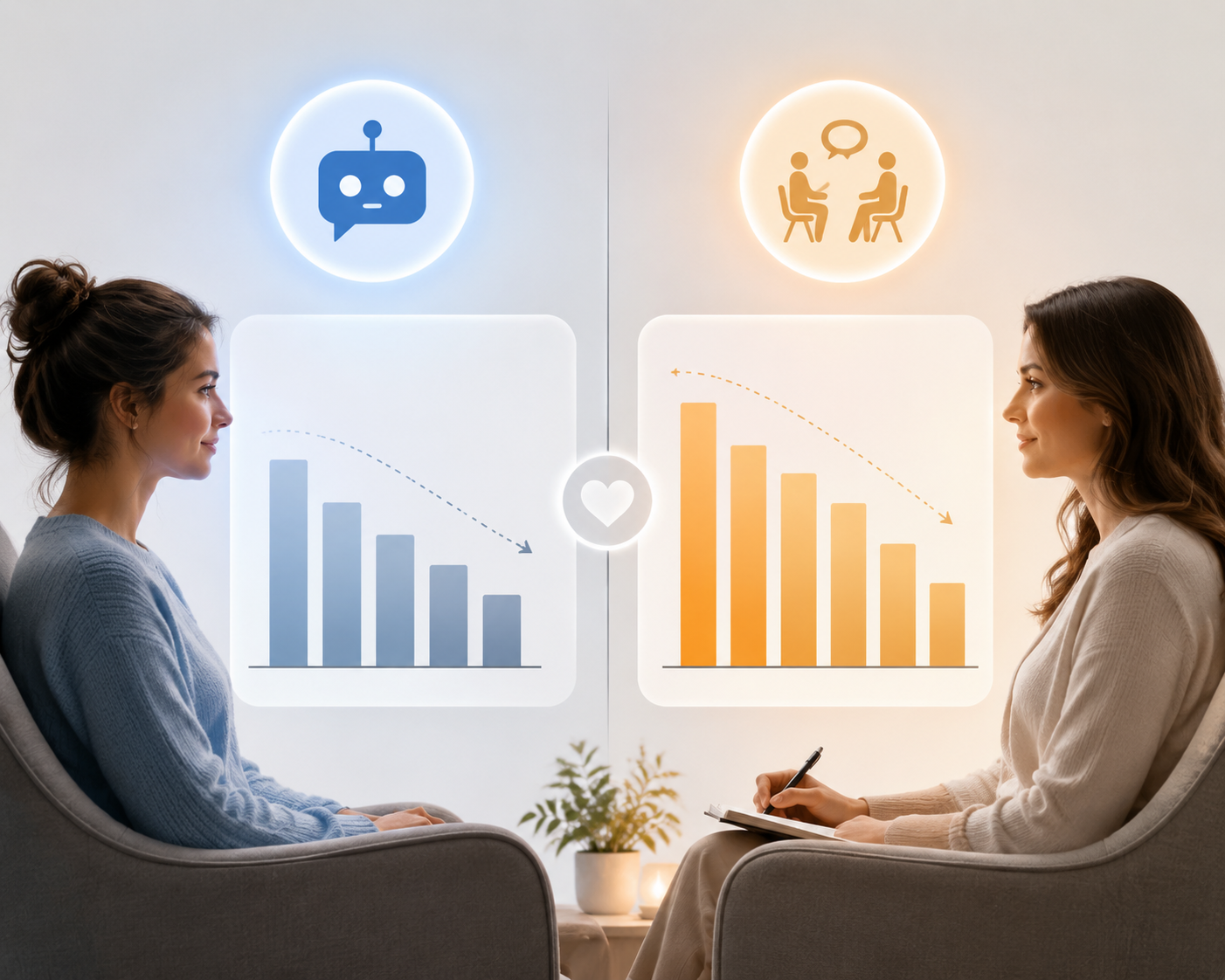
The setting matters. Women with anxiety disorders living in active war zones are not an abstract convenience sample. If a chatbot can reduce symptoms in that context, the result deserves attention. At the same time, the same severity and specificity that make the trial compelling also limit what can be generalized from it. The study does not establish that Friend would perform similarly across genders, diagnoses, countries, languages, health systems, or levels of risk. It also does not make the chatbot equivalent to psychotherapy; the traditional therapy arm did better.
That pattern fits the broader direction of the literature. A systematic review and meta-analysis of AI conversational agents for mental health and well-being found evidence that conversational agents can improve some mental health outcomes, while also emphasizing heterogeneity across studies, interventions, and populations.[3] That heterogeneity is not a technical footnote. A structured CBT-oriented agent, a scripted psychoeducation tool, and a generative system that produces open-ended responses do not create the same clinical questions.
| Evidence area | What the evidence supports | What it does not establish |
|---|---|---|
| Friend chatbot RCT | Statistically significant anxiety reductions in 104 women with anxiety disorders in active war zones | Equivalence to traditional therapy or generalizability to all mental health populations |
| Broader conversational-agent evidence | Potential improvement in selected mental health and well-being outcomes | Uniform effectiveness across tools, diagnoses, or care settings |
| Generative mental health agents | Possible engagement and symptom reduction in studied populations | Safe autonomous operation for all clinical scenarios |
Generative systems add another layer. The Therabot randomized trial reported significantly greater symptom reductions for major depressive disorder, generalized anxiety disorder, and eating disorder risk, and participants reported trust comparable to working with a real therapist. The first author still cautioned that no generative AI agent is ready to operate fully autonomously in mental health. That caution is consistent with the clinical problem: trust and symptom change matter, but they do not by themselves prove that a tool can manage deterioration, ambivalence, suicidality, withdrawal risk, trauma complexity, or medication-related questions without supervision.
This is why “AI therapy” is too blunt a category. Woebot-style structured CBT agents constrain much of the interaction in ways that may reduce certain hazards but also limit flexibility. Generative systems can feel more responsive and personal, but their openness changes the risk surface. A clinician deciding whether to recommend one of these tools is not choosing between “AI” and “no AI.” They are choosing among specific intervention designs, escalation pathways, content controls, evidence bases, and failure modes.
Warmth Is Not the Same as Safety in Substance-Use Advice
The clinical tolerance for error changes when the conversation turns to addiction. A chatbot that gives a generic grounding exercise for mild anxiety may be merely incomplete. A chatbot that invents a helpline number, misses a detoxification warning, or normalizes unsafe withdrawal management can create a more immediate harm pathway.
In a 2024 Psychiatry Research study of generative AI responses to substance-use questions, clinician ratings were relatively favorable at the response-quality level: ChatGPT-4 responses were rated 3.92 out of 5, and LLaMa-2 responses were rated 4.18 out of 5. The responses were described as warm, empathetic, and personalized. Those ratings should not be dismissed; tone affects whether a patient stays in the conversation long enough to accept help.[4]
But the same study also found errors that are difficult to soften with good bedside manner. Models provided non-existent helpline numbers and failed to advise against unsupervised home heroin detox 23% of the time. The authors noted that a higher-temperature re-prompting analysis may have inflated inconsistency, so the exact instability signal should be read carefully. The base quality ratings at default settings are more reliable. Even with that caveat, the safety concern remains: an answer can be empathic, locally coherent, and clinically unacceptable.[4]
The heroin detox example is especially important because it exposes a category error in many discussions of chatbots. The problem is not only whether a model “understands” addiction or whether patients like the interaction. The problem is whether the system reliably recognizes a scenario that should trigger medical caution. In substance-use care, some advice should be boringly consistent: do not improvise emergency resources, do not present fabricated referrals, and do not make unsupervised withdrawal sound like an ordinary self-help plan.
That standard is different from asking a chatbot to be perfect. Human clinicians also make mistakes, and access delays can be dangerous in their own right. But the acceptable error profile for an unsupervised consumer tool has to account for scale, invisibility, and confidence. A clinician who gives poor advice may be documented, supervised, corrected, or sued. A chatbot can repeat a polished error across many conversations, often without the treatment team knowing that the conversation happened.
Access Is a Real Clinical Value, But It Does Not Erase Role Boundaries
The strongest case for chatbots is not that they outperform clinicians. The stronger case is that they can occupy moments clinicians routinely miss. Before intake. Between appointments. After relapse. During a panic spike. While a patient is deciding whether to disclose substance use to anyone at all.
In those moments, a well-designed tool may lower friction. It can explain what therapy usually involves, help a patient write down symptoms, rehearse coping skills, encourage use of an existing safety plan, or prompt the patient to contact a clinician or crisis resource when risk rises. Those are adjunctive functions. They are not trivial, and in strained systems they may be valuable. But they are also different from diagnosis, longitudinal formulation, medication management, detoxification planning, or psychotherapy that adapts to risk over time.
The distinction matters operationally. If a health system deploys a chatbot as psychoeducation, the key questions are content accuracy, readability, escalation language, privacy, and whether clinicians know patients are using it. If the same system lets the tool respond freely to addiction treatment questions, the questions change: who validates resource lists, who monitors unsafe advice, what happens when withdrawal risk appears, and whether a clinician is accountable for follow-up.
Patients will not necessarily perceive those boundaries. A chatbot that uses therapeutic language, remembers prior disclosures, and responds with warmth may feel like a clinician even when it is legally framed as a wellness product. That mismatch places extra burden on deployment decisions. Boundary language hidden in terms of service will not help much when a distressed patient is asking whether to detox alone.
The Regulatory Gap Is Part of the Intervention
The FDA authorization gap is not a bureaucratic sidebar. It is part of the clinical risk assessment. If a product is marketed as a wellness app, a clinician or health system cannot assume that it has cleared the same evidentiary, labeling, monitoring, and change-control expectations that would apply to an authorized medical device.
The November 2025 FDA advisory discussion also pointed toward possible regulatory mechanisms, including Predetermined Change Control Plans, which are meant to address how AI-enabled products may change after authorization. That issue is central for generative tools. A chatbot is not just a static pamphlet with a friendlier interface. Model updates, prompt changes, retrieval sources, safety filters, and vendor policies can alter the intervention patients actually receive.[1]
Substance-use and mental health guidance is also still being built outside the FDA pathway. The Canadian Centre on Substance Use and Addiction is developing National Guidance for AI in Mental and Substance Use Health Care, with final launch expected in 2026/2027. That work may help define expectations, but it is not yet finalized guidance that a clinic can simply adopt as a finished operating standard.[5]
Until authorization and guidance mature, clinical leaders have to treat evidence, supervision model, and regulatory status as inseparable. A chatbot supported by an RCT in one population, used as between-session support with clinician awareness, is not the same intervention as a general-purpose generative model answering unsupervised addiction questions. Lumping them together produces either inflated confidence or unnecessary rejection.
Where Chatbots Fit Now
Current evidence supports a restrained clinical role. AI chatbots may fit as adjunctive tools for access, between-session support, psychoeducation, structured skills practice, and triage-adjacent engagement. They may be especially useful when the alternative is silence, delay, or no preparation before care.
The same evidence does not justify autonomous replacement of psychotherapy or addiction care. In the Friend trial, traditional therapy produced larger anxiety reductions than the chatbot. In substance-use questioning, high warmth and adequate average quality coexisted with hallucinated resources and missed detox warnings. In the regulatory environment, no AI-enabled device had been authorized for mental health treatment as of the FDA’s November 2025 discussion.[1][2][4]
The clinically defensible position is not to ban these tools from care, and it is not to scale them as substitutes for clinicians. They can belong in mental health and addiction treatment only when their evidence, risk profile, supervision model, and regulatory status are treated as part of the intervention itself.
References
- FDA panel reviews AI tools for mental health use: 9 notes, Becker's Behavioral Health, November 2025.
- Friend or foe? A randomized controlled trial of an AI-based chatbot for anxiety disorders among women in war conditions, BMC Psychology, 2025.
- Artificial intelligence-based conversational agents for promoting mental health and well-being: a systematic review and meta-analysis, npj Digital Medicine.
- Generative artificial intelligence responses to substance use-related questions, Psychiatry Research, 2024.
- National Guidance for AI in Mental and Substance Use Health Care, Canadian Centre on Substance Use and Addiction.
Comments
Join the discussion with an anonymous comment.