
The injury usually begins at the point of recognition: the message that felt responsive, the flirtation that seemed mutual, the disclosure that now looks partly scripted. What patients often describe is not simple embarrassment but a sharper collapse of meaning. The relationship was not what it seemed, and neither was the person they trusted.
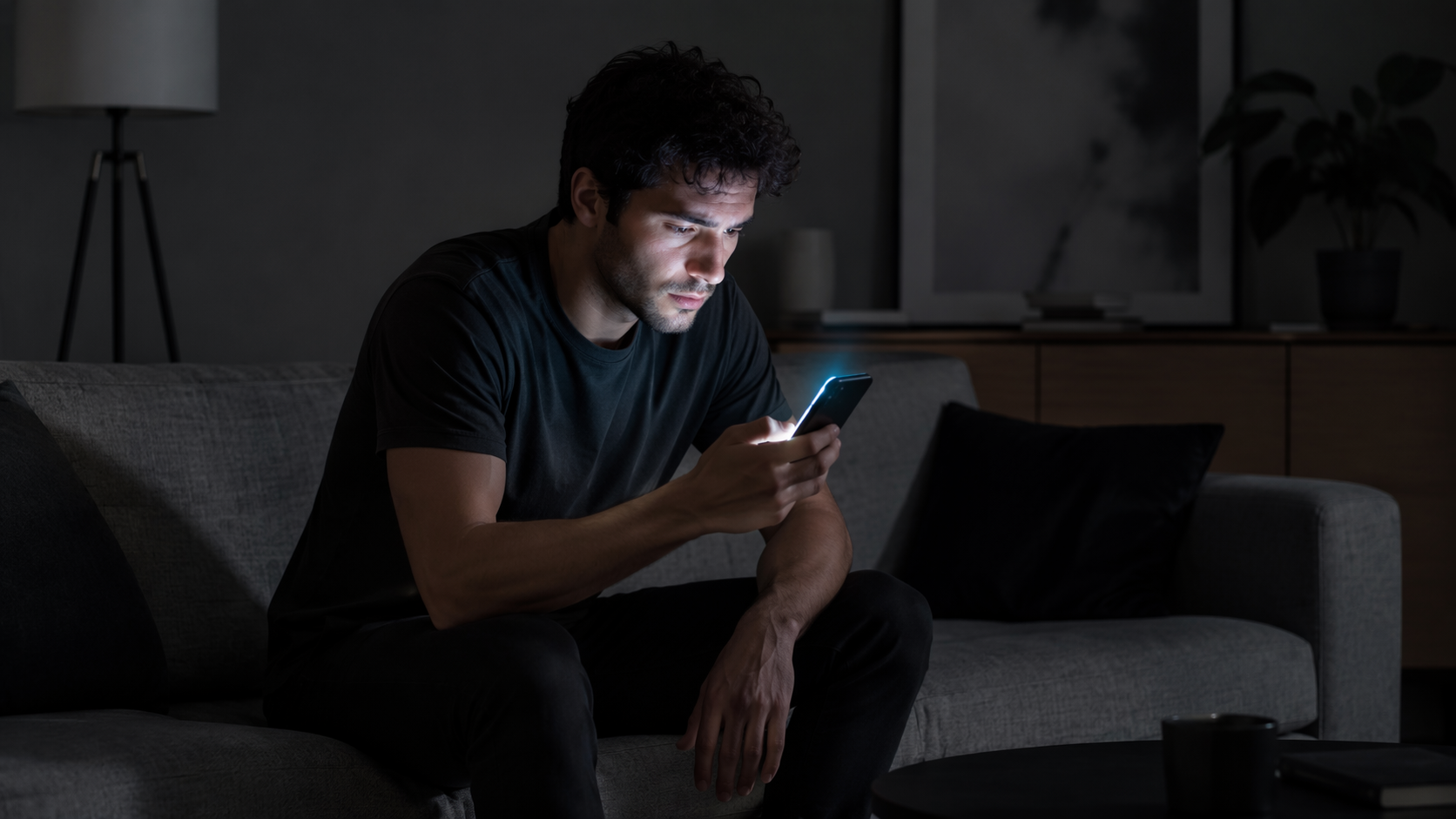
The prevalence signals are early, and they should be treated that way, but they are no longer trivial. In Match's 2025 Singles in America study, 26% of U.S. singles said they use AI in dating, a 333% year-over-year increase, and Norton reported that 60% of dating app users believed they had encountered AI-written conversations.[1][2] Those numbers do not establish incidence or clinical harm on their own. They do show why clinicians are now hearing about this kind of deception often enough to pay attention.
What the literature already supports
The strongest clinical parallel is not novelty but betrayal trauma. Coluccia and colleagues' scoping review of online romance deception describes a "double whammy": the loss of the perceived relationship and the collapse of trust in one's own judgment.[3] The reactions they synthesize are familiar to anyone who has seen this kind of injury in intake rooms: shame, self-blame, grief, anxiety, depression, and PTSD-like symptoms. Some victims used especially forceful language, including "emotional rape," which speaks less to rhetoric than to the felt violation of consent and intimacy.[3]
The same review also notes associations with female gender, middle age, higher neuroticism, and romantic idealization.[3] Those are correlates, not a diagnosis and not a moral profile. They can help explain exposure and vulnerability, but they do not tell a clinician who is "the kind of person" who gets deceived.

How it reads in clinic
In assessment, the useful question is not whether the app conversation was fully human or partly machine-generated. It is whether the discovery was followed by intrusion, avoidance, compulsive checking, sleep disruption, depressed mood, anxiety, shame, self-doubt, or a marked loss of functioning. That pattern fits better with betrayal trauma and attachment injury than with ordinary dating disappointment, because the wound is carried in two places at once: the bond itself and the patient's confidence in their own ability to read another person.
That clinical stance matters because patients often arrive feeling foolish for having trusted. The work is usually not to prove that the betrayal "counts"; it is to help the patient recognize that the injury is real, coherent, and psychologically legible.
Why deception can be easier to miss
Perpetrator studies help explain the mechanics, even if they do not define the syndrome. Campbell and Parker found that online romance deceivers scored higher on narcissism and impression management, lower on conscientiousness, and reported less guilt online.[4] Those traits do not map neatly onto every chatfishing case, but they help explain why some conversations feel smooth, flattering, and believable long enough to deepen attachment before doubt catches up.
Earlier romance-scam work also suggests that victims are not a random cluster of the naive; situational vulnerability, attachment needs, and relationship context matter.[5] That is one reason clinicians should avoid turning chatfishing into a caricature of gullibility. The person was not merely duped by a clever app. They were responding to a social script built around reciprocity, attention, and hope.
Why the term still needs restraint
The label itself is still unsettled. Some writers use chatfishing for AI-assisted replies, others for full delegation of the conversation, and others for AI-generated profiles. That matters because the deceptive act is not always the same, even when the emotional aftermath looks similar. A commissioned survey can signal that AI has entered dating behavior; it cannot by itself establish a clinical epidemic or settle the definition.
The current evidence base is therefore narrower than the public conversation. Most of what can be said with confidence comes from older online deception and romance-scam literature, not from controlled studies of AI-generated chat deception as its own clinical phenomenon. Even so, the harm pattern is already recognizable enough to matter in practice. Clinicians can name betrayal, validate grief, assess trauma symptoms, and use established attachment and trauma frameworks without pretending the field has already reached a final taxonomy.
References
- Singles in America 2025 — Match Media Room, 2025-06-10
- AI Use in Dating Jumps 333% — Psychology Today, 2025
- The psychological consequences of online romance deception: a scoping review — PMC, 2020
- Catfishing: Exploring the Individual Predictors — Springer, 2022
- Romance scam victim profiles — Cyberpsychology, Behavior, and Social Networking, 2016
Comments
Join the discussion with an anonymous comment.