
The phrase “AI chip stocks impact on healthcare technology” can sound like an invitation to rank tickers. For health systems, that is the wrong doorway. The more useful question is what chip-company competition is making technically and economically possible inside hospitals, research labs, imaging suites, EHR environments, and medical devices.
A procurement committee that treats “AI chips” as one interchangeable category is already in trouble. A pathology foundation model, a radiology triage model, an EHR-adjacent summarization tool, a surgical robot, and a continuous glucose monitor do not ask the same thing of silicon. Some workloads are limited by memory. Some are limited by inference cost. Some need the software ecosystem more than the raw accelerator. Some cannot tolerate a round trip to a cloud service at all.
That is why the competitive landscape around NVIDIA, AMD, Intel, and custom ASIC suppliers matters to healthcare technology. Not because hospitals should behave like semiconductor investors, but because capital markets are making visible which compute strategies may be available, supported, and priced aggressively enough to survive past pilot projects.

Market attention is a signal, not a deployment plan
The infrastructure layer has become too large to ignore. Mordor Intelligence values the semiconductor applications in healthcare market at $9.26 billion in 2026 and projects it to reach $15.79 billion by 2031, with edge AI inference and sub-28nm designs identified as fast-growing segments in that market frame.[1] That does not prove any specific clinical model works. It does show that healthcare is now part of the semiconductor demand story, rather than a niche downstream buyer of generic compute.
The stock-market evidence should be handled with even more care. Quartz reported a sharp Q2 2026 rally in several chip names, including Micron, Intel, and AMD, and described roughly $2 trillion in combined market capitalization added during that period.[2] That snapshot is useful only as context: investors are treating AI infrastructure demand as broader than hyperscale cloud. It is not evidence that a hospital should standardize on one vendor, nor that a clinical AI budget should follow a quarterly stock chart.
Clinical adoption will be constrained by a different set of gates: FDA-cleared use cases, integration with imaging and EHR workflows, local IT capacity, latency, reimbursement, model monitoring, and the ability to pay for inference at scale. Imaging is the most immediate terrain because it already has a large authorized-device base. Innolitics counted more than 1,300 cumulative FDA-authorized AI-enabled imaging devices as of late 2025, with 295 cleared in 2025 alone and radiology accounting for about 80% of approvals.[3]
The chip layer is not one layer
A useful healthcare AI infrastructure plan starts by separating workloads before selecting silicon. The boundaries are not perfect, and many real deployments use multiple architectures. Still, the distinctions matter enough to change the purchase.
| Healthcare workload | Primary compute constraint | Architecture that tends to matter most | Procurement question |
|---|---|---|---|
| Whole-slide pathology, multimodal foundation models, drug discovery training | High-bandwidth memory, GPU scale, software ecosystem | High-end GPUs and mature accelerator software | Can the model fit, train, and be maintained without fragmenting the research stack? |
| Radiology AI inference, image reconstruction, triage, segmentation | Throughput, latency, device integration, software support | GPUs, data-center accelerators, and embedded systems | Will inference remain affordable once the pilot becomes routine clinical volume? |
| EHR-adjacent AI, clinical documentation support, operational models | CPU performance, data-center integration, certification, governance | Server CPUs plus accelerators where needed | Does the compute plan fit the existing EHR environment and security model? |
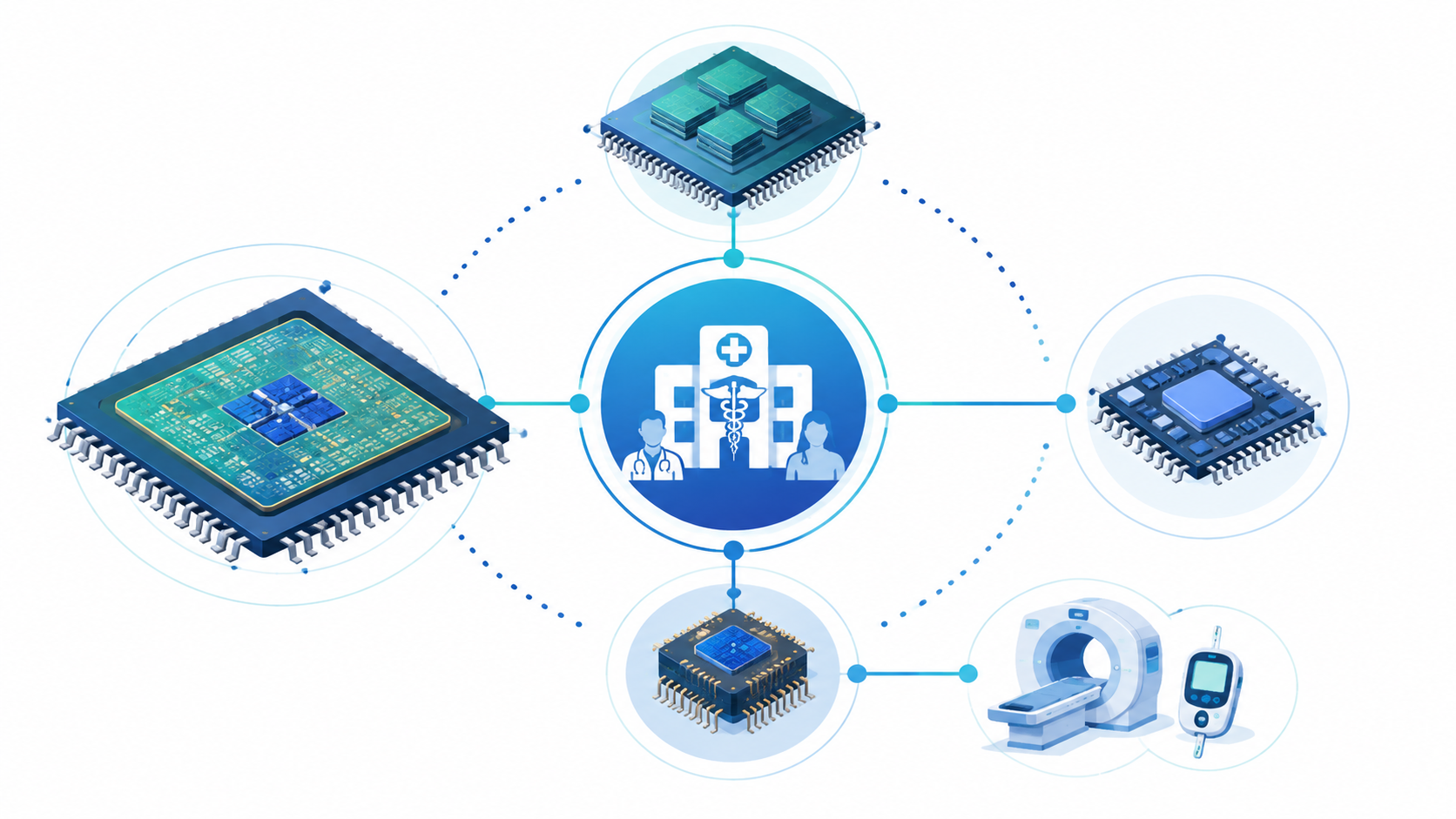
| Bedside devices, surgical robotics, wearables, continuous monitors | Power, reliability, size, latency, always-on operation | Edge AI chips and custom ASICs | Does the silicon change the device’s clinical performance or only its benchmark score? |
NVIDIA’s advantage is not just the GPU
NVIDIA receives the most attention in healthcare AI infrastructure because it has more than accelerator hardware. Its position rests on the combination of GPUs, CUDA, healthcare-specific platforms, developer familiarity, and partnerships that place its compute close to clinical and research workflows.
CUDA is the least glamorous part of the story and one of the most important. Arc Compute cites more than 4 million CUDA developers, a scale that helps explain why research code, imaging pipelines, and AI tooling often assume NVIDIA hardware before procurement has even started.[4] A CIO may see a GPU line item; the informatics team inherits the software ecosystem around it.
In healthcare, that ecosystem is not abstract. NVIDIA positions Clara for medical imaging, MONAI for imaging AI workflows, BioNeMo for drug discovery, and Holoscan for medical devices and sensor-processing applications.[5] Arc Compute reports more than 8 million MONAI downloads and notes deployment across more than 15,000 clinical devices through Siemens Healthineers.[4] Those figures do not say that every deployment is clinically transformative. They do show that NVIDIA’s healthcare footprint is no longer confined to research clusters.
The memory profile of newer GPUs is where the discussion becomes operational. The Blackwell B200 is described with 192GB of HBM3e memory, or 2.4 times the H100 memory level cited by Arc Compute.[4] That kind of memory threshold matters for large medical images and multimodal models because splitting data across devices can add complexity, slow experimentation, or force lower-resolution compromises. In pathology, where whole-slide images can be enormous, the question is not simply whether a model can run. It is whether the model can use clinically meaningful resolution without turning the infrastructure plan into a workaround.
Pharma infrastructure makes the same point from a different angle. Roche announced in March 2026 that it was building an AI factory with more than 3,500 NVIDIA Blackwell GPUs, described by Roche as the largest announced GPU deployment in the pharmaceutical industry.[6] That is not a hospital deployment pattern. It is evidence that at the high end of drug discovery and biomedical model development, access to a particular GPU generation can become a gating factor for the scale of experimentation.
The clinical implication is not that every health system needs Blackwell-class infrastructure. Most do not. The implication is that “AI-ready” means different things depending on whether the organization intends to train foundation models, fine-tune imaging models, perform batch research inference, or serve bedside predictions. NVIDIA’s stack is most compelling when the workload benefits from memory, accelerator density, and a software ecosystem that researchers and vendors already know how to use.
AMD is pressure from memory and from the EHR side of the house
AMD’s healthcare relevance is not simply that it competes with NVIDIA. Its more practical significance is that it gives buyers another high-memory path for selected AI workloads while also remaining deeply relevant to the CPU infrastructure many hospitals already depend on.
AMD lists the Instinct MI300X with 192GB of HBM3 memory, compared with the H100’s 80GB figure cited in AMD’s healthcare materials.[7] For memory-bound workloads, that profile matters. A procurement team evaluating large imaging models, genomics-linked workloads, or local inference for larger models should not reduce the choice to brand familiarity. It should ask whether the workload is memory-constrained, whether the software stack supports the target model, and whether the organization can operate the hardware without creating a support burden.
AMD also points to EPYC CPUs certified for Epic EHR environments and cites 34.2 million global references per second in that context.[7] The EHR detail is easy to overlook because it is less dramatic than a foundation-model demo. It is also exactly where many health systems live. Clinical AI tied to documentation, operations, patient access, revenue-cycle workflows, and EHR-adjacent analytics may be constrained less by exotic GPU training and more by data-center architecture, CPU performance, certification, and integration discipline.
AMD’s embedded portfolio also points toward bedside inference. Its Ryzen AI Embedded positioning is relevant where AI must run closer to the device or clinical environment rather than in a remote cluster.[7] That does not automatically make it the right choice for every monitor, cart, or imaging system. It does mean health systems should stop treating edge inference as an afterthought in contracts that are written only around cloud capacity.
Intel’s strongest healthcare argument is economic realism
Intel’s current AI-chip story is easier to underestimate because it is less associated with the most visible frontier-model training stacks. But health systems do not only buy frontier training. They run inference repeatedly, under budget pressure, inside data centers that already have CPU-heavy operating models.
Computerworld reported Intel’s Gaudi 3 positioning at roughly $125,000 compared with NVIDIA solutions exceeding $300,000, with Intel emphasizing inference cost efficiency.[8] The exact comparison depends on configuration and workload, so it should not be read as a universal price-performance rule. It is still the right kind of pressure for healthcare: inference economics can decide whether an AI model moves from a controlled pilot to routine use.
Consider a hypothetical hospital that pilots an imaging model on a small set of scanners and then tries to expand it across an enterprise. During the pilot, a high per-study inference cost can hide inside an innovation budget. At enterprise scale, the cost shows up in operating expense, support queues, GPU scheduling, latency complaints, and model-governance meetings. If a lower-cost accelerator can meet the latency, accuracy, security, and integration requirements, it may matter more than having the most fashionable training platform.
Intel also frames Xeon 6 around data-center AI and has announced a $20 billion Ohio fab investment for domestic AI chip production.[8] Domestic fabrication capacity is not a hospital feature in the way dose reduction or latency is. But supply-chain resilience has become part of infrastructure planning, and it belongs in the conversation when organizations are making multi-year compute commitments.
Imaging is where accelerator choices meet clinical throughput first
The FDA clearance pattern helps explain why imaging absorbs so much attention from chip companies. Radiology has a large base of authorized AI devices, and imaging workloads are compute-heavy in ways that infrastructure teams can observe: reconstruction time, triage latency, scanner throughput, image-transfer bottlenecks, and post-processing queues.[3]
NVIDIA’s collaboration with GE HealthCare on autonomous diagnostic imaging is one signal that accelerator vendors are embedding themselves earlier in the imaging stack, not merely selling cards to data centers.[9] The same pattern appears in NVIDIA’s disclosed partnerships with Medtronic around surgical robotics using NVIDIA IGX Thor and with Johnson & Johnson MedTech, where compute is tied to device and procedural environments rather than generic IT.[5]
For imaging leaders, the evaluation should stay close to workflow. A reconstruction improvement that frees scanner time has a different financial and clinical meaning from a research segmentation model that runs overnight. A triage model that must return results in the reading workflow has a different architecture profile from a batch analytics model used for retrospective quality review. The accelerator choice matters only after the clinical timing requirement is clear.
Custom ASICs change the device, not just the data center
The GPU narrative can become too large. Some of the most clinically direct chip-level effects appear in custom silicon designed for a particular device class. Here the question is not how many models can be trained in a cluster. It is whether a chip changes radiation dose, scan time, battery life, portability, or always-on sensing.
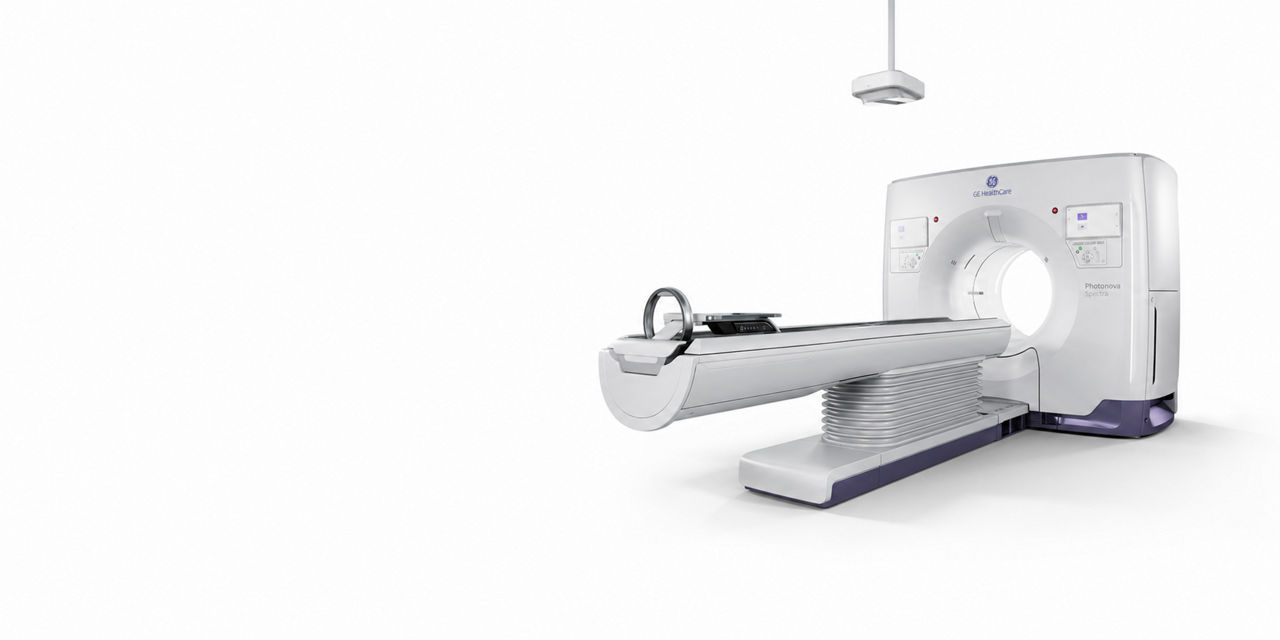
GE HealthCare’s Photonova CT example is useful because the silicon is tied to clinical parameters. Arc Compute describes the Photonova system as integrating a custom 7nm ASIC that halves radiation dose and cuts scan time by 35%.[4] Those are not abstract benchmark claims. Dose and scan time affect patient exposure, throughput, scheduling, and the economic case for a modality.
GlobalFoundries offers another kind of edge case. The company says its 22FDX platform powers more than 300 million continuous glucose monitors and frames custom chips as enabling ultra-portable, AI-enabled medical devices.[10] A continuous monitor cannot depend on the same assumptions as a cloud-hosted model. It needs low power, reliability, small form factor, and dependable sensing over ordinary patient life.
This is the part of the chip landscape that should make healthcare buyers most careful with language. A custom ASIC in a scanner or wearable is not a substitute for a research GPU cluster. A GPU cluster is not a substitute for custom edge silicon inside a regulated device. Both may be “AI chips” in a market story, but they belong to different procurement conversations and different clinical risk models.
What competition changes for adoption timelines
Competition among AI chip companies can accelerate healthcare AI adoption, but not evenly. It is most likely to shorten timelines where the technical bottleneck is already known and the clinical workflow is already receptive. Imaging inference, drug discovery infrastructure, EHR-adjacent compute, and device-level edge AI sit in different parts of that adoption curve.
In drug discovery and biomedical research, larger GPU deployments can expand experimentation and model scale, as the Roche Blackwell buildout suggests.[6] In radiology, a mature authorized-device base creates a more immediate path for infrastructure decisions to affect clinical operations.[3] In EHR environments, CPU certification and integration may matter as much as accelerator choice.[7] In portable and implant-adjacent devices, custom silicon may determine whether AI can be present at all without unacceptable power or reliability tradeoffs.[10]
The competitive pressure also changes vendor negotiations. A health system that can articulate its workload has more leverage than one asking for an “AI platform.” For example:
- If the roadmap depends on native-resolution pathology models or multimodal model development, memory capacity, accelerator interconnect, and software ecosystem should be evaluated before price alone.
- If the roadmap depends on enterprise imaging inference, the key questions are throughput, latency, integration with PACS and reading workflows, and per-study operating cost.
- If the roadmap depends on EHR-adjacent AI, the architecture conversation should include certified CPU infrastructure, data governance, security, and how inference will be monitored inside existing clinical systems.
- If the roadmap depends on bedside, wearable, or procedural devices, edge reliability, power draw, and regulatory device integration matter more than data-center benchmark leadership.
This also means health systems should be wary of claims that collapse adoption and effectiveness. A vendor partnership signals embedding. A clearance count signals regulatory activity. A GPU deployment signals infrastructure scale. None of those facts, by itself, proves better outcomes across a health system. The useful work is connecting each claim to the workload it actually supports.
The planning question to ask before buying compute
A practical AI infrastructure discussion can start with four questions:
- Is the organization training, fine-tuning, or only running inference?
- Does the workload fail first because of memory, latency, throughput, software support, power, or integration?
- Will the model run in a research cluster, enterprise data center, cloud environment, scanner, bedside device, or wearable?
- Who pays when the pilot becomes routine volume: research, radiology, IT, the device program, or the service line?
Those questions do more for healthcare technology planning than a ticker ranking. NVIDIA’s strength is clearest where software ecosystem, GPU scale, and high-memory acceleration set the ceiling. AMD creates practical pressure in memory-bound acceleration and EHR-adjacent infrastructure. Intel’s argument becomes stronger where inference cost and data-center efficiency determine whether deployment can scale. Custom ASICs occupy a separate and clinically consequential layer, where silicon can alter device performance directly.
Chip competition is expanding the clinical option set. It is also making the wrong purchase easier to justify with the right buzzwords. Health systems do not need to predict the winning stock. They do need to know whether their near-term AI roadmap depends on high-memory training, scalable inference, EHR-adjacent CPUs, or custom edge silicon, because overpaying for the wrong kind of compute and underbuilding for the desired model are both expensive ways to learn the same lesson.
References
- Semiconductor Applications in Healthcare Market — Mordor Intelligence
- Micron, Intel, AMD Q2 2026 rally — Quartz
- 2025 Year in Review: AI/ML Medical Device Clearances — Innolitics
- GPU Infrastructure for Medical Imaging AI 2026 Guide — Arc Compute
- NVIDIA Healthcare — NVIDIA
- Roche builds AI factory with NVIDIA — Roche, March 2026
- AMD Healthcare Solutions — AMD
- AMD and Intel take on Nvidia with new AI chips and pricing strategies — Computerworld
- NVIDIA and GE HealthCare Collaborate to Advance the Development of Autonomous Diagnostic Imaging With Physical AI — NVIDIA Newsroom
- How GlobalFoundries is powering the rise of ultra-portable AI-enabled medical devices, one custom chip at a time — GlobalFoundries
Comments
Join the discussion with an anonymous comment.