
The public wants a cleaner answer than clinicians can honestly give. In a 2024 Harvard Gazette discussion of aging politicians and cognitive tests, Brody Magid cited polling in which 75% of voters supported cognitive testing for aging politicians.[1] In June 2025, a House amendment from Rep. Marie Gluesenkamp Perez that would have required cognitive acuity testing for certain congressional leaders was rejected.[2] Around the same time, neuropsychologists were watching a different problem unfold: the casual conversion of video clips, verbal slips, and campaign moments into confident remote diagnoses. Reilly’s 2024 review of the U.S. election cycle called out how easily neuropsychology and politics collide when public observation is treated as clinical examination.[3]
That is the uneasy entrance point for cognitive assessments for age-related decline in public figures. The question is not whether television panels can diagnose a president, judge, senator, or executive. They cannot. Professional ethics, including the Goldwater Rule boundary discussed in this literature, exist for a reason: diagnosis without examination, consent, adequate data, and role clarity is not a clinical act.[3] But stopping there is also too easy. Public-facing competence can persist long after the kind of subtle decline that matters in a neuropsychological evaluation has begun to appear.
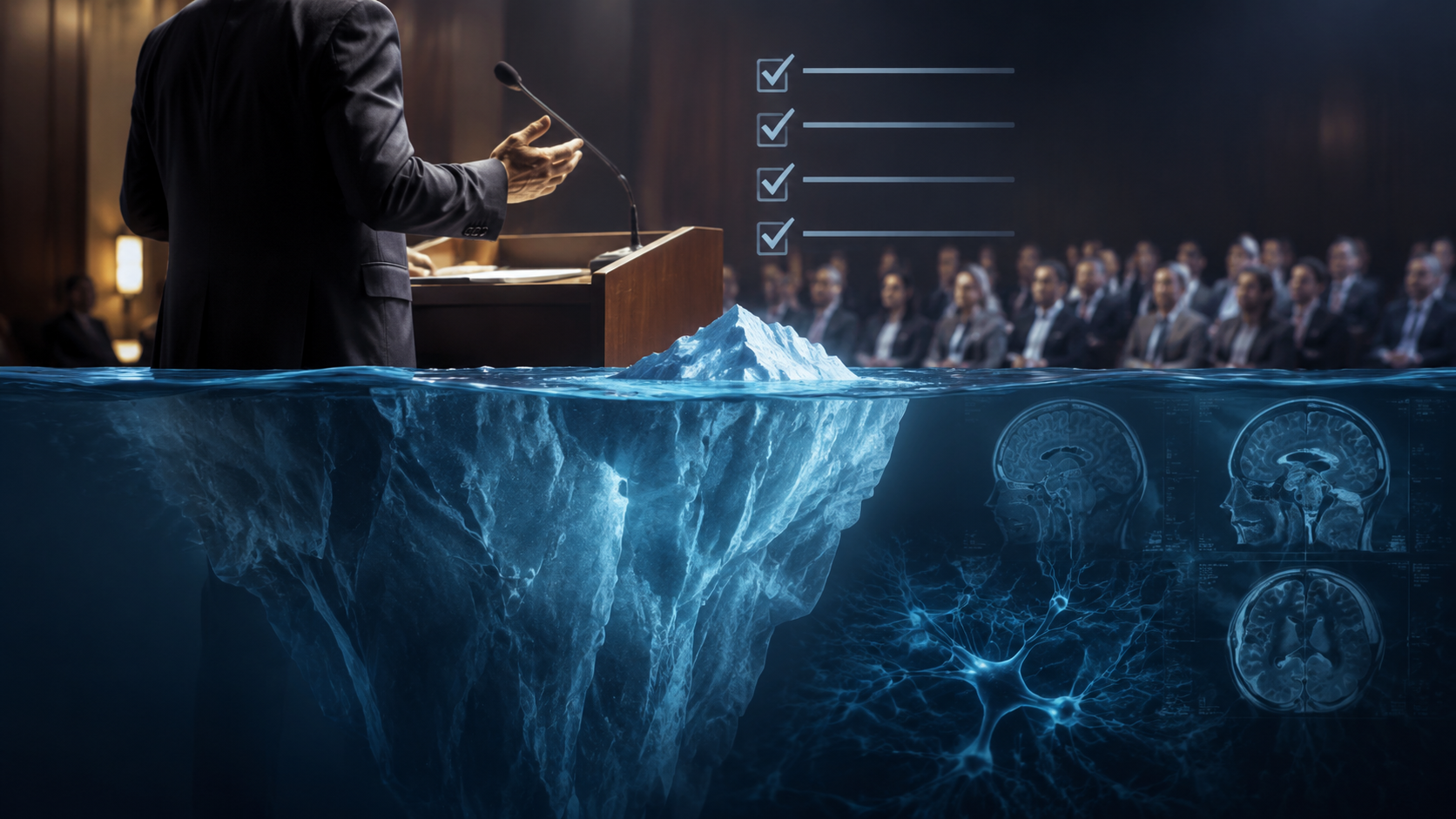
This is where the best-known screens, including the MoCA and MMSE, become both useful and easy to overinterpret. They are not useless tools. They are brief screens designed to flag concern, not comprehensive measures of whether a high-functioning older adult can still manage complex, changing, high-stakes work. A normal score can be reassuring in the right context. It can also be thin evidence when staff, family, or colleagues are describing new inflexibility, reduced judgment, slowed adaptation, or a narrower repertoire of coping strategies.
Why a normal screen can be least revealing in the people who look best
High-cognitive-reserve patients are the uncomfortable test case for brief cognitive screening. They may have more education, more practiced verbal fluency, more occupational rehearsal, and better strategies for filling gaps. They can tell a polished story, stay socially charming, use familiar phrases effectively, and perform well enough on a brief office screen to look intact. That same person may struggle when routines break, when competing information must be integrated, when speed matters, or when a trusted aide is no longer quietly scaffolding the day.
Stern’s work on cognitive reserve gives this problem a biological and clinical frame. Higher cognitive reserve is associated with reduced dementia risk, with an approximately 46% reduction in risk drawn from meta-analytic work, yet reserve can also delay overt symptoms until underlying disease burden is more advanced. Once the threshold is crossed, decline may appear steeper because compensation has been masking functional loss.[4]
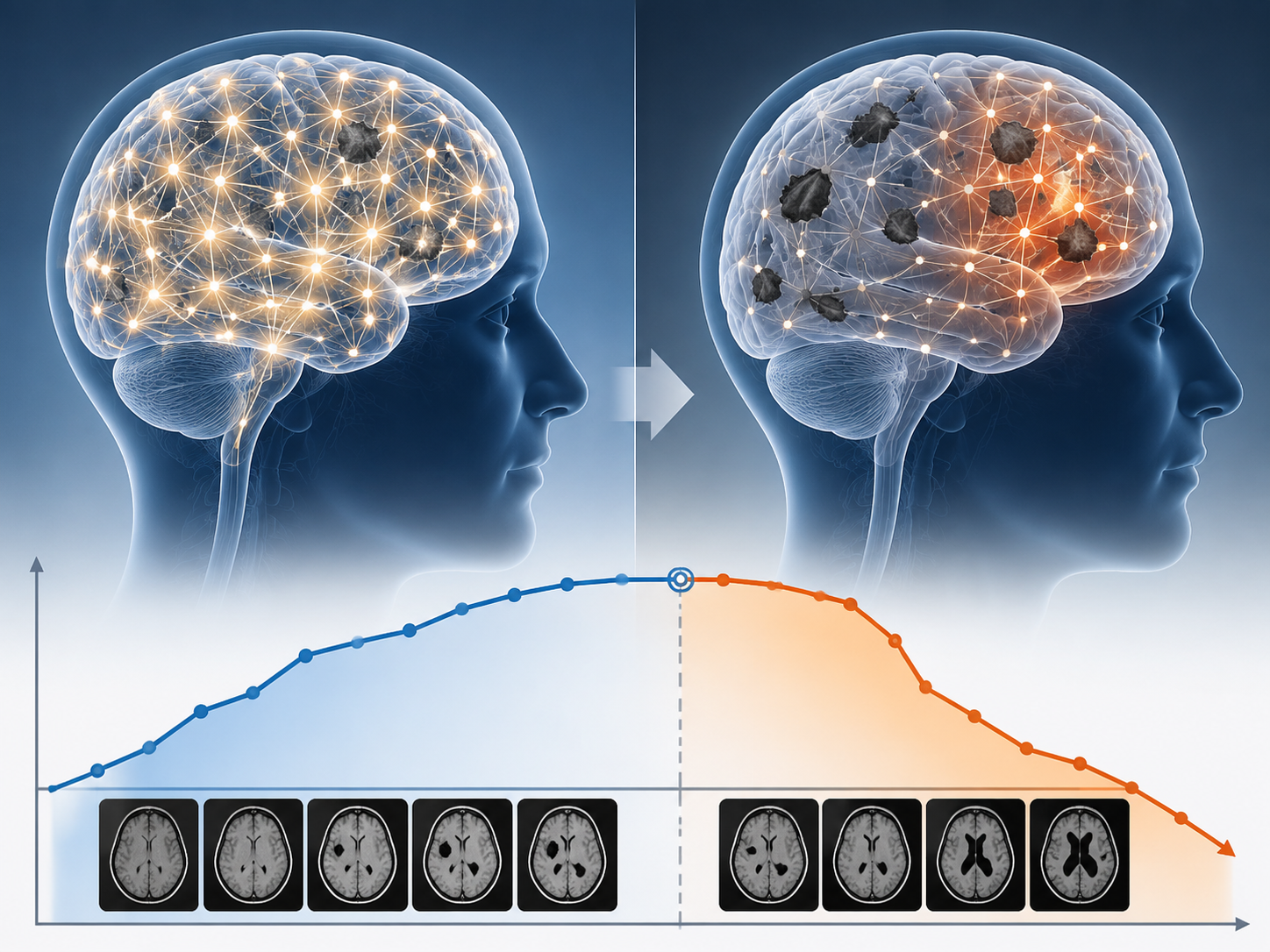
For a retired patient living quietly, that delayed visibility is already a clinical challenge. For a public figure, it becomes a systems problem. The visible job may contain a great deal of repetition: speeches, committee rituals, familiar interviews, ceremonial duties, predictable legal or executive formats. Those performances may not stress the same capacities that decline first. Executive flexibility, processing speed, divided attention, error monitoring, and learning under novelty are not always exposed by a fluent answer at a podium.
MoCA and MMSE scores are also shaped by the assumptions built into their design and norms. The research base summarized in the brief notes concerns about coaching vulnerability, cultural bias, and normative samples that do not fully represent highly educated, high-performing populations.[5] The Harvard discussion likewise emphasized that cognitive tests require interpretation rather than headline treatment.[1] A person who knows the structure of a screening exam, has taken similar tests before, or has lifelong strengths in language and test-taking may not be the person in whom a brief cutoff score carries the most weight.
The practical mistake is treating a screen as if it answered a longitudinal question. “Did this person pass today?” is not the same as “Has this person changed from their own prior level?” A clinician hearing credible reports of new disorganization, reduced inhibition, unusual dependence on notes, or inability to recover from interruptions should not let a normal brief score end the inquiry. The next step is not a public declaration of impairment. It is a better assessment question.
The gap AI tools are trying to fill
AI-powered cognitive assessment is appealing because it can measure signals that are difficult for a clinician to quantify during a short visit. It can count pauses, track response timing, model speech features, compare motor patterns, or record performance across an instrumented task. That does not make it diagnostic. It may make screening less dependent on the examiner’s impression and less vulnerable to the polished surface that high-reserve patients can maintain.
| Signal type | What it measures | Best clinical use | Main caution |
|---|---|---|---|
| Speech analysis | Acoustic and linguistic changes such as pitch, jitter, shimmer, formants, part-of-speech ratios, information units, and lexical diversity | Flagging subtle language, fluency, and speech-production changes that may not be obvious in conversation | Performance may vary by language, culture, recording quality, education, and sample size |
| Digital cognitive tests | Instrumented task performance, including response accuracy, timing, navigation, and interaction patterns | Adding objective process data to screening rather than relying only on total score cutoffs | Vendor claims, FDA clearance, deployment scale, and independent clinical validity are not the same thing |
| Gait analysis | Motor-cognitive patterns captured through walking, including accelerometer and gyroscope signals | Passive or low-burden screening when mobility data are available | High sensitivity can come with modest specificity, so false positives remain important |
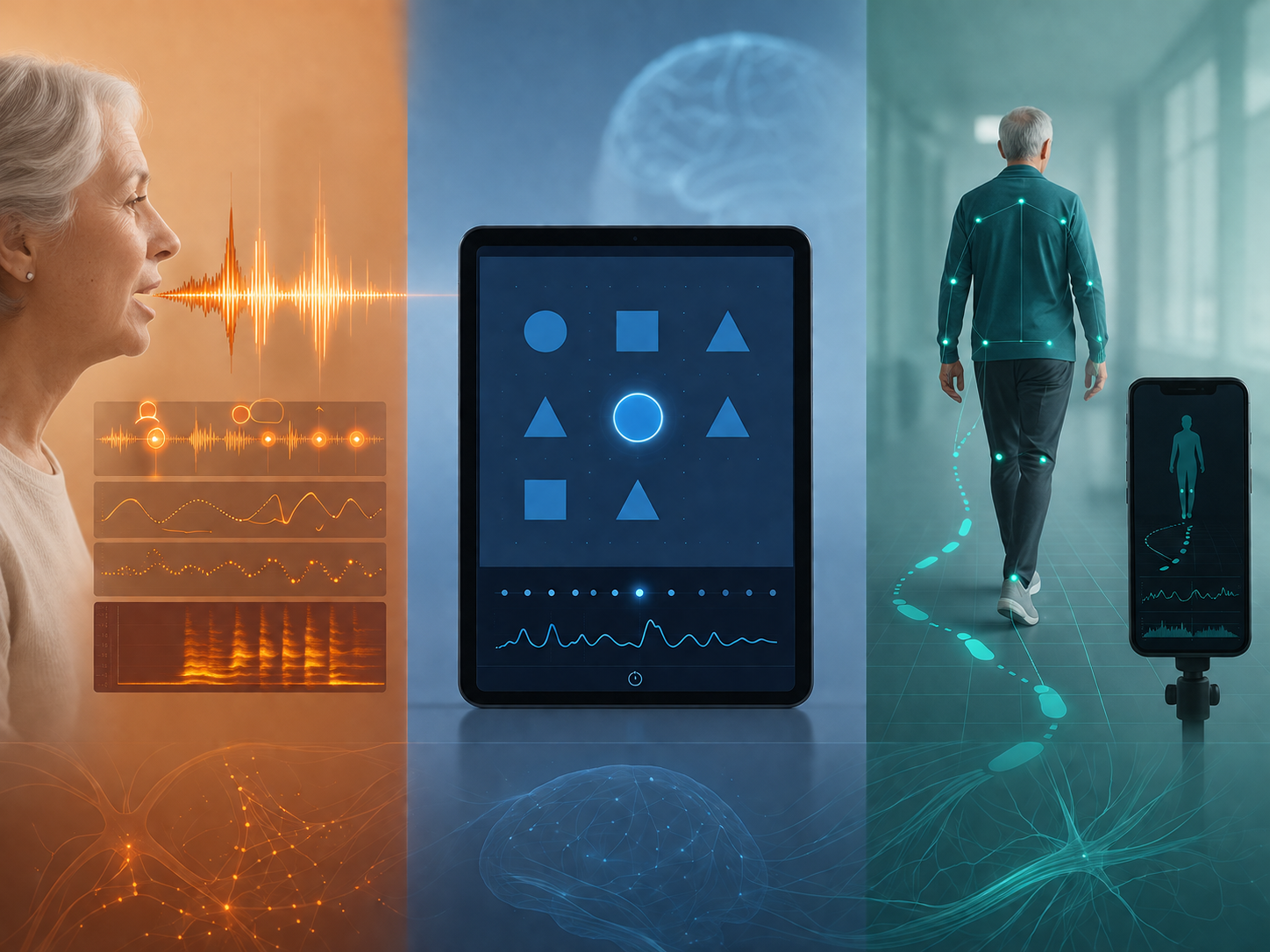
The useful comparison is not “AI versus the doctor.” It is whether a given tool adds a measurable signal to a screening workflow: something earlier, more repeatable, or more sensitive to within-person change than a brief paper screen. A public figure does not need a machine-generated verdict. An institution may need a defensible reason to recommend formal neuropsychological evaluation without pretending that rumors, clips, or partisan impressions are evidence.
Speech analysis: more than counting verbal mistakes
Speech is attractive because public figures generate a great deal of it. But the clinically interesting work is not the amateur search for gaffes. AI speech models can examine acoustic features such as pitch, jitter, shimmer, and formants, along with linguistic features such as part-of-speech ratios, information units, and lexical diversity. These measures may pick up changes in planning, retrieval, fluency, and information density before the change is obvious to a listener.
The evidence is promising, but its weight varies. Washington State University reported a 2026 pilot in which an AI model using speech samples reached 75% accuracy with a K-nearest neighbors classifier, but the study included only 12 participants.[6] That is a signal worth watching, not a foundation for institutional policy by itself. Small pilots are especially vulnerable to overfitting, sample idiosyncrasy, recording conditions, and optimism that disappears in broader validation.
A 2024 Frontiers in Public Health study gives a stronger example, though still with boundaries. In a Chinese cohort of 92 older adults, automatic speech analysis using a support vector machine reached 80.77% accuracy and an AUC of 0.922 for detecting cognitive decline.[7] That is more substantial than a 12-person pilot, but it is not automatically portable to U.S. public figures who may be multilingual, heavily coached, professionally scripted, or drawn from educational and cultural backgrounds not represented in the cohort.
The National Institute on Aging has also described AI speech analysis that predicted progression from mild cognitive impairment to Alzheimer’s disease with over 78% accuracy.[8] That endpoint is different from declaring whether a currently serving public figure is impaired. It is about risk prediction in a studied clinical context. The distinction matters: progression models can help triage follow-up, but they do not replace a diagnosis, and they do not answer role-specific fitness questions by themselves.
For screening workflows, speech analysis is most useful when it is longitudinal and consented. A single speech clip can be distorted by fatigue, illness, medication effects, stress, teleprompter failure, hearing problems, or context. Repeated structured samples, collected under comparable conditions and interpreted with demographic and linguistic caution, are more clinically meaningful than viral excerpts.
Digital cognitive tests: process data, not just a prettier screen
Digital cognitive tests can improve on legacy screens when they capture how a person performs, not merely whether the final answer was correct. Response latency, variability, hesitation, sequencing, correction patterns, and performance under divided demands may carry information that a total score hides. This is especially relevant for high-reserve individuals who can still arrive at the right answer, but more slowly, with more effort, or through a narrowed strategy.
The commercial landscape is already moving faster than the clinical literature. A 2025 Being Patient review described Cognivue Clarity as FDA-cleared, with company-reported deployment of 4,000 devices in U.S. clinics and approximately 100,000 administrations per year. The same report described Cognivue’s CARM algorithm as predicting beta-amyloid plaque presence.[9] Those figures show adoption and product positioning. They do not, by themselves, prove independent effectiveness across every population in which a clinic or institution might use the tool.
The same review described Linus Health’s DCTclock and Core Cognitive Evaluation as detecting mild cognitive impairment earlier than MMSE and being used in large-scale research involving tens of thousands of people. It also described Altoida’s augmented-reality approach as collecting 350,000 data points over 10 to 12 minutes through simulated real-world tasks.[9] These are exactly the kinds of process-rich measures that may be better suited to high-functioning older adults than a brief paper screen. They also raise the usual questions: What population validated the model? What language and education effects remain? How often does the test create false reassurance or unnecessary alarm? What does the clinician receive besides a risk score?
FDA clearance deserves careful wording. It may establish that a device met a regulatory pathway for a defined use. It does not mean the device can diagnose dementia, determine capacity, or settle whether an elected or appointed official can perform a role. In clinical use, these tools belong upstream: they can support a referral, sharpen monitoring, or justify comprehensive testing when ordinary screens remain normal despite credible concern.
Gait analysis: the motor signal clinicians should not ignore
Gait has always carried cognitive information, even if it is easy to treat it as separate from cognition. Walking is not just a musculoskeletal act. It draws on attention, planning, balance, sensory integration, and executive control, particularly in older adults and under dual-task conditions. AI-based gait analysis is therefore not a gimmick; it is a way to quantify a motor-cognitive marker that clinicians have long observed less formally.
Obuchi and colleagues reported a 2024 study using AI detection of cognitive impairment from walking data in 879 older adults, analyzing 12,302 strides. The model reached an AUC of 0.833, with sensitivity of 0.961 and specificity of 0.643. The study found that one comfortable walking stride captured from a smartphone’s embedded accelerometer and gyroscope was sufficient for the model.[10]
Those numbers point in two directions at once. The high sensitivity is attractive for screening because missed impairment is costly. The modest specificity means positive flags would still need follow-up; otherwise, gait changes from arthritis, vestibular disease, neuropathy, frailty, medication effects, or temporary illness could be mistaken for cognitive concern. In a public-figure context, the risk of misinterpretation is obvious. A gait signal can justify a closer clinical look. It cannot identify the cause of the signal on its own.
Why public figures keep forcing the question
The question recurs because public roles often lack a graceful middle state between private concern and public crisis. Historical discussions commonly invoke cases such as Ronald Reagan, Woodrow Wilson, and, more recently, Judge Pauline Newman, who was suspended at age 96 after a dispute involving fitness and judicial duties.[11] These examples should not be used as shortcuts for diagnosing other people. Their value is structural: institutions often have to respond before there is a neat, universally accepted clinical endpoint.
Aging leaders are also surrounded by compensatory systems. Staff filter schedules, prepare briefing materials, manage transitions, repeat information, absorb delays, and protect the principal from unpredictable demands. Some of that is normal executive support. Some of it can mask decline. A brief cognitive screen administered in a calm setting may not reproduce the demands that caused concern in the first place.
This is why a single mandated pass-fail test is clinically tempting and clinically crude. It promises neutrality, but it may simply move the argument to the cutoff score. A high-reserve person may pass despite meaningful decline. Another person may be penalized by language, education, disability, anxiety, sensory impairment, or cultural mismatch. If the assessment is not tied to a defined clinical pathway, it becomes theater with a score sheet.
What a responsible screening workflow would actually do
A defensible workflow begins by separating screening from diagnosis. Screening asks whether there is enough signal to justify more evaluation. Diagnosis asks what condition, if any, explains the findings. Role-capacity decisions ask a still different question: whether the person can safely and reliably perform specified duties. Confusing these three steps is how a useful tool becomes a political weapon or a false reassurance device.
- Use MoCA, MMSE, or another brief screen as an entry point, not a final answer, especially when the person has high education, high verbal skill, or strong occupational routines.
- Add objective signals only when the collection method is consented, standardized, and appropriate for the person’s language, culture, sensory status, and motor health.
- Interpret AI outputs as risk flags or monitoring data, not as diagnoses of dementia, Alzheimer’s disease, incapacity, or unfitness for office.
- Escalate abnormal or concerning longitudinal findings to comprehensive neuropsychological evaluation, with collateral history and medical review.
- Document uncertainty explicitly, including false-positive risks, false-negative risks, and whether the validation population resembles the person being assessed.
For clinicians and health systems, the most important feature of AI-powered assessment may be repeatability. A public figure’s baseline is often more informative than a population cutoff. If a digital cognitive task, speech measure, or gait signal changes over time under comparable conditions, the clinician has a more concrete reason to ask for full testing. If the signal is stable, that does not prove intact cognition, but it may reduce reliance on anecdote.
Equity cannot be an afterthought. Speech models trained in one language community may not behave the same way in another. Digital tasks can import education and technology-access effects. Gait models can confuse neurologic, orthopedic, and environmental influences unless interpreted clinically. “Objective” is not the same as unbiased. A model can measure something consistently and still measure the wrong thing for a particular person.
The better endpoint is therefore modest but useful: AI-powered cognitive assessments can make the screening stage more sensitive, more quantitative, and less dependent on public performance. They can help clinicians notice when a normal MoCA or MMSE is not enough. They can support a referral for comprehensive neuropsychological evaluation. They cannot ethically pronounce a public figure impaired from afar, and they should not be sold as automated fitness tests for public life.
References
- Should aging politicians take cognitive tests? Harvard Gazette, 2024.
- Gluesenkamp Perez Proposes Cognitive Acuity Amendment. Office of Rep. Marie Gluesenkamp Perez, June 2025.
- Neuropsychology and Politics Collide in the 2024 US Presidential Election. Journal of Neuropsychology, 2024.
- Cognitive reserve in ageing and Alzheimer's disease. Lancet Neurology, 2012.
- Brief neuropsychological test scores are associated with Alzheimer's disease biomarkers in cognitively normal older adults. NACC database, 2012.
- AI Shows Promise for Detecting Early Cognitive Decline through Speech Samples. WSU Medicine, March 2026.
- Automatic speech analysis for detecting cognitive decline of older adults. Frontiers in Public Health, 2024.
- AI speech analysis predicted progression of cognitive impairment to Alzheimer's with over 78% accuracy. National Institute on Aging, 2023.
- Digital Cognitive Tests: How AI Tools Could Transform Alzheimer's Diagnosis and Care. Being Patient, 2025.
- Artificial intelligence detection of cognitive impairment in older adults during walking. PMC, 2024.
- Is Your Political Candidate Showing Early Signs of Dementia? Psychology Today, 2024.
Comments
Join the discussion with an anonymous comment.