
The practical promise of AI in pharmaceutical plant safety and emergency response is not that a camera suddenly becomes intelligent. It is that a camera already watching a filling corridor, solvent handling area, warehouse lane, gowning transition, or restricted utility space can start flagging the conditions people usually discover too late: a forklift moving too close to a pedestrian, a missing face shield, a worker crossing into a controlled zone, or a near-miss that would otherwise become a few disputed sentences in an investigation file.
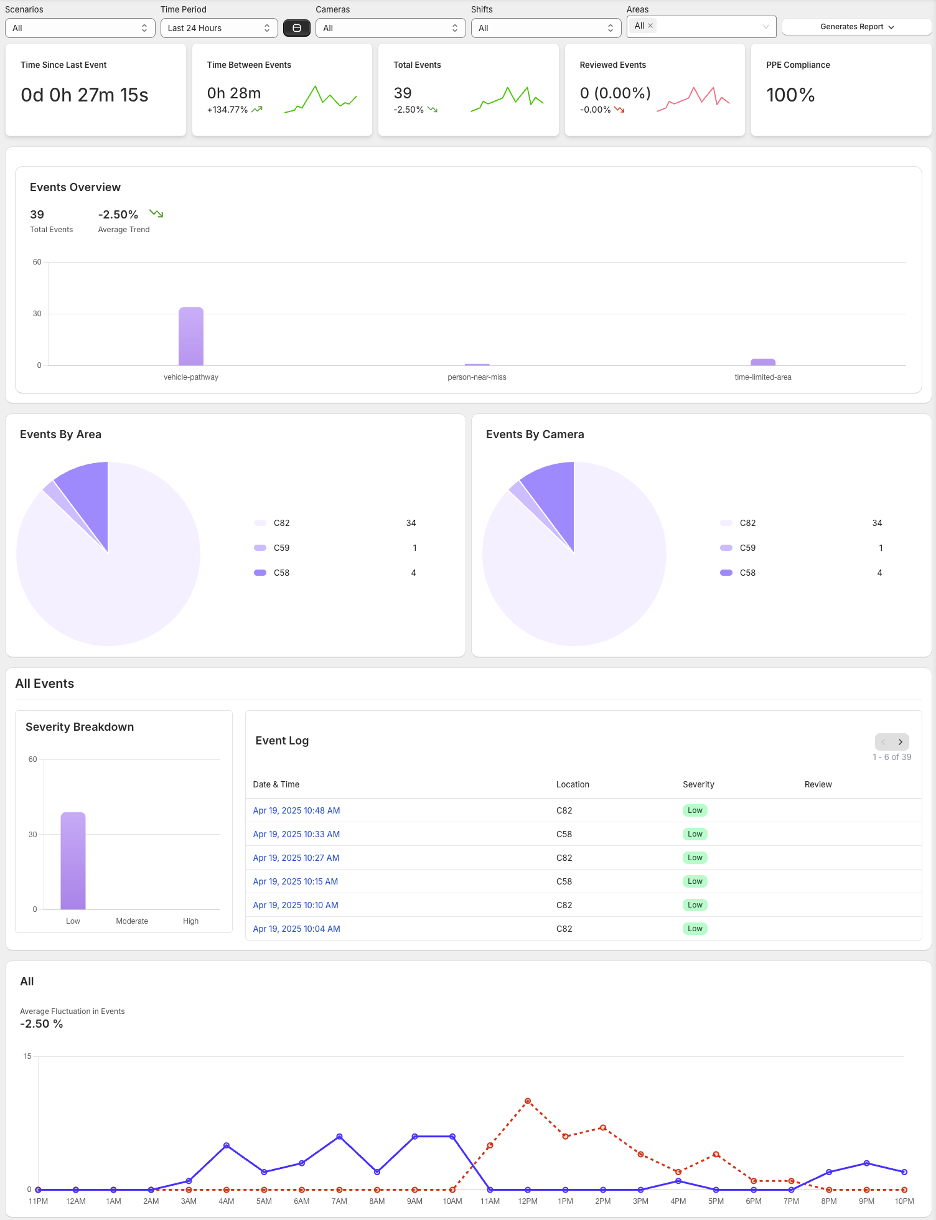
That is why the most useful evidence starts outside pharma, in a chemical plant case study from Visionify. The company reports that its AI safety system, deployed on existing CCTV, reduced near-miss incidents by 48%, made hazard response 65% faster, and automatically logged and reviewed more than 90% of incidents. The same case says the system detected more than 50 safety scenarios, including PPE compliance, restricted area access, and forklift proximity hazards, with deployment completed in about two weeks and 87% of surveyed employees saying they felt safer after the system was introduced.[1]
Those are strong operating numbers. They are also vendor-published numbers from a chemical facility, not independently replicated results from a GMP pharmaceutical plant. That distinction matters less because the technology is exotic and more because pharma has different consequences when a safety alert becomes a record, a deviation input, a training trigger, or evidence during an audit.
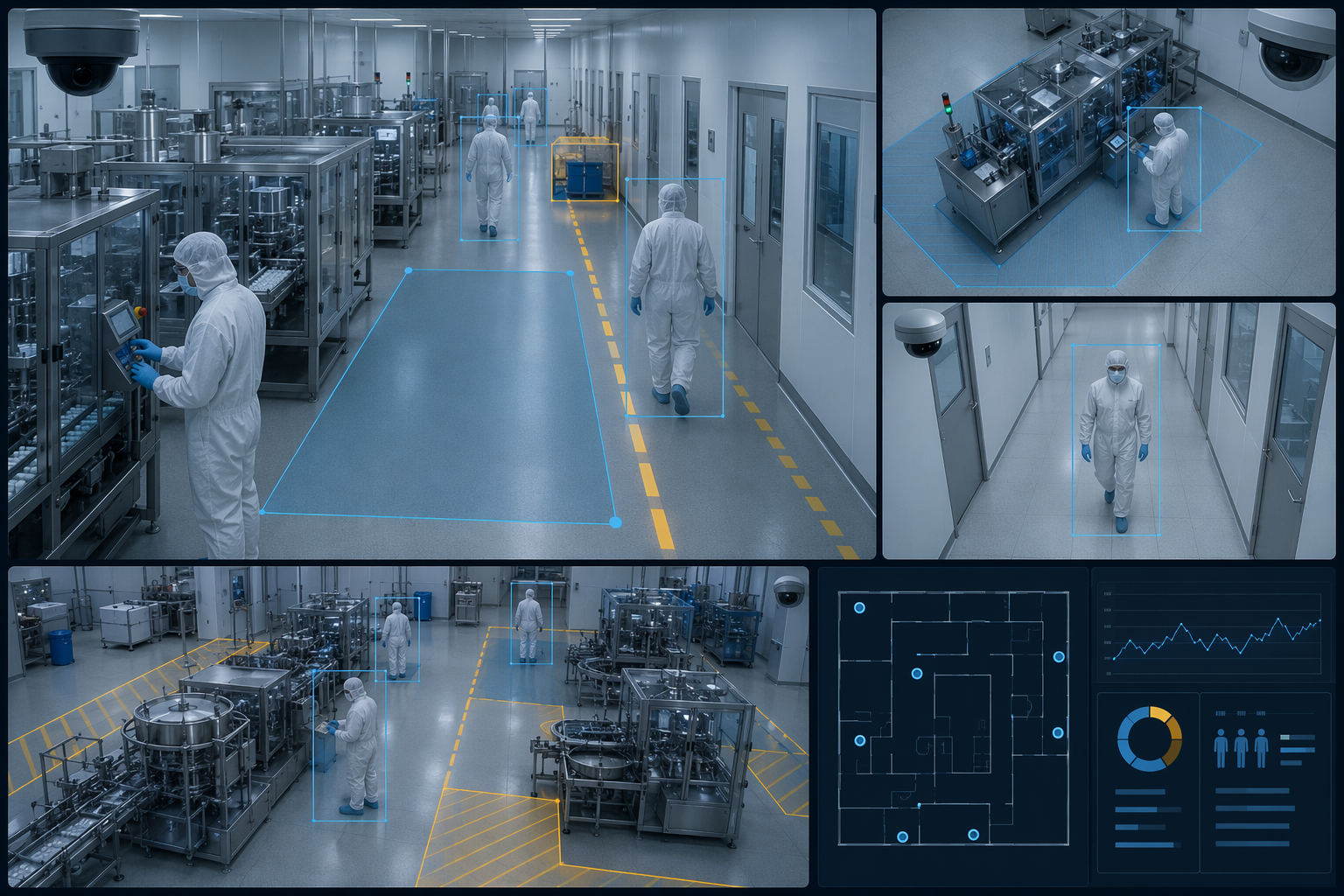
What the chemical plant case shows
The Visionify case is useful because it does not depend only on a broad claim that AI improves safety. It names work conditions that plant teams recognize immediately. PPE detection is a visible control. Restricted area monitoring is a real access problem. Forklift proximity hazards are a common industrial risk. Near-miss logging is often where the administrative burden begins after the event is already over.
The more interesting figure is not only the 48% reduction in near-misses. It is the combination of faster response and automated logging. A hazard detected 65% faster changes who has time to intervene. More than 90% automated incident logging changes what the supervisor, EHS reviewer, or QA observer has to reconstruct after the fact.[1] In a plant where investigations depend on memory, radio calls, partial CCTV review, and shift notes, cleaner first capture is not a cosmetic improvement.
The deployment model also deserves attention. Retrofitting analytics onto existing CCTV is different from asking a facility to replace its camera network, add new wearable devices, or install a separate sensor layer across every production area. If the initial claim is understood as a pilot-zone deployment on existing cameras, the roughly two-week timeline is plausible enough to evaluate.[1] It should not be read as a promise that a validated pharmaceutical site can move from purchase order to full GMP-controlled rollout in two weeks.
| Published outcome | What it measures | How far pharma can carry it |
|---|---|---|
| 48% reduction in near-miss incidents | Change in reported near-miss events in the Visionify chemical plant case | Useful benchmark for pilot evaluation, not a guaranteed pharma outcome |
| 65% faster hazard response | Speed of response after AI hazard detection | Relevant to EHS escalation design and supervisor intervention |
| More than 90% automated incident logging and review | How much incident capture moved from manual logging to automated workflow | Highly relevant if logs meet data integrity, audit trail, and review controls |
| About two-week deployment on existing CCTV | Vendor-reported implementation period for the case environment | Best interpreted as pilot-zone setup, not full GMP validation |
| 87% of surveyed employees felt safer | Worker attitude after implementation | Adoption signal, not proof of safety effectiveness |
Employee sentiment belongs in the evidence, but in the right place. If 87% of surveyed employees reported feeling safer, that helps answer whether workers treated the system as a useful safety layer rather than only as surveillance.[1] It does not prove that every camera expansion will be accepted, and it does not remove the need to define where cameras will not be used.
Safety monitoring is not the same as emergency response
Continuous safety monitoring has the clearer evidence base. PPE checks, restricted zone alerts, forklift proximity detection, and near-miss capture are all conditions a vision system can identify from routine video streams when cameras are positioned appropriately. The alert may be wrong, late, or poorly routed, but the monitored condition itself is specific.
Emergency response is narrower. Here the claim is not that computer vision replaces evacuation procedures, spill response plans, alarm systems, or trained responders. The credible claim is that video analytics can identify certain visible hazards sooner, push an alert into the right alarm or workflow channel, and preserve a timestamped event trail for the investigation that follows.
Surveily’s high-risk chemical facility case supports that narrower reading. The company reports a fourfold improvement in emergency response speed and an 83% reduction in unauthorized zone entries after integrating real-time video analytics with alarm systems.[2] The case is useful because it connects detection to escalation, not just dashboard visibility. It is thinner than the Visionify example on implementation detail, so it should be treated as supporting evidence rather than a complete pharma deployment model.
Some industry writing goes further. DartAI reports that AI vision systems can prevent 75% of workplace accidents and that predictive alerts can prevent 87% of catastrophic equipment failures in chemical industry projects.[3] Those figures may be directionally interesting, but the source does not provide traceable primary citations for each number. For a pharma EHS or QA budget discussion, they should not carry the same weight as a case with named deployment conditions and measured operational outputs.
The pharma translation problem
A pharmaceutical plant can borrow the safety logic from chemical manufacturing, but not the implementation assumptions. A system that watches for PPE, proximity hazards, and unauthorized entry in a chemical facility has to be reinterpreted inside GMP controls. The question is not simply whether the model can see a missing glove. It is whether the alert, record, review, and system change process can survive the same scrutiny as other controlled plant systems.
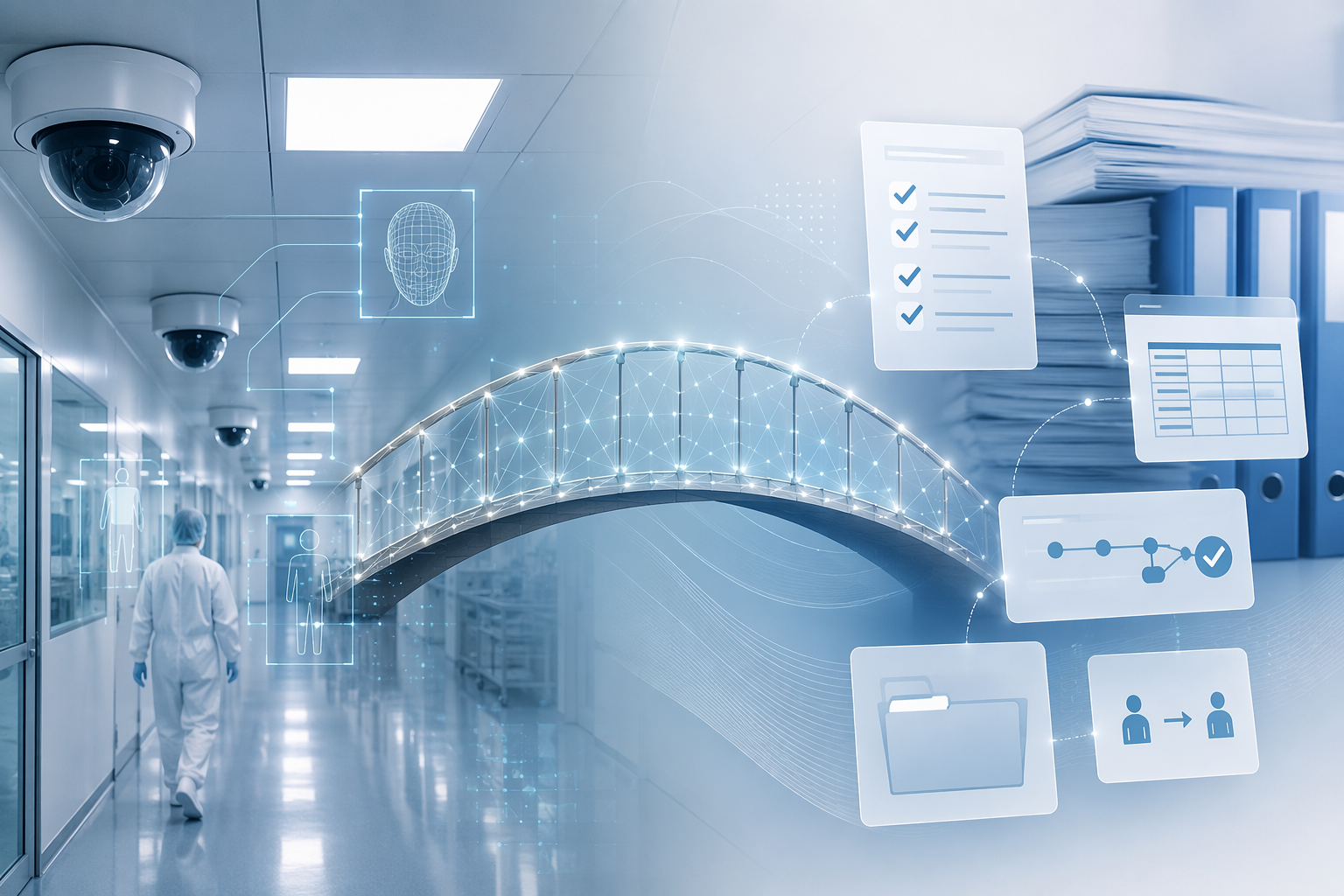
The regulatory frame is already broad enough to include these systems. Niazi’s 2025 review of AI and machine learning implementation in pharmaceutical GMP environments identifies FDA’s Emerging Technology Program, including ETP 2.0, as a route for early engagement on novel AI uses. The same review connects AI-enabled GMP systems to 21 CFR Part 11 expectations for electronic records, audit trails, and electronic signatures, while also noting OSHA obligations such as the general duty clause and standards related to PPE, HAZWOPER, and lockout/tagout.[4]
That does not make every safety camera a GMP system. It means the boundary has to be drawn deliberately. If an AI alert only tells a shift supervisor to check a warehouse aisle, the quality burden may be different from an alert that becomes part of a deviation record, batch-related investigation, or formal CAPA package. Once automated incident logs are used as controlled evidence, Part 11 questions stop being theoretical: who can edit the record, what is the audit trail, how is review documented, and when is an electronic signature required?
Camera placement and area classification come first
Before model validation, there is a simpler physical question: is the camera allowed to be there? In pharmaceutical manufacturing, camera hardware may need to match the room and hazard. Cleanrooms introduce sanitation, cleaning, mounting, and airflow concerns. Solvent areas or other hazardous locations may require appropriately classified equipment, such as ATEX or IECEx-rated cameras where relevant. A retrofit strategy is attractive only if the existing CCTV is suitable for the monitored area and the safety condition being detected.
Camera angle also changes the quality of the safety claim. A model cannot reliably detect a missing respirator if the camera sees only the back of the worker’s hood. It cannot enforce a restricted boundary if the line is hidden behind mobile equipment. Pilot zones should therefore be selected by the visibility of the risk, not by where camera coverage happens to be convenient.
Edge processing is usually the cleaner starting point
For a GMP facility, the choice between edge and cloud processing is not only an IT architecture decision. Sending production video to a cloud service can raise data integrity, confidentiality, access control, retention, and validation questions. Edge processing does not solve every issue, but it can reduce how much video leaves the site and can make the system boundary easier to describe during qualification.
A practical pilot can separate the video stream, the AI inference, the alert, and the controlled record. The site may decide that raw video remains under existing security retention rules, while validated event metadata enters an EHS or quality workflow. That design choice has to be written down before anyone claims that automated logging is audit-ready.
Model updates belong in change control
Computer vision systems are often sold with the promise that they improve over time. In GMP settings, improvement is not a free category. If the model changes, the validated state may change with it. A site needs to know whether updates alter detection thresholds, add new classes of events, change confidence scoring, affect false-positive rates, or modify alert routing.
That is where pharma discipline is useful rather than obstructive. The change record should identify what changed, why it changed, which safety scenarios are affected, how regression testing was performed, who approved the release, and whether SOPs or training materials need revision. If a vendor cannot describe its model update process in terms a validation lead can examine, the system is not ready for a controlled manufacturing environment.
What a defensible pilot should measure
A pharma pilot should not begin with “AI safety” as the use case. It should begin with a small number of CCTV-visible conditions that already create work for EHS, operations, or QA. The best candidates are specific enough to validate and consequential enough that faster detection matters.
- Forklift and pedestrian proximity in a warehouse or material movement corridor
- PPE compliance in a defined hazardous handling area
- Unauthorized entry into a restricted room, utility space, or safety exclusion zone
- Blocked emergency exits, eyewash stations, fire equipment, or safety showers where camera coverage is appropriate
- Visible spill, smoke, fallen-person, or abnormal movement alerts only where detection performance can be tested against realistic site conditions
The measurement plan should track more than whether the model generated alerts. For continuous monitoring, the useful measures include true alerts reviewed, false alerts dismissed, response time, repeat events by area, and the percentage of events with complete review records. For emergency-response support, the measures should include alert-to-notification time, notification-to-acknowledgment time, escalation path completion, and whether the event record was available for post-incident review.
This is where the Visionify numbers become a benchmark rather than a promise. A site may decide that a successful pilot does not need to reproduce a 48% near-miss reduction immediately. It may first need to show that alerts are accurate enough to be reviewed, that response times improve, that supervisors do not start ignoring the system, and that automated logs are complete enough to reduce investigation friction.[1]
Alert fatigue is a safety risk, not an interface problem
A bad AI vision deployment can make a plant less attentive. If every borderline posture, brief threshold crossing, or uncertain PPE frame becomes an alarm, the system trains people to dismiss it. That is not a dashboard defect. It is a safety design failure.
Tiered escalation is the usual remedy. A low-confidence or low-severity event may go to a dashboard queue. A repeated restricted-zone entry may notify a shift supervisor. A forklift proximity hazard may generate an immediate local alert. A visible emergency condition may route to the site’s alarm or emergency workflow. The routing should follow the consequence of delay, not the excitement of the technology.
Review ownership also has to be assigned. Someone must know which alerts require same-shift closure, which require EHS review, which can be trended weekly, and which must enter a quality process. If automated logging creates a larger backlog of unreviewed records, it has not made the plant more controlled.
Privacy boundaries need to be explicit
The worker acceptance signal in the Visionify case is encouraging, but it should not be used to flatten privacy concerns. Safety monitoring in a forklift aisle or hazardous handling zone is different from monitoring break rooms, restrooms, locker rooms, or other non-safety spaces. If a company wants workers to treat AI vision as a safety control, it has to say what the system detects, where it operates, who reviews alerts, how long records are retained, and what the system will not be used for.
The communication should be operational rather than inspirational. Workers do not need a lecture about digital transformation. They need to know whether the system is flagging missing PPE, zone entry, proximity risk, or emergency conditions; whether it identifies individuals; whether alerts affect discipline; and how false alerts are corrected.
Where AI vision fits in emergency response
In emergency response, computer vision should be treated as an earlier signal source, not as the response system itself. It may detect a visible spill, smoke, a person down, unauthorized presence in a danger zone, or a blocked emergency route. The emergency plan still depends on trained responders, evacuation procedures, containment controls, alarm integration, and command responsibility.
The Surveily case is relevant because it reports faster emergency response through integration with alarm systems, not merely faster visual detection.[2] For pharma, that connection is the hard part. A useful alert has to reach the person who can act, in the channel where they are expected to respond, with enough context to avoid a second round of verification that wastes the time the system supposedly saved.
Potent compound handling, sterile operations, and containment areas add another layer. A visible hazard may not be enough to define the response if opening a door, sending an untrained responder, or interrupting airflow could create a larger GMP or exposure problem. The AI system can accelerate detection, but the escalation tree still has to reflect the site’s containment and quality rules.
The procurement question
For pharma teams, the right buying question is not whether the vendor has AI. It is whether the vendor can support a controlled safety workflow. The system should be able to define each detection scenario, show how alerts are generated and routed, preserve event records with appropriate auditability, support review and closure, and explain how model or configuration changes are governed.
- Ask which published outcomes come from pharma GMP sites and which come from chemical or general industrial facilities.
- Ask whether deployment estimates refer to pilot zones, full-site rollout, or validated GMP implementation.
- Ask how automated logs meet audit trail, retention, review, and electronic signature expectations when used as controlled records.
- Ask how model updates, threshold changes, new detection classes, and configuration changes are documented and approved.
- Ask how the system prevents alert fatigue, routes high-severity events, and proves that alerts were acknowledged.
The credible conclusion is neither vendor triumph nor plant-floor refusal. AI computer vision is ready for serious pharma pilots in defined CCTV-monitored safety scenarios, especially where near-misses, PPE lapses, proximity hazards, unauthorized entry, or emergency escalation delays already create measurable risk. Comparable results will require treating the system as a validated, auditable, change-controlled component of plant safety operations, not as a camera analytics add-on.
References
- Case Study: From Reactive to Proactive Safety – How a Chemical Plant Streamlined Workplace Safety using AI — Visionify.ai
- AI-Driven Safety in a High-Risk Chemical Facility - Case Study — Surveily.com
- How Can AI Ensure Safety In Chemical Industry Projects: A Deep Dive Into Prevention-First Thinking — DartAI.com
- Regulatory Perspectives for AI/ML Implementation in Pharmaceutical GMP Environments — PMC, 2025
Comments
Join the discussion with an anonymous comment.