
The most useful way to think about AI in concussion detection and sports medicine is not as a single sideline test. It is a set of decision-support tools appearing at different points in care: detecting a possible concussion, monitoring head impacts and symptoms, estimating recovery trajectory, and modeling future risk. Those are not interchangeable jobs. A tool that helps decide whether a head CT is likely to be necessary is not answering the same question as a model that predicts prolonged symptoms or a mouthguard algorithm that filters true impacts from noise.
The best current map comes from a 2026 scoping review in the Journal of Science and Medicine in Sport that identified 55 studies and 29,887 total participants, with 80% of studies published from 2020 onward. The review grouped AI applications into detection and diagnosis, monitoring and surveillance, prognosis and recovery, and prevention or risk modeling. Detection and diagnosis accounted for 44% of studies, while monitoring and surveillance involved more than 15,000 athletes and prognosis or recovery studies included more than 6,000 athletes.[1]
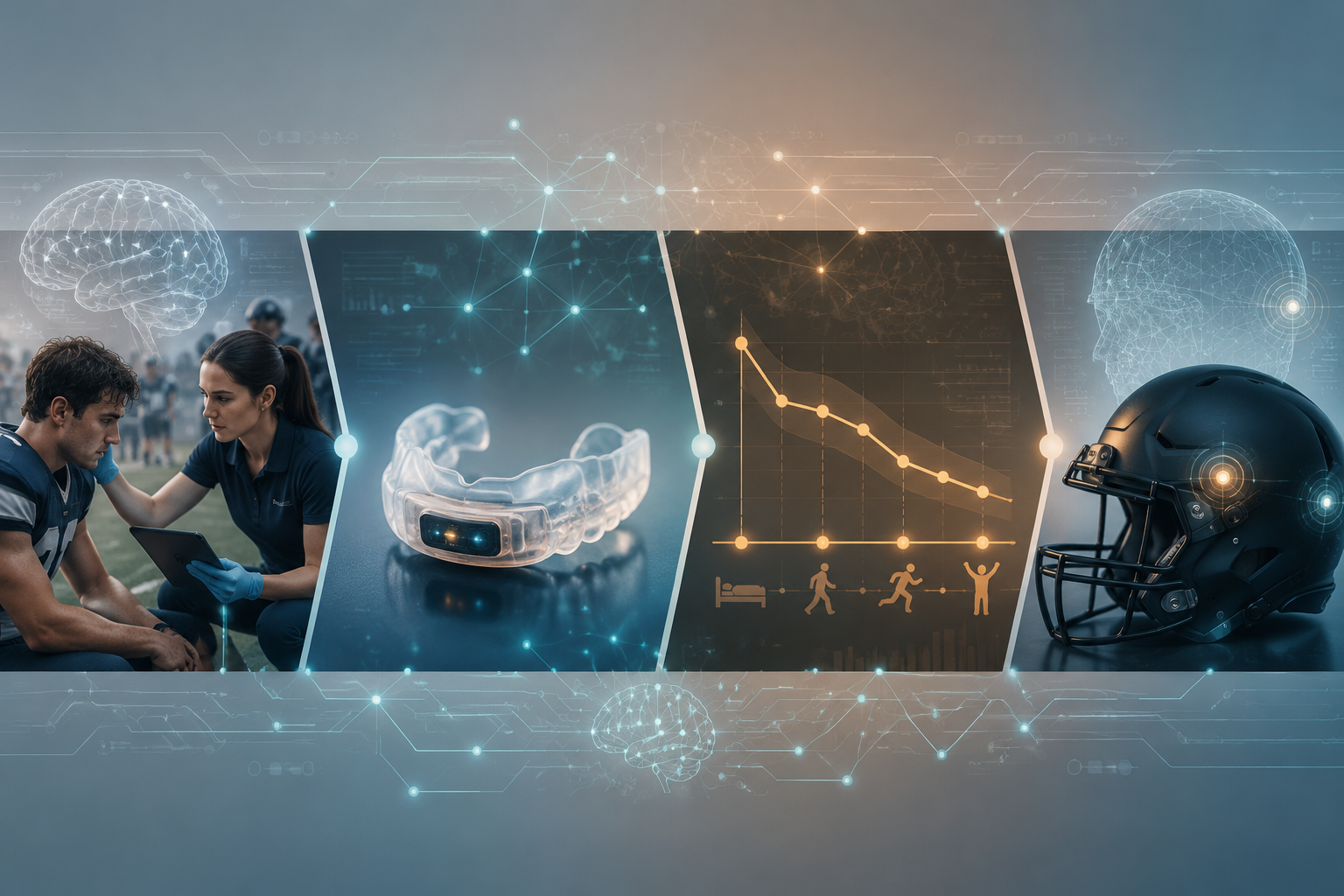
That distribution matters clinically. The evidence is not evenly mature across the pathway. Detection and diagnosis have the largest and most visible body of work, including EEG-based models reported at up to 94.4% accuracy and speech-based models above 90% accuracy in the scoping review. But the same review also flags the field’s uncomfortable sampling problem: among 41 human-participant studies with sex reported, female athletes made up 38% of participants, and pediatric participants made up only 6.7%.[1]
Those gaps are not academic footnotes. A model trained and tested mostly in adult or male cohorts may still be useful, but its performance should not be casually generalized to a girls’ soccer tournament, a pediatric emergency department, or a mixed-age community sports setting. The clinician on the sideline is not treating the average participant in a pooled review; they are deciding what to do with the athlete in front of them.
Where AI Is Closest to the Sideline Decision
Detection and diagnosis attract the most attention because they sit near the highest-pressure moment: the athlete looks composed, symptoms may be incomplete or underreported, and the athletic trainer has to decide whether this is a remove-from-play event, an emergency referral, or something to monitor closely. AI is appealing here because concussion assessment depends on subtle signals across cognition, eye movement, balance, symptoms, speech, and neurophysiology. It is also dangerous here if “aid” becomes “answer” in conversation.
EEG-based models are among the strongest examples of a measurable signal being turned into a clinically relevant index. In a JAMA Network Open validation study, a machine-learning brain electrical activity-based index was evaluated as an aid in diagnosing concussion among athletes, not as an independent diagnostic authority.[2] That distinction is the whole clinical point. Brain electrical activity can add objective information when symptoms and examination findings are messy, but it does not erase the need to assess mechanism, red flags, medication use, prior concussion history, vestibular findings, and the athlete’s evolving course.
BrainScope illustrates one practical version of that adjunct role. The company describes its platform as an AI/ML-enabled brain injury assessment technology with 10 FDA clearances, and BrainScope has been associated with an approximately 50% reduction in unnecessary head CTs.[3] That is a concrete workflow gain: fewer athletes or patients exposed to imaging they do not need, without pretending that the device itself performs the full neurologic evaluation.
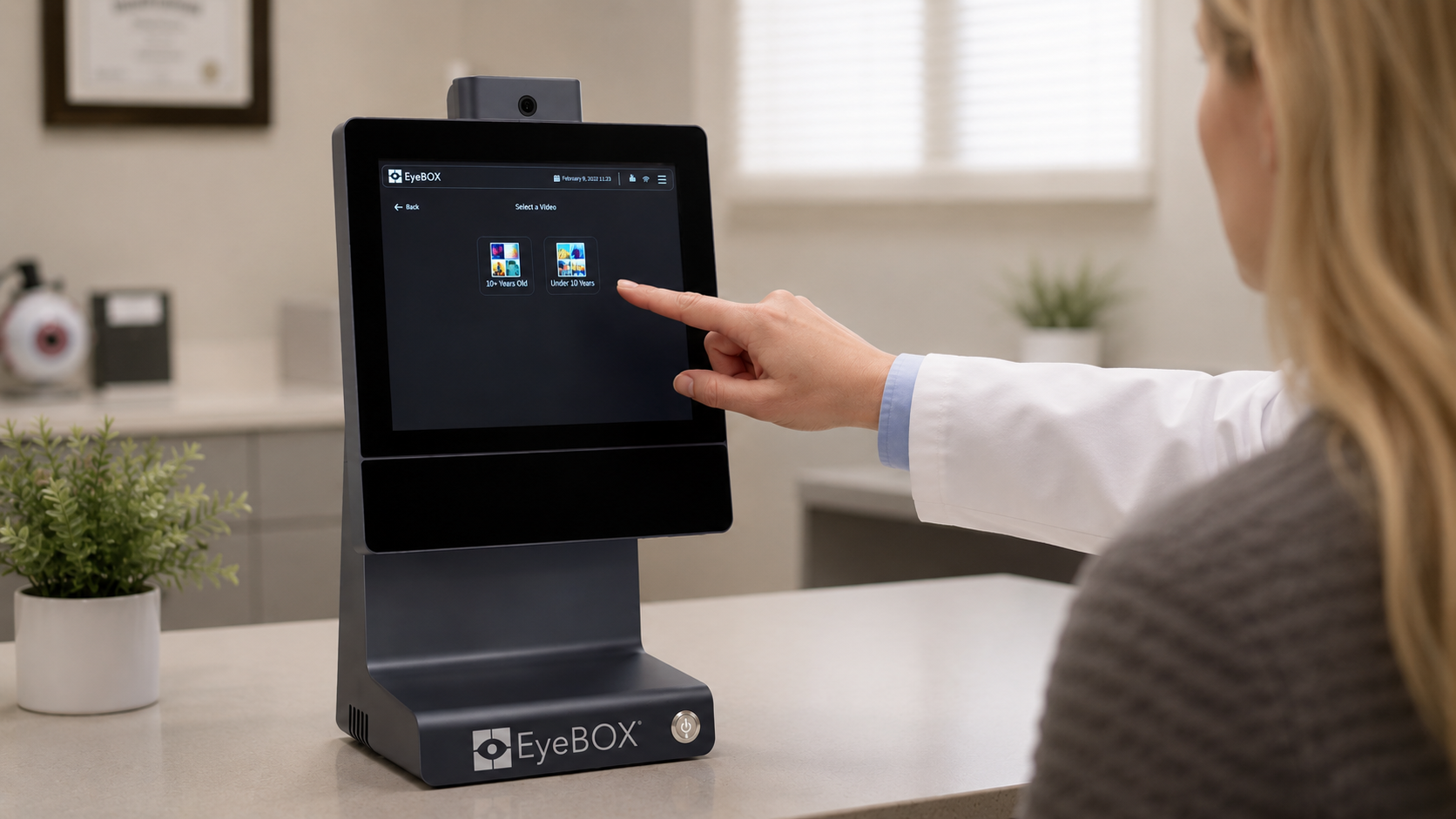
Eye-tracking tools ask a different question. They are less about electrical brain activity and more about whether oculomotor behavior contains a detectable concussion signal. Oculogica’s EyeBOX is described by the company as an FDA-cleared, non-invasive eye-tracking device for objective concussion assessment across ages 5 to 67, with six FDA clearances and 16 publications; SNAP is described as a 90-second sideline-oriented assessment.[4] Those age and setting boundaries are not marketing trivia. They define where the tool’s claim begins and where clinicians should slow down before extrapolating.
SyncThink’s EYE-SYNC occupies a related space, using mobile eye tracking to aid assessment of mild traumatic brain injury. MobiHealthNews reported that SyncThink received a second FDA clearance for an AI system to aid concussion diagnosis.[5] Again, the operative word is “aid.” Eye movement abnormalities can sharpen suspicion or support referral, but they do not settle the diagnosis by themselves, particularly when migraine, vestibular disorders, sleep deprivation, medications, or pre-existing visual problems may complicate interpretation.
HeadSafe’s Nurochek uses yet another signal strategy: EEG plus visual evoked potentials. The company describes a two-minute scan collecting more than 400,000 data points per scan and lists an intended age range of 12 to 44.[6] That combination is clinically interesting because it tries to compress neurophysiologic testing into a format that could fit sports workflows. It also shows why age range has to travel with any performance claim. A two-minute test is only helpful if the population, indication, and validation setting match the patient being assessed.
Speech-based models are attractive for similar reasons: speech can be captured quickly, repeated over time, and analyzed for changes that might not be obvious in a brief conversation. The scoping review reported speech-based models exceeding 90% accuracy.[1] That figure should be read as a promising research signal, not as permission to diagnose concussion from a voice sample in any athlete. Speech varies with language, fatigue, anxiety, intoxication, pain, sleep, and baseline neurodevelopmental differences. A good model may detect a pattern; a clinician still has to decide what the pattern means in context.
Traditional computerized neurocognitive testing also belongs in this conversation, including ImPACT, which is widely used in sport-related concussion workflows and identified in the research brief as FDA cleared. Its role is different from an acute EEG index or eye-tracking test. It is often most useful when interpreted against baseline or normative expectations, alongside symptoms and examination findings. The problem is familiar: poor sleep, effort, learning effects, ADHD, mood symptoms, and testing environment can all influence results. AI does not make those confounders disappear; it may help organize them.
The Detection Evidence Is Strongest, but Also Easiest to Overstate
Accuracy figures are useful only after several questions are answered: accuracy in whom, compared with what reference standard, at what time after injury, in what setting, and for what intended use. A model that performs well in a controlled research cohort may not perform the same way during a crowded tournament, after delayed symptom onset, or in an athlete with a prior vestibular disorder. External validation is the difference between a promising classifier and a tool that deserves confidence across sites.
The scoping review’s warnings are therefore central, not cautionary decoration. The field remains limited by heterogeneous study designs, retrospective and single-center evidence, limited external validation, and demographic imbalance.[1] No head-to-head comparison across FDA-cleared concussion-related devices resolves which tool performs best for a specific sideline, clinic, emergency department, or collegiate sports medicine program. For procurement, that is frustrating. For clinical care, it means the device question has to start with the decision it is meant to support.
| Clinical question | AI signal or tool type | What it can reasonably support | What it should not be treated as |
|---|---|---|---|
| Is this athlete showing objective findings consistent with concussion? | EEG, eye tracking, speech, neurocognitive testing | Adjunctive evidence during assessment | A standalone diagnosis |
| Does this patient need escalation, imaging consideration, or closer follow-up? | Brain electrical activity or multimodal assessment tools | Triage support when combined with clinical examination | A replacement for red-flag screening |
| Is recovery likely to be prolonged? | Clinical ML models, biomarker models, symptom and baseline data | Risk stratification and follow-up planning | A guaranteed return-to-play timetable |
| Which athletes may be at higher future injury risk? | Baseline profiling, biomechanical modeling, post-concussion risk models | Targeted prevention and monitoring hypotheses | A mature universal prevention system |
Monitoring and Surveillance: Better Signal Filtering, Not Automatic Clinical Meaning
Monitoring and surveillance studies cover a larger athlete base than many diagnostic studies, with more than 15,000 athletes represented in the scoping review’s summary of this domain.[1] AI-enabled instrumented mouthguards and video analytics are reported to outperform traditional threshold-based impact detection.[1] That is believable on workflow grounds: fixed acceleration thresholds have always been a blunt way to sort meaningful head impacts from sensor artifact, body contact, or equipment noise.
The clinical value is not that a mouthguard or video model can declare a concussion. It is that better filtering may help medical staff know which impacts deserve review, which athletes need a symptom check, and which patterns are accumulating over time. A cleaner alert stream matters because alert fatigue has consequences. If every hit looks urgent, the staff stops trusting the system; if subtle but important events are missed, the athlete carries the risk.
Surveillance data can also create a false sense of completeness. A player can sustain a concussion without a captured high-magnitude event, and a player can register repeated impacts without meeting clinical criteria for concussion. Impact data should prompt observation and assessment; it should not become a proxy diagnosis.
Prognosis Is Where AI Starts Answering the Harder Question
After the initial diagnosis, the practical question often shifts from “Is this a concussion?” to “How worried should we be about this recovery?” That is where prognosis and recovery models become clinically interesting. Return-to-play protocols can look orderly on paper, but athletes do not recover on schedule for the convenience of a bracket, a depth chart, or a clinic template.
One machine-learning study using clinical data reported that a CatBoost model predicted protracted recovery beyond 21 days with an AUC of 0.84 in males and 0.78 in females, outperforming traditional models with AUC values of 0.73 to 0.74 in a sample of 655 athletes.[7] That is a meaningful use case: not replacing the clinician’s judgment, but identifying athletes who may need earlier follow-up, vestibular therapy consideration, academic accommodations, or more conservative expectations.
A separate multivariate machine-learning approach reported a random forest model with 94.6% accuracy and an AUC of 0.96 for predicting more than five games missed, integrating demographics, injury history, MRI, and SCAT5 data in a cohort of 375 sportspeople.[8] The strength of that model is also its deployment problem. A sports medicine clinic without MRI data, standardized SCAT5 capture, or a similar case mix should not assume the same performance.
The CARE Consortium example complicates a common sideline intuition. University of Michigan researchers reported that, in data from about 3,200 athletes, concussion frequency and intensity had little impact on symptom progression, while baseline evaluation was the strongest predictor.[9] That does not mean impacts are irrelevant. It means a simple impact-dose story may miss the athlete-level factors that shape recovery. Baseline status, symptom profile, prior history, and individual vulnerability may carry more predictive weight than the visible violence of the hit.
Post-concussion risk does not stop at symptom resolution. University of Delaware researchers reported an AI-powered model that used more than 100 variables and achieved 95% accuracy in predicting lower-extremity musculoskeletal injury risk after concussion in college athletes, with risk persisting beyond initial return to play.[10] That result fits what many clinicians already watch for: reaction time, neuromuscular control, and confidence may lag behind symptom checklists. But the model remains a single-center result needing external validation before it can be treated as a general rule.
Biomarker approaches are also entering the prognosis conversation. Salivary RNA biomarkers have been reported with an AUROC of 0.86 for prolonged recovery prediction in early validation work.[11] The appeal is obvious: an objective biological signal could help stratify recovery risk. The limitation is equally important: early validation is not the same as broad clinical deployment across sports, ages, and care settings.
Prevention and Risk Modeling Are Still Earlier-Stage
Prevention is the most tempting domain to overpromise. Finite-element biomechanical models, baseline risk profiling, and AI-supported exposure analysis could eventually help identify risky mechanisms, equipment issues, training patterns, or athlete-specific vulnerabilities. The current evidence base is less developed than detection, monitoring, or prognosis.[1]
That does not make prevention modeling unimportant. It means the output should be treated as hypothesis-generating unless it has been validated in the setting where it will be used. A model that estimates tissue-level strain from reconstructed impacts may teach researchers something about mechanism. It does not automatically tell a high school athletic trainer which player will sustain the next concussion.
What Clinicians Should Ask Before Trusting the Output
The practical evaluation starts with intended use. Is the tool cleared or marketed to aid diagnosis, support triage, monitor impacts, predict recovery duration, or estimate future injury risk? A device can be clinically valuable inside one of those boundaries and inappropriate outside it. For broader evaluation of AI tools in practice, ClinicalMind’s framework on how to evaluate AI tools in clinical practice is a useful companion lens.
- Population: Does the validation cohort match the athlete’s age, sex, sport, level of play, and clinical setting?
- Timing: Was the model tested acutely, days after injury, during recovery, or after return to play?
- Comparator: Was performance measured against expert clinical diagnosis, symptom scales, imaging, recovery duration, or another reference?
- Validation: Has the model been externally validated outside the development site?
- Workflow: Does the output change a decision clinicians already struggle with, or does it merely add another dashboard?
- Regulatory boundary: Is the device cleared for the exact use being proposed, and is that clearance adjunctive?
The regulatory question deserves to be asked early, not after the purchase order is nearly signed. The FDA-cleared examples in this space are generally positioned as adjuncts. That is not a weakness; it is a clinically honest boundary. For readers tracking the broader decision-support landscape, ClinicalMind’s discussion of the FDA’s 2026 CDS guidance is relevant because concussion AI sits squarely in the tension between objective measurement and clinician responsibility.
The Boundary That Holds Across the Pathway
AI is credible enough in concussion care to be taken seriously. The evidence base is no longer just speculative, especially in detection and diagnosis, and some tools have moved into regulated clinical use. The more persuasive applications make a specific step better: they quantify a neurologic signal, reduce unnecessary imaging, flag recovery risk, or filter surveillance data so a human can look where attention is most needed.
It is not mature enough to be treated as a standalone diagnostic authority. The current literature is constrained by heterogeneous designs, limited external validation, retrospective and single-center studies, demographic imbalance, and narrow device indications.[1] Those constraints matter most in the exact moments when clinicians most want certainty: a borderline sideline presentation, a young athlete with delayed symptoms, a female athlete underrepresented in training data, or a recovery course that refuses to match the expected timeline.
Used well, AI can make subtle concussion-related signals more visible and help clinicians allocate attention, follow-up, and caution. Used carelessly, it can turn an adjunctive measurement into an answer it was never cleared or validated to provide.
References
- Artificial intelligence applications in sport-related concussion: an updated scoping review — Journal of Science and Medicine in Sport, 2026
- Validation of a machine learning brain electrical activity-based index to aid in diagnosing concussion among athletes — JAMA Network Open
- BrainScope
- Oculogica
- SyncThink scores FDA clearance for AI system to aid concussion diagnosis — MobiHealthNews
- HeadSafe
- Machine learning to predict sports-related concussion recovery using clinical data — PubMed
- Developing a multivariate model for the prediction of concussion recovery in sportspeople: a machine learning approach — PMC
- Researchers use AI to predict the toll of concussions on student athletes over time — University of Michigan
- A game-changing tool: UD's AI-powered model predicts post-concussion injury risk in college athletes — UDaily, April 2025
- Machines Predict Recovery Time from a Sports Concussion — FAU
Comments
Join the discussion with an anonymous comment.