What the sideline actually needs from AI
AI tools for concussion care have reached the point where the headline is no longer the problem. The problem is the handoff: can a tool help an athletic trainer decide, in a few minutes and in front of other people, whether an athlete who says they feel fine should be removed from play. Voice analysis, EEG, eye tracking, and neuroimaging all claim some version of that answer, but they do not arrive there with the same evidence, the same workflow fit, or the same regulatory footing.
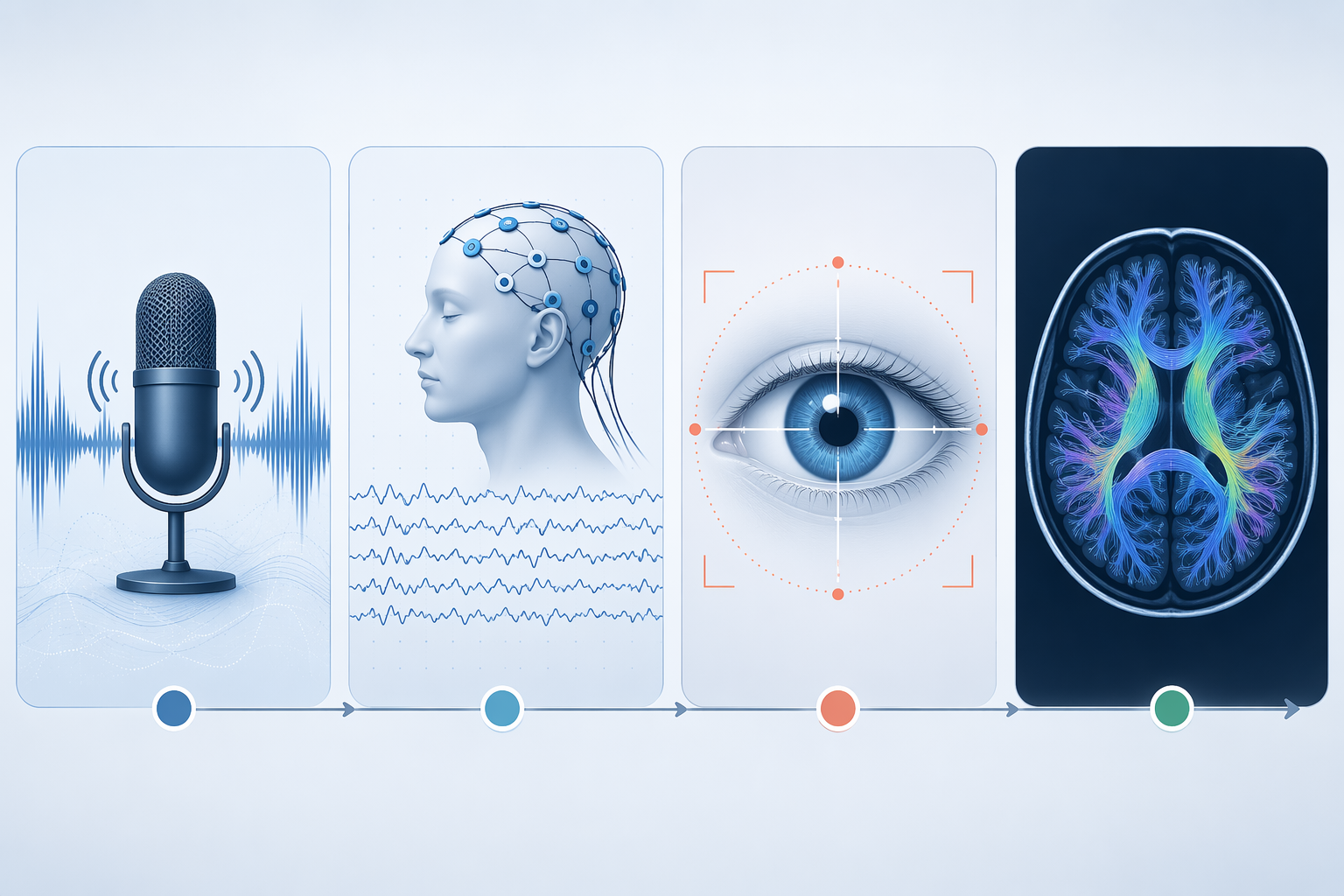
| Modality | What it measures | What the evidence says | Regulatory / sideline readiness |
|---|---|---|---|
| Voice analysis | Acoustic features such as pitch, jitter, shimmer, and speaking rate | Reported to separate concussed from non-concussed athletes with more than 90% accuracy within seconds [1] | Research-stage; not FDA cleared; no live-game sideline validation against SCAT6 |
| EEG / BrainScope Concussion Index | Brain electrical activity through an EEG-based index | Validated in 586 athletes with high classification accuracy for concussed vs. non-concussed athletes at the time of injury [2] | FDA 510(k) cleared; closest to sideline deployment, but still adjunctive |
| Eye tracking / SyncThink EYE-SYNC | Gaze stability and related oculomotor metrics | FDA-cleared system for AI-aided concussion diagnosis; VOMS plus machine learning improved AUC by 4.4% over SCAT3 alone [3] | FDA 510(k) cleared; practical near-field tool, but not a stand-alone diagnosis |
| Advanced neuroimaging | Diffusion MRI and other structural imaging signals | Scientifically important work on post-concussion brain changes, but largely research-stage for diagnosis | Not a sideline pathway |
Voice analysis gets attention first, then needs discipline
The most striking recent signal comes from voice biomarkers. A Florida International University report described acoustic measures that include pitch, jitter, shimmer, and speaking rate, and said they could distinguish concussed from non-concussed athletes with more than 90% accuracy within seconds [1]. That is exactly the kind of claim that can pull clinicians in, because it imagines a test that is fast enough to fit the moment when a player goes down and keeps insisting nothing is wrong.
But the attraction should stop short of overreach. The same material points to the current limits: this is research-stage work, not an FDA-cleared device, and there is no live-game sideline validation against SCAT6 as a reference standard [1]. That matters because a second-or-two result is only useful if it holds up in the noise of a real sideline, where privacy is limited, the athlete may be minimizing symptoms, and the people who need the answer are already under time pressure.
Voice is appealing precisely because it could be inserted into the first pass of decision-making without requiring a scanner, electrodes, or a patient to sit still for long. It is also the modality most likely to be misunderstood by a procurement team that wants a simple number. More than 90% accuracy sounds decisive until the questions arrive: in whom, against what comparator, and under what conditions.
EEG has the strongest sideline pedigree
BrainScope’s EEG-based Concussion Index sits in a different place on the maturity curve. In the JAMA Network Open validation study cited here, the index was tested in 586 athletes and showed high classification accuracy for concussed versus non-concussed athletes at the time of injury [2]. It is also FDA 510(k) cleared [2], which immediately makes it more operationally legible than most concussion AI claims.
That does not make it a proof of clinical benefit. Clearance under 510(k) is not the same as evidence that the device improves outcomes, prevents missed concussions, or changes return-to-play decisions in a measurable way. It means the device can enter practice under a regulatory pathway that depends on substantial equivalence, not on the kind of prospective outcome trial clinicians might wish had already been done.
Even so, EEG remains one of the few modalities that plausibly belongs near the field rather than in a research suite. It can be used quickly enough to matter, and it asks for a workflow that athletic trainers can imagine fitting into the narrow window after impact. That makes it less glamorous than voice analysis, but much harder to dismiss.
Eye tracking is practical in a way many AI tools are not
SyncThink’s EYE-SYNC is also FDA 510(k) cleared for AI-aided concussion diagnosis using gaze stability metrics [3]. That is a meaningful difference from research-only systems because eye tracking can be paired with an exam a clinician already recognizes. The VOMS-plus-machine-learning evidence described in the research brief also points in the same direction: the AI layer improved AUC by 4.4% over SCAT3 alone [3].
The result is modest, which is exactly why it deserves attention. A small improvement on top of an existing clinical assessment is often more believable than a perfect standalone classifier. It also fits the real job. The tool does not need to replace the sideline exam to be useful; it needs to reduce uncertainty when the athlete is minimizing symptoms and the clinician is deciding whether the next step is observation, removal, or more formal evaluation.
The limit is still the same one that applies to EEG: cleared does not mean definitive. A cleared system can be a better adjunct than a clever prototype, but the clinician still has to integrate symptoms, history, exam findings, and context. In other words, eye tracking can make the decision cleaner without making it automatic.
Neuroimaging is scientifically valuable, but it is not a sideline answer
Advanced neuroimaging has an obvious scientific appeal because it can probe structural or microstructural brain changes that are invisible to bedside testing. Deep-learning work on diffusion MRI is part of that effort, and it matters for understanding what concussion does to the brain beyond symptoms alone. But that does not make it a practical removal-from-play tool. Imaging requires transport, scanner access, and time, all of which move it away from the sideline problem and toward characterization after the fact.
That distinction is easy to miss when a model performs well in a paper. It is also the reason neuroimaging should not be treated as the natural endpoint for concussion AI. For immediate decision-making, it is simply too far from the place where the decision has to happen.
The evidence problem is narrower than the marketing problem
The shared weakness across all four modalities is not that they never work. It is that most of the work has been done in narrow, internally validated settings, often with predominantly male, North American, adolescent or adult football players. That is not a trivial detail. It means the evidence base is much thinner for female athletes, younger children, non-contact sports, and settings outside North America.
The reference standard problem is just as important. Concussion is usually judged by a multidisciplinary clinical process, often with tools like SCAT6 in the mix, but the reference itself is imperfect. When an AI tool appears to outperform a flawed standard, the result can look more impressive than it is. That does not invalidate the model; it just means the comparison is less clean than the abstract accuracy number suggests.
Prospective, multi-site validation is the missing step that would change this conversation. Without it, high accuracy mainly tells us that a model fit a dataset well. It does not yet tell us that the tool will behave reliably across teams, seasons, sports, ages, and real sideline pressures.
The practical hierarchy is clearer than the headlines
If the question is readiness for use in concussion management for athletes, EEG and eye tracking are the closest to deployment because they have FDA 510(k) clearance and can plausibly fit a sideline workflow [2][3]. Voice analysis is the most exciting research signal and the fastest-sounding one, but it is still research-stage [1]. Neuroimaging remains important for research characterization, not for a field-side decision.
The question is no longer whether AI can produce strong-looking concussion numbers in a paper. It is whether those numbers survive prospective, multi-site testing in diverse athlete populations against a rigorous clinical reference process, and whether the tool can be used by already overloaded clinicians at the exact moment they need it.
References
- AI voice analysis could diagnose a concussion within seconds of a player going down — Florida International University, 2026
- Validation of the Concussion Index in athletes — JAMA Network Open, 2021
- SyncThink scores FDA clearance for AI system to aid concussion diagnosis — MobiHealthNews
Comments
Join the discussion with an anonymous comment.