As of Q3 2026, the blunt answer is no: there is no validated, court-admissible AI tool that can reliably assess mental capacity for conservatorship. That does not make AI in mental health care and conservatorship an unserious topic. It makes it a high-stakes evidentiary problem before it is a software problem.

A conservatorship or guardianship proceeding is not an ordinary clinical workflow in which a model flags risk and a clinician decides what to do next. The proceeding can restrict a person’s legal authority to manage money, consent to care, choose where to live, or make other decisions that ordinarily belong to the person. If an AI system enters that room, the question is not whether it seems useful. The question is whether its output can be tied to the legal standard, explained to the court, tested against an appropriate population, and kept in the role that law permits.
Capacity Is Not One Hidden Score
The first difficulty is that “capacity” is not a single trait waiting to be detected. A person may lack capacity for one kind of decision and retain it for another. Financial, medical, testamentary, and other legally relevant capacities do not share one universal threshold. They ask different questions about what the person understands, appreciates, reasons through, and can communicate in relation to a specific decision.
That is why capacity opinions become fragile when they are reduced to global impressions. A proposed conservatee who cannot manage a complex trust may still express a consistent and legally meaningful preference about medical treatment. A person with dementia may perform poorly on a screening test yet still understand who should receive a particular item of property. The court needs the narrower account, not a polished substitute for it.
Existing forensic and clinical instruments already reflect this partial, domain-bound reality. Tools such as the Capacity Assessment Instrument, Testamentary Capacity Determination Screening Tool, Legal Capacity Questionnaire, Testamentary Capacity Assessment Tool, and Testamentary Capacity Instrument have been used or proposed to structure aspects of evaluation, but the field still lacks full standardization and broad validation across the settings in which courts actually receive capacity evidence.
That imperfection is the opening through which AI enters the conversation. A well-designed aid could, in principle, reduce uneven questioning, catch missing elements in an interview, compare documentation against a legal criterion, or make an evaluator show the basis for a conclusion. Those are worthwhile ambitions. They are also much narrower than saying a model can determine capacity.

The One Serious AI Framework Is Still Preliminary
The most relevant published proposal is Economou and Kontos’s 2023 Perspective paper on testamentary capacity assessment in dementia. The authors propose a mixed human-AI approach using natural language processing and explainable AI to support assessment under the Banks v Goodfellow criteria, a nineteenth-century testamentary capacity standard that remains influential in common-law analysis of whether a person understood the act of making a will, the extent of the property, potential claims, and the absence of mental disorder affecting the disposition.[1]
The paper is valuable because it does not pretend the evaluator can be removed. It imagines AI as a structured aid, not as a replacement judge. In the proposed model, natural language processing would examine responses from a testamentary capacity interview, while explainability methods, including SHAP values, would help identify which features contributed to the output.[1]
But the status of the paper matters. It is a Perspective article, not a validation study. It does not present a validation corpus, tested performance in a conservatorship or probate population, or a court-tested implementation. It therefore cannot support the evidentiary claim that an AI system can assess testamentary capacity, much less broader conservatorship capacity.[1]
That distinction is easy to lose when familiar technical terms appear. NLP is a method, not a forensic foundation. XAI is a design commitment, not an admissibility ruling. SHAP values may help describe why a model weighted certain features, but they do not by themselves show that the features are legally sufficient, clinically appropriate, or fair to the person being evaluated.
Prediction Does Not Map Cleanly Onto Legal Capacity
Machine learning systems are strongest when the target is stable enough to be labeled, measured, and predicted. Conservatorship capacity is not like that. The evaluator must connect observed abilities to a legal threshold in a concrete decision context. The relevant issue is not whether the person resembles prior cases labeled “incapable.” It is whether this person can perform the legally required mental act for this decision, at this time, with the supports and limitations that actually exist.
A fixed criterion-referenced model could be useful for consistency if the criterion is properly defined. It might make sure the interview asks about appreciation, reasoning, and communication rather than drifting into a general cognitive exam. It might flag contradictions between a clinician’s narrative and the elements of the governing standard. It might help identify when a report jumps from diagnosis to incapacity without describing functional decision-making.
Those functions are different from deciding the case. A diagnosis of dementia, psychosis, aphasia, or intellectual disability does not answer the legal question by itself. Nor does fluent speech prove capacity. Courts need an individualized bridge from clinical data to legal criteria. A model trained to predict a label may produce a probability, but the court still needs to know what ability was assessed, what evidence supported it, what alternatives were considered, and why less restrictive conclusions were not adequate.
| AI-friendly task | Conservatorship capacity requirement |
|---|---|
| Classify cases against prior labels | Explain this person’s abilities under the relevant legal standard |
| Optimize prediction from recurring features | Account for context, supports, communication limits, and decision domain |
| Generate a score or risk category | Show the reasoning that justifies restricting or preserving autonomy |
| Standardize documentation | Permit cross-examination and judicial review |
Language-Centered Models Create a Specific Equity Problem
The Economou and Kontos proposal is centered on language because testamentary capacity interviews are language-rich. That makes sense for documentation, but it also creates one of the most serious risks. The authors acknowledge that NLP-based assessment may inappropriately filter people with language disorders, aphasia, or non-native English fluency.[1]
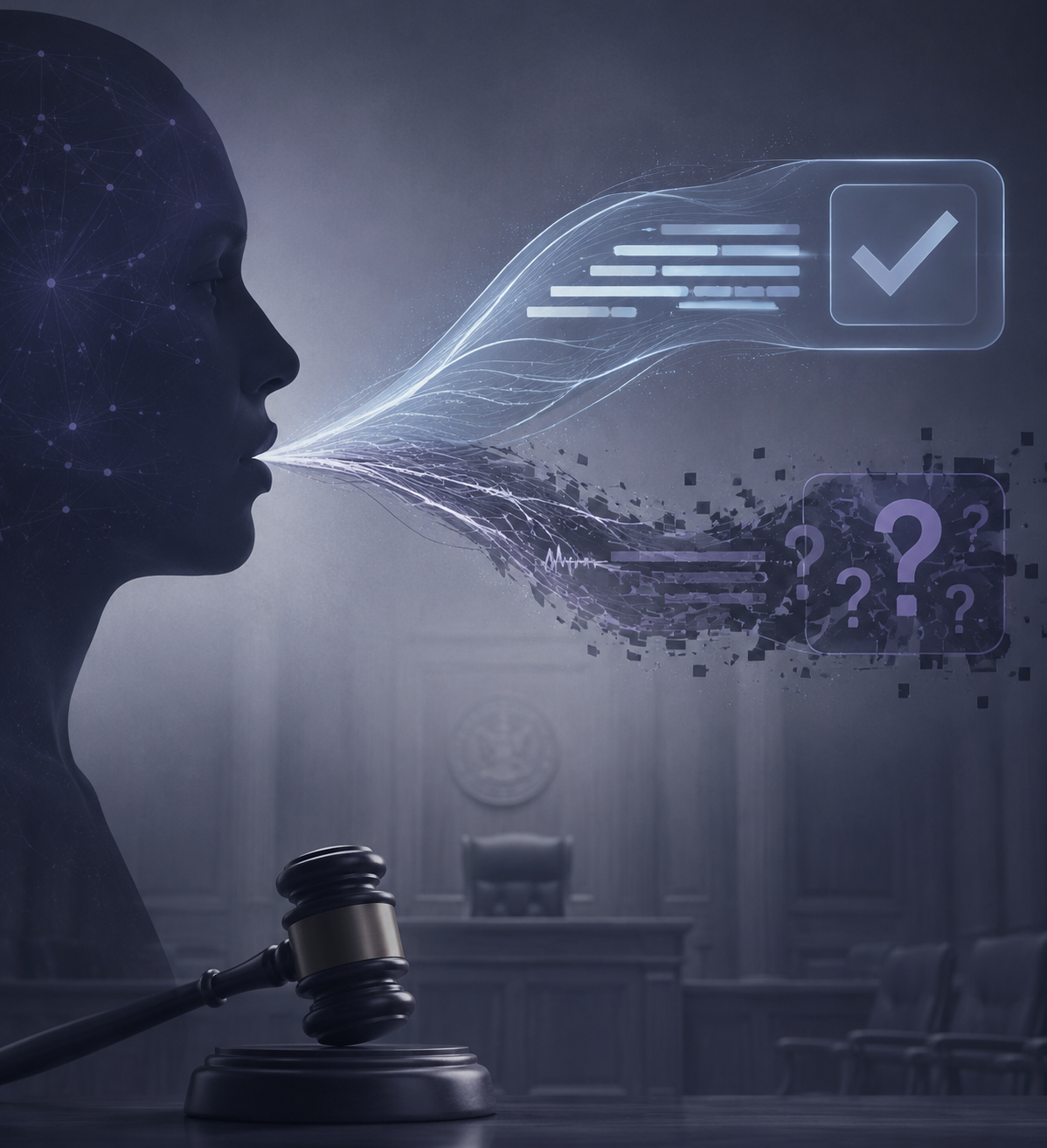
That caveat cannot sit in the footnotes. A person with aphasia may understand a decision better than they can produce a clean verbal explanation. A person speaking in a second language may hesitate, simplify, or choose less precise words while retaining the underlying legal understanding. If a model treats linguistic fluency as a proxy for decisional ability, it risks converting a communication barrier into evidence of incapacity.
A responsible system would need to show how it handles supported communication, interpreters, speech-language impairment, educational variation, and cultural differences in discussing money, family obligations, illness, and dependency. It would also need to show that these issues were tested empirically, not merely acknowledged as concerns. The available literature does not provide that empirical showing.
Explainability Has to Survive the Courtroom
In a conservatorship case, an explanation must do more than satisfy a model developer. It must be usable by lawyers, experts, judges, and the person whose rights are at stake. If the evaluator says the model contributed to the opinion, the court should be able to ask what data entered the system, how the data were obtained, what the model was trained to predict, what population it was validated on, what error rates are known, and how the output affected the final conclusion.
SHAP values can identify features that influenced a prediction, but they do not automatically translate into legal reasoning. A feature can be statistically influential and legally irrelevant. Another can be clinically meaningful but unfairly measured. If an explanation says that short answers, lexical simplicity, or inconsistency contributed to a capacity score, the court still needs to know whether those features reflect impaired understanding, fatigue, fear, aphasia, limited English proficiency, medication effects, or the structure of the interview itself.
This is where autonomous or weakly explained systems run into a hard wall. The more the AI output substitutes for the evaluator’s reasoning, the less defensible it becomes in a proceeding that requires individualized adjudication. A clinician can be cross-examined on how they weighed contradictory evidence. A model output without a validated and legally intelligible account of its reasoning gives the court a number where it needs a basis.
The Regulatory Ceiling Is Uneven, Not Empty
In Europe, the ceiling is explicit. GDPR Article 22 gives a person the right not to be subject to a decision based solely on automated processing, including profiling, when that decision produces legal effects or similarly significant effects.[2] A conservatorship or guardianship determination plainly belongs in the category of decisions with legal effects because it can alter a person’s authority over major life decisions.
That does not ban every AI-supported workflow. It does rule out a fully automated capacity determination with legal effect. Human involvement cannot be ornamental. If a court or evaluator relies on AI, the human decision-maker must retain meaningful authority, understand the basis of the output, and be able to depart from it.
The United States has a different problem. The research materials identify no federal equivalent to GDPR Article 22 and no US state legislation explicitly authorizing or regulating AI-based capacity assessment for conservatorship as of mid-2026. That absence should be treated as a governance gap, not as permission. Without a clear statutory framework, courts would still have to evaluate admissibility, relevance, reliability, due process, disability rights, and the continuing requirement for human legal judgment.
The asymmetry matters because technology often moves faster through administrative demand than through doctrine. A tool marketed as documentation support could become, in practice, the decisive capacity indicator if courts, agencies, or overburdened evaluators begin to treat its output as neutral. That is how a decision aid becomes a decision-maker without anyone voting to make it one.
What Would Have to Exist Before the Question Reopens
The responsible boundary is not anti-technology. It is evidentiary. Before AI output could be treated as meaningful capacity evidence in conservatorship, several conditions would have to be met.
- A defined legal domain: the tool would need to specify whether it concerns financial, medical, testamentary, or another capacity, rather than claiming to measure global capacity.
- A representative validation dataset: performance would need to be tested on the kinds of people who appear in real proceedings, including people with dementia, psychiatric illness, communication disorders, disability, low education, and non-native English fluency.
- Known limits and error rates: courts would need more than a vendor description or proof of technical novelty.
- Court-usable explanations: the system would need to connect its outputs to legally relevant abilities in a way that can be reviewed and challenged.
- Human decisional control: the evaluator and the judge would need to remain responsible for the ultimate capacity judgment.
- Procedural safeguards: the person whose rights are at stake would need access to the basis of the AI-assisted opinion and a meaningful chance to contest it.
A modest AI tool might eventually earn a role in this setting. It could help structure interviews, identify missing legal elements, compare reports for internal consistency, or support better documentation. Those uses would still require validation, but they are closer to the proper function of decision support.
The present materials do not justify more than that. By Q3 2026, AI-based capacity assessment for conservatorship remains theoretical. The only serious published framework is preliminary, unvalidated, and not court-tested. Until a tool can meet the legal standard, explain its reasoning, withstand validation in the relevant population, protect people with communication and language differences, and preserve human judgment, AI output should not be treated as court-admissible evidence of mental capacity for conservatorship.
Comments
Join the discussion with an anonymous comment.