
The clinical question behind AI content moderation for teen mental health on social media is not whether automation is good or bad. It is what the system is actually doing to a young person’s path through distress: detecting age, changing defaults, reducing exposure to graphic or abusive material, suppressing a phrase, steering a search result, or making a conversation harder for adults to notice.
Those distinctions matter because the evidence does not point in one direction. Meta reported in May 2026 that its AI-powered age-assurance measures use proactive visual analysis and profile scanning to detect under-13 and teen accounts, place more than 54 million teens into default protective settings, and keep 97% of 13- to 15-year-olds in those protections once applied.[1] That is not a small operational claim. If a teenager is moved by default away from some contact from adults, cyberbullying exposure, or graphic content, the intervention may plausibly reduce some risks before a clinician ever hears about them.
But company-reported retention of a safety setting is not the same as a demonstrated mental-health outcome. It does not tell us whether depressive symptoms fell, whether self-harm risk changed, whether marginalized teens lost access to supportive peers, or whether a young person learned to route around the system. At the same time, teens themselves are not uniformly dismissive of the harms. In Pew Research Center’s 2025 survey, 48% of teens said social media negatively affects people their age, while 21% said the effects are mostly positive.[2] That is an attitude measure, not a clinical endpoint, but it captures the ambivalence clinicians hear often: social media can be both the place where a teen is hurt and the place where someone finally answers.

AI Moderation Is Not One Intervention
A single phrase, “AI content moderation,” can hide several mechanisms with very different mental-health implications. Lumping them together makes it too easy to overclaim benefits from one mechanism and export them to another.
| Moderation mechanism | What it changes | Clinical question |
|---|---|---|
| Age assurance and age detection | Which account experience a teen receives by default | Does the system reduce exposure to contact, bullying, or graphic material without excluding teens from needed resources? |
| Algorithmic filtering and ranking | Which content is removed, downranked, recommended, or interrupted | Does the system reduce repeated exposure to harmful material, and how does it decide what counts as harmful? |
| Keyword-based moderation | Which words, tags, spellings, or phrases become risky to use | Does blocking language reduce harm, or does it displace help-seeking into less visible spaces? |
The strongest case for AI moderation is usually the least dramatic one: default settings that reduce predictable exposures for minors. A 14-year-old should not have to understand every privacy, recommendation, messaging, and content-control setting before receiving age-appropriate protections. Age assurance may be imperfect, and false age classification can create its own problems, but protective defaults are a different kind of intervention from censoring mental-health vocabulary.
The more difficult evidence begins where moderation touches language. A platform may be trying to reduce contagion, self-harm encouragement, eating-disorder reinforcement, bullying, or graphic imagery. But if the operational tool is a list of prohibited or downranked terms, the system can end up punishing the very words a distressed adolescent might use to find support.
When Words Are Blocked, Need Does Not Disappear
Zhang and colleagues’ 2024 debate article in Child and Adolescent Mental Health argues that social media content moderation may do more harm than good for youth mental health when it relies on keyword censorship, because it can produce lexical evasion, suppress beneficial discourse, and push conversations into more polarized communities without clear evidence that youth harm is prevented.[3] The article is a debate intervention, not a settled consensus statement. Still, the mechanism it highlights is clinically plausible: adolescents do not stop needing words for shame, hunger, self-injury, panic, dysphoria, or suicidality because a platform makes certain terms harder to use.
Lexical evasion is the social-media version of talking around the forbidden thing. A term is blocked, downranked, or made unsafe to type. Users then alter spellings, add symbols, adopt inside jokes, or migrate to substitute tags. In communities organized around eating-disorder content, earlier work by Chancellor and colleagues described the emergence of lexical variants designed to evade automated moderation; Zhang and colleagues use that line of evidence to argue that keyword bans can change the vocabulary of a community more readily than they change the underlying need or risk.[3]
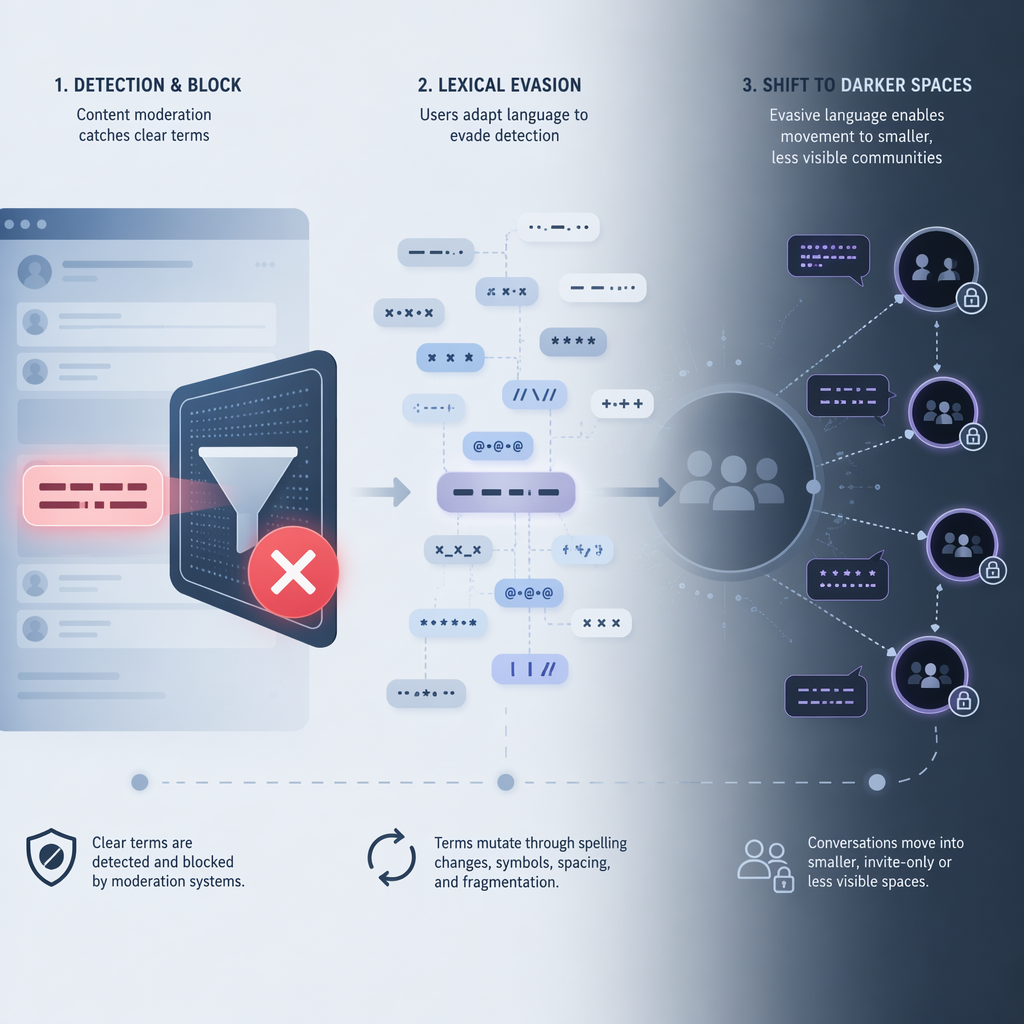
For a clinician, the crucial point is not that every evasive spelling is harmful. Some are harmless adaptations to platform culture. The concern is that moderation can change visibility. A teen who once searched an ordinary term may now learn the coded language of a smaller group. A parent, pediatrician, school counselor, or therapist may not recognize the new vocabulary. A platform safety team may also lose signal if the language mutates faster than detection systems update.
Displacement can also change the social environment around the teen. Larger communities are not automatically safe, but they are more likely to include bystanders, counter-speech, recovery-oriented peers, public scrutiny, and some moderation. Smaller spaces built around evasion may become more intense because membership itself signals familiarity with the code. The teen who arrives there may not simply find the same conversation under a different name; they may find a narrower, more reinforced version of it.
This is where broad “content removal” language becomes too blunt. Removing explicit encouragement of self-harm is not equivalent to suppressing a teen’s post that says they feel unsafe. Blocking graphic eating-disorder imagery is not equivalent to making recovery language harder to find because it shares tags with harmful content. A moderation system that cannot make these distinctions may reduce some visible material while also reducing the surface area where help can occur.
Suppression Can Look Like Improvement
A dangerous measurement problem follows. If a platform blocks terms and visible posts decline, that may look like success. It may also mean users changed spellings, shifted to private groups, moved platforms, or stopped using explicit language. Without outcome data, a reduction in visible mental-health terms cannot be assumed to mean a reduction in distress.
Digital Wellness Lab’s 2025 research brief on young people, content effects, and current content moderation practices emphasizes that moderation is part of a broader ecology of youth exposure, design, and platform incentives rather than a stand-alone clinical intervention.[4] That framing is useful because a teen’s risk is shaped not only by whether one post is removed, but by what is recommended next, which communities remain searchable, how reporting works, and whether the user is offered a route to support.
For mental-health speech, the cost of a false positive can be unusually high. If a teen writes about self-harm in order to ask for help and the post is removed or hidden, the platform may reduce exposure for other users while also interrupting disclosure. If a teen learns that direct language triggers enforcement, they may stop using direct language with everyone, including clinicians. The clinical interview then receives a quieter patient, not necessarily a safer one.
The opposite error also matters. Under-removal of targeted harassment, graphic self-harm material, or content that intensifies eating-disorder behavior can leave teens exposed to repeated injury. The evidence does not justify abandoning moderation. It just requires asking whether the moderation target is the harmful content, the vulnerable speaker, the searchable term, or the social pathway through which help might arrive.
Unequal Enforcement Becomes an Access Problem
Moderation systems also inherit the unevenness of the data, languages, labels, and policy judgments behind them. Zevo Health’s 2025 discussion of AI-driven content moderation highlights concerns about demographic bias and mental-health impacts when automated systems misclassify or unevenly enforce content rules.[5] The clinical implication is not limited to fairness in an abstract sense. If some teens are more likely to have distress language flagged, misunderstood, or removed because of dialect, language, identity, or community norms, those teens become less visible in the very channels where they may be seeking connection.
This is especially important for adolescents whose help-seeking is already indirect. A teen may test whether a space is safe by posting a meme, a lyric, a coded phrase, or a vague statement. Automated moderation may read that content as a policy object. A clinician may later need to understand it as a bid for recognition. Those interpretations are not interchangeable.
Language coverage is part of the same problem. English-language moderation performance should not be treated as a general safeguard for multilingual adolescents. A system can be too aggressive in one language, too permissive in another, and blind to code-switching between them. The result is not merely inconsistent enforcement; it is unequal access to safer online spaces and to peer support that remains intelligible to adults.
Moderation and Mental-Health Chatbots Are Separate, but Teens Do Not Experience Them Separately
Content moderation is not the same intervention as an AI mental-health chatbot. One governs visibility and access inside a platform; the other offers conversational advice or companionship. But in an adolescent’s daily life, the boundary is thin. A teen may see a moderated post, search for a coded term, be shown an AI-generated answer, or turn to a chatbot after human conversation feels unavailable.
McBain and colleagues reported in JAMA Pediatrics that 19.2% of U.S. adolescents and young adults ages 12 to 21 had used AI chatbots for mental-health advice, corresponding to about 8.2 million people, and that 63.3% of those users had not disclosed this use to any person.[6] Those data do not prove harm. They do show that AI-mediated mental-health advice is already common enough to matter in assessment, and private enough that clinicians cannot assume it will be volunteered.
For moderation, this adjacent finding changes the stakes. If a platform suppresses ordinary mental-health speech but leaves a teen alone with an AI system, the pathway has shifted from peer discourse to machine-mediated advice. That may be helpful in some moments, inadequate in others, and risky if the teen has escalating self-harm thoughts, psychosis, coercive relationships, or eating-disorder behaviors. The evidence base cited here does not establish that chatbots are causing those outcomes. It does make nondisclosure clinically relevant.
The JED Foundation’s 2025 policy position called for the AI and technology industry to safeguard youth mental health, including strong concern about emotionally responsive AI companions for minors.[7] The American Psychological Association’s 2025 health advisory, available here through a secondary source summary, similarly urged age-appropriate AI design, reduced persuasive design, and distinct standards for adolescents.[8] These are policy and professional cautions, not trials. Their value is that they name a design problem clinicians are already seeing: adolescents may interact with systems that feel responsive without having the obligations, judgment, or continuity of care that human helpers carry.
What Better Design Would Have to Prove
The evidence does not support a simple instruction to turn AI moderation up or down. Age detection and protective defaults deserve a fair hearing because they may reduce predictable exposure for large numbers of teens before harm accumulates. Keyword censorship deserves more skepticism because its apparent success may be disappearance from view rather than reduced distress.
Ramos and colleagues’ 2025 Nature Mental Health article argues for youth co-design in ethical guidelines for AI-powered digital mental-health tools.[9] That principle matters for moderation as well. Teens often know which words are used for recovery, which tags are used for harm, which euphemisms signal risk, and which platform interventions feel protective rather than punitive. Adult-only design can miss those distinctions, especially when it treats youth speech mainly as content to classify.
A more clinically credible moderation system would need to show its work at the level of pathways, not just removals. It would need to distinguish explicit harmful instruction from disclosure, recovery support from symptom promotion, and coded escalation from ordinary adolescent slang. It would also need to report what happens after enforcement: whether users are connected to crisis resources, whether appeals work, whether marginalized language communities are overflagged, and whether search behavior migrates toward less moderated spaces.
The current research base is not strong enough to answer those questions with confidence. It includes company-reported operational data, survey attitudes, debate articles, research briefs, policy advisories, and emerging prevalence data on chatbot use. Those sources are useful, but they are not longitudinal clinical-outcome trials. Causal claims about population-level adolescent mental health remain beyond what the evidence can carry.
What Clinicians Can Responsibly Take From the Evidence
In assessment, it is no longer enough to ask whether a teen uses social media. The more useful questions are about routes: where they go when distressed, which words they avoid using, whether posts have been removed or hidden, whether they have moved into private or coded groups, whether they use AI chatbots for advice, and whether any adult knows.
Silence on a platform should not be read too quickly as recovery. It may reflect improvement, but it may also reflect evasion, migration, shame, enforcement fatigue, or a turn toward AI-mediated conversation outside human awareness. The same caution applies to visible cleanup after keyword moderation. Less searchable distress is not automatically less distress.
The most defensible reading is mixed. AI content moderation can be protective when it changes defaults for minors and limits clearly harmful exposure. It becomes more clinically troubling when it censors mental-health vocabulary in ways that suppress peer support, distort help-seeking, or drive vulnerable adolescents into smaller and less visible communities. The uncertainty is not a reason to ignore moderation; it is part of the clinical picture.
References
- New AI-Powered Age Assurance Measures to Place Teens in Age-Appropriate Experiences, Meta, May 2026.
- Teens, Social Media and Mental Health, Pew Research Center, 2025.
- Debate: Social media content moderation may do more harm than good for youth mental health, CAMH, 2024.
- Research Brief: Young People, Content Effects, and Current Content Moderation Practices, Digital Wellness Lab, 2025.
- The Mental Health Impacts of AI-Driven Content Moderation, Zevo Health, 2025.
- AI Chatbot Use and Disclosure for Mental Health Among US Adolescents and Young Adults, JAMA Pediatrics / RAND, 2026.
- Tech Companies and Policymakers Must Safeguard Youth Mental Health in AI Technologies, JED Foundation, 2025.
- Health Advisory on Artificial Intelligence and Adolescent Well-being 2025, Media Literacy Now, 2025.
- Advancing youth co-design of ethical guidelines for AI-powered digital mental health tools, Nature Mental Health, 2025.
Comments
Join the discussion with an anonymous comment.