
In the planning room, ai in cosmetic surgery planning is not being asked to do anything magical. It is being asked to do three practical jobs: estimate risk before the incision, show a likely outcome before the patient commits, and turn images into measurements faster than a human can manage by hand.
The three jobs that matter
- Risk prediction: machine-learning models are being used to estimate complication risk and guide patient selection, with reported AUC values from 0.70 to 0.89 across cosmetic procedures; in larger validation sets, POTTER reached 0.84 for morbidity and 0.92 for mortality in 382,960 NSQIP patients, while MySurgeryRisk reported AUCs from 0.77 to 0.94 in 51,457 patients [1][2].
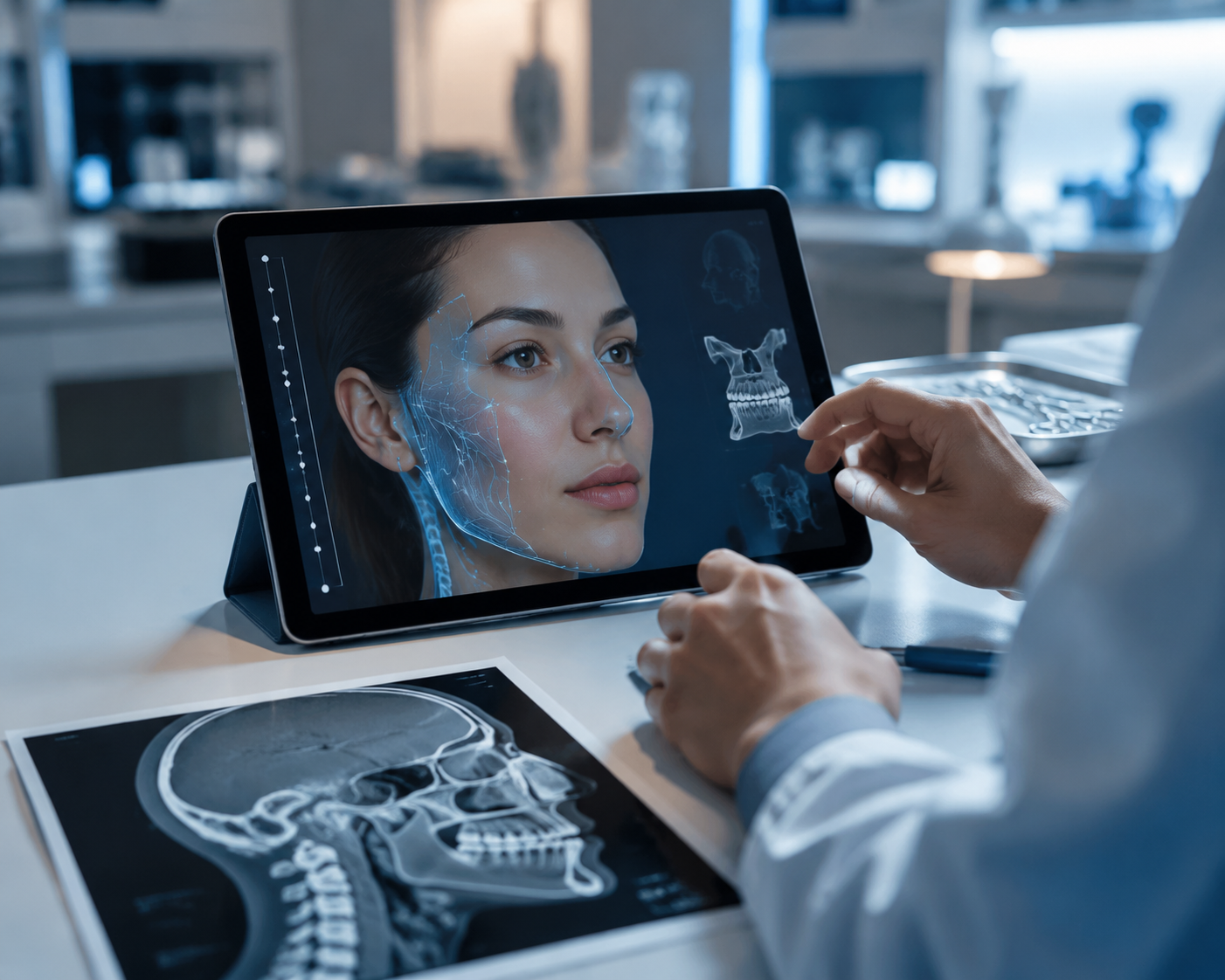
- 3D outcome simulation: GAN- and CNN-based tools are generating photorealistic previews for rhinoplasty, breast augmentation, facelift, and blepharoplasty, with reported prediction accuracies between 81% and 97.68% in research settings [3][4].
- Automated imaging analysis: segmentation tools can cut preoperative analysis from 30-60 minutes to seconds while still reporting Dice scores above 0.95 for critical structures [1].
Risk prediction deserves the most weight because it can change whether surgery is offered, delayed, or modified. The performance numbers are not trivial, especially when a model outperforms traditional ASA scoring, but they are still model-performance numbers, not proof that a clinic's complication rate will fall once the software is installed [1][2].
The 3D simulation work is the easiest to admire and the easiest to oversell. A polished image can make a consultation feel more precise than it really is, and the literature still leans heavily on single-center retrospective studies for those 81% to 97.68% accuracy claims [3][4]. That distinction matters: a convincing rendering is not the same thing as a prediction that has been tested in a different clinic, with different photographers, different surgeons, and a different patient mix.
Automated segmentation is the quietest gain, but often the most defensible one. Saving 30 to 60 minutes on image analysis can matter in a busy practice, and maintaining Dice scores above 0.95 suggests the software can be accurate enough for routine measurement work [1]. It still needs oversight, but it is easier to justify a tool that removes drudgery than one that changes expectations.
What the evidence still does not give you
The central problem is not that these systems are useless. It is that research-grade performance often shrinks when the model leaves the original center. Fewer than 40% of surgical AI prediction models meet TRIPOD-AI reporting standards, and externally validated breast reconstruction models commonly lose 10% to 15% of AUC compared with internal testing [5]. In the material summarized here, there is still no prospective multicenter randomized trial showing that these planning tools improve patient outcomes.
Regulation and adoption
The regulatory picture is still narrow. One systematic review identified only six FDA-approved AI/ML devices for plastic surgery between 2016 and 2024, and broad authorization for cosmetic-surgery planning systems is still not what most clinicians are actually working with [6][7]. That is why the clearance question belongs in the same conversation as the evidence gap, not in place of it; a broader version of that argument is laid out in The Evidence Gap in FDA-Cleared AI Medical Devices.
The adoption gap is just as revealing. In a 2024 survey of 153 plastic surgeons, 82.1% reported little or no AI experience, yet 66.2% believed AI could improve surgical planning accuracy [5]. Because that sample was concentrated in Latin America, it should be read as a directional signal rather than a universal census, but the pattern is hard to miss: interest is ahead of hands-on experience.
That is where ai in cosmetic surgery planning stands now. It is already changing how some consultations are framed, and it may become genuinely useful in routine practice, but the support is still mostly research-grade rather than deployment-grade. The missing pieces are the ones that matter most to surgeons who have to defend the plan in front of a patient: prospective multicenter validation, bias scrutiny across different faces and body types, and clearer liability rules when the model looks confident and the case still goes wrong.
References
- Use of Artificial Intelligence in Preoperative Planning in Surgery: A Narrative Review
- The Transformative Role of Artificial Intelligence in Plastic and Reconstructive Surgery
- AI-supported plastic surgery planning: Is technology changing the plastic surgery landscape?
- Artificial Intelligence in Plastic Surgery: Advancements, Applications, and Future
- Artificial Intelligence in Plastic Surgery: Insights from Plastic Surgeons, Education Integration, ChatGPT's Survey Predictions, and the Path Forward (2024)
- Growth in FDA-Approved Artificial Intelligence Devices in Plastic Surgery
- Navigating FDA Regulations for the Development of Artificial Intelligence in Plastic Surgery
Comments
Join the discussion with an anonymous comment.