
As of July 18, 2026, the AI question in Cyclospora prevention is no longer abstract. CDC’s July 14 Health Alert Network notice reported 1,645 confirmed domestically acquired cyclosporiasis cases across 34 states, 141 hospitalizations, and more than 5,100 additional cases under investigation, with shredded iceberg lettuce from a single Mexican supplier reported as the outbreak link at that time.[1] Those figures explain why health departments, clinics, employers, schools, and consumers might reach for automated education tools: the demand for timely salad-safety answers can outrun the normal pace of handouts, webpages, and call-center scripts.
But using AI education to prevent Cyclospora infection from salad is not a generic chatbot task. It is a test of whether a system can preserve awkward, changing, and easily flattened details under pressure. A tool that says “wash your greens thoroughly” may sound responsible while still giving people too much confidence. A tool that treats “pre-washed” as meaning “safe” may turn a label into a false endpoint. A tool that misses a current outbreak update may provide advice that was acceptable yesterday and incomplete today.
The Hard Part Is the Prevention Message, Not the Chat Interface
Cyclospora prevention advice for salad produce contains several traps for fluent systems. Public reports during the 2026 outbreak emphasized that standard washing does not reliably remove Cyclospora, chlorine does not kill it, alcohol hand sanitizer is ineffective, cooking to 158°F is the only certain kill step, vinegar soaks may reduce but not eliminate risk, and pre-washed bagged salads can still carry risk despite label claims.[2][3][4]
Those details are not decorative. They define the minimum competence test for a consumer education tool. A reliable system would need to say what washing can and cannot do, avoid implying that sanitizer solves a produce-contamination problem, handle “triple-washed” language without turning it into a guarantee, distinguish risk reduction from elimination, and check outbreak-specific source information before answering a question about a particular salad product.
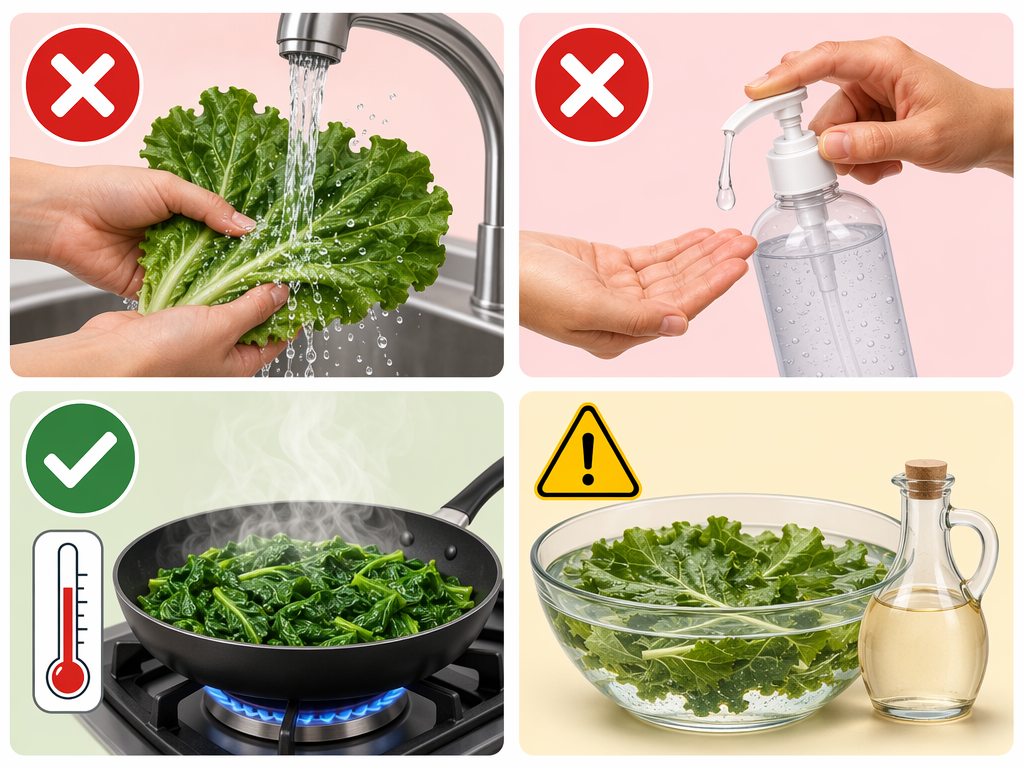
This is where ordinary health education templates become risky. Many food-safety messages teach a familiar sequence: clean hands, rinse produce, separate raw foods, chill promptly. For many hazards, that framework is useful. For Cyclospora in implicated salad during an outbreak, it can mislead if it does not also explain the limits of rinsing and the practical meaning of a confirmed or suspected source link.
The consumer does not experience that as a taxonomy problem. They ask, “Can I eat this bag of salad?” or “If I wash it again, is it safe?” The system has to answer in a way that survives the real decision in the kitchen, cafeteria, clinic waiting room, or grocery aisle. A near-correct answer can be worse than an obvious failure because it may be acted on.
What Chatbot Evidence Actually Shows
The available chatbot evidence does not yet show dependable performance for this kind of outbreak-specific prevention counseling. Consumer Reports’ 2024 evaluation of five major AI chatbots for health and safety advice warned that “95% accurate responses are more likely to go undetected,” because consumers may not recognize the small missing piece that changes the safety implication.[5] The same evaluation found that chatbots generally failed to flag late-breaking food safety alerts or recall information.[5]
That finding maps directly onto Cyclospora salad education. A chatbot does not have to invent a parasite to cause harm. It only has to omit that washing is not reliable, overstate the value of a sanitizer, fail to distinguish vinegar-soak risk reduction from elimination, or answer from stale outbreak context. The answer may read polished, balanced, and helpful. The health educator or call-center nurse will still be left correcting it after a consumer has already made a food decision.
A 2026 Journal of Food Science study reported limited alignment between chatbot outputs and food safety specialists, and found that prompt wording significantly influenced output quality.[6] The accessible public details are limited, so the study should not be stretched beyond its reported conclusion. It is still relevant because outbreak education rarely occurs through carefully engineered prompts. Consumers ask messy questions, use brand fragments, misspell terms, and combine symptoms, product labels, and rumors in one query.
A public health team can improve prompts inside a controlled workflow. A general consumer chatbot cannot assume that discipline from every user. That distinction matters more than a broad accuracy percentage. The real deployment question is whether the system can handle the known Cyclospora edge cases reliably when the user does not know which edge case they are asking about.
| Cyclospora education detail | Why a generic AI answer can fail |
|---|---|
| Washing salad | May be described as sufficient even though standard washing does not reliably remove Cyclospora |
| Alcohol hand sanitizer | May be recommended as a reassuring hygiene step while missing that it is ineffective against this parasite |
| Pre-washed bagged salad | May be treated as lower risk without stating that label claims do not eliminate outbreak concern |
| Vinegar soaks | May be framed as a solution rather than a risk-reduction step that does not eliminate risk |
| Outbreak-linked products | May be answered from stale or generic food-safety information rather than current public health notices |
Scale Without Source Control Is Not Public Health Capacity
There is a tempting argument for AI education during a large outbreak: if thousands of people need guidance, a tool that answers instantly looks like capacity. That argument becomes weaker if the tool cannot show which source it used, when it last checked outbreak information, how it handles uncertainty, and what it refuses to answer.
For Cyclospora salad prevention, updating is not a technical nicety. CDC’s July 14 notice was a time-stamped statement during an ongoing investigation, not a permanent final map of risk.[1] A consumer education system should therefore be able to communicate the date of its outbreak grounding, route product-specific or symptom-specific questions to official sources, and avoid presenting old source attribution as settled if the investigation changes.
This is also where personalized learning platforms, VR simulations, and surveillance-linked alert systems should be judged cautiously. They may eventually help public health teams teach produce-risk concepts, train staff, or distribute targeted messages. Their readiness depends on the same conditions: validated content, source control, update pathways, human review, and testing against the prevention details that are most likely to be mishandled.
The evidence reviewed here does not identify a validated AI consumer education tool purpose-built for Cyclospora prevention from salad. That absence is not a minor gap. It is the central finding. General chatbot performance, even when promising, is not equivalent to validated outbreak communication for a parasite with counterintuitive prevention constraints.
Where AI Looks More Credible in the 2026 Response
The stronger AI examples in this outbreak are not unsupervised consumer education bots. They are bounded workflows with defined inputs, narrow tasks, and professional oversight.
ARUP Laboratories reported deploying a convolutional neural network through the Techcyte platform to screen stool slides for Cyclospora during the outbreak, with approximately two minutes of review time per slide, a 200% increase in testing throughput, and more than 50 positive results per day during the surge.[7] Those details come from real-time journalistic reporting rather than a peer-reviewed performance paper, so they should be treated as documented deployment evidence, not as a complete validation record. Still, the example is instructive: the task is narrow, the specimen type is defined, trained laboratory personnel remain in the pathway, and the system is used to improve throughput rather than replace all judgment.
CDC also describes machine learning use in the National Syndromic Surveillance Program for early outbreak detection.[8] FDA’s agency-wide AI tool, Elsa, has been described as a cross-department performance optimization effort.[9] These examples belong in the conversation because they show where AI can support outbreak operations: detection, triage, workflow acceleration, document handling, and pattern recognition. They do not prove that a chatbot can safely advise consumers about whether washing a particular bag of lettuce changes their risk.
The distinction is not anti-AI. It is the difference between a controlled instrument and an open-ended public voice. A diagnostic screening model can be evaluated against slides, throughput, and laboratory review. A consumer-facing chatbot must be evaluated against ambiguity, urgency, product uncertainty, language variation, and the user’s inability to spot a near miss.
The Evidence Standard Should Match the Harm Pathway
For public health deployment, the right question is not whether AI can help. It is which task, under what evidence standard, with what oversight.
- Drafting: AI may help staff produce first-pass plain-language materials, translations, or call-center scripts if every output is checked against current public health sources.
- Triage: AI may help route questions to the right human team or official page if it is configured to escalate product-specific, symptom-specific, or outbreak-update questions.
- Distribution: AI may help tailor formats for SMS, web, clinic portals, or social media if the underlying prevention content remains locked to reviewed language.
- Education: AI should not independently generate Cyclospora salad-prevention advice for consumers unless it has been tested against the specific failure modes of this outbreak.
That testing cannot be satisfied by asking whether the answer sounds sensible. A useful evaluation set would include questions about pre-washed salad, rewashing bagged lettuce, chlorine and sanitizer, vinegar soaks, cooking, current outbreak attribution, symptoms mixed with product questions, and requests for certainty where certainty is not available. Outputs would need review by food safety specialists and public health communicators, not only by general clinicians or software teams.
For teams already building AI into outbreak operations, related implementation questions overlap with broader public health AI governance. Source grounding, version control, prompt testing, output monitoring, and escalation rules matter as much as model choice. A parallel discussion appears in ClinicalMind’s overview of how AI fits into CDC’s GI outbreak protocol, while consumer-facing clinical context is better handled in Cyclosporiasis Symptoms and Prevention During the 2026 Outbreak.
A Deployment Judgment for July 2026
On the evidence available as of July 18, 2026, AI tools may reasonably support public health teams behind the scenes: drafting, translating, formatting, routing, monitoring questions, and accelerating bounded analytic or laboratory workflows. They should not be treated as validated stand-alone consumer educators for preventing Cyclospora infection from salad during the active outbreak.
The practical standard is straightforward. If an agency, health system, employer, or vendor uses AI for this message pathway, the content needs human review, dated source grounding, recall and outbreak-update checks, prompt and output testing against Cyclospora-specific edge cases, and clear escalation to official public health sources. Fluency is useful only after the facts survive the pathway.
References
- Health Alert Network (HAN) - 00531, CDC, July 14, 2026, https://www.cdc.gov/han/php/notices/han00531.html
- Cyclospora produce washing tips, AP News, July 2026, https://apnews.com/article/cyclospora-produce-washing-tips-022730ccbc514e15b1f0021c47bf1b68
- Cyclosporiasis parasite food safe avoid, CNN, July 15, 2026, https://www.cnn.com/2026/07/15/health/cyclosporiasis-parasite-food-safe-avoid
- Can washing produce help prevent cyclosporiasis? What experts recommend, The Washington Post, July 14, 2026, https://www.washingtonpost.com/wellness/2026/07/14/can-washing-produce-help-prevent-cyclosporiasis-what-experts-recommend/
- We Quizzed AI Chatbots for Health and Safety Advice, Consumer Reports, 2024, https://www.consumerreports.org/electronics/artificial-intelligence/we-quizzed-ai-chatbots-for-health-and-safety-advice-a1164538940/
- Journal of Food Science chatbot food safety alignment study, ScienceDirect / Journal of Food Science, 2026, https://www.sciencedirect.com/science/article/pii/S0362028X26001572
- AI Takes on Cyclospora Outbreak, GovInfoSecurity, July 17, 2026, https://www.govinfosecurity.com/ai-takes-on-cyclospora-outbreak-a-32261
- Examples of CDC Programs Currently Using AI, CDC, 2026, https://www.cdc.gov/ai/vision/examples-of-cdc-programs-currently-using-ai.html
- FDA Launches Agency-Wide AI Tool to Optimize Performance for the American People, FDA, https://www.fda.gov/news-events/press-announcements/fda-launches-agency-wide-ai-tool-optimize-performance-american-people
Comments
Join the discussion with an anonymous comment.