
By mid-July 2026, questions about Cyclospora symptoms and AI-enabled foodborne illness tracking pointed less to a patient-facing symptoms guide than to an informatics problem. The outbreak was large enough to be nationally visible, yet still moving through a surveillance system built on delayed confirmation, changing reporting obligations, and partial source attribution. CDC’s July 14 Health Alert Network notice reported 1,645 laboratory-confirmed cases across 34 states, more than 5,100 additional cases under investigation, an age range from 2 to 95 years, a median age of 44 years, and a 9% hospitalization rate.[1] CIDRAP reported that this represented roughly a sixfold increase over about 250 cases in all of 2025.[2]
The important point is not that Cyclospora is clinically mysterious. It commonly presents as a gastrointestinal illness, and those GI symptom descriptions are exactly the kind of language that can appear before a case is confirmed: in a clinician’s note, a local health department intake form, a social media post, or a restaurant review. The surveillance problem is that those fragments usually do not arrive in one clean channel.
Even the official numbers showed the plumbing. CDC’s July 9 surveillance page cited 843 cases, while the July 14 HAN notice cited 1,645 confirmed cases.[1][2] That difference does not, by itself, prove anyone failed. It is what happens when state investigations, laboratory confirmation, national aggregation, and public posting move at different speeds. But for a pathogen spread through fresh produce and eaten across many jurisdictions, a normal reporting lag can still be operationally consequential.
The Visibility Gap Was Built Into the Workflow
A traditional foodborne illness signal usually strengthens only after several steps have already happened. A person becomes ill, seeks care or contacts public health, testing is ordered, a laboratory result is generated, a report reaches the state, investigators interview cases, and a national system eventually sees enough comparable reports to call the pattern unusual. Each step improves confidence. Each step also consumes time.
Cyclospora became more vulnerable to that delay after FoodNet changed its reporting requirements. CIDRAP reported that, effective July 1, 2025, Cyclospora reporting became optional in CDC’s FoodNet program, leaving only Salmonella and Shiga toxin-producing E. coli as required pathogens. The same report noted CDC data lags of up to 6 weeks behind state-level reporting.[2]
Optional reporting does not mean invisible reporting. States can still investigate, laboratories can still test, and CDC can still issue alerts. The narrower problem is that a national early warning system loses consistency when one of the relevant pathogens no longer flows through the same required pathway. A rise that is obvious inside one state may remain harder to interpret nationally until enough jurisdictions, interviews, and lab confirmations line up.
| Signal source | What it can show early | What it cannot prove by itself |
|---|---|---|
| Clinical and laboratory reporting | Confirmed cases, demographics, hospitalization, jurisdictional spread | Exposure source before interviews and traceback |
| Restaurant reviews | Repeated GI symptom language tied to a venue, meal, or food type | A laboratory-confirmed pathogen or true denominator |
| Social media posts | Geolocated clusters of illness language, foods, symptoms, and timing | Whether the writer is a confirmed case |
| EHR or clinical notes | Syndromic patterns across encounters before final coding or reporting | A public-health-confirmed outbreak without investigation |
That distinction matters because AI does not turn a noisy complaint into a confirmed outbreak. At best, it creates an earlier, inspectable cue: a place, food, symptom cluster, or time window that public health staff can decide whether to investigate.
Earlier Signal Is Not the Same as Confirmed Attribution
The confirmed-source question is already narrower than the early-signal question. CDC identified shredded iceberg lettuce served at Taco Bell in 5 states as a confirmed source, while noting that additional sources were likely given the multistate distribution pattern.[3] That is the kind of finding that requires epidemiologic investigation, exposure interviews, product tracing, and enough comparable cases to make the link credible.
An AI surveillance layer would not replace that work. It would sit before and beside it. The useful version would ask: are there unusual increases in posts or reviews mentioning diarrhea, prolonged GI illness, salad, lettuce, a restaurant chain, or a local geography? Are several emergency departments seeing similar symptom language before diagnosis codes settle? Are the same food terms recurring across locations that do not yet share a confirmed exposure?

That is a more modest claim than saying AI could have prevented 1,645 confirmed cases. It is also a more useful claim. In outbreak surveillance, a weak signal that arrives early and can be reviewed by humans may be worth more than a polished dashboard that updates after the field investigation is already far along.
What Restaurant-Review AI Actually Extracts
The most relevant work here is not a generic chatbot demonstration. In March 2025, the UK Health Security Agency described exploratory work using large language models to analyze online restaurant reviews. Epidemiologists manually annotated 3,000 reviews for gastrointestinal symptom mentions, then evaluated multiple LLMs for entity extraction, including symptoms and food types.[4]
The operational detail is the interesting part. Reviews are not written like case report forms. People use slang, misspell symptoms, describe meals unevenly, and bury timing inside narrative. An LLM-based system is useful only if it can turn that messy text into structured fields that a public-health reviewer can inspect: symptom, food, location, venue, and possibly timing.
For a Cyclospora outbreak, that kind of system would not need to know the parasite on day one. It would need to surface an unusual pattern of GI illness language associated with relevant foods or venues. A hypothetical alert might say that reviews mentioning prolonged diarrhea and salad-type foods have risen around several locations in the same period. That alert would still need human review, deduplication, and comparison with laboratory and interview data.
UKHSA did not present this as a finished routine surveillance program. The agency described the work as exploratory and noted barriers such as slang, spelling variation, and access to data in real time. It also stated that further work was needed before adopting the methods into routine practice.[4] That caution is not a footnote; it is the difference between a promising method and a deployed public-health instrument.
Social Media Adds Geography, Speed, and More Noise
The Twitter pipeline from Tao and colleagues is useful because it shows what a full text-mining workflow can look like, not because it proves Cyclospora detection in 2026. The researchers collected 430,000 geolocated tweets from 2017 through 2021, classified 110,000 as foodborne-illness-related, and used BERTweet and RoBERTa models to extract food, symptom, and location entities under a “3W” framework.[5]
The model was not merely counting the word “sick.” It tried to identify who was reporting illness, what food was mentioned, and where the event appeared to occur. Tao and colleagues also reported that logistic regression outbreak forecasting achieved 0.80 accuracy for binary outbreak versus non-outbreak classification, and that food category distributions such as chicken, salad, and dairy closely matched CDC National Outbreak Reporting System data.[5]
Those results support a complementary surveillance argument. They do not support a pathogen-specific claim. The pipeline’s performance was not validated during a Cyclospora-specific US outbreak, and a binary outbreak classifier is not the same as identifying Cyclospora cayetanensis, tracing lettuce distribution, or deciding whether a national alert should be issued.
Still, social media has one property the case-reporting chain often lacks: it can appear before a patient enters care or before a laboratory result is reported. That is also why it requires disciplined triage. A credible system would need to filter jokes, secondhand reports, news sharing, duplicated complaints, and vague posts that mention food and illness without a plausible exposure relationship.
Clinical Data Could Help, but It Has a Different Job
EHR-derived surveillance has a different strength. It is closer to care, closer to laboratory ordering, and less dependent on who chooses to post publicly. It is also messier in its own way: symptoms may sit in free-text notes, diagnosis codes may arrive late or remain nonspecific, and exposure history may be missing unless a clinician asks and documents it.
The pathogen-prediction study by Wang and colleagues shows the limits of analogy. Their gradient boosting decision tree models reached 69% accuracy across 4 pathogens using geographic location, seasonality, age, and symptom features, but the study was trained on Chinese surveillance data and targeted Salmonella, norovirus, E. coli, and Vibrio parahaemolyticus, not Cyclospora.[6]
That makes it secondary evidence for this outbreak. It suggests that symptoms, seasonality, age, and geography can support machine-learning triage for foodborne pathogens. It does not show that a similar model would have correctly predicted Cyclospora in the 2026 US outbreak, especially when reporting rules and produce distribution patterns differ.
The Deployment Gap Is the Real Finding
Outside the United States, public agencies are at least moving toward broader AI-assisted food surveillance. In March 2026, Food Safety News reported that the European Commission launched an AI platform intended to detect food fraud, contaminated food, and foodborne outbreaks across member states.[7] The available public details are thin, so the platform should not be treated as proof that Europe has solved the problem. It is evidence that the application is no longer speculative.
For the 2026 Cyclospora outbreak, the stronger conclusion is uncomfortable but limited: plausible complementary systems exist, and some have been tested on exactly the kinds of text streams that foodborne illness produces, but none of the systems described in the available evidence is deployed as operational US surveillance infrastructure for Cyclospora.
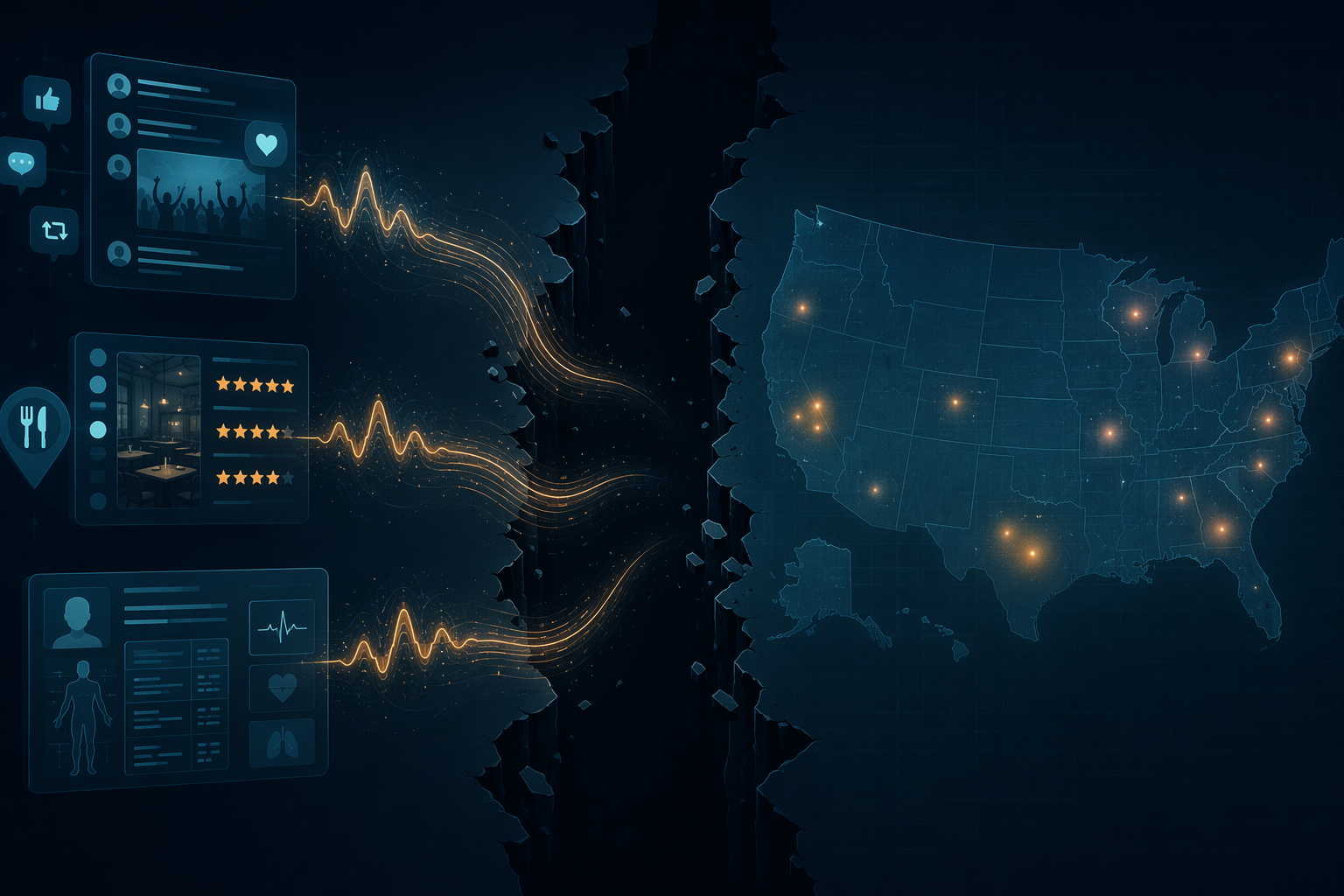
That means the country had data-adjacent signals in places where foodborne illness often first becomes visible: reviews, posts, clinical notes, and state-level reports. What it did not have, at least from the evidence available here, was a routine national mechanism to ingest those weak signals, extract auditable entities, route credible clusters to public health staff, and reconcile them with laboratory and epidemiologic confirmation.
The most useful AI design for this setting would be deliberately unglamorous. It would not issue autonomous outbreak declarations. It would rank reviewable clusters, preserve source text for audit, show which foods and symptoms drove the alert, separate public chatter from first-person illness reports where possible, and let epidemiologists decide whether the signal deserves follow-up.
The 2026 outbreak does not justify saying AI would have identified every source or prevented more than 1,600 confirmed illnesses. It does justify asking why, after reporting became less consistent for Cyclospora and national data could lag state reports by weeks, complementary systems that can read the public and clinical exhaust of GI illness are still not part of the routine US foodborne surveillance stack.[2]
References
- CDC Health Alert Network HAN00531. Centers for Disease Control and Prevention, July 14, 2026.
- Cyclospora outbreak grows amid CDC reporting changes. CIDRAP, July 9, 2026.
- Cyclospora Outbreak Linked to Shredded Iceberg Lettuce. Centers for Disease Control and Prevention.
- Using artificial intelligence to detect foodborne illness from online restaurant reviews. UK Health Security Agency, March 2025.
- A Foodborne Illness Detection Framework by Using Large-Scale Social Media Data. Foods, 2023.
- Machine Learning-Based Prediction of Foodborne Disease Pathogens. JMIR Medical Informatics, 2021.
- European Commission launches AI platform to detect food fraud and outbreaks. Food Safety News, March 2026.
Comments
Join the discussion with an anonymous comment.