
By the time a Cyclospora signal becomes obvious in conventional case reporting, the produce lot that matters may already have been harvested, packed, distributed, eaten, and forgotten. That is the uncomfortable starting point for any serious discussion of AI in lettuce supply-chain surveillance: the first failure is usually not that public health cannot investigate. It is that the first usable signal arrives late.
Cyclospora makes that delay particularly punishing. The illness has an incubation period measured in roughly two weeks, and the 2026 reporting picture was further slowed by an estimated six-week lag before cases were reflected in national counts. As of July 14, 2026, CDC had confirmed 1,645 cases, but that number was understood to represent only a portion of true infections because Cyclospora cannot be cultured and many routine stool tests do not include it unless specifically ordered or included on a multiplex panel.[1]
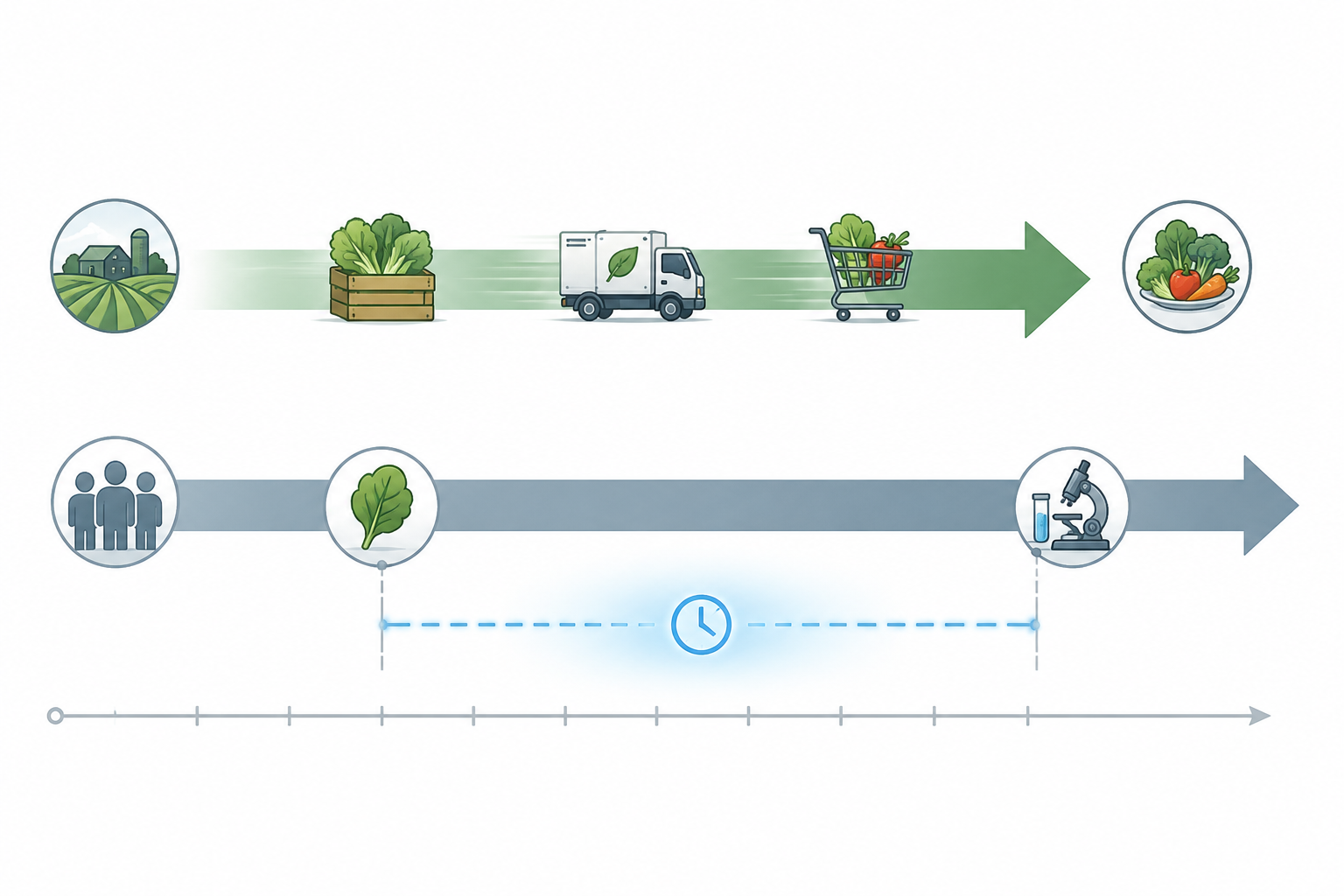
That gap is where multiplex diagnostics and analytics matter. Not because they identify a contaminated farm, processor, or food vehicle on their own. They do not. They matter because they can move the first credible warning from the back end of case aggregation toward the front end of clinical and environmental detection, while there is still a chance to connect patients, specimens, menus, purchase records, and distribution data.
The Case Count Is Already a Delayed Instrument
Human-case surveillance begins after several things have already gone right. A patient has to become ill enough to seek care. A clinician has to order stool testing. The laboratory has to use a method that can detect Cyclospora. The result has to move into the reporting stream. Then an analyst has to see enough related results to suspect a cluster rather than isolated summer diarrhea.
Each step loses time, and some steps lose cases. Routine ova-and-parasite testing does not automatically solve the problem, and many standard stool workflows do not screen for Cyclospora unless the organism is specifically considered. Nonculture diagnosis adds another constraint: there is no isolate to culture and bank in the way many bacterial foodborne investigations rely on. A reported total such as 1,645 cases is therefore useful, but it is not a live map of current exposure.[1]
The genomics do not offer an easy escape hatch. Cyclospora has a genome described as approximately nine times larger than that of E. coli, which makes whole-genome sequencing for traceback far more difficult than the bacterial sequencing workflows many outbreak teams are used to leaning on.[2] That does not make attribution impossible, but it shifts more weight back onto epidemiology, food histories, purchase data, supplier records, and coordination among laboratories, FDA, CDC, state partners, and industry.
This is the operational reason faster detection is valuable. A signal that appears before recall interviews go cold is not just a prettier dashboard. It gives infection prevention teams, public health laboratories, and epidemiologists more living threads to pull.
What the BIOFIRE Signal Actually Adds
The BIOFIRE FILMARRAY GI Panel is relevant here for a simple reason: Cyclospora cayetanensis is included as one of its targets, alongside 21 other enteric pathogens, with a reported turnaround time of about one hour.[3] In a patient with compatible gastrointestinal illness, that can turn Cyclospora from a special-request diagnosis into an organism detected within a syndromic stool panel.
The clinical effect is not abstract. Earlier recognition can get patients to appropriate therapy sooner; trimethoprim-sulfamethoxazole is the standard treatment and can shorten illness duration when used appropriately. It can also prevent a positive result from sitting as a curiosity in one institution while similar positives are accumulating elsewhere.
The more interesting outbreak signal comes when individual test results are viewed as a network trend. bioMérieux reported that its FIREWORKS analytics platform detected Cyclospora positivity on BIOFIRE GI Panels rising from a 1–2% baseline to 10–12% during the outbreak, creating near-real-time syndromic trend data that could be shared with public health authorities.[3]
That comparison needs careful handling. The 1–2% baseline is not a population prevalence estimate. It reflects a tested population: people with gastrointestinal symptoms for whom a multiplex GI panel was ordered. The rise to 10–12% is still a meaningful laboratory signal, but it should be read as a sharp change inside a specific diagnostic stream, not as a direct measure of how many people in the community had Cyclospora.
For a reference laboratory or large hospital, that kind of trend can change the tempo of response. A lab director can alert infection prevention and public health contacts that Cyclospora positives are no longer behaving like background noise. An epidemiologist can begin looking for shared exposures earlier. A state or federal partner can decide whether the pattern is consistent with other jurisdictions before traditional case counts fully mature.
| Signal | What It Can Support | What It Cannot Prove |
|---|---|---|
| BIOFIRE GI Panel positive result | A patient-level molecular detection of Cyclospora DNA in a symptomatic testing workflow | Whether the detected organism is viable, where exposure occurred, or which food vehicle was responsible |
| FIREWORKS trend increase | A near-real-time rise in positivity across participating BIOFIRE testing data | Population prevalence or source attribution by itself |
| WATCHFIRE GI wastewater detection | Community-level evidence that Cyclospora is present near the sampled source | Identification of individual cases, specific meals, or a contaminated supply-chain node |
There is also a laboratory limitation that should not be blurred. Multiplex PCR detects nucleic acid. It does not tell the analyst whether the organism is viable, infectious, or still present in the same form at the point of exposure. That distinction matters when a result is used for clinical care, environmental interpretation, or regulatory follow-up.
Wastewater Moves the Signal Closer to the Source
Patient testing still waits for illness, care seeking, specimen collection, and ordering behavior. Wastewater surveillance changes the sampling frame. bioMérieux describes WATCHFIRE GI as a panel that can detect Cyclospora in community wastewater near the source and return results in approximately one hour from sample collection.[3]
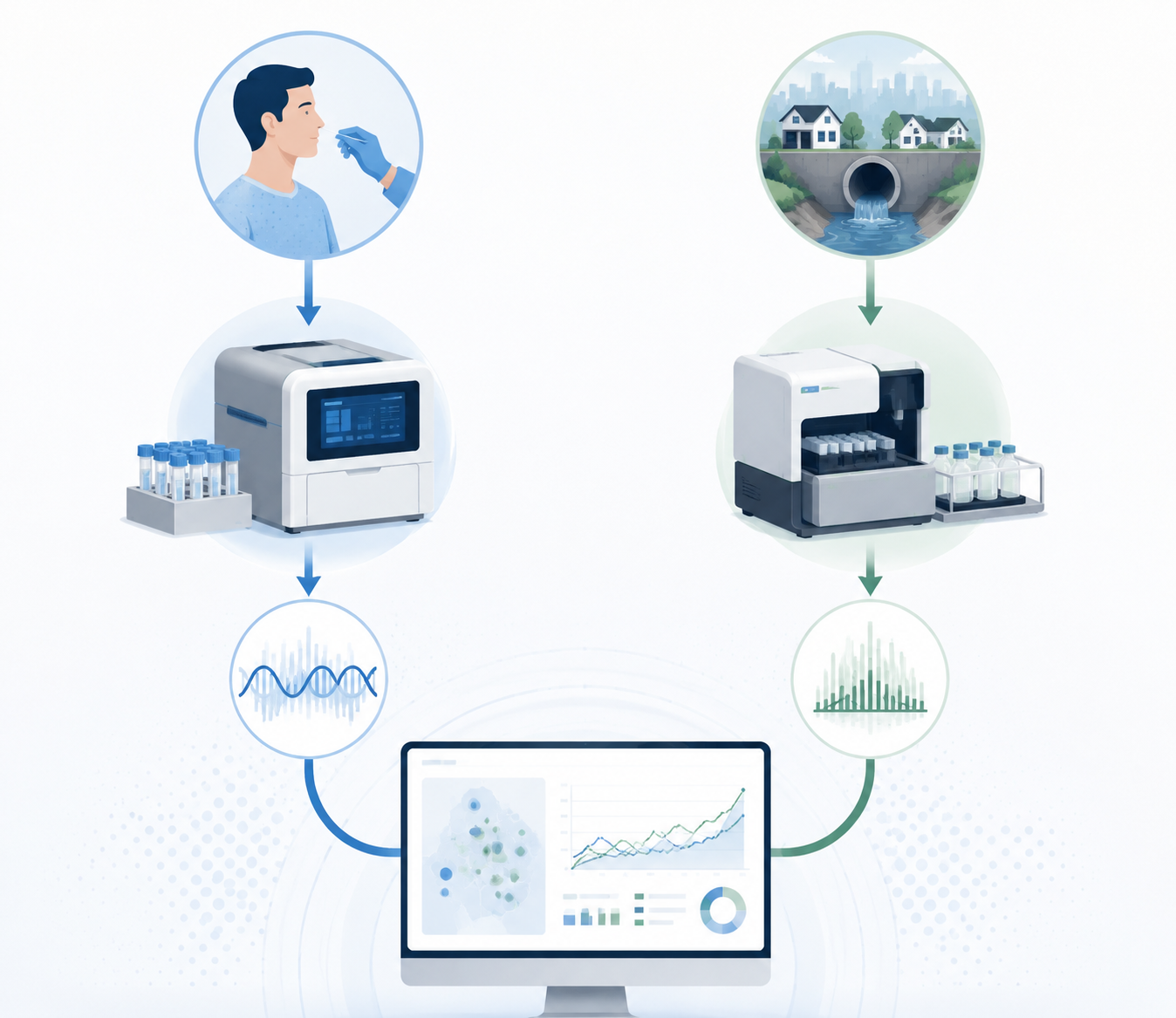
That is a different kind of public health instrument. A clinical panel starts with a sick person. A wastewater assay starts with a community catchment or source-adjacent sampling point. The former is closer to patient management; the latter may be closer to an exposure geography. Neither replaces the other, and neither should be treated as a solitary answer.
In practice, the useful comparison is not which tool is more impressive. It is where each tool moves the bottleneck. A syndromic panel can shorten the diagnostic delay for a symptomatic patient and feed aggregate trend detection. A near-source wastewater result can show that Cyclospora is appearing in a community signal before all individual cases have been recognized. Together, they can give public health teams an earlier reason to start asking the expensive questions: which exposures overlap, which distributors are common, which facilities need attention, and which records are good enough to interrogate.
The hour-scale result is important, but it is not magic. A wastewater positive does not name the infected person. It does not identify the salad mix, herb, berry, supplier, field, processor, or restaurant. It tells the team that the organism’s signal is present in the sampled stream. What happens next depends on sampling design, jurisdictional communication, epidemiologic context, and whether there are patient-level or purchasing data to connect.
Where AI Helps, and Where It Has to Hand Off
The useful role for AI in this setting is pattern recognition under time pressure. FIREWORKS is valuable because it can surface a deviation from expected positivity across diagnostic data before a human analyst manually assembles the same picture from delayed reports. That is a real gain for outbreak visibility.
But visibility is not attribution. A dashboard can show that Cyclospora positivity is rising. It can help prioritize attention, trigger calls, and focus review. It cannot, by itself, certify a lettuce supply chain as Cyclospora-free or identify the contaminated vehicle behind a multistate signal. That remains a records-and-coordination problem as much as a detection problem.
This is where outbreak response often becomes less glamorous and more decisive. Food histories have to be collected while patients can still remember what they ate. Purchase records have to be available and linkable. Distributor and processor data have to be complete enough to compare across cases. FDA and CDC partners need enough converging evidence to move from suspicion to action. A faster molecular signal can start that work earlier, but it cannot substitute for the work.
The current deployment pattern also limits equity of benefit. These tools are most likely to be available through reference laboratories, larger hospitals, and organized surveillance programs. Rural and under-resourced settings, where patients may still present with prolonged diarrheal illness, may not have the same immediate access to multiplex testing or near-source wastewater workflows. If the surveillance network sees mainly the places with advanced testing, the blind spots do not disappear; they become easier to overlook.
The Detection Window Can Collapse Before the Traceback Does
The practical advance is substantial. A one-hour multiplex result can make Cyclospora visible to a clinician and laboratory while the patient is still in the care pathway. A networked analytics platform can show that positives are rising from a low tested-population baseline to an outbreak-like pattern. A near-source wastewater assay can put a community signal in front of public health before case reports finish catching up.
That is how the delay moves from weeks toward hours or days. It does not mean the contaminated food vehicle is identified in hours. It means the first credible warning can arrive early enough for clinical treatment, cluster recognition, targeted questioning, and interagency coordination to begin sooner.
For Cyclospora, that distinction is the whole point. AI-enhanced multiplex diagnostics and wastewater surveillance can collapse the detection lag. Food vehicle identification still depends on the slower, less automated machinery of supply-chain records, exposure interviews, traceback, and public health coordination. The clock can start earlier now. It still has to be used well.
References
- CIDRAP analysis, CIDRAP
- Inside the fight against the parasite Cyclospora, Science News
- Tracking the Cyclospora cayetanensis Outbreak in the United States, bioMérieux
Comments
Join the discussion with an anonymous comment.