
The strongest reason to take AI in brain health and dance exercise programs seriously is not the AI. It is that dance therapy already has a measurable cognitive signal before any camera, sensor, or algorithm enters the room.
In a 2023 meta-analysis of dance therapy for older adults with mild cognitive impairment, Huang and colleagues included 984 participants aged 55 and older and found improvement in global cognitive function, with a standardized mean difference of 0.94. The analysis also reported effects across memory, executive function, attention, language, and mental health outcomes, which matters because cognitive decline rarely presents as a single isolated deficit in the clinic. The dose signal was also clinically useful: programs lasting more than 12 weeks and delivered at least three times per week produced larger effect sizes. [1]
That finding gives dance a sturdier rationale than the loose “movement is good for the brain” language that often surrounds it. Dance asks a participant to remember sequences, shift attention, coordinate timing, respond to rhythm, monitor balance, and often move in relation to other people. It can be pleasant, but it is not light cognitive work.
The same meta-analysis also marks the first practical constraint. Dance therapy is not one standardized treatment. The included evidence drew heavily from Chinese and European studies, including square dance and ballroom dance, and the effective dose implied frequent attendance over months. [1] A US memory clinic, community senior center, or outpatient rehabilitation program cannot assume that the same form, schedule, staffing, and cultural fit will transfer unchanged.
What AI is being asked to change
The clinical promise of AI-enhanced dance therapy is not that it makes dance more futuristic. The useful question is narrower: can AI make the intervention better matched to a person’s cognitive and motor profile, easier to measure, and safer to adjust over time?
A conventional group class usually adapts through the therapist’s eye, verbal check-ins, and broad modifications: slow the tempo, simplify the step, add a chair, reduce turning, repeat the sequence. Those adaptations are valuable, and they are also difficult to quantify. AI systems attempt to make more of that clinical observation visible: step timing, range of motion, hesitation, balance challenge, fatigue signals, physiological arousal, engagement, and change across sessions.
If that measurement is accurate and not too burdensome, it could shift dance therapy from a fixed class format toward an adaptive rehabilitation program. If it requires extra calibration, produces vague alerts, or asks participants to tolerate unrealistic session demands, the technology becomes another task for therapists, caregivers, and patients to manage.
The personalization study that makes the AI question concrete
The most direct evidence for AI-personalized dance therapy comes from Yan and colleagues’ 2026 conference paper on deep learning multimodal fusion for individualized dance treatment. The study reported treatment effectiveness of 89.3% for AI-personalized plans versus 72.1% for standardized plans across 1,250 patients. It also described attention-weight modulation that varied across mild cognitive impairment, Alzheimer’s disease, and anxiety, suggesting that the system was not merely assigning a preferred dance style but weighting different cognitive and clinical features differently by condition. [2]
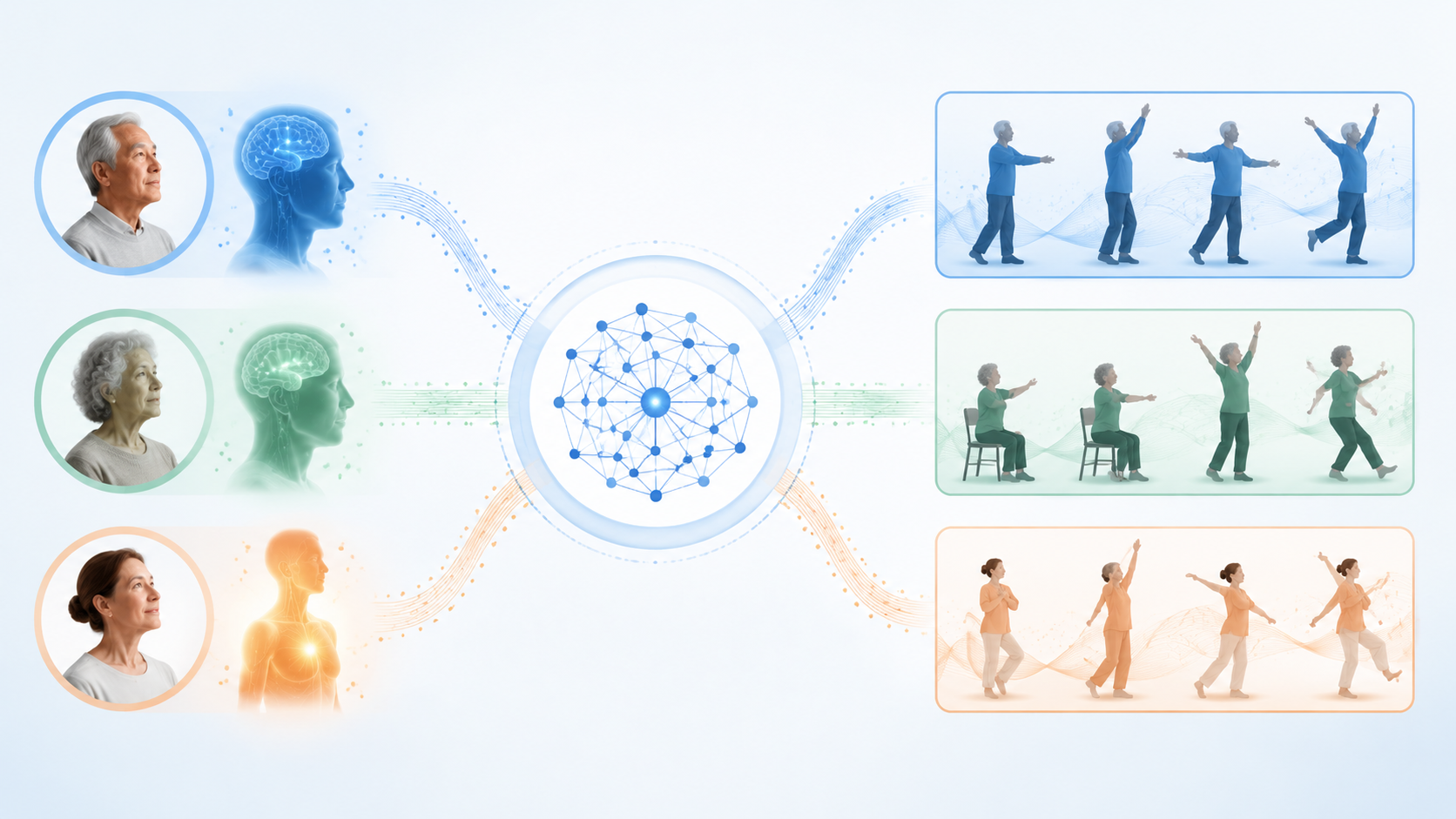
Operationally, that is the part worth noticing. A useful AI layer would not simply ask whether a participant has “memory problems” and then recommend a generic low-intensity dance class. It would need to distinguish, for example, a person whose main barrier is sequence recall from one whose limiting factor is gait instability, divided attention, anxiety during group movement, or fatigue after several repetitions. The treatment plan might then change the rhythm complexity, cueing frequency, movement amplitude, partner work, repetition structure, or rest interval.
That distinction is clinically important because two participants with the same diagnosis can fail the same dance task for different reasons. One may lose the sequence after a turn. Another may remember the pattern but reduce step length when the tempo changes. A third may perform adequately when cued one-on-one but withdraw in a group setting. Personalization only matters if it detects differences that change the therapy plan.
The caveat belongs close to the result. Yan et al. is a conference paper, and the dataset came from urban South Korean hospitals. [2] That does not make the finding unimportant, but it does limit how far it can travel. Replication in broader populations, with transparent outcome definitions and comparison groups that resemble real clinical programs, is still needed before the reported effectiveness gap can be treated as a dependable clinical effect.
Measurement is the intervention’s hinge point
The emerging technology stack around AI-enhanced dance therapy can be understood as a measurement pipeline. First, the system observes movement. Then it classifies or quantifies features of that movement. Then it combines those data with cognitive, affective, or physiological information. Only after that can it adapt the task, dose, or cueing strategy.
| Clinical task | What AI may add | What still has to be proven |
|---|---|---|
| Observing participation | Attendance, adherence, completion, session-to-session change | Whether digital tracking improves outcomes rather than just documentation |
| Capturing movement | Computer vision or sensors measuring timing, amplitude, coordination, and variability | Accuracy across body types, mobility aids, room layouts, and lighting conditions |
| Combining profiles | Multimodal models linking motor, cognitive, mood, and physiologic data | Whether model outputs lead to better clinical decisions |
| Adapting therapy | Changes in rhythm, sequencing, intensity, cueing, or rest | Whether adaptation improves cognition, mobility, safety, or adherence |
| Monitoring risk | Detection of fatigue, imbalance, distress, or overarousal | Whether alerts are reliable enough to help therapists rather than distract them |
This is where dance therapy begins to overlap with other markerless movement-analysis work in rehabilitation. The same computer vision logic discussed in How Football’s Offside AI Is Becoming a Clinical Tool is relevant here: cameras and models can turn movement into analyzable data without requiring every participant to wear a lab-grade motion-capture setup. In dance therapy, however, the bar is not whether the system can track a limb in a demonstration. It is whether the system can track clinically meaningful change while an older adult is turning, stepping, pausing, compensating, and sometimes moving imperfectly on purpose to stay safe.
Closed-loop dance therapy: promising, but still small
Radanliev’s 2025 XR dance/movement therapy work shows where the field is trying to go: a closed-loop system that uses biometric monitoring, including heart rate variability and skin conductance, to adapt movement therapy in real time. [3] This is a different level of ambition from recording attendance or scoring steps after a session. The system is meant to sense the participant’s state during movement and adjust the therapeutic environment accordingly.
For cognitive decline and neurodegenerative disease, that idea has appeal. A participant may need stimulation, but not overload. A movement sequence may be therapeutic at one tempo and destabilizing at another. Anxiety, frustration, and fatigue can change performance before they appear as a fall or a refusal to return next week. A closed-loop system could, in principle, help therapists adjust earlier.
The evidence is not yet at the same level as the ambition. The Radanliev paper is single-author, the pilot involved 20 participants, and the larger trial design proposing 102 or more participants with HPO classification had not yet produced completed trial results in the cited work. [3] It is best read as an architecture and early feasibility signal, not as proof that XR-biometric dance therapy improves cognitive outcomes.
Parkinson’s disease shows why motor-cognitive measurement matters
Bek and colleagues’ 2025 digital dance work in Parkinson’s disease is clinically useful because Parkinson’s makes the motor-cognitive interface difficult to ignore. Dance programs for Parkinson’s are not only about exercise tolerance. They also involve timing, cue response, balance confidence, initiation, freezing risk, mood, and social participation.
The study used computer vision and machine learning to measure movement changes and adjust programs, and the feasibility data showed good attendance and adherence, no adverse events, and signals of improvement in functional mobility, anxiety, and depression. [4] Those are the kinds of outcomes that matter to patients and therapists even when a study is not powered to make large efficacy claims.
The limitations are also familiar: small samples, reliance on self-report data, and no direct comparison with in-person delivery. [4] Digital dance may reduce travel burden and support home or hybrid participation, but it may also remove hands-on support, immediate environmental correction, and some social cueing. A remote system that works well for a confident participant with stable internet and a safe room may not work for someone with fluctuating balance, low digital literacy, or a caregiver who cannot supervise sessions.
Adjacent evidence: exergaming, dual-tasking, and dementia care
Dance-based exergaming adds another nearby line of evidence. The University of Illinois Chicago Cognitive Motor and Balance Rehabilitation Laboratory describes VR-based motor-cognitive dual-tasking for chronic stroke and mild cognitive impairment, including feasibility work in upper-extremity rehabilitation and fall-risk reduction. [5] This is not the same as AI-personalized dance therapy for dementia, but it supports a related clinical premise: movement programs can be designed so that motor and cognitive demands are trained together rather than treated as separate rehabilitation targets.
The dementia-focused discussion by Fontanesi and Newman-Bluestein adds a different caution. Their 2024 article emphasizes synchrony, syncopation, embodied expression, AI monitoring, and the preservation of personhood in Alzheimer’s disease and dementia care. [6] This language can sound soft compared with effect sizes and classifiers, but it points to something clinicians recognize: in severe cognitive impairment, the value of movement may include expression, connection, and regulation even when conventional cognitive gains are hard to measure.
That human value should not be inflated into a claim of disease modification. It does mean that outcome selection needs care. A dementia dance program might reasonably measure agitation, affect, engagement, caregiver experience, gait confidence, or participation quality alongside cognition. If AI monitoring is introduced, it should preserve those therapeutic aims rather than narrowing the session to whatever the model can score most easily.
Where the evidence stands in 2026
The evidence is strongest for dance therapy as a cognitive and mental health intervention in older adults with mild cognitive impairment, with a visible dose signal in the 2023 meta-analysis. [1] The evidence is more preliminary for AI-enhanced dance therapy specifically. Yan et al. provides the most direct personalization result, but it remains a conference-paper finding from urban South Korean hospital data. [2] XR-biometric and digital dance studies show plausible implementation routes, but they are still small, early, or feasibility-oriented. [3][4]
No FDA-cleared AI dance therapy products are identified in the available evidence. The systems described here are research-stage or pilot-stage clinical applications, not routine clinical tools. That regulatory gap matters because AI-supported rehabilitation products do not only need engaging content; they need defined indications, validated measurements, safety procedures, data governance, and a clear account of who responds when the system detects risk.
For clinicians and researchers, the practical reading is this: AI-enhanced dance therapy is a plausible next step for brain health programs because it targets a real limitation of current dance interventions—the mismatch between heterogeneous patients and standardized classes. The early evidence suggests that models may help personalize therapy, quantify movement, monitor engagement, and support adaptive dosing. It does not yet show that these systems are ready for broad clinical deployment across diverse US populations.
The work that would change that judgment is not mysterious. The field needs diverse comparative trials, clearer outcome definitions, replication outside narrow source populations, direct comparisons of digital and in-person delivery, and safety reporting that includes falls, near-falls, fatigue, distress, adherence failures, and caregiver burden. Until then, AI-enhanced dance therapy sits in a useful but unfinished category: mechanistically credible, clinically interesting, and still too under-tested to be treated as standard care.
References
- Effects of dance therapy on cognitive and mood symptoms in people with mild cognitive impairment: A systematic review and meta-analysis, PMC, 2023.
- Research on Individualized Dance Treatment Plan Based on Deep Learning Multimodal Data Fusion, ACM, 2026.
- XR-DMT: extended reality dance movement therapy with biometric monitoring, Frontiers in Virtual Reality, 2025.
- Digital dance for Parkinson’s disease, Frontiers in Psychology, 2025.
- Dance-based exergaming, University of Illinois Chicago Cognitive Motor and Balance Rehabilitation Laboratory.
- Dance/movement therapy for Alzheimer’s disease and dementia: Syncopation, synchrony, and artificial intelligence monitoring, Frontiers in Psychology, 2024.
Comments
Join the discussion with an anonymous comment.