
The stock risk in AI data center energy demands does not begin at the utility meter. It begins in the contract stack. A healthcare AI vendor sells documentation automation, coding support, imaging assistance, triage tools, prior authorization workflow, or patient messaging into a hospital. Many of those products then call models, storage, APIs, and cloud infrastructure controlled by a hyperscaler. If power, grid upgrades, or AI infrastructure costs rise, the hyperscaler has more room to absorb the hit, reprice services, optimize workloads, or negotiate supply than the healthcare AI vendor has to refuse the bill.
That is the asymmetric risk investors should care about. AI data center energy demands are not automatically bearish for every healthcare AI stock. They are a margin problem for companies whose products become more useful only as inference volume rises, but whose compute costs are rented from infrastructure providers with greater pricing power.
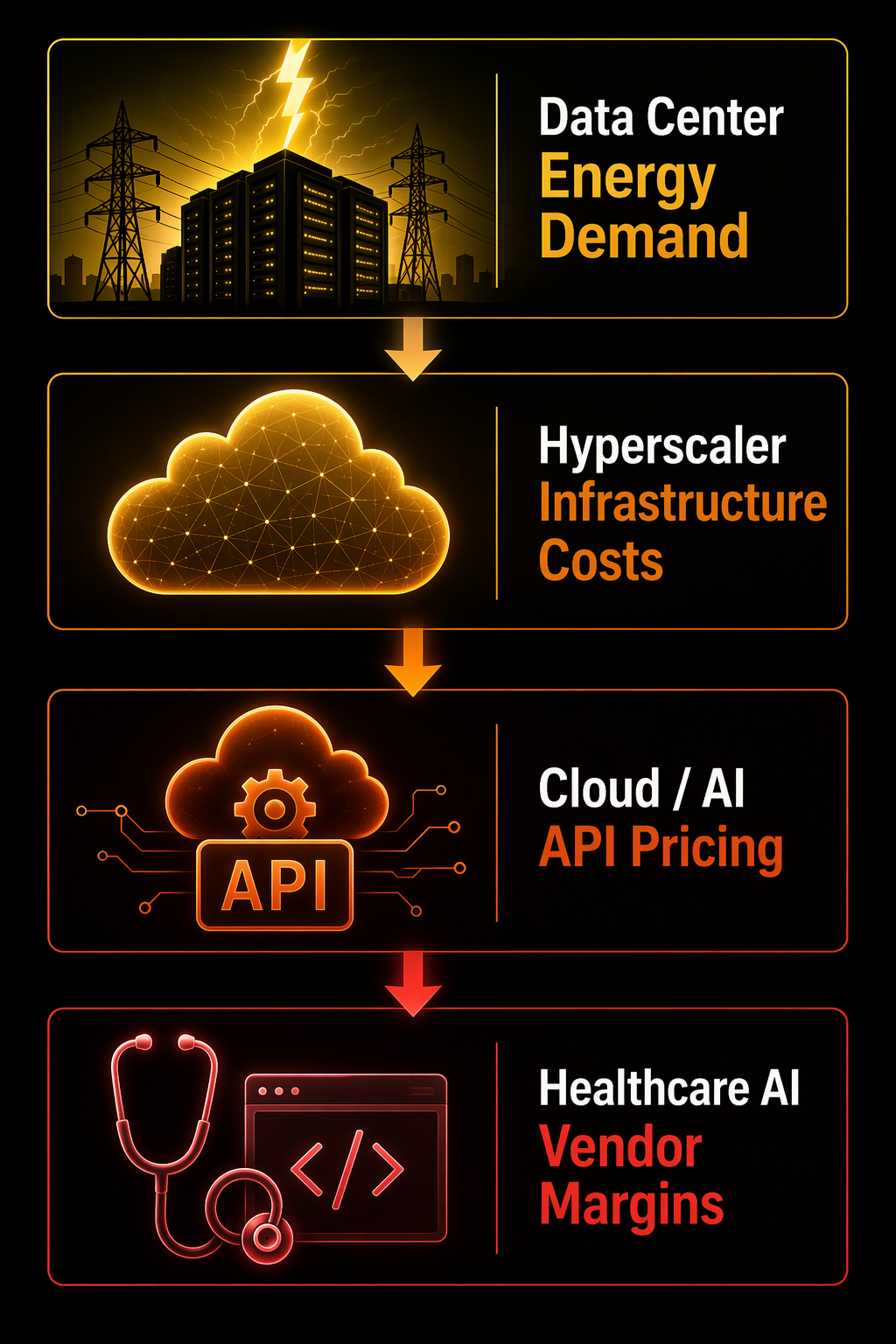
The Cost Chain Is No Longer Theoretical
Goldman Sachs projected in May 2026 that U.S. data center power demand would more than double to 66 GW by 2027. The same estimate put AI infrastructure capital expenditure at $527 billion for 2026, with continuing upward revisions.[1] Those numbers matter less as a macro spectacle than as a clue about bargaining power. When an input requires that much capital, the firms controlling access to it eventually have to decide who pays.
Morgan Stanley’s February 2026 work makes the bridge more explicit: hyperscalers could spend more than $1 trillion in 2025–2026 and may pass energy-cost increases through to cloud and AI service customers.[2] For healthcare AI, that is the sentence that turns a grid story into an earnings story. The relevant question is not whether a documentation model consumes much power in isolation. It is whether a vendor’s gross margin assumes that cloud, GPU, and API costs remain tame while usage scales across thousands of clinicians.
The International Energy Agency’s executive summary provides the broader demand trajectory: AI and data centers are part of a rising electricity-consumption path, even when forecasts vary by region, model mix, and efficiency assumptions.[3] That backdrop does not prove any individual healthcare AI company is mispriced. It does make it harder to treat compute as a weightless cost of goods sold.
Inference Volume Is the Healthcare-Specific Multiplier
Healthcare AI is unusually exposed to inference economics because many of its most commercially attractive products are repeat-use workflow tools. A clinical note draft is not a one-time event. A coding suggestion is not a demo. A radiology assist, inbox reply, eligibility check, denial appeal draft, or call-center summarization model creates value by being used again and again inside routine operations.
Brookings estimated in April 2026 that AI inference queries consume about 0.24–2.9 Wh per query depending on model complexity.[4] That range is small at the level of one query and material at the level of adopted workflow. The unit cost does not have to look frightening on a slide to matter in a gross-margin bridge. If a product’s revenue model is per seat, per encounter, per document, or per covered life, and model calls rise faster than contracted revenue, the margin pressure shows up quietly before it shows up dramatically.
This is why adoption and profitability must be kept separate. A hospital can increase usage of an AI scribe, coding assistant, or administrative automation tool because the tool saves time. That does not mean the vendor captures the full benefit. Inference-heavy adoption can improve retention while also increasing the vendor’s dependence on compute prices it does not control.
| Healthcare AI product pattern | Why energy-linked compute costs matter |
|---|---|
| High-frequency clinical documentation | More encounters can mean more model calls, even when customer pricing is fixed by seat or contract period. |
| Administrative automation and coding support | Usage can scale across claims, denials, messages, and reviews, creating recurring inference demand. |
| Imaging or decision-support assistance | Model complexity may raise compute intensity, though actual exposure depends on architecture and deployment. |
| Enterprise platforms with mixed AI features | Large firms may offset AI compute pressure through broader contracts, bundled pricing, and infrastructure leverage. |
Hyperscalers Have More Escape Routes
The large cloud providers are not immune to power costs. They are simply better positioned. They can sign long-term energy agreements, finance infrastructure, shift workloads, improve chip and model efficiency, price premium AI services differently, and spread capital spending across a much larger revenue base. They also sit closer to the point where infrastructure costs are translated into customer prices.
A smaller healthcare AI vendor has fewer choices. It can optimize prompts, compress models, cache outputs, renegotiate cloud contracts, restrict high-cost features, or raise prices at renewal. Those are real levers, but they are not equivalent to owning the infrastructure layer. The smaller the vendor and the more competitive the category, the harder it is to pass through cost increases without slowing sales or inviting replacement.
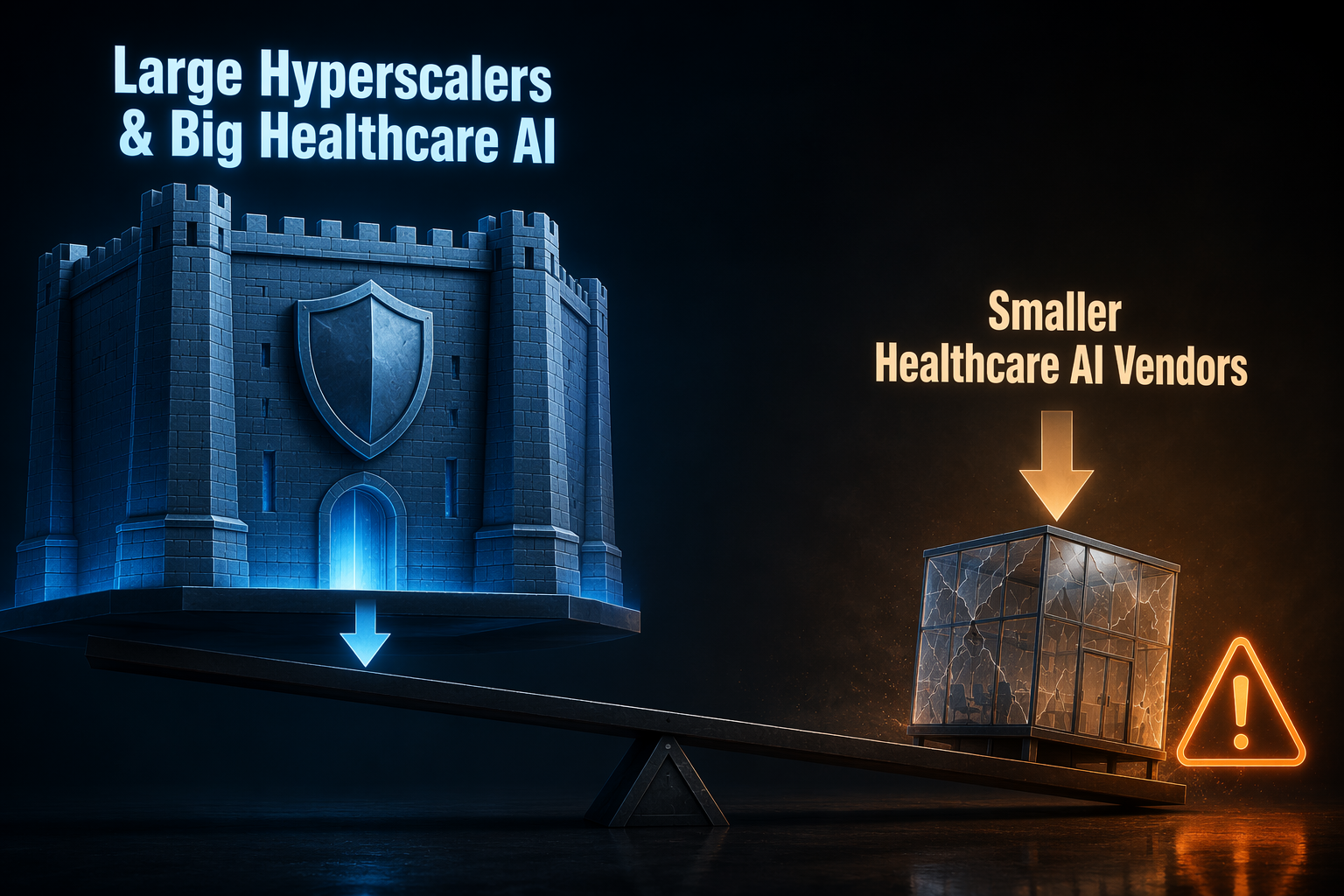
That asymmetry is the point. A large healthcare technology company with a broad installed base can bundle AI into enterprise contracts, subsidize features temporarily, and absorb compute volatility across a wider platform. A smaller vendor selling a narrow AI workflow may have excellent product-market fit and still be exposed if its cost per action rises while hospital purchasing teams resist mid-contract price changes.
Grid Upgrade Costs Add a Second Pass-Through Risk
Electricity prices are only one part of the risk. Grid connection and upgrade costs matter because data centers can require infrastructure that local ratepayers, utilities, developers, and large power customers may fight over for years. CNBC reported in June 2026 that the Ratepayer Protection Act, then under House consideration, would require data-center builders to pay for grid upgrades.[5] As of that June 2026 reporting, it should be treated as a legislative proposal, not settled law.
For healthcare AI investors, the bill’s significance is not partisan or procedural. It is a cost-allocation signal. If more grid-upgrade costs land on data-center builders, some of those costs may eventually appear in hyperscaler economics. From there, they can move into cloud and AI service pricing, especially for customers without scale discounts or strategic importance.
That does not mean every cloud customer receives an immediate surcharge. Large providers may absorb some costs, phase them into regional pricing, adjust service tiers, or recover them through broader AI infrastructure pricing. The risk for smaller healthcare AI vendors is that they are usually price takers in that chain.
Efficiency Helps, But It Does Not Remove the Exposure
The cleanest objection to the margin-risk argument is efficiency. It is a serious objection. Google reported a 33-fold reduction in inference energy from May 2024 to May 2025, while absolute data-center electricity consumption still grew 27% year over year.[6] The first number says engineering can reduce unit cost. The second says lower unit cost can coexist with higher total consumption when usage expands.
Both can be true inside healthcare AI. A vendor may reduce tokens per task, route simple work to smaller models, cache standard outputs, or move some functions to more efficient infrastructure. At the same time, successful deployment can push AI into more encounters, more departments, more administrative queues, and more patient interactions. Efficiency changes the slope. It does not guarantee the cost line stays flat.
This is also why broad claims about an AI energy crisis are less useful than a product-level cost model. The relevant diligence question is not whether AI consumes energy. It is whether a vendor’s revenue per workflow event exceeds its fully loaded cost per workflow event after cloud, model, storage, compliance, monitoring, and support costs are included.
Where the Stock Risk Concentrates
The source material does not provide healthcare AI company-specific figures for energy cost as a percentage of revenue, cloud cost per inference, or gross-margin sensitivity by vendor. That absence matters. It means the risk cannot be assigned equally across named companies without further diligence. It also means investors should be suspicious of valuation stories that assume usage growth while leaving the compute line vague.
The exposure pattern is still credible. The risk concentrates where three conditions overlap: high inference volume, limited customer pricing power, and dependence on hyperscaler infrastructure. A company with those traits may report strong demand and still face downward pressure if cloud or AI service pricing moves against it.
- Highest concern: smaller or mid-cap healthcare AI vendors with narrow products, heavy model-call volume, and contracts that do not clearly pass infrastructure cost increases to customers.
- Moderate concern: larger healthcare AI firms that rely on third-party cloud infrastructure but have broader contract leverage, more pricing flexibility, and more engineering resources.
- Lower concern: hyperscalers and infrastructure-rich platforms that can internalize efficiency gains, negotiate energy supply, and reprice AI services across a large customer base.
CNBC’s January 2026 warning that many small companies in the AI power ecosystem are “highly leveraged” and volatile is not a healthcare AI margin model, but it is relevant to the same financing environment.[7] Companies positioned downstream from AI infrastructure can look attractive while the market pays for growth. They become more fragile when capital intensity, power constraints, and cost pass-through start to matter.
What Investors and Buyers Should Watch
For investors, the first signal is not a press release about green power. It is gross margin resilience as AI usage scales. If revenue growth depends on more clinicians, more documents, more images, more claims, or more messages flowing through models, then cost of revenue should be read with the same care as net retention. A vendor that celebrates utilization but discloses little about cloud cost discipline is asking the market to underwrite an input it does not control.
Cloud gross margins and AI service pricing also deserve more attention than they usually receive in healthcare AI valuation work. If hyperscalers begin recovering energy and infrastructure costs through AI APIs, premium model access, regional compute pricing, or enterprise contract terms, the impact will not arrive evenly. Strategic accounts and large platforms may negotiate. Smaller healthcare AI vendors may absorb.
Procurement teams should read infrastructure language closely. A hospital may not care which cloud region or model route a vendor uses until service cost, uptime, or renewal pricing changes. Contract terms around usage limits, AI feature tiers, pass-through infrastructure charges, data residency, and model substitution are not back-office details when a vendor’s service depends on an increasingly capital-intensive compute layer.
- Watch whether vendor gross margins hold as inference-heavy products move from pilots to enterprise deployment.
- Watch whether cloud and AI API providers change pricing, service tiers, or regional availability as infrastructure spending rises.
- Watch contract language that allows vendors to pass through infrastructure, hosting, or third-party AI service costs.
- Watch products where revenue is fixed but model calls increase with clinical or administrative adoption.
- Watch policy decisions that shift grid-upgrade costs toward data-center builders and, indirectly, their tenants.
AI data center energy demand is not a blanket short thesis on healthcare AI. The better distinction is between companies that control or can bargain over the compute stack and companies that rent it while promising customers cheap, scalable automation. For the second group, rising infrastructure costs are a material and underpriced stock risk because the next dollar of cost is more likely to land on the party with the least power to renegotiate it.
References
- Goldman Sachs AI infrastructure capex and U.S. data center power demand projection, Goldman Sachs, May 2026.
- Hyperscaler AI infrastructure spending and energy-cost pass-through analysis, Morgan Stanley, February 2026.
- Executive summary: energy and AI data center electricity demand trajectory, International Energy Agency.
- AI inference query energy consumption estimate, Brookings, April 2026.
- Ratepayer Protection Act and data-center grid upgrade cost reporting, CNBC, June 2026.
- Inference energy reduction and data-center electricity consumption disclosure, Google, May 2024–May 2025.
- Small-company leverage and volatility in the AI power ecosystem, CNBC, January 2026.
Comments
Join the discussion with an anonymous comment.