
The practical question for health systems is not whether an AI data center moratorium will shut off a radiology model next month. There is no evidence that it will. The more useful question is what changes when an AI deployment plan depends on future cloud capacity, regional power availability, facility permitting, compliance review, and a budget that already has to explain why inference costs keep moving.
Two policy signals make that question harder to avoid. At the federal level, S.4214, the AI Data Center Moratorium Act introduced by Sen. Bernie Sanders and Rep. Alexandria Ocasio-Cortez, would pause certain data center developments and has National Nurses United listed among its endorsers.[1] Reporting on the proposal makes clear that it faces long odds in the current Congress, but that is not the same as irrelevance.[2] A bill can fail and still teach hospital planners something about where public pressure is moving.
The more concrete signal came from New York. On July 14, 2026, the state imposed what CNBC described as the first U.S. state AI data center ban, structured as an executive order and applying to facilities at or above 50 megawatts.[3] That scope matters. It does not describe the server closet beside a hospital data center, and it does not cancel existing cloud services. It targets new large-scale facilities, which is precisely where future hyperscale AI capacity is supposed to come from.

A Moratorium Can Change Planning Without Stopping Current Services
The first planning mistake would be to overstate the immediate legal effect. These measures are not a switch that turns off current cloud regions. They are aimed at new construction, large facilities, or approval pathways. For most clinical AI tools already running in commercial cloud environments, the near-term operational risk is not that a state order suddenly breaks the application.
The second mistake would be to dismiss the movement because the most sweeping federal proposal is unlikely to become law. Healthcare infrastructure planning is not built only around statutes already in force. It is built around lead times, capital approvals, vendor roadmaps, facilities constraints, and the probability that a dependency will become more expensive or less available just as a clinical program moves from pilot to production.
That is why New York’s threshold is important. A 50 MW cutoff is not a healthcare-specific rule, but healthcare AI buys capacity from the same cloud and data center markets that are trying to serve frontier model training, enterprise copilots, financial services, and consumer inference. If more states or local authorities slow the construction of large facilities, the burden may not show up as a prohibition on clinical AI. It may show up as longer procurement cycles, less favorable pricing, tighter regional capacity, or fewer acceptable options for workloads that must stay near particular patients, physicians, or datasets.
Reuters has tracked authorities restricting data centers amid the AI boom, a reminder that the New York order sits inside a broader set of local and state conflicts over land, energy, and infrastructure.[4] Hospitals do not need to take a position on every one of those conflicts to recognize the pattern. Data center capacity is becoming a governed resource, not an invisible utility.
Healthcare AI Is Not Just Another Cloud Workload
The case for cloud-first healthcare AI was never irrational. Cloud services made pilots easier to start, helped teams avoid early capital purchases, and gave researchers and informatics groups access to infrastructure they could not have built quickly inside a hospital. For model development, burst experimentation, and temporary research environments, that flexibility still matters.
Production clinical AI behaves differently. A model embedded in emergency care, imaging workflow, revenue cycle review, bedside documentation, or capacity management is not an occasional experiment. It receives repeated requests, interacts with live operational systems, and often depends on data that already sits inside the health system. If the workflow becomes clinically meaningful, the infrastructure stops being a background technical choice. It becomes part of the care pathway.
The data gravity problem is unusually severe in healthcare. Iceotope states that hospitals produce about 50 petabytes of data yearly, a scale that makes constant cloud movement expensive and operationally awkward when large volumes must be repeatedly prepared for inference.[5] The exact economics will differ by system, contract, architecture, and workload, but the direction is familiar to anyone who has priced storage, egress, backup, and security controls across multiple environments.
Energy intensity adds another pressure point. Iceotope cites Cisco data indicating that a typical AI data center query uses about 2.9 Wh, compared with about 0.3 Wh for a standard search.[5] That comparison does not prove a specific hospital’s bill will rise by a fixed amount. It does explain why inference-heavy applications become harder to treat as marginal consumption. A scribe, imaging triage tool, prior authorization assistant, or inbox summarizer that runs all day across many users creates a different infrastructure profile than a limited proof of concept.
Forbes has described projected AI inference workload growth of about 30% annually in the context of data center and energy risk.[6] Whether a given health system grows faster or slower, the planning implication is straightforward: when inference volume compounds, any constraint on future capacity becomes more visible in budgets and service commitments.
Why Limited Construction Rules Still Reach The Hospital Budget
A hospital CIO does not usually control where a hyperscaler builds its next region, how fast a utility can connect a new facility, or whether a local permitting dispute delays construction. Yet a cloud-dependent AI roadmap assumes all of those decisions work out well enough to keep capacity available at tolerable cost.
That assumption becomes thinner when moratorium proposals enter mainstream policy debate. Cornell expert commentary on the federal moratorium bill called the concerns behind it “legitimate,” which is a modest but meaningful signal: the politics of data center growth are no longer confined to environmental advocates or neighborhood opponents.[7] They are becoming part of national AI governance.
The healthcare consequence is indirect. A moratorium constraining new large-scale data center construction does not tell an oncologist that a decision-support model is unavailable. It tells the health system that one of the model’s hidden dependencies may become less predictable. That is enough to change architecture decisions, especially for applications expected to become routine rather than experimental.
| What the moratorium signal affects | What it does not directly prove | Why health systems still care |
|---|---|---|
| Future large-scale data center construction and approval pathways | Immediate interruption of existing clinical AI tools | Production AI roadmaps depend on future capacity, not only current service availability |
| Regional cloud capacity and power competition over time | That every healthcare workload should move on premises | Latency-sensitive and high-volume inference may need more controlled placement |
| Cloud price and procurement uncertainty | That hyperscale cloud is unsuitable for healthcare | Budget owners need scenarios for cost escalation and capacity constraints |
| Compliance and governance scrutiny of external dependencies | That local infrastructure removes regulatory burden | Hybrid architectures still require security, monitoring, audit, and facilities readiness |
There is also a reputational and public-interest layer that healthcare cannot ignore. Brookings has placed AI’s energy demands inside the broader regulatory landscape for artificial intelligence, reflecting the extent to which compute capacity, electricity supply, and public policy are now linked.[8] Hospitals are anchor institutions in their communities. If their AI strategy appears to rely on unlimited external power consumption while local access, rates, and infrastructure are politically contested, the discussion will not stay inside IT.
Cloud-First And Hybrid On-Premises Are Different Operating Models
The shift under discussion is not a romantic return to owning every machine. It is a more selective question: which healthcare AI workloads should run in cloud environments, which should run closer to the EHR and clinical data estate, and which should move between the two depending on sensitivity, volume, cost, and performance?
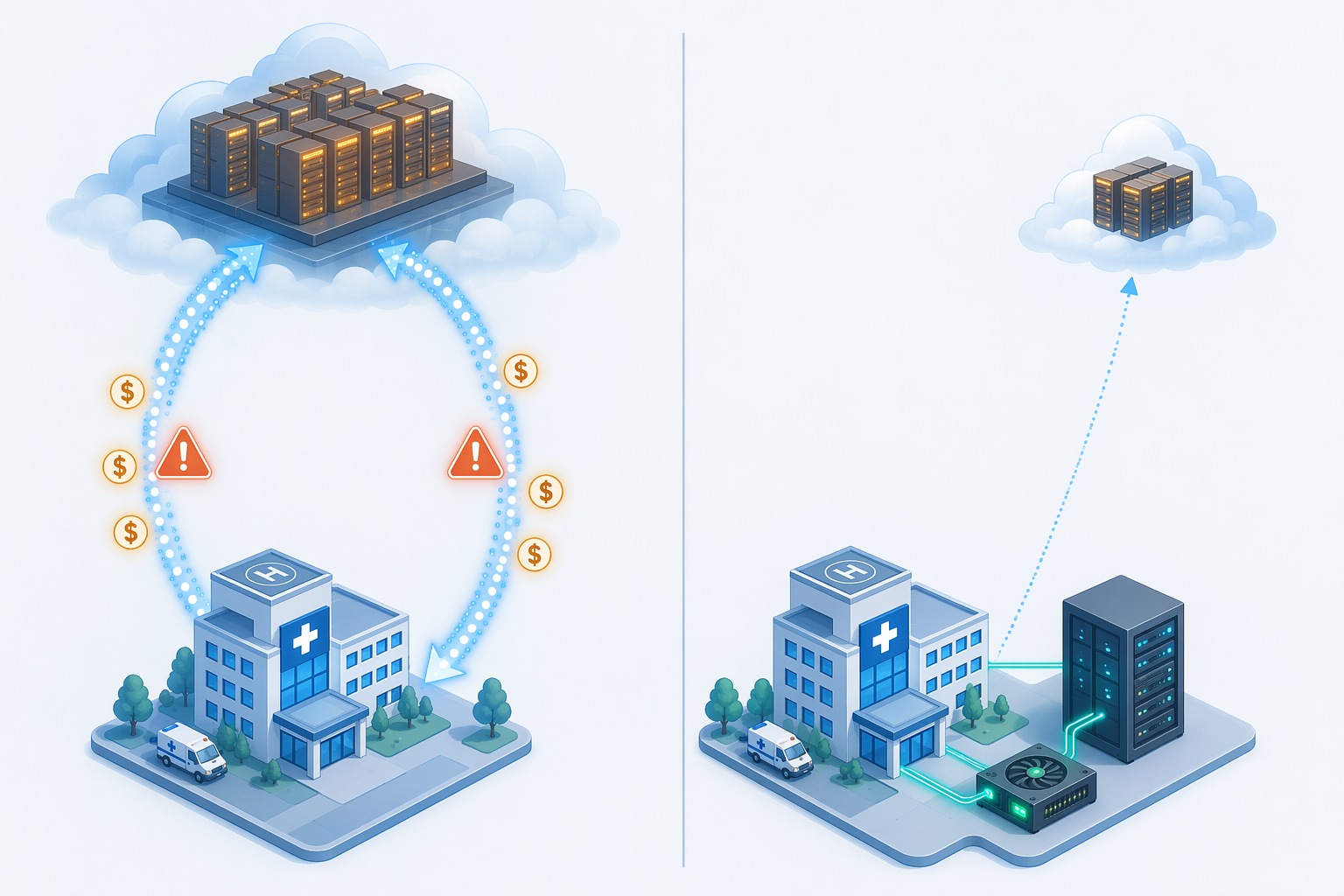
In a cloud-first pattern, the default assumption is that model access, storage expansion, orchestration, and often inference run in hyperscale environments unless a specific barrier forces an exception. That pattern is attractive when a team needs speed, does not know final demand, or wants to test several tools before making a capital commitment. It also fits research and development work where usage is intermittent and flexibility matters more than the lowest possible unit cost.
In a hybrid on-premises pattern, the default assumption changes. Sensitive or high-volume inference may run inside health system-controlled infrastructure, while cloud services remain available for model development, large-scale training access, burst capacity, backup options, or vendor-managed functions that are not latency-sensitive. The goal is not to remove cloud from the stack. It is to stop treating cloud as the automatic destination for every inference request.
HealthTech Magazine has described hybrid data center infrastructure as increasingly important for healthcare, with cost, compliance, and latency among the drivers.[9] Iceotope makes a similar case for moving from cloud AI toward clinical-grade infrastructure, though its evidence should be read with the caution appropriate to vendor-affiliated analysis.[5] The vendor interest does not make the argument false; it does mean health systems should validate the economics against their own workloads, contracts, facilities, and risk tolerances.
That validation has to be more granular than “cloud versus on premises.” A low-volume administrative model with no urgent response requirement may be perfectly reasonable in the cloud. A high-volume clinical documentation tool that touches protected health information, runs continuously, and sits inside daily physician workflow deserves a different analysis. An imaging workflow that depends on local PACS data, near-real-time turnaround, and predictable availability deserves a different analysis again.
The Workload Placement Conversation Has To Start Earlier
Too often, workload placement is treated as a technical detail after a clinical AI use case has already gathered executive support. By then, the vendor has demonstrated the model, the clinical sponsor wants a timeline, compliance is reviewing data flows, and finance is trying to determine whether a pilot line item has become a recurring operating cost.
A better planning sequence asks placement questions before procurement hardens:
- Will inference run occasionally, continuously, or at clinical scale across many users?
- Where does the source data already reside, and how often must it move?
- What latency can the workflow tolerate before clinical value erodes?
- Which data elements trigger HIPAA, contractual, or institutional review concerns?
- What happens if cloud capacity tightens, pricing changes, or a regional dependency becomes unavailable?
- Can the local facility support the power, cooling, monitoring, and physical security the workload would require?
The last question is the one that gets skipped when hybrid infrastructure is described too casually. Hospitals do not become data center operators simply because a GPU rack is closer to the EHR. Local inference can reduce some network, compliance, and cost exposures, but it creates other responsibilities: liquid cooling or other thermal planning, hardware refresh cycles, failover design, capacity monitoring, identity controls, physical access controls, and governance over which models are allowed to run on shared infrastructure.
The Compliance Case Is About Control, Not Magical Safety
HIPAA does not require every AI workload to be on premises, and on-premises infrastructure does not automatically make an AI system compliant. The real compliance argument for hybrid infrastructure is narrower and more useful: some health systems will prefer to keep protected health information, audit logs, inference outputs, and model access controls inside environments they can inspect and govern directly.
That preference becomes stronger when a workflow is tightly connected to operational systems. If a model summarizes messages, extracts features from imaging, drafts clinical notes, or supports bed management, the compliance team is not only reviewing a vendor contract. It is reviewing data routing, retention, access control, monitoring, incident response, and whether the AI output becomes part of the medical or operational record.
Cloud providers can support sophisticated controls, and many health systems will continue to rely on them. The moratorium issue does not change that. What it changes is the tolerance for a single-path architecture in which every meaningful AI function assumes external capacity will always be available on acceptable terms.
Infrastructure Strategy Becomes Part Of AI Governance
Clinical AI governance committees usually know to ask about bias, validation, safety, monitoring, and clinician oversight. They increasingly need to ask where the workload runs and what would happen if that placement stopped being viable. This is not a request for every governance member to become a data center engineer. It is a request to treat infrastructure as part of the risk model.
A health system evaluating a cloud-dependent AI product should ask the vendor how inference is hosted, what regions are used, whether regional substitution is possible, how data is retained, how pricing changes with volume, and whether an on-premises or private deployment option exists. If the vendor cannot answer those questions clearly, the issue is not just technical maturity. It is operational resilience.
This is where the current moratorium movement connects to the larger AI computing procurement problem. Health systems are already watching public-sector and defense-related AI infrastructure investments shape the supply chain for accelerators, data center capacity, and managed services. A companion analysis on defense AI computing contracts and healthcare AI infrastructure fits the same planning reality: healthcare AI depends on infrastructure markets shaped by actors outside healthcare.
For larger systems, the next planning cycle should include a serious inventory of AI workload candidates by placement category. Some workloads should remain cloud-first. Some should be designed for hybrid operation from the beginning. Some should not move forward until the facilities team confirms that local compute capacity can be powered, cooled, secured, and monitored without creating a different bottleneck.
| Workload characteristic | Cloud-first may fit when | Hybrid on-premises deserves attention when |
|---|---|---|
| Usage pattern | Demand is intermittent, exploratory, or difficult to forecast | Inference is continuous, high-volume, or tied to daily clinical workflow |
| Data location | Required data is already cloud-hosted or limited in volume | Required data sits mainly in EHR, PACS, or local operational systems |
| Latency | Delayed response does not materially affect workflow | Clinicians or operations teams need predictable low-latency response |
| Compliance review | Data flows are limited, well-contained, and contractually mature | Protected health information, auditability, and retention controls require tighter local governance |
| Cost exposure | Volume is low enough that variable cost is acceptable | Repeated inference, egress, and storage costs become material at scale |
| Resilience need | Temporary unavailability has limited operational consequence | Downtime would disrupt clinical, documentation, or capacity workflows |
What Not To Conclude
It would be wrong to conclude that data center moratoriums are already throttling healthcare AI. The available evidence supports a narrower claim: the policy environment around new data center construction is becoming more restrictive and more politically visible, and that creates uncertainty for cloud-dependent growth plans.
It would also be wrong to conclude that on-premises AI is a clean escape from cost or regulation. Local infrastructure can reduce some recurring cloud exposure and keep computation closer to protected data, but it can also introduce capital cost, specialized staffing needs, cooling constraints, hardware obsolescence, and governance burden. A hospital that cannot maintain ordinary infrastructure reliably should be cautious about adding dense AI compute without a facilities and operations plan.
For planning purposes, cloud access remains valuable, but it should no longer be treated as infinite, apolitical, or detached from physical infrastructure. Moratorium proposals and state-level restrictions make visible what has always been true: AI capacity depends on land, power, cooling, permits, capital, and public tolerance.
Health systems should keep using cloud AI where it fits. They should also make hybrid on-premises capacity, workload placement, cost modeling, and compliance architecture part of strategic planning rather than optional optimization.
References
- News: Sanders, Ocasio-Cortez Announce AI Data Center Moratorium Act, U.S. Senator Bernie Sanders
- Data centers AI electricity Sanders AOC, AP News
- New York AI data center ban, CNBC, July 14, 2026
- Where authorities are restricting data centres amid AI boom, Reuters, July 14, 2026
- From Cloud AI to Clinical-Grade Infrastructure, Iceotope
- How Data Centers And Energy Impact AI Risk In 2026, Forbes, February 27, 2026
- AI data center moratorium bill: Cornell expert says concerns legitimate, Cornell Chronicle
- Global energy demands within the AI regulatory landscape, Brookings
- The Importance of Data Centers in Healthcare Hybrid Infrastructures, HealthTech Magazine, December 2025
Comments
Join the discussion with an anonymous comment.