
The expensive part of a denied claim is not only the write-off. It is the late scramble: the coder pulled back into an encounter that has already moved on, the authorization specialist reconstructing payer rules after service, the billing team deciding which accounts are worth another pass, and the CFO asking why cash is slipping again. In 2025, the industry spent an estimated $18 billion overturning denials, with average rework cost reported at $57.23 per denied claim.[1]
That is the practical entry point for ai in revenue cycle management. The useful question is not whether a model can write a better appeal letter. It is whether the health system can see the denial forming while there is still time to prevent it.
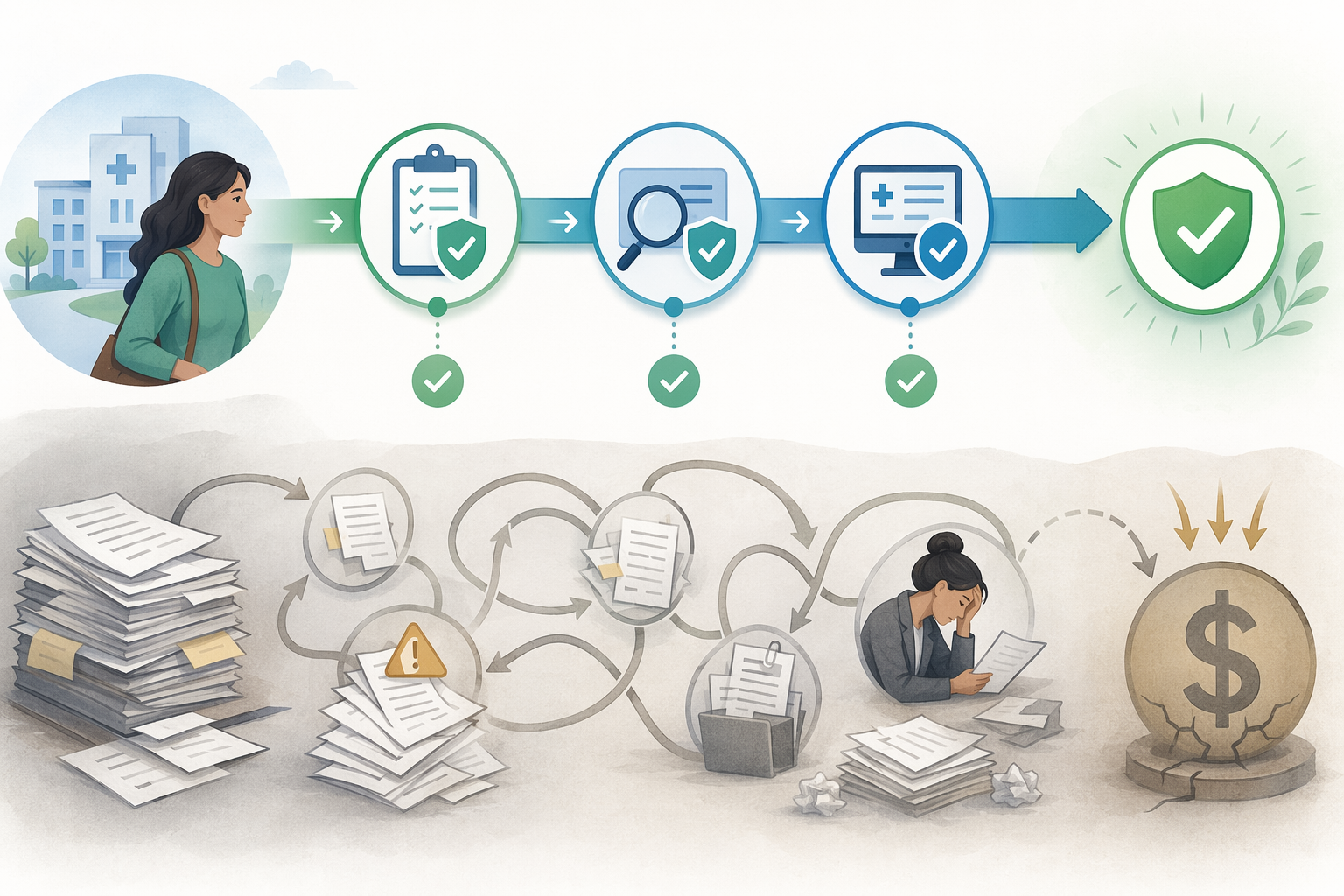
The performance gap is already wide enough to matter. Industry denial averages are commonly reported around 11% to 12%, while early adopters of AI-enabled denial prevention are moving toward 4% to 5% denial rates. Those figures should not be read as a universal promise; they are a signal that prevention-oriented workflows are beginning to separate themselves from traditional denial recovery programs.
The adoption gap is just as important. Oliver Wyman reports that only 14% of providers currently use AI to reduce denials, while 59% are planning to invest. Among the providers already using AI for this purpose, 69% report fewer denials and more successful resubmissions.[2] That is not saturation. It is a short operational window in which a minority of organizations is learning how to move denial work upstream before the rest of the market catches up.
Denial work is shifting before the claim leaves the building
Traditional denial management starts after the payer has already said no. Staff sort the denial, identify the reason code, gather documentation, assign appeal priority, and decide whether the likely recovery justifies the labor. That work is still necessary. But it is a weak center of gravity for a revenue cycle department, because the team is always downstream from the defect.
AI changes the sequence when it is placed at the points where denials are created: before eligibility is trusted, before authorization risk is ignored, before coding reaches the claim, and before the bill is transmitted. That is different from using automation to make appeal production faster. Faster cleanup may improve throughput; prevention changes the volume of cleanup that lands on the team at all.
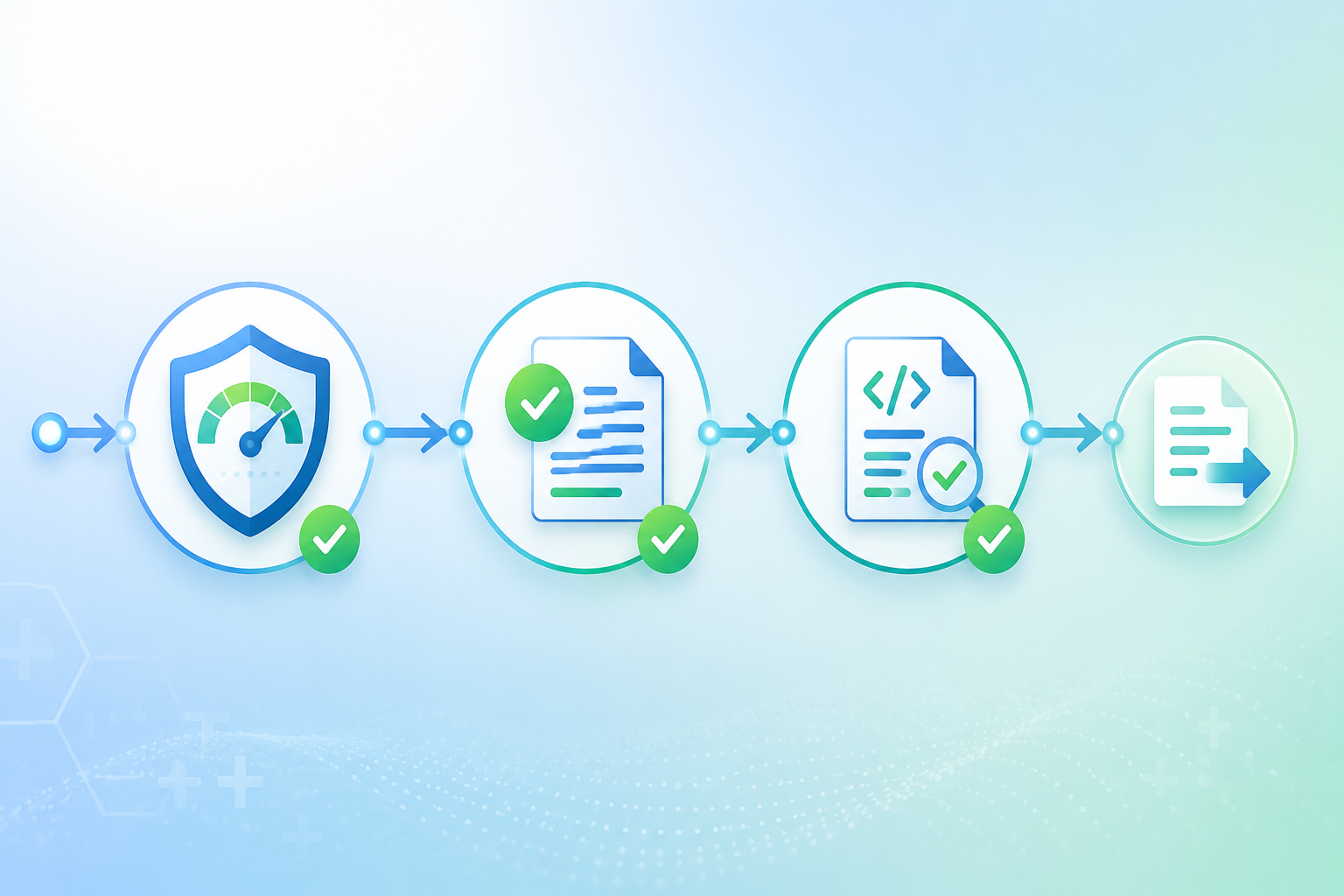
| Workflow point | AI function | Operational question it answers |
|---|---|---|
| Before or during encounter setup | Predictive denial scoring | Which claims are likely to fail if no one intervenes? |
| Before service and before submission | Eligibility and authorization verification | Is the service covered, authorized, and aligned with payer rules? |
| Before final claim release | Autonomous coding review | Does the documentation support the code set being submitted? |
These functions are often sold under the same broad RCM AI label, but they do different work. A health system that buys one-point solution and calls the denial problem solved will still leave gaps in the claim path. The better test is whether the organization can identify risk early enough, route it to the right owner, and keep the account from entering the denial queue in the first place.
Predictive scoring turns denial queues into pre-submission worklists
Predictive denial scoring is the triage layer. It looks across claim, patient, payer, authorization, diagnosis, procedure, and historical denial patterns to identify accounts with a higher likelihood of failure. The operational value is not the score itself. The value is the worklist it creates before submission.
Without that triage, denial teams often see every claim only after the payer has imposed the next step. With predictive scoring, a manager can separate accounts that need eligibility correction, authorization review, documentation support, coding validation, or no intervention. The queue becomes less about recovering damage and more about preventing predictable damage.
This is where adoption data matters. If only 14% of providers are currently using AI to reduce denials, the majority are still competing with denial processes built around retrospective sorting.[2] That does not mean late adopters are doomed. It does mean that early adopters are accumulating payer-specific learning, exception rules, staff routing patterns, and governance habits that are hard to copy overnight.
Eligibility and authorization checks catch failures while someone can still act
Eligibility verification has always sounded basic until it fails. A coverage mismatch discovered after service is not a clerical inconvenience; it is a preventable denial, a patient billing problem, or both. AI-enabled eligibility and authorization tools are useful when they make those mismatches visible early enough for patient access, scheduling, authorization staff, or the ordering department to do something about them.
The Fresno Community Health Network case is a concrete example of the prevention logic. After using AI claim review, the organization reported a 22% reduction in prior-authorization denials, an 18% reduction in denials for uncovered services, and 30 to 35 hours per week saved.[3] Those are not abstract transformation metrics. They point to fewer accounts reaching the denial team for reasons that should have been visible before submission.
The time savings are easy to underestimate. Thirty to 35 hours a week is not just a productivity figure; it is a full workweek that can be redirected away from avoidable rework. In a short-staffed revenue cycle department, that time can become better follow-up on complex accounts, cleaner authorization documentation, faster payer escalation, or reduced overtime. The case does not prove that every provider will see the same result, but it does show the kind of operational movement that matters.
Prior authorization also sits inside a broader payer-provider arms race. Payers are using automation to review claims and utilization faster, and provider organizations are responding with their own tools to detect risk earlier. That context is covered in more depth in the payer-side analysis of AI in prior authorization. For revenue cycle operations, the immediate point is narrower: if payer rules are becoming more automated, provider-side checks cannot remain manual, late, and fragmented.
Autonomous coding addresses a major denial source before billing
Coding is one of the places where denial prevention either becomes real or stays a dashboard exercise. Becker's Hospital Review has cited industry estimates that 42% of claim denials result from coding issues, and the often-repeated claim that up to 80% of medical bills contain errors is widely circulated but harder to trace to a single original study.[4] The first figure is directionally useful for operations; the second should be handled carefully rather than repeated as settled evidence.
The practical case for autonomous coding is strongest when it improves the claim before it leaves the organization. HealthTech Magazine reports that AI coding tools have achieved accuracy above 90% in specific clinical domains and reduced coding time for complex cases by up to 46%.[5] Those results should not be generalized across every specialty, payer, or documentation environment. They do suggest why coding AI belongs in the denial-prevention discussion rather than only in a labor-efficiency discussion.
A faster coding process that produces unsupported codes can still create denials. A useful autonomous coding workflow has a different standard: it flags missing documentation, identifies code-documentation mismatches, supports coder review where the risk is high, and lets lower-risk claims move with less friction. That kind of routing protects both cash timing and coder attention.
This is also where implementation quality separates real prevention from software theater. If coding AI is disconnected from denial analytics, the organization may improve coding speed without learning which coding patterns are actually driving payer rejections. If it is connected, denial feedback can sharpen pre-bill edits, coder education, and payer-specific rules.
The first-mover window is operational, not just technological
The gap between current use and planned investment is the market signal. Fourteen percent of providers currently use AI to reduce denials, while 59% are planning investment.[2] That planned investment will not convert into performance evenly. Some organizations will buy tools and leave workflows intact. Others will redesign who sees risk, who is accountable for correcting it, and which claims are allowed to move forward.
The second group has the more durable advantage. Denial prevention depends on operational choreography: patient access sees eligibility gaps, authorization teams see payer-specific risk, coders see documentation problems, billers see final claim edits, and finance sees whether the intervention changed denial rate, cash timing, and rework volume. A model can surface the risk, but the organization still has to decide who owns the next action.
McKinsey has estimated that AI in revenue cycle management could reduce cost to collect by 30% to 60%.[6] That is worth watching, but it is a projection, not a measured result from a provider's close process. The more reliable near-term evidence is narrower: specific organizations are reporting fewer preventable denial categories, saved staff time, improved resubmission outcomes, and lower denial rates when AI is applied before submission.
For broader benchmark context, AI in Healthcare Administration: Evidence-Based Benchmarks for Cost Reduction, Accuracy, and Adoption in 2026 examines administrative AI performance across more than denial management. The denial-specific lesson is simpler: the financial upside is most credible when the tool changes the claim's path, not merely the appeal team's speed.
What a credible denial-prevention program has to prove
Revenue cycle leaders do not need another generic AI roadmap. They need proof that the system reduces avoidable work without shifting risk into another department. A credible program should be measured against the points where denials originate and the places where staff time is consumed.
- Denial rate by payer, service line, and denial reason before and after deployment
- Pre-submission intervention volume, including which teams act on AI flags
- Authorization and eligibility-related denial categories, not only total denials
- Coding-related denials, coder touch rate, and post-bill correction volume
- Staff hours saved or redirected, with enough detail to show where the time went
- Appeal success and resubmission outcomes, while keeping prevention as the primary target
The caution is that not every impressive number belongs in the same evidence bucket. Fresno's reported reductions in prior-authorization and uncovered-service denials are workflow results from a named implementation.[3] Oliver Wyman's 14% current adoption figure and 69% user-reported improvement figure are survey findings.[2] McKinsey's 30% to 60% cost-to-collect estimate is a forward-looking analysis.[6] They can all inform decisions, but they should not be treated as the same kind of proof.
That distinction matters in procurement. A vendor promising denial reduction should be able to show how its tool fits into eligibility, authorization, coding, billing, and reporting workflows. It should also be able to explain whether the performance claim comes from a live implementation, a client survey, a controlled validation, or a forecast. Revenue cycle teams have enough cleanup work already; they do not need vague AI claims creating another reconciliation project.
The decision point for health systems
AI will not eliminate denials. Payer behavior, documentation quality, benefit design, authorization rules, and patient coverage changes will keep producing exceptions. The more defensible conclusion is that denial management is becoming a pre-submission discipline for organizations that can connect prediction, eligibility, authorization, and coding before the claim leaves the building, while still scrutinizing evidence sources and separating projections from measured results.
The open window is real because adoption is still low and planned investment is high. Health systems can keep funding denial recovery as the operational center of gravity, or they can begin moving staff, analytics, and automation toward prevention before today's 14% adopter group becomes the new baseline.[2]
References
- Artificial intelligence claims review raises payer-provider tensions, Healthcare Dive.
- AI impact on revenue cycle healthcare, Oliver Wyman, May 2026.
- Predict, prevent, perform: The AI evolution of denials management, HFMA.
- Industry reporting on medical billing and coding denial drivers, Becker's Hospital Review.
- AI in Medical Billing and Coding, HealthTech Magazine, June 2025.
- Agentic AI and the race to a touchless revenue cycle, McKinsey.
Comments
Join the discussion with an anonymous comment.