
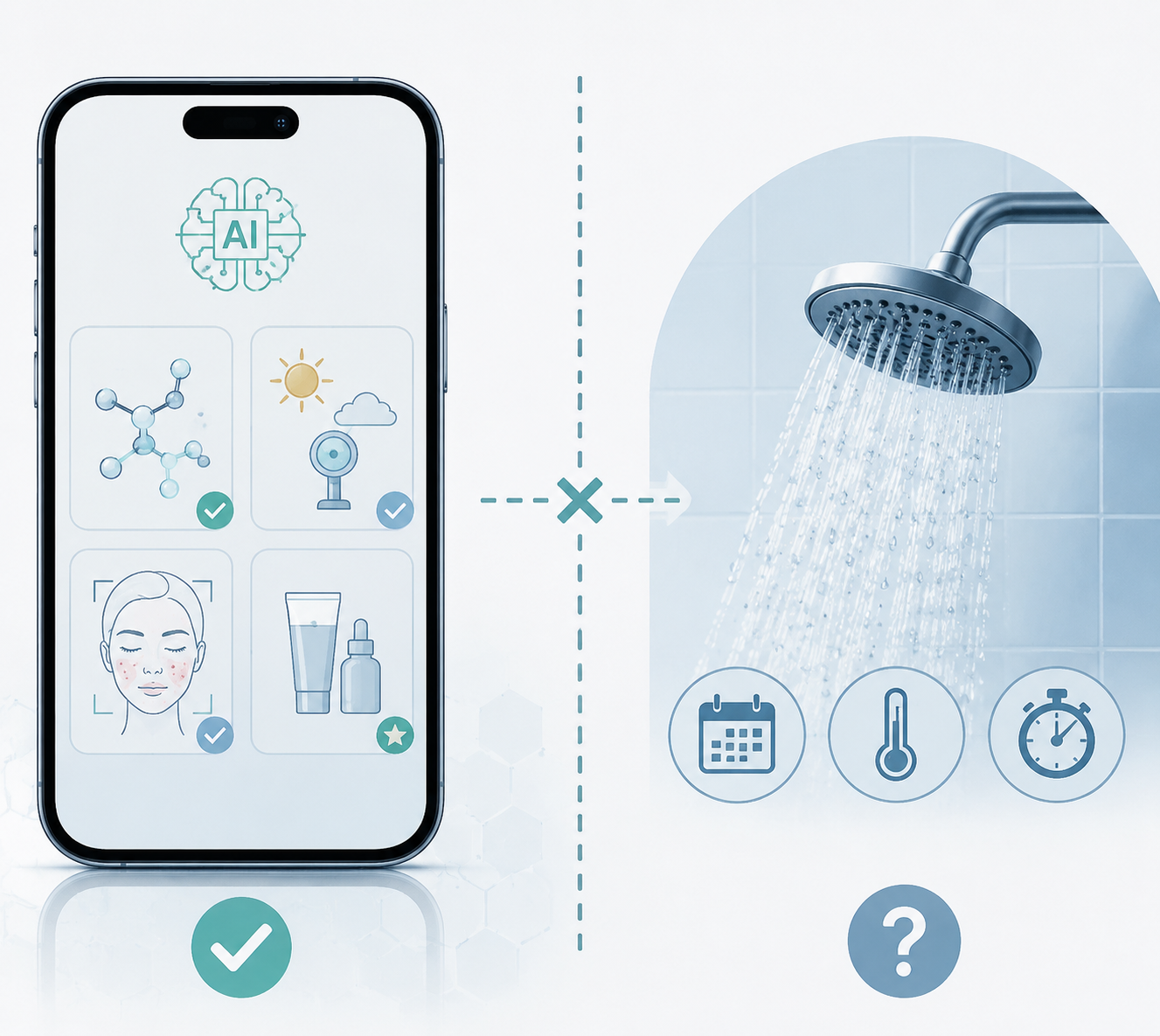
A striking thing about many AI dermatology and skincare tools is not how little they can do. It is how much they can do while still missing a question clinicians ask almost reflexively when a patient arrives with xerosis, irritant dermatitis, eczema flares, or a stinging “simple” routine: how often are you bathing, how hot is the water, how long are you in there, and what touches the skin before you towel off?
The gap matters because the question of whether there are credible AI dermatology recommendations for shower frequency has a plain answer in the current app landscape: not really. In a 2024 audit of 41 dermatology mobile applications with artificial intelligence features, Wongvibulsin and colleagues found that none had FDA approval, and none addressed bathing or showering frequency as a modifiable behavior.[1] That is not a quibble about tone, interface design, or whether an app uses the word “personalized” too freely. It is a documented omission across a sampled category of AI dermatology apps.
The Missing Question Is Clinically Ordinary
The JAMA Dermatology survey is useful because it keeps the discussion from collapsing into an anecdote about one overconfident chatbot or one badly built beauty app. The authors evaluated AI-enabled dermatology mobile applications and characterized their features, regulatory status, and user-facing functions. The finding that 0 of 41 addressed bathing or showering frequency sits beside another important finding: 0 of 41 were FDA approved.[1] These tools were not operating as cleared medical devices, but many were still presenting themselves in the vicinity of skin health decision support.
That distinction should be kept intact. A consumer app that recommends a moisturizer does not need to become a regulated dermatology clinic. But if it claims to personalize skin health advice, it should not treat product selection as the whole patient story. Bathing is not a cosmetic footnote. It is a repeated exposure, often daily, sometimes occupationally intensified, and it can change the skin’s barrier environment before the first cleanser or leave-on product is applied.
The omission is more conspicuous because current AI skincare systems are not primitive. A 2025 review of AI in customized skincare describes platforms using acne grading, ingredient analysis, UV and environmental adjustments, and product recommendation logic.[2] In other words, the category has learned to notice comedones, parse labels, and respond to ambient exposure. It has not learned, at least in the app survey, to ask whether the patient is taking two hot showers a day with a fragranced body wash and an exfoliating glove.
Why Shower Frequency Belongs Inside Skin-Barrier Logic
For dermatology clinicians, bathing history is not trivia collected after the “real” skincare routine. It is often where the routine starts to make sense. A patient may be using the recommended gentle cleanser and barrier cream, yet still be exposing inflamed skin to prolonged heat, repeated detergent contact, vigorous mechanical friction, or delayed moisturization after bathing. The product list can look careful while the skin behavior remains disruptive.
This is exactly the kind of variable that personalization systems should be structurally good at handling. Showering advice rarely depends on one input. Age, skin type, climate, occupation, activity level, and the presence of inflammatory skin disease can all affect the practical answer. Expert guidance from University Hospitals frames showering frequency as individualized rather than universal, with factors such as age, skin type, climate, and lifestyle affecting what is reasonable.[3] Advanced Dermatology expert guidance similarly emphasizes that showering needs vary with factors including skin type, activity level, and environmental conditions.[4]
An AI system does not need to invent a rigid schedule to use that information well. It could ask whether bathing is daily, multiple times daily, or less frequent. It could ask about water temperature in ordinary language. It could ask whether symptoms worsen after showering, whether the patient uses soap everywhere or only on high-odor areas, whether moisturizers are applied immediately afterward, and whether occupational exposures require extra washing. Even a modest intake flow would be more clinically coherent than a highly polished serum sequence that never asks how the skin is being washed.
| Personalization input | Why it matters for bathing guidance |
|---|---|
| Skin type and baseline dryness | The same bathing pattern may be tolerated by one user and aggravating for another. |
| Inflammatory disease status | Eczema, irritant dermatitis, and barrier-compromised states make technique and aftercare more consequential. |
| Climate and season | Low humidity and cold weather can make frequent hot bathing more drying. |
| Occupation and activity | Healthcare work, athletics, manual labor, and heat exposure may increase washing needs. |
| Products used in the shower | Cleansers, fragrances, exfoliants, and antiseptic washes can change the impact of bathing frequency. |
None of these inputs is exotic. They are not beyond the reach of a questionnaire, a rules engine, or a cautious language-model interface. They are also not more sensitive or technically difficult than many inputs apps already request when they ask users to photograph lesions, identify skin concerns, name products, or rate goals. The issue is not that bathing data are impossible to collect. The issue is that the current app logic appears to value product-matching variables more consistently than hygiene-behavior variables.
The Evidence Does Not Support a Universal “Bathe Less” Rule
The strongest version of the critique is not that every AI dermatology app should tell users to shower less. That would be too easy, and in some patients wrong. The evidence is more interesting than that.
A 2026 randomized clinical trial in the British Journal of Dermatology compared daily and weekly bathing in eczema and found no significant difference in eczema outcomes between the two groups.[5] That result should slow down any system designer tempted to convert barrier repair counseling into a universal frequency limit. It suggests that frequency alone may not be the deciding variable, at least in the studied eczema context. Technique, products, temperature, duration, moisturization timing, baseline disease control, and patient preference may matter as much as, or more than, the raw count of baths or showers.
But this trial does not make bathing irrelevant. It makes simplistic recommendation logic less defensible. A responsible AI tool could say, in effect: evidence does not support one ideal schedule for everyone; if your skin is dry, itchy, inflamed, or stinging after bathing, frequency, heat, duration, cleanser choice, and moisturization timing are worth reviewing. That is different from issuing a universal command. It is also different from ignoring the variable entirely.
Clinical uncertainty is not an excuse for silence. It is a reason to ask better questions and explain the boundaries of the answer. Dermatology is full of advice that lives in that space: avoid known irritants, reduce unnecessary friction, simplify when the barrier is inflamed, and escalate to clinical care when symptoms persist or worsen. An app can represent uncertainty without pretending the patient’s shower never happened.
Product Intelligence Has Outpaced Routine Intelligence
The selective nature of the omission is what makes it clinically irritating. AI skincare tools can be quite good at sounding attentive. They can compare ingredient lists, flag potentially comedogenic or irritating components, recommend sunscreen reapplication based on UV context, and sort users into acne or aging or hyperpigmentation pathways.[2] Those functions are not trivial. Ingredient parsing, image analysis, and environmental adjustment can be useful when presented honestly and with appropriate boundaries.
Yet a patient with barrier symptoms may leave one of these tools with a longer product routine and no meaningful change to the exposures that are keeping the barrier irritated. The interface has produced activity: add this, switch that, layer in this order. The clinical visit later has to undo part of that activity, identify the irritants, and ask the basic bathing questions the app skipped.
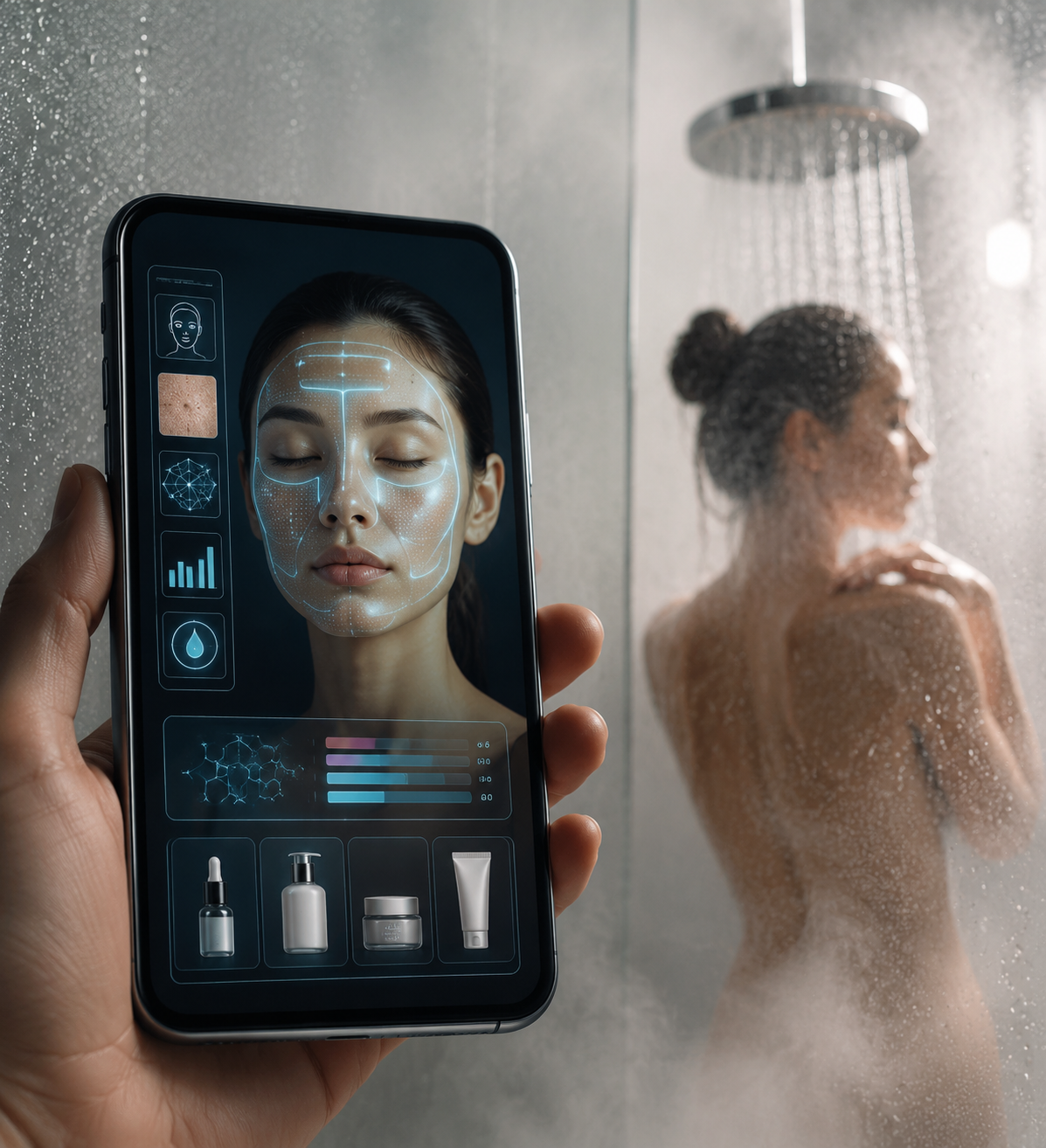
This is not only an efficiency problem. It shifts burden downstream. The patient may think they followed “personalized” advice faithfully. The clinician then has to explain why the plan was incomplete, why adding actives to irritated skin may have worsened symptoms, and why a behavior as unglamorous as shower technique deserves attention. The app interface captured the consumer appeal of customization, but the clinical consequence lands elsewhere.
Real-World Errors Make the Omission Less Abstract
Reports of poor AI skincare advice should not be inflated into a systematic harm rate unless the evidence supports it. Still, they give texture to what can happen when confident digital guidance meets irritated skin. A July 2026 Guardian investigation described AI chatbots recommending non-existent products and giving incorrect skincare step ordering; it also reported dermatologists seeing patients with irritant contact dermatitis after AI-recommended routines.[6]
That source is not a controlled study of AI dermatology outcomes. It should not be treated like one. Its value is different: it shows the plausible patient pathway. A user seeks help, receives a confident routine, buys or applies products, and presents later with irritation. In that pathway, the absence of bathing assessment is not the only risk, but it is one of the easiest missing safeguards to name.
A better system would not need to diagnose irritant dermatitis from a chat exchange. It could simply slow the routine down when barrier symptoms are present, ask about bathing and cleansing, and avoid escalating product complexity before basic exposures are reviewed. That is not medical-device sophistication. It is minimum clinical common sense translated into interface logic.
What Better AI Shower Guidance Would Actually Look Like
The design goal should not be a single answer to “How often should I shower?” A single answer is exactly where consumer convenience and clinical reality start to diverge. The better goal is structured questioning, cautious interpretation, and clear escalation when symptoms suggest disease or injury rather than routine optimization.
- Ask about frequency, duration, temperature, cleanser type, exfoliation, and post-bath moisturization before recommending additional products for dryness, itching, burning, or eczema-prone skin.
- Distinguish hygiene need from barrier tolerance, especially for users whose work, exercise, climate, or caregiving duties make frequent washing difficult to avoid.
- Explain uncertainty rather than presenting one bathing schedule as evidence-settled for all patients.
- Modify product recommendations when bathing patterns or cleansing products are likely contributors to irritation.
- Prompt medical evaluation when symptoms are persistent, painful, spreading, infected-appearing, or associated with significant eczema flares.
The same standard should apply to personalization claims across diverse users. If an AI system has not been evaluated across skin tones, ages, climates, and disease contexts, it should not imply that its hygiene guidance is equally reliable for everyone. Skin-of-color underrepresentation in dermatology AI development is a known concern in the field, and bathing guidance would not be exempt from that problem. The safe design posture is to disclose limits, test broadly, and avoid letting a polished interface substitute for validation.
Sensor-equipped showers and smart bathing devices may eventually add another stream of data, such as water exposure patterns or environmental context. For now, that category should be kept separate from the app-based AI dermatology tools at issue here. Without peer-reviewed validation showing that those devices improve dermatologic outcomes, they are adjacent gadgets, not evidence that the shower-frequency problem has been solved.
The Evaluation Standard Should Change
For clinicians, health systems, and anyone assessing AI dermatology applications, the procurement question should move beyond whether the app recognizes acne, explains ingredients, or generates a routine that looks plausible. Those are useful functions, but they are not enough to establish skin-barrier personalization.
A more clinically relevant evaluation asks whether the system identifies modifiable behaviors that dermatologists actually counsel on. Bathing frequency and technique belong on that list. The evidence is not sufficient for a universal AI shower prescription, and the 2026 eczema trial argues against that kind of overconfidence.[5] It is sufficient, however, to expect AI dermatology apps to ask about bathing, interpret it in context, and acknowledge uncertainty when the evidence does not support a single answer.
An AI dermatology app that claims to personalize skin-barrier guidance should be judged not only by how elegantly it recommends products, but by whether it asks about the bathing behaviors that shape the barrier before those products ever reach the skin.
References
- Current State of Dermatology Mobile Applications With Artificial Intelligence Features, JAMA Dermatology, 2024.
- Artificial Intelligence in Customized Skincare: A Review, Cureus, 2025.
- How Often Do You Really Need to Shower?, University Hospitals, 2025.
- How Often Should You Shower? Expert Advice from Dr. Courtney Gwinn of Advanced Dermatology & Skin Surgery, Advanced Dermatology & Skin Surgery.
- Eczema Bathing RCT, British Journal of Dermatology, 2026.
- AI could revolutionise medicine – but when it comes to health advice, it can be dangerously wrong, The Guardian, July 8, 2026.
Comments
Join the discussion with an anonymous comment.