
The hard part of AI-enabled clinical trial design in drug discovery is not imagining a cleaner protocol. It is getting that protocol through real sites, real patients, real records, and real review. The current design system is already under strain: IQVIA’s June 2025 analysis cites recruitment delays in 80% of trials, success rates below 12%, and protocol complexity that has risen 139% in procedures and 600% in data points since 2005.[1] Those are not abstract inefficiencies. They show up as screen failures, amendment meetings, stalled activation, exhausted coordinators, and patients who technically exist in a data model but never reach consent.
AI is being inserted into trial design because these failures are structural. The useful question is narrower than whether AI will “transform” clinical development. It is where AI has already improved design decisions enough to matter, and where the evidence still stops short of handing it authority.

Where AI Enters Trial Design
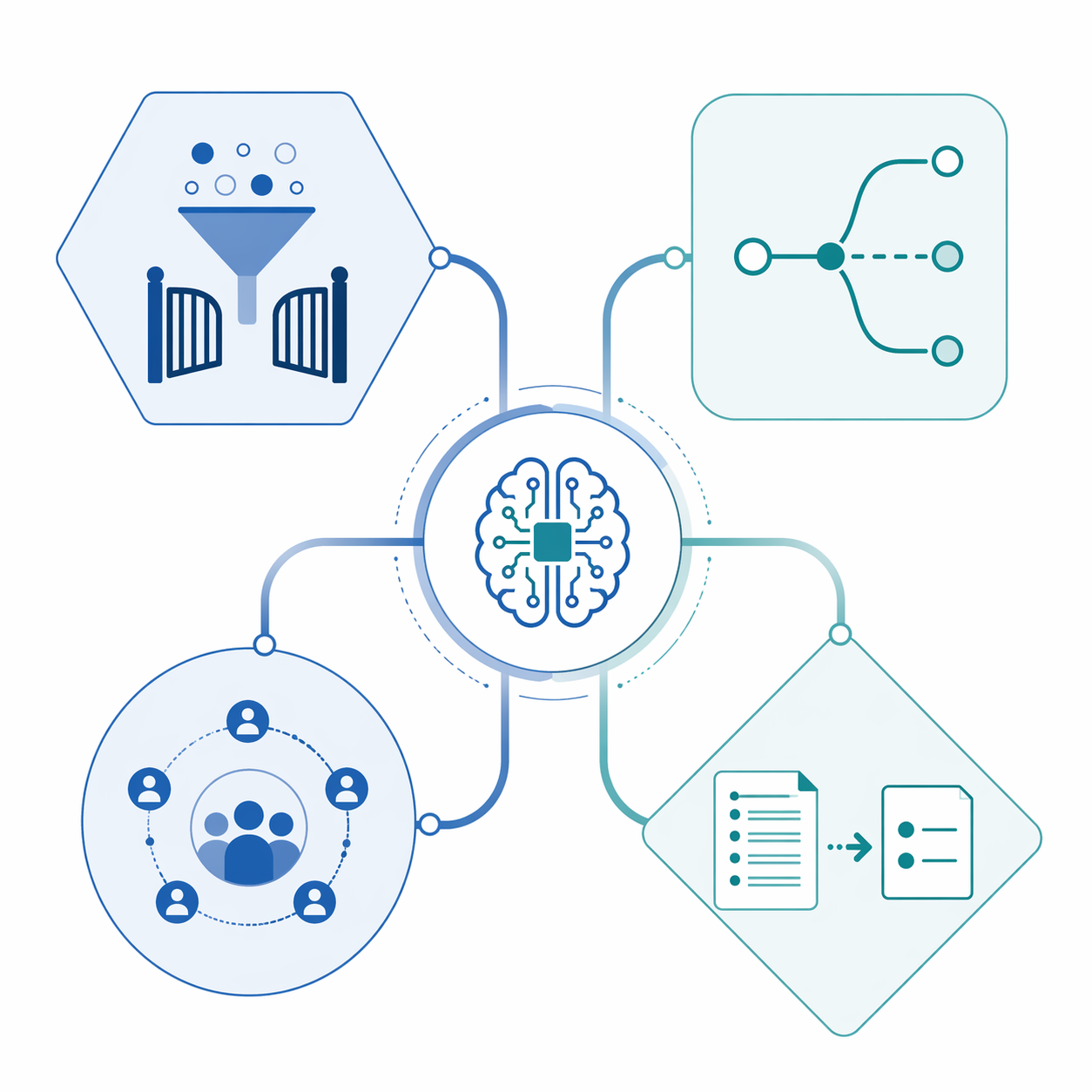
Across the evidence base, four uses are doing most of the practical work: eligibility optimization, adaptive trial frameworks, recruitment and retention support, and protocol complexity reduction. They are connected, but they do not carry the same evidentiary weight. Eligibility and recruitment have the clearest operational stakes because they affect who can enter a trial and how quickly sites can find them. Adaptive designs and protocol simplification matter as well, but their value depends more heavily on governance, statistical controls, and implementation discipline.
| Application lever | Design decision it affects | Most useful when |
|---|---|---|
| Eligibility optimization | Which inclusion and exclusion criteria remain necessary | Historical trial data and real-world patient records are rich enough to test whether broader criteria preserve safety |
| Adaptive frameworks | How allocation, arms, or trial rules can change during the study | Statistical validity is pre-specified and model outputs are reviewed inside a governed decision process |
| Recruitment and retention | Which patients may match, which sites may enroll, and where outreach should focus | Matching tools connect to current, high-quality clinical data and do not confuse identification with enrollment |
| Protocol complexity reduction | Which procedures, endpoints, data fields, or amendments are avoidable | Feasibility review happens before the protocol becomes expensive to repair |
Eligibility Optimization Has The Strongest Case For Changing Expectations
Eligibility criteria are where a protocol’s theory often collides with available patients. A narrow criterion can protect safety or preserve interpretability. It can also exclude people who resemble the intended treatment population closely enough that the exclusion becomes more habit than necessity. The operational damage appears later, when sites screen large numbers of patients who fail on criteria that may not materially change risk.
Trial Pathfinder is the most important case because it tests exactly that problem. In the reported work, the system used electronic health record data from 61,000 patients and evaluated eligibility criteria across 10 completed Phase III non-small cell lung cancer trials. The result was a doubling of the eligible patient pool without compromising safety in the retrospective analysis.[2]
That finding matters because it does not merely say AI can rank patients or summarize protocols. It suggests that some completed trials may have been designed with avoidable exclusions. If a model can identify criteria that shrink the eligible population without a corresponding safety benefit, it gives study teams a more defensible way to challenge inherited templates before they become site burden.
The condition is important: this was retrospective work in completed Phase III NSCLC trials using large-scale EHR data.[2] That is a stronger setting than vague platform claims, but it is not the same as proving that every therapeutic area, endpoint, or data environment will behave similarly. Oncology trials often have structured disease staging, biomarker logic, and treatment histories that make some eligibility questions especially amenable to analysis. A rare disease study with fragmented records, a first-in-human safety profile, or a subjective endpoint would not automatically inherit the same confidence.
The practical design use is therefore not “let the model write the criteria.” It is more specific: use AI to pressure-test whether each exclusion criterion is still doing real work. A trial team can ask what happens to the eligible pool when a lab threshold, comorbidity exclusion, medication history, or prior-treatment rule is relaxed. If the model shows a large enrollment gain and no apparent safety deterioration in comparable records, that criterion deserves a harder clinical and statistical review.
Recruitment Gains Are Real, But Matching Is Not Enrollment
Recruitment is the area where AI promises are easiest to oversell because the workflow contains several distinct steps. A system can identify a possible patient, match that patient to criteria, alert a coordinator, support outreach, and still fail to enroll the patient. The difference matters. A candidate found in an EHR is not yet available, willing, eligible after source-document review, or able to reach the site on schedule.
The reported gains are still substantial. A 2026 comprehensive review in the International Journal of Medical Informatics reported a 65% improvement in enrollment rates for AI-powered recruitment applications.[3] The same body of work reports models reaching 85% accuracy in forecasting trial outcomes, while AI integration is associated with 30–50% timeline acceleration and cost reductions up to 40%.[3] Merative/Zelta’s 2026 clinical trial trends discussion also frames targeted AI as a contributor to faster, more continuous trial operations, while emphasizing uncertainty in the operating environment.[4]
Those numbers are useful when they are treated as workflow signals rather than universal guarantees. A 65% enrollment improvement may reflect the quality of the source data, the maturity of site workflows, the specificity of the protocol, or the baseline inefficiency of the comparison process.[3] The result can change expectations for a trial team evaluating a recruitment tool, but it should not be pasted into a startup plan as if every study will accelerate by the same amount.
More specialized systems show why the distinction matters. ClinicalAgent, a multi-agent system discussed in Badani et al., improved trial outcome prediction by 0.33 AUC over baseline prompting.[2] The 2026 review also reports strong matching and decision-support results, including MAKAR achieving 100% accuracy in patient-trial matching and oncology GPT-4 agents reaching 87% accuracy in diagnostic and enrollment decisions compared with 30% for standalone large language models.[3] These are impressive benchmarks, but they are still bounded by the evaluation setting. Accuracy in matching is not the same as regulatory acceptance of the matching logic, nor is it the same as a site’s ability to verify every inclusion and exclusion criterion before randomization.
For trial operations, the valuable output is often a shorter and better-ranked queue. If coordinators can review fewer false leads, if investigators can see why a patient appears eligible, and if the system flags missing evidence instead of guessing through it, recruitment support becomes more than a search layer. It becomes a way to reduce the amount of manual reconciliation that sits between a protocol and an enrolled participant.
Adaptive Design Needs Statistical Guardrails Before It Needs More Automation
Adaptive trials are attractive because they acknowledge something fixed protocols often resist: information accumulates during the study. AI methods can help interpret interim signals, evaluate patient subgroups, update allocation rules, or support decisions about dropping arms. The methods cited in current reviews include reinforcement learning, decision trees, neural networks, and Bayesian frameworks that allow trial modification while preserving statistical validity.[3]
The phrase “real-time protocol modification” should be handled carefully. In a clinical trial, real time does not mean improvised. It means rules are pre-specified, operating characteristics are tested, decision thresholds are documented, and the consequences for type I error, power, bias, and interpretability are understood before the first patient is enrolled. AI can help simulate more scenarios and surface patterns earlier, but it does not remove the need to defend the adaptation plan.
This is where Bayesian approaches have an important role. They can support planned updating as new evidence arrives, but the trust comes from the design framework, not from the model’s sophistication alone.[3] A neural network that recommends a change without an auditable rationale creates a problem for monitors, statisticians, ethics committees, and regulators. A governed adaptive design that uses AI to improve simulation, prediction, and decision support is a different proposition.
Protocol Complexity Is Where AI May Save Time Without Looking Dramatic
The least glamorous use of AI may be one of the most operationally valuable: finding protocol burden before it becomes an amendment. IQVIA’s analysis links modern protocol growth to a 139% increase in trial procedures and a 600% increase in data points since 2005.[1] Each additional procedure or field may be defensible alone. In aggregate, they create visit burden, monitoring burden, data cleaning burden, and more opportunities for inconsistent execution across sites.
Protocol amendments are an expensive symptom of design decisions made too confidently too early. IQVIA estimates that reducing avoidable amendments can save up to $535,000 and 3 months of delay per amendment.[1] That figure should make feasibility review feel less administrative. A protocol that requires repair after activation has already shifted cost to sites, sponsors, patients, and timelines.
AI can help here by comparing proposed protocols with historical trial patterns, identifying procedures that rarely support decision-critical endpoints, flagging visit schedules that conflict with ordinary care pathways, and highlighting eligibility combinations that make recruitment mathematically thin. None of that requires the system to invent a new trial design. It requires the system to make hidden operational risk visible early enough for humans to change the document.
- Criteria review: Which exclusions remove many patients while contributing limited safety or interpretive value?
- Visit schedule review: Which assessments create site burden without supporting a primary or key secondary endpoint?
- Data field review: Which collected variables are unlikely to be analyzed, monitored, or used for decision-making?
- Amendment risk review: Which protocol elements resemble patterns that have historically triggered late changes?
The Evidence Is Strongest In Well-Characterized Settings
The strongest examples share a common feature: the design question is bounded. Trial Pathfinder evaluated completed Phase III NSCLC trials using large EHR data.[2] Recruitment tools perform best when matching criteria are structured and patient data are current enough to support screening.[3] Adaptive frameworks are most defensible when the statistical plan defines what may change and why.[3] Protocol analytics become useful when historical trial data can be compared with proposed design features.[1]
That pattern is encouraging, but it is also a boundary. AI systems can learn from what has been captured. They struggle when data are missing, inconsistent, non-standardized, or clinically important but poorly encoded. A patient’s performance status, prior toxicity, disease progression narrative, transportation constraints, caregiver availability, and willingness to join a trial may not sit neatly in the fields a model can read.
Interpretability is the second boundary. A model that recommends broadening eligibility, shifting allocation, or prioritizing a recruitment cohort needs more than a score. Trial teams need to know what data drove the recommendation, whether the data came from comparable patients, how missingness was handled, and what happens when the protocol changes. Without that chain, the person left defending the decision is usually not the vendor. It is the sponsor, investigator, statistician, or clinical operations lead in front of an IRB, data monitoring committee, or regulator.
Regulatory Alignment Is Moving, But Not Finished
Regulators are not ignoring AI in drug development, but the posture as of Q3 2026 is still evolving. FDA’s CDER AI materials include the agency’s January 2025 draft guidance on AI use to support regulatory decision-making for drugs and biological products, and the final expectations may differ from the draft.[5] The FDA-EMA 10 Guiding Principles issued in January 2026 and FDA’s April 2026 pilot program request for information indicate active movement toward shared expectations, but they do not yet amount to a settled global operating model.[5]
That matters for trial design because AI recommendations can affect patient selection, endpoint timing, interim decisions, and evidence generation. These are not back-office optimizations. They can change who is studied and how results are interpreted. A policy framework for generative AI in clinical trials, published in npj Digital Medicine, emphasizes governance needs around transparency, validation, privacy, bias, and accountability.[6] Those requirements are practical, not decorative.
A sponsor using AI for design support should expect to preserve the reasoning trail: source data, versioned model behavior, validation results, human review, risk controls, and documentation of how outputs did or did not influence the final protocol. The more directly a model affects eligibility, adaptation, or patient prioritization, the less acceptable it becomes to treat it as an informal productivity aid.
What AI Can Reliably Do In Trial Design Now
As of Q3 2026, the practical center of gravity is not autonomous trial design. It is structured decision support. AI is most reliable when it is used to test eligibility assumptions against historical data, improve feasibility analysis, rank likely recruitment opportunities, forecast operational risk, support adaptive simulations, and identify protocol features that may cause amendments.
The measurable gains are meaningful: eligibility expansion in the Trial Pathfinder analysis, reported enrollment improvements, timeline acceleration, and potential cost reductions all point to real design value.[2][3][4] But the useful interpretation is conditional. These tools perform best in well-characterized trial contexts, with sufficiently representative data, clearly defined design questions, and humans accountable for final decisions.
The unresolved issues are also material. Data heterogeneity limits portability. Model interpretability affects whether recommendations can be defended. Regulatory expectations are still developing. Patient matching still has to become patient enrollment. And a broader eligible pool only helps if the revised criteria remain clinically, statistically, and ethically sound.
AI is already reshaping clinical trial design in drug discovery where the task is concrete and the evidence can be checked. It is not yet a fully trusted design authority. The strongest use is to expose avoidable friction before it reaches the site, not to make protocol judgment disappear.
References
- Revolutionizing Clinical Study Design: The Role of AI and Analytics, IQVIA, June 2025.
- AI and innovation in clinical trials, npj Digital Medicine, 2025.
- Artificial intelligence in clinical trials: A comprehensive review, International Journal of Medical Informatics, 2026.
- Trends for 2026: Targeted AI, continuous trials, and navigating uncertainty, Merative/Zelta, February 2026.
- Artificial Intelligence in Drug Development, FDA CDER.
- Policy framework for generative AI in clinical trials, npj Digital Medicine.
Comments
Join the discussion with an anonymous comment.