The practical question behind AI-enhanced earthquake preparedness for healthcare facilities is not whether an alert can arrive before the worst shaking. In some hospitals, it already can. The harder question is what happens inside the building during that thin interval: elevators return and open, gas valves close, imaging systems protect themselves, overhead speakers interrupt the unit, beds brake, and someone at the bedside has to decide whether to shield a patient, stop moving equipment, pause a procedure, or keep hands exactly where they are.
That is where the technology becomes less abstract. UCLA Health and Torrance Memorial have implemented ShakeAlert-integrated systems that can trigger elevator homing, gas shutoff valves, MRI quench prevention, and overhead PA announcements. Seattle Children's Hospital has deployed automated bed braking and surgical team alerts. Ridgecrest Regional Hospital uses SeismicAI for warning and post-event structural assessment, a use case shaped by its proximity to the 2019 magnitude 7.1 Ridgecrest earthquake sequence.[1]
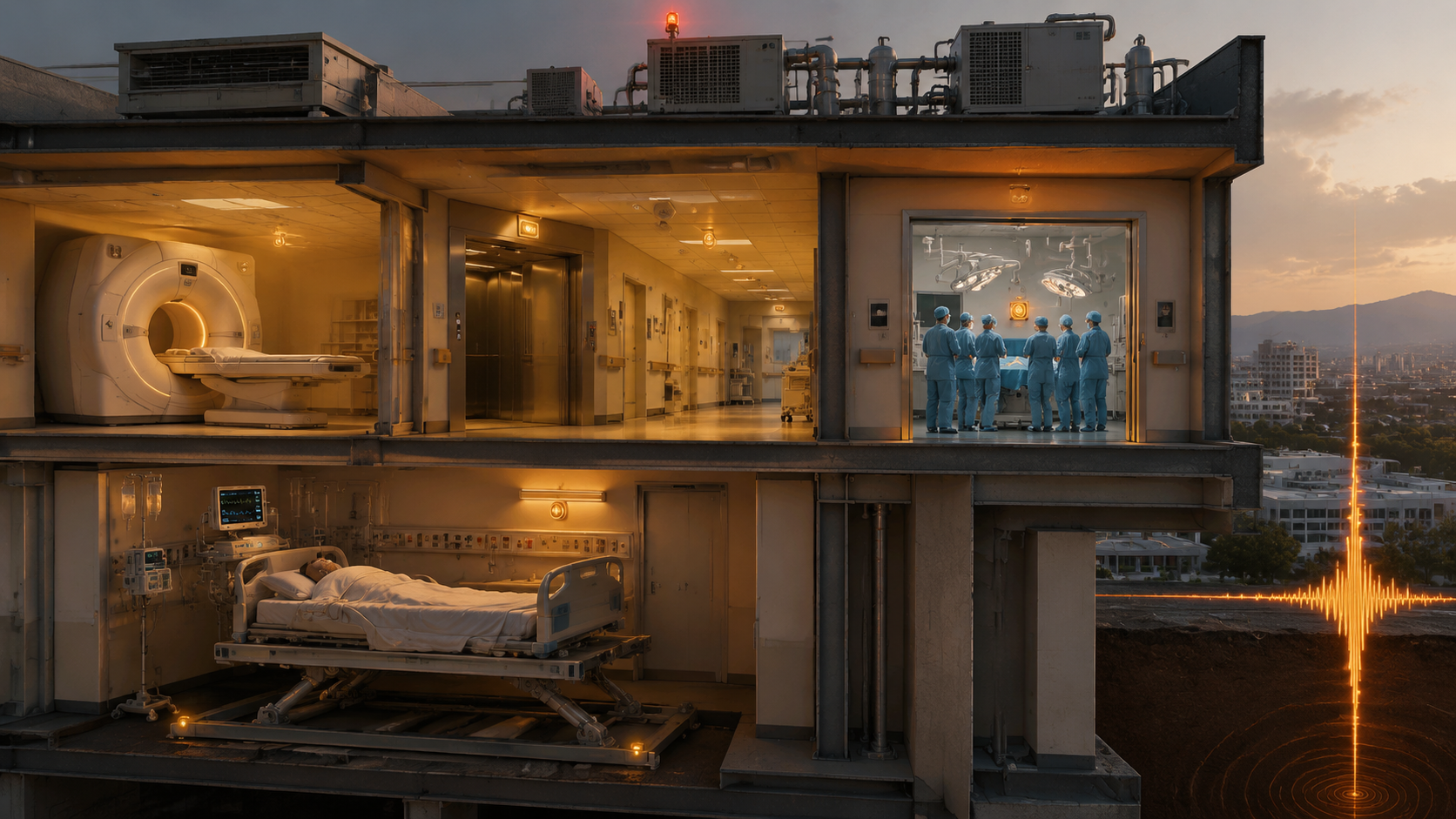
Those actions are useful precisely because hospitals are bad places to improvise. An office worker can drop, cover, and hold on. A nurse may be holding a line. A surgical team may be mid-procedure. A patient on a ventilator cannot move away from falling equipment. A facilities operator may be watching alarms accumulate while also wondering which entrance, stairwell, or wing is safe to use.
What the systems actually trigger
Earthquake early warning depends on a timing difference. The first waves detected by sensors, P-waves, travel faster and are usually less damaging than the later S-wave energy that produces stronger shaking. ShakeAlert, operated through the USGS system on the US West Coast, uses a dense seismic sensor network to detect that initial arrival and transmit alerts before the stronger shaking reaches a location.[2]
The hospital-facing systems build on that signal. SeismicAI describes a tiered ecosystem: Safe provides basic audiovisual alerts, Safe+ adds automated equipment shutdown and elevator control, and SafePro adds post-event structural impact reports within 30 minutes.[2] Kinemetrics' OasisPlus combines seismometers, predictive computations, ShakeAlert-powered alerts, and a SAFE Report dashboard intended to give incident commanders real-time structural safety tagging after an event.[3]
| Hospital function | Possible automated action | Why it matters operationally |
|---|---|---|
| Elevators | Return to a designated floor and open doors | Reduces the chance of patients, staff, or visitors being trapped during shaking |
| Medical gases and utilities | Trigger shutoff valves | Limits secondary hazards when lines or infrastructure may be compromised |
| MRI and CT areas | Protect sensitive imaging equipment | Helps prevent equipment damage and unsafe interruption around high-value systems |
| Patient beds | Activate automated braking | Reduces movement during shaking, especially for patients who cannot protect themselves |
| Operating rooms | Send surgical team alerts | Gives scrubbed teams a few seconds to stabilize the field rather than react to surprise |
| Incident command | Receive structural safety dashboards after the event | Supports re-entry, evacuation, and service-continuity decisions |
The point is not that every hospital should buy the same bundle of controls. A small facility, a pediatric hospital, and a tertiary medical center with surgical suites and advanced imaging do not have the same exposure. The useful question is narrower: when the warning arrives, which physical systems can move faster and more reliably than a human can?
The case examples are really workflow examples
UCLA Health and Torrance Memorial show the building-automation side of early warning. Elevator homing is a good example because it is not glamorous, but it is exactly the kind of intervention hospitals need: it converts a seismic signal into a mechanical action before staff have to make individual decisions. Gas shutoffs and PA announcements work the same way. They do not make the hospital earthquake-ready by themselves, but they remove a few predictable failure points from the first seconds of response.[1]
Seattle Children's Hospital points to a different layer: patient-care workflow. Automated bed braking is not just a facilities feature. It reaches the bedside, where nurses and transport staff may already be occupied with IV lines, monitors, ventilators, family members, or a moving patient. Surgical team alerts are similarly specific. They do not tell the whole hospital to do one generic thing; they reach a team whose hands, sterile field, and timing constraints make ordinary alert behavior unrealistic.[1]
Ridgecrest Regional Hospital adds the aftershock of the first decision: what happens after the shaking. The facility uses SeismicAI for both early warning and post-event structural assessment, which matters because a hospital's problem does not end when the floor stops moving. Someone still has to decide whether to continue operating, move patients, close an area, or send staff back into spaces they may not fully trust.[1]
This is where dashboards such as OasisPlus SAFE Report and SeismicAI SafePro are most interesting, but also where the evidence should be read carefully. Vendor descriptions make the capability concrete: structural impact reports, safety tagging, and post-event information for incident commanders.[2][3] What remains limited is independent hospital-level evidence showing how often these reports change decisions, reduce downtime, prevent injury, or improve patient outcomes.
A warning without a unit plan can become noise
The strongest evidence in this topic does not come from the product pages. A 2024 qualitative study of Mexican and US hospitals with operational earthquake early warning systems found that real-world effectiveness was limited by inconsistent staff response, missing micro-protocols for different units, weak drill reinforcement, staffing constraints, cost-benefit concerns, and alert channels that did not always fit the clinical environment.[4]
That finding should make hospital leaders pause before treating implementation as a technical installation. The system can detect, calculate, and notify. It cannot decide for every unit whether staff should secure movable equipment, shield a patient, hold a sterile position, stop a medication preparation process, move away from shelving, or wait for a follow-up instruction. Those decisions have to exist before the alert.
One interviewee in the Vaiciulyte study described nurses shouting desperately after a warning because no evacuation or protective action plan was in place.[4] The detail is memorable because it shows a failure mode hospitals should take seriously. The alert was not absent. Urgency was present. What was missing was a shared script for what urgency meant in that space.
Micro-protocols sound bureaucratic until the alert arrives. Then they are the difference between a useful instruction and a building-wide interruption. An OR team needs a different instruction than a phlebotomy station. An ICU nurse needs a different threshold for movement than someone in an administrative suite. A pharmacy, lab, quiet zone, radiology department, and general medical floor do not have the same equipment, acoustics, patient mobility, or tolerance for interruption.
Alert channels are not interchangeable
The same study found that alert delivery mechanisms have to vary by unit. Phone messages may not be received in quiet zones or operating rooms. Flashing lights may suit some sections. Loudspeakers may work better elsewhere.[4] This is a design problem, not a preference survey.
- Operating rooms need alerts that do not depend on personal phones and do not require scrubbed staff to touch a device.
- ICUs need instructions that account for immobile patients, ventilators, pumps, and bedside procedures already in progress.
- Labs and pharmacies need alerts matched to hazardous materials, shelving, refrigeration, and medication preparation workflows.
- General floors need simple, repeated actions that work for mixed staffing levels, visitors, and patients with different mobility.
- Facilities teams need both the initial alert and the post-event status information needed to isolate hazards and advise incident command.
Hospitals already know this principle from fire alarms, code calls, and infection-control workflows: the signal matters, but the response pathway matters more. Earthquake early warning compresses that pathway into seconds.
Preparedness is still constrained by staffing, drills, and budgets
The Vaiciulyte findings also point to less visible constraints. Hospital administrators have to pass cost-benefit review. Emergency managers need staff time to write protocols and run drills. Units need reinforcement often enough that the response survives turnover, night shifts, travelers, float staff, and surge conditions.[4]
That is an uncomfortable limit because it is not solved by a better sensor. A technically successful alert can still underperform if a charge nurse has never drilled the unit's response, if facilities staff are short-handed, if the alert goes to a device no one can check, or if leadership never resolved whether a particular unit should shelter in place, secure equipment, or prepare for transfer.
The California Earthquake Warning medical facility toolkit gives hospitals a starting point for planning and implementation, but guidance is not the same as adoption, and adoption is not the same as practiced readiness.[5] The hard work sits in policies, drills, device placement, escalation paths, and the mundane question of who is responsible at 3 a.m.
Early warning cannot make a weak building resilient
There is also a structural boundary that hospitals should not blur. Earthquake early warning can reduce exposure in the seconds before shaking and can support decisions after shaking. It does not retrofit a building, brace nonstructural hazards, anchor equipment, or create surge capacity.
A 2025 systematic review of Middle Eastern hospitals found serious seismic-readiness gaps, including 31.6% structural compliance in Damghan and 56.6% construction mitigation scores in Iranian hospitals. The same review reported that less than 50% of staff participated in drills in surveyed Iranian facilities.[6] Those figures should not be generalized to US hospitals or other regulatory settings, but they are a useful warning about the hierarchy of protection: warning systems sit on top of building safety, nonstructural mitigation, and trained response. They do not replace them.
For US facilities, geography adds another practical limit. ShakeAlert coverage is currently a West Coast capability for California, Oregon, and Washington.[2] Hospitals in other seismic zones would need to understand what early warning infrastructure is actually available to them before building plans around a service they cannot receive.
The bottleneck is moving from signal to practiced action
AI-enhanced earthquake early warning is already capable of hospital-relevant actions. It can move elevators, trigger speakers, protect equipment, brake beds, alert surgical teams, and feed post-event structural information to incident command. Those are not speculative benefits. They are the kinds of discrete actions that can be mapped to real hospital workflows.
The evidence does not support a broader promise that warning equals preparedness. The more defensible conclusion is narrower and more useful: the technology can buy seconds, and hospitals decide in advance whether those seconds become protection, confusion, or another alarm competing for attention.
A serious readiness review should start with traceability. What signal is generated? Which automated action follows? Who receives the alert? What is that person trained to do in that unit? What happens if the unit is understaffed, the drill has not been repeated, the phone is inaccessible, or the post-event dashboard conflicts with what staff see on the floor?
That is where the next gains are likely to be found. Not in treating AI as a futuristic layer over hospital safety, but in making sure the building, the equipment, and the people inside it already know what to do when the warning arrives.
References
- Hospitals implement quake-ready technology as teams in seismically active areas prepare, Fierce Healthcare, https://www.fiercehealthcare.com/hospitals-health-systems/hospitals-implement-quake-ready-technology-teams-seismically-active-areas
- Earthquake Early Warning Ecosystem, SeismicAI, https://seismicai.com/earthquake-early-warning-ecosystem/
- Kinemetrics Launches Earthquake Early Warning Alerts for OasisPlus Earthquake Response Platform Powered by ShakeAlert, Kinemetrics, https://kinemetrics.com/news/kinemetrics-launches-earthquake-early-warning-alerts-for-oasisplus-earthquake-response-platform-powered-by-shakealert/
- Earthquake early warnings can help hospitals — if they’re prepared, PreventionWeb/Temblor, https://www.preventionweb.net/news/earthquake-early-warnings-can-help-hospitals-if-theyre-prepared
- Medical Facilities Toolkit, Earthquake Warning California, https://www.earthquake.ca.gov/toolkit-medical/
- Hospital preparedness and resilience to earthquakes in the Middle East: a systematic review, PMC, https://pmc.ncbi.nlm.nih.gov/articles/PMC12523173/
Comments
Join the discussion with an anonymous comment.