
The cabin problem is not whether ECG AI exists, but whether it can change a hard call in time
An in-flight chest pain event is a decision problem before it is a diagnostic problem. Someone has to decide whether the ECG is worrisome enough to divert, whether the crew can keep the passenger stable, and whether the available medical help is good enough to trust. In that setting, an AI-assisted response to in-flight heart attacks depends on a plain question: can it make the first reading more reliable when there is no physician on board, time is compressed, and the cost of being wrong is high. The strongest signal so far comes from Queen of Hearts, a deep-learning ECG platform tested retrospectively in emergency departments rather than aircraft cabins. In a multi-center study using 2020-2024 data from three U.S. sites, it identified 553 of 601 confirmed STEMIs on the initial ECG, or 92% sensitivity, compared with 427, or 71%, by standard triage; false positive activations fell from about 42% to about 8% [1].

That drop in false activations is the part that matters operationally. In the air, a false alarm is not just a charting nuisance; it can mean a diversion, an unscheduled landing, disruption for dozens or hundreds of passengers, and a bill that can run from $15,000 to $893,000 per event [3]. The alternative is not reassurance. It is a noisy judgment call made with limited equipment, constrained lead placement, and uneven expertise. The pressure point is sharper because 41.1% of in-flight medical emergencies occur without a physician on board [2].
That is why the Queen of Hearts result deserves attention even from people who are skeptical of most AI claims. It does not prove outcome benefit in flight. It does show that a model can outperform standard triage on the first ECG in a setting where under-reading STEMI is a real failure mode. If a system can reduce both missed infarctions and unnecessary activations in the emergency department, it has at least earned a serious look for the cabin, where the downstream consequences of uncertainty are more expensive and less forgiving [1][3].
What has to be true in flight
The translation problem is not conceptual; it is logistical. For ECG AI to matter on an aircraft, there has to be a portable ECG on board, a way to transmit the tracing in real time, and a workflow that lets the crew or ground support act on the result fast enough to influence the diversion decision. Real-time satellite connectivity makes that at least technically plausible. A 2025 Digital Health analysis described low-Earth-orbit satellite connectivity, including Starlink, as operating around 30 ms latency, which is within the <300 ms threshold cited for real-time telehealth, with 4-10 Mbps bandwidth enough for ECG transmission [4].
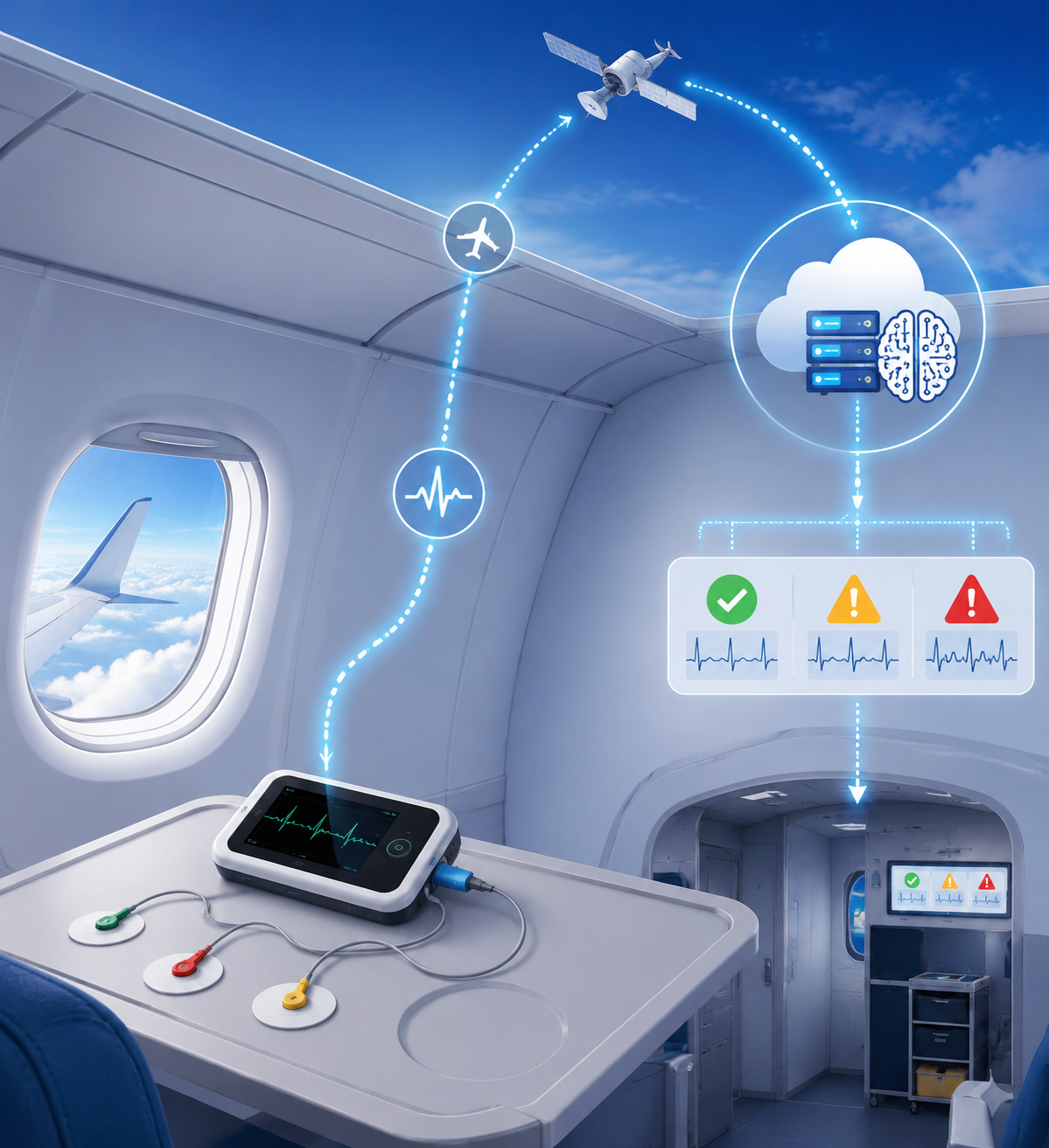
That matters because the cabin is not just a smaller emergency department. It is a moving, noisy, vibration-filled environment with limited lead placement and often no physician to confirm or dispute the machine output. The best-case version of this tool is not autonomous diagnosis. It is an additional read that arrives quickly enough to support telemedicine, crew protocols, and the decision to continue or divert. If the model cannot tolerate motion artifact, cabin noise, and partial lead acquisition, the retrospective emergency-department gains will shrink fast.
The broader cardiovascular AI literature points in the same direction, but with the same limitation. The 2024 American Heart Association scientific statement argued that AI and machine learning applied to ECG can detect occult structural disease one to two years earlier and outperform rule-based interpretation, but it also emphasized that few tools have yet shown improved cardiovascular outcomes at scale and that most studies remain retrospective [5]. That is the right framing here. Queen of Hearts is promising signal, not deployment proof.
The system question is bigger than the model
Airline medical support already operates at scale, which is one reason an ECG AI layer is worth discussing at all. MedAire reported 133,886 total calls in 2024, including 59,131 medical cases, and said it serves 67% of top global airlines [7]. That does not prove that a new diagnostic layer will fit the workflow, but it shows that the infrastructure around in-flight medicine is not hypothetical. There is already a support network trying to make time-sensitive decisions from incomplete information.
The arrest side of the problem is the other pressure point. With an AED, survival after in-flight cardiac arrest has been reported at 21% to 70%; without one, about 6%, and every minute without defibrillation reduces survival by 7% to 10% [6]. The United States mandates AEDs on commercial aircraft, while up to one-third of EU aircraft may lack them [6]. That context does not make ECG AI a substitute for defibrillation. It does explain why reducing diversion uncertainty and catching STEMI earlier is not a marginal software improvement. It is part of the same chain of survival.
What still blocks routine use
Three barriers remain before this belongs in routine in-flight care. First, the cabin use case needs prospective validation under aviation conditions, not just retrospective emergency-department data. Second, the regulatory path is still unclear: FAA certification, FDA clearance for the specific in-flight use case, and liability for AI-influenced diversion decisions all remain unsettled. Third, the model has to be integrated into the existing medical support chain so that a result is not just displayed, but acted on by crew, ground physicians, and dispatch in a way that is traceable and defensible.
That is why the current evidence supports a cautious permission structure, not rollout. Queen of Hearts looks strong enough to justify aviation-specific testing because it improved STEMI detection and sharply reduced false activations in the emergency department [1]. Connectivity now looks good enough to make cloud-based or edge-based interpretation plausible in flight [4]. But the cabin still changes the job enough that retrospective success cannot be treated as deployment readiness. The next step is not to declare victory. It is to test whether the same signal survives the noise, motion, and responsibility of real aircraft use.
References
- Queen of Hearts AI-ECG study, JACC: Cardiovascular Interventions, 2025.
- Ceyhan & Menekşe, Journal of Travel Medicine, 2021.
- Borges do Nascimento et al., American Journal of Emergency Medicine, 2021; Lewis et al., Aerospace Medicine and Human Performance, 2021.
- Kim et al., Digital Health, 2025.
- American Heart Association Scientific Statement, Circulation, 2024.
- Bassi et al., Canadian Journal of Cardiology, 2025.
- MedAire operational data and Duke / JAMA Network Open in-flight medical events study, 2024-2025.
Comments
Join the discussion with an anonymous comment.