
The hard part of using AI in neurology and brain health monitoring is not proving that an EEG contains useful information. It is getting the useful part in front of the right person before the ICU has already moved on. Continuous EEG can produce a day of data on a patient who is sedated, paralyzed, encephalopathic, or otherwise unable to declare a seizure at the bedside. Manual review is still the control point in many hospitals, and specialist EEG readers are a scarce resource. That mismatch is where AI EEG tools are beginning to matter.
The practical contrast is simple. A 24-hour recording that once required hours of expert review may be screened by software first, with suspicious events pushed to a central technologist or physician workflow. Cleveland Clinic’s collaboration with Piramidal is the clearest example in the current evidence base: its retrospective pilot reported about 90% sensitivity and about 90% specificity for seizure detection and lateralization, and its proposed workflow could reduce review time from roughly 2–3 hours to about 10–15 minutes per 24-hour recording per patient.[1]
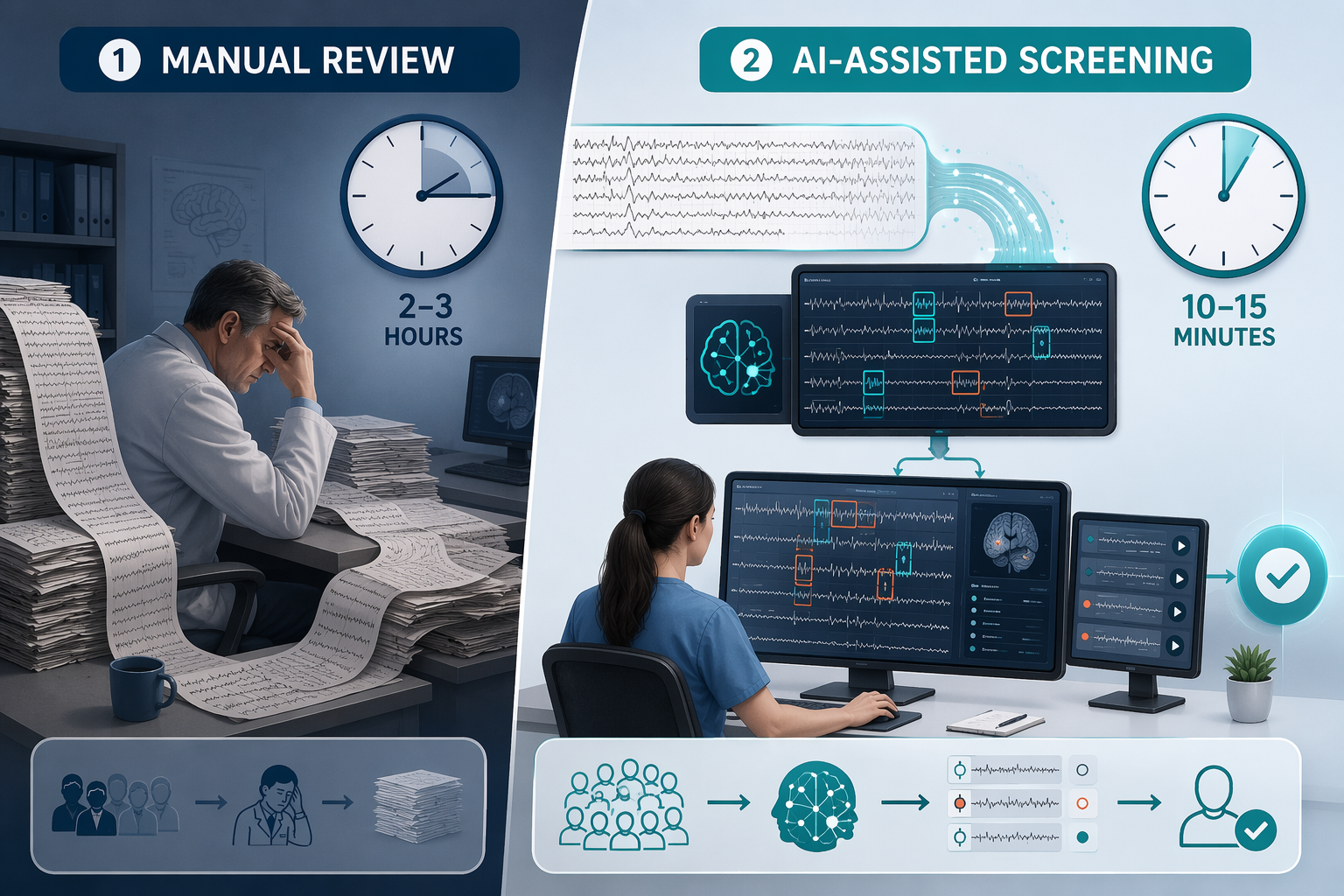
That is a workflow claim before it is a philosophical one. A World Economic Forum article has framed AI EEG analysis as a possible new vital sign for brain health, which helps explain why the topic is getting attention beyond epilepsy and neurocritical care.[2] But the ICU question is narrower and more urgent: can the system identify likely seizures quickly enough, accurately enough, and in a form that a human reviewer can act on without being buried in noise?
The bottleneck is the reader, not the waveform
Continuous EEG monitoring expanded faster than the workforce available to interpret it. In a neurocritical care unit, the question is often time-sensitive: is this patient having nonconvulsive seizures, is a pattern evolving, and does treatment need to change now? A conventional approach can leave the treating team waiting for expert interpretation while hours of recording accumulate.
AI does not remove the need for the expert. In the more credible deployment models, it changes the order of operations. Instead of asking a neurologist or technologist to comb through every epoch with the same urgency, the system continuously screens the recording, marks candidate events, and routes them for verification. The human still decides whether the pattern is a seizure, whether it is lateralized, and whether the result fits the patient.
| Workflow point | Manual-first EEG review | AI-assisted screening model |
|---|---|---|
| Initial pass | Human reviewer examines the recording directly | Algorithm continuously screens EEG and flags candidate events |
| Queue management | Recordings wait for available specialist review | Flagged segments can be prioritized across many monitored beds |
| Verification | Expert interpretation is the first major filter | Technologist or physician verifies AI-flagged events before final interpretation |
| Final responsibility | Physician issues the read | Physician still issues the read |
The last row matters. The serious versions of this technology are not replacing clinical interpretation with an autonomous seizure verdict. They are trying to make sure the most important segments are not trapped inside an unread recording.
Why the Cleveland Clinic model is more interesting than the headline accuracy number
The Cleveland Clinic pilot is worth attention because it describes a usable operating model, not just a model score. The proposed system uses AI to screen EEG continuously across many ICU beds, then displays detected events on a central screen. A technologist reviews the AI-detected events, and a physician provides the final read.[1]
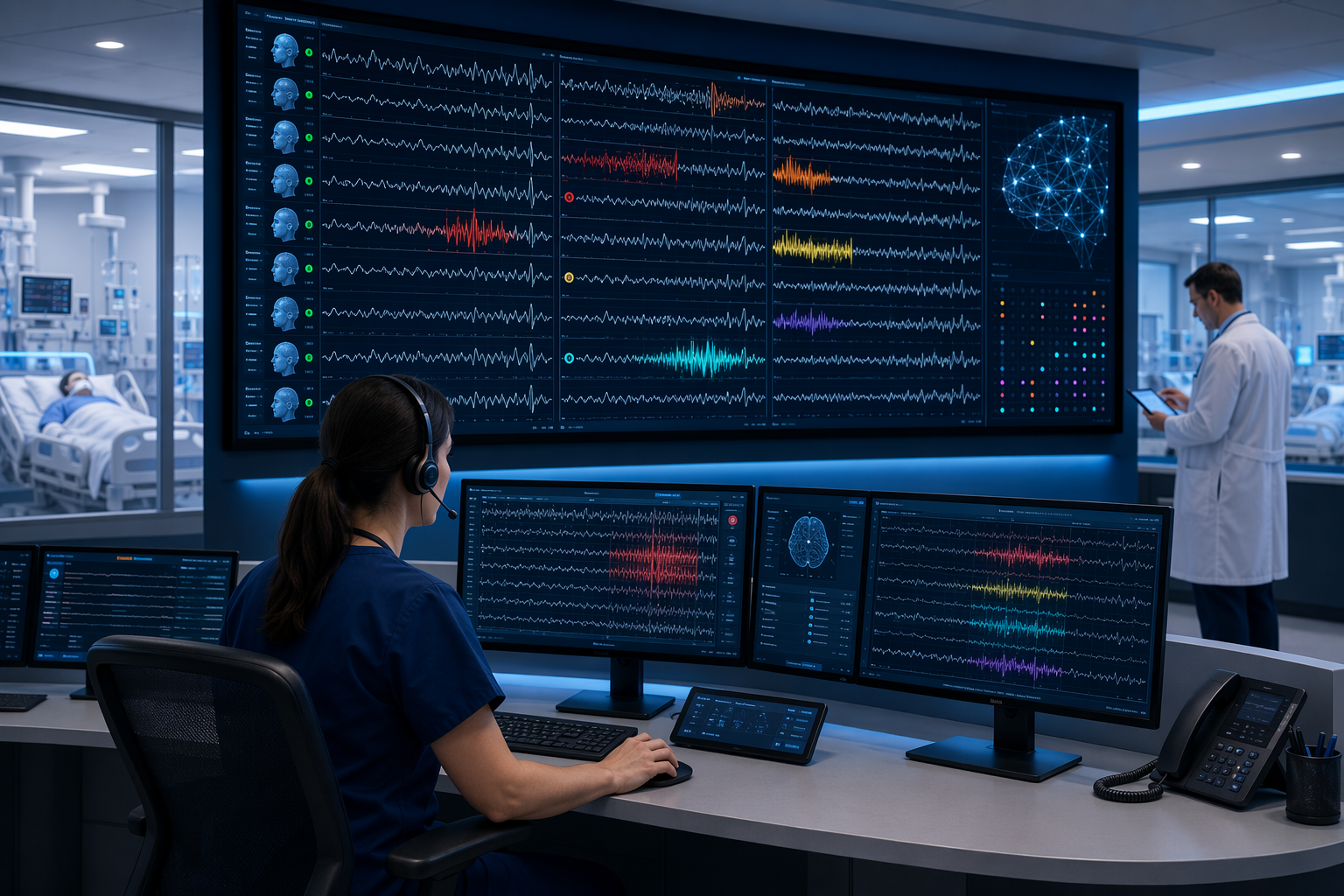
That hub-and-spoke structure is the part hospitals should study closely. A single ICU bedside monitor can show beautiful data and still fail operationally if nobody is assigned to respond to it. A centralized monitoring hub gives the alert somewhere to go. It also makes staffing more realistic: a trained technologist can triage flagged events across monitored beds, escalate the ones that survive review, and spare the physician from treating every algorithmic marker as an interruption.
The reported time reduction is also clinically meaningful because it attacks a familiar waste point. Reviewing a full day of EEG is not the same task as reviewing a short list of candidate events plus surrounding context. If the AI screen is good enough to narrow the worklist while preserving the important seizure events, the physician’s time moves closer to interpretation and farther away from search.
Still, the Cleveland Clinic evidence should be read with the correct label. The pilot was retrospective, and prospective validation data are not yet published.[1] Retrospective performance can show that a signal is real enough to pursue. It cannot, by itself, prove how the system behaves when alerts arrive during a busy shift, when electrodes are noisy, when the patient is being moved, or when the ICU team has already been interrupted five times by other devices.
Sensitivity and specificity are not the whole workflow
A roughly 90% sensitivity figure for seizure detection is encouraging because missed seizures are the failure mode that matters most. But the remaining misses deserve more scrutiny than a rounded accuracy summary can provide. A system that misses brief, low-amplitude, or lateralized seizures would have different clinical consequences than one that misses ambiguous artifacts. The available summary supports the narrower conclusion that seizure detection and lateralization looked promising in a retrospective pilot; it does not settle the bedside risk profile.
Specificity has a different operational consequence. False positives do not only lower a statistic; they create work. Someone has to open the event, inspect the raw tracing, decide whether the marker is seizure, artifact, rhythmic slowing, or another pattern, and then either escalate or dismiss it. If the false-positive stream is heavy, the labor savings can evaporate into technologist fatigue and physician distrust.
This is why the central verification step is not a formality. It is the safety valve. Without it, AI seizure detection risks becoming another alarm source in a room already full of alarms. With it, the software becomes a prioritization tool that still respects the difficulty of EEG interpretation.
Regulatory movement is real, but it is not the same as clinical proof
Zeto’s ONE headset gives the field a second anchor because it moves the discussion from research workflow to cleared point-of-care use. Practical Neurology reported that the Zeto ONE received FDA 510(k) clearance for point-of-care EEG with AI-enabled seizure notifications. The same report notes that up to 40% of brain injury patients in emergency department and ICU settings experience undiagnosed subclinical seizures.[3]
That combination addresses a real gap: many patients who need rapid EEG are located exactly where conventional setup and interpretation can be slowest. A point-of-care headset with seizure notification capability could shorten the path from suspicion to recording, especially in emergency and critical care environments where conventional EEG resources are constrained.
The caution is equally important. FDA clearance indicates that a device has met the relevant regulatory pathway for its cleared use. It does not prove superiority over standard EEG review, does not guarantee improved outcomes, and does not answer every implementation question. Hospitals still have to decide who places the device, who receives the notification, who confirms the tracing, how quickly the final read occurs, and what happens when the AI alert conflicts with the bedside picture.
Seizure detection should not be quietly stretched into full EEG interpretation
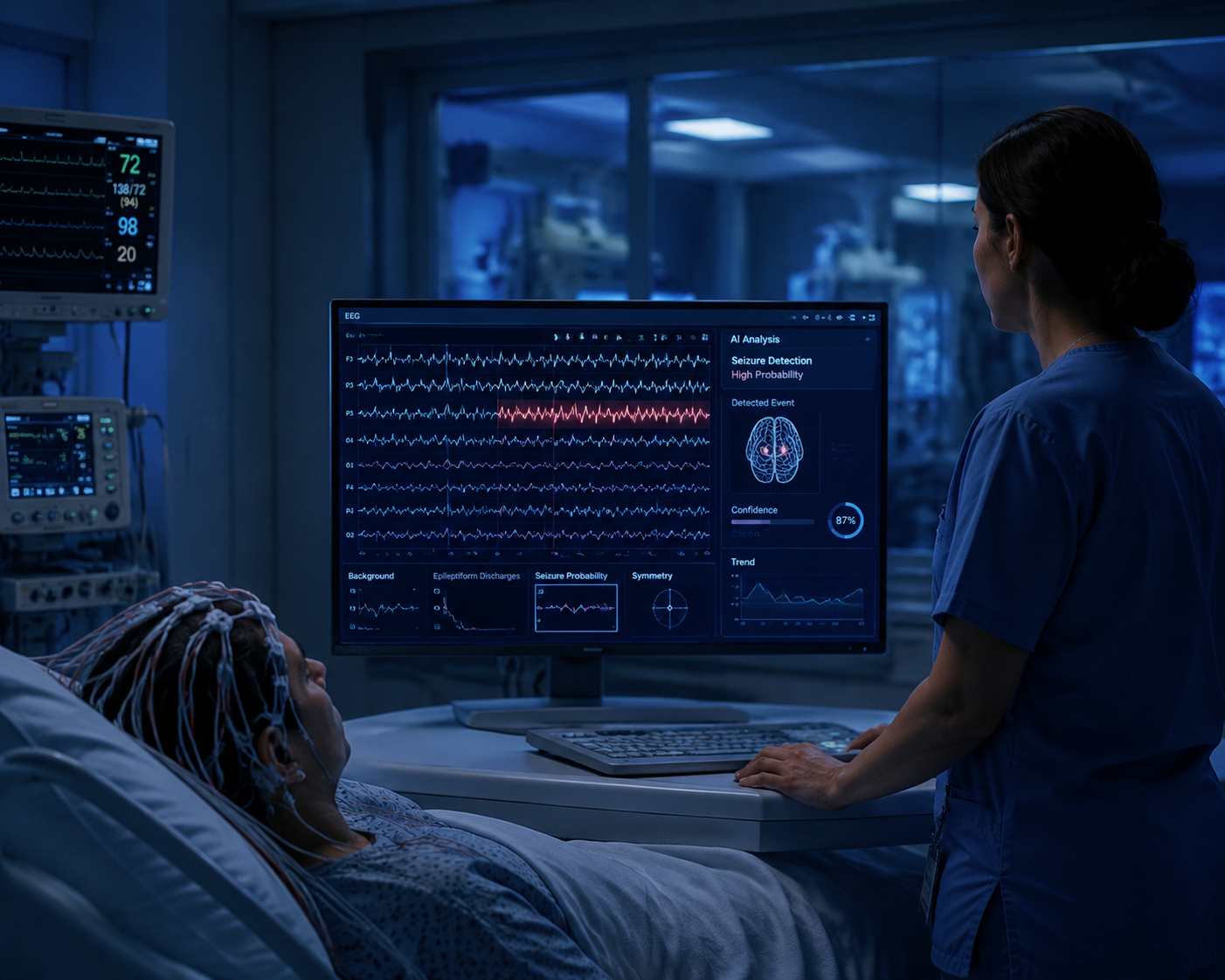
The strongest current claims are about seizure detection. That boundary should stay visible. EEG interpretation in the ICU includes patterns that are clinically important but harder to collapse into a binary alert: periodic lateralized epileptiform discharges, triphasic waves, bilateral independent periodic discharges, diffuse slowing, medication effects, and evolving ictal-interictal patterns. The Cleveland Clinic pilot’s reported figures apply to seizure detection and lateralization, not to these broader non-seizure patterns.[1]
This distinction is where marketing language can get ahead of evidence. A tool that helps find seizures faster can be valuable without being a general-purpose EEG interpreter. In fact, it is probably more deployable when its job is kept narrow. Seizures are concrete enough to define, urgent enough to justify screening, and common enough in neurocritical care to create a meaningful workload problem.
Ceribell’s Clarity algorithm belongs in the same operational conversation because it reflects the broader movement toward rapid EEG triage and AI-supported seizure assessment. But the same rule applies: the relevant question is not whether a platform sounds like “brain monitoring,” but which EEG task it is cleared or validated to perform, how its alerts are reviewed, and what type of clinical decision it is meant to support.
The broader literature supports momentum, not finality
The field is not just a single-vendor story. A 2025 systematic review by Mehmood and colleagues in Biosensors surveyed AI-driven EEG analysis for neurological disorders, reflecting a broad research push across detection, classification, and decision-support tasks.[4] That breadth is useful context. It also makes careful reading more important, because a review of AI EEG methods across neurological disorders cannot be treated as proof that any one ICU seizure-notification workflow improves care.
For hospital leaders, the evidence hierarchy should remain practical. Retrospective algorithm performance can justify piloting. FDA clearance can justify procurement consideration within the cleared indication. A centralized monitoring model can justify workflow redesign. None of those alone answers whether the system will reduce time to treatment, improve outcomes, or decrease total interpretive burden in a specific hospital.
What has to be solved at the bedside
The unresolved problems are not abstract objections. They are the daily usability problems that decide whether a system becomes part of care or another screen people learn to ignore.
- Alert burden: false positives create verification work, and the cost falls first on technologists and physicians already covering multiple patients.
- Training: staff need to know what the algorithm is designed to detect, what it commonly flags incorrectly, and when to distrust a clean screen.
- Escalation rules: an alert has to trigger a defined path, not a vague expectation that someone will notice.
- Raw EEG access: reviewers need to inspect the underlying tracing and surrounding context, not just accept a marker.
- Scope control: seizure detection should not be sold internally as full interpretation of all ICU EEG abnormalities.
- Prospective validation: retrospective performance should be followed by real-world data on timing, alert volume, reviewer workload, and clinical action.
A hospital evaluating these tools should ask to see the whole route from electrode placement to final read. Who is watching the dashboard at 3 a.m.? How are alerts prioritized when several patients are flagged? What is the expected number of events a technologist must dismiss? Does the system integrate with existing EEG and electronic health record workflows, or does it create a parallel process? These questions are less glamorous than a model-performance slide, but they determine whether the promised 10–15 minute review window is realistic.
A disciplined adoption stance
AI EEG interpretation has crossed an important threshold. It is no longer confined to retrospective experiments or conference demonstrations. Cleveland Clinic’s centralized screening-and-verification model shows how AI can fit into a real neurocritical care workflow, and Zeto’s cleared point-of-care seizure notification shows that regulatory pathways are moving alongside deployment.[1][3]
The responsible conclusion is narrower than the most enthusiastic language around brain health monitoring, and stronger than blanket skepticism. AI-powered EEG tools are already changing real-time seizure monitoring by reducing the search burden and helping scarce experts focus on flagged events. The evidence is promising enough for careful implementation, especially where EEG reader shortages delay ICU decisions. It is not yet complete enough to treat retrospective accuracy, regulatory clearance, or seizure detection as proof of broad automated EEG interpretation.
The next useful data will be prospective and operational: time from recording to verified seizure identification, alert burden per patient-day, technologist review time, physician override patterns, treatment changes, and patient outcomes. Until those data are available, the best deployments will keep the human verification layer visible, keep the claims tied to seizure detection, and judge success by whether the right person sees the right EEG segment in time to act.
References
- Harnessing AI to Bring Real-Time EEG Interpretation to the ICU, Cleveland Clinic Consult QD
- AI could unlock a new vital sign to advance brain health, World Economic Forum, June 2025
- Headset for EEG-Assessment of Seizure Activity Cleared by FDA, Practical Neurology
- AI-Driven EEG Analysis for Neurological Disorders, Biosensors, 2025
Comments
Join the discussion with an anonymous comment.