
The ethics of AI in detention healthcare begins with an uncomfortable fact: the clinical need is real, and the usual language of “access” is not enough. A person in custody may need faster tuberculosis screening, suicide prevention, psychiatric support, or continuity of medication. That same person cannot freely leave the institution, choose another clinician, or always refuse a data-driven intervention without wondering whether refusal will be interpreted as noncooperation. In detention healthcare, consent, privacy, and clinical independence are not merely harder to administer. They change meaning.
That is why general healthcare AI ethics guidance matters early, before any vendor demonstration or pilot protocol. The World Health Organization’s 2021 guidance sets six principles for AI in health: protect autonomy, promote human well-being and safety, ensure transparency and explainability, foster responsibility and accountability, ensure inclusiveness and equity, and promote AI that is responsive and sustainable.[1] In community care, those principles already require work. In custody, they become minimum conditions because the patient is structurally less able to protect herself when a tool is wrong, opaque, or repurposed.
The Council of Europe’s CM/Rec(2024)5 sharpens that point for prisons and probation by framing AI as a human-centered technology and, in reported summaries, emphasizing human review of AI-influenced decisions and the need to maintain clinical independence from security functions.[2] Those requirements are not decorative. They are the difference between a clinical tool that informs care and a custody tool that uses health data to manage people.

The Same AI Tool Does Not Mean the Same Ethical Problem
It is tempting to speak of prisons, immigration detention, and forensic psychiatric facilities as one setting. That shortcut hides too much. Legal authority, length of confinement, clinical staffing, appeal rights, language access, trauma history, and security priorities differ across these institutions. A detainee awaiting immigration proceedings, a sentenced prisoner, and a forensic psychiatric patient may all encounter AI-mediated healthcare, but the routes for consent, complaint, review, and independent treatment are not identical.
The same caution applies to AI categories. A model that flags suicide risk from records and behavior is not ethically equivalent to an X-ray tool that assists tuberculosis screening. A therapy chatbot offered to someone who cannot access a human counselor is not the same intervention as telehealth scheduling software. The governance question is not whether “AI in detention healthcare” is good or bad. It is which clinical purpose is bounded enough, which data pathway is controlled enough, and which human professional retains enough authority to protect the patient.
| Use type | Clinical promise | Detention-specific ethical pressure |
|---|---|---|
| Suicide prediction | Earlier identification of people who may need urgent mental health intervention | Predictions may trigger interventions that change the outcome the model later claims to predict |
| Diagnostic imaging | Faster screening for conditions such as tuberculosis where risk is high and specialist access may be delayed | Data use, validation, and follow-up must remain clinical rather than disciplinary |
| Therapy chatbots and telehealth | More contact where human mental healthcare is scarce | Privacy, emotional dependency, surveillance, and substitution for human care become harder to separate |
Suicide Prediction: The Highest Stakes and the Hardest Validation Problem
Suicide prediction is the place where the promise of AI is most morally serious. Detention systems have long struggled with mental illness, self-harm, delayed assessment, understaffing, and discontinuity of care. A model that can help clinicians notice danger sooner is not a trivial administrative upgrade. If it works, someone may live who otherwise would have been missed.
That moral urgency is exactly why weak evidence should not be laundered into certainty. Secondary reporting on Akhtar et al.’s 2024 correctional suicide prediction model describes very high performance, including 98.6% accuracy and 98.9% precision.[3] Those figures are striking, but they should be read with two cautions. First, the underlying study was not directly available, so the claim must be treated as reported rather than independently examined. Second, accuracy in a high-stakes detention context does not answer the clinical question by itself: what happens after the model flags a person?
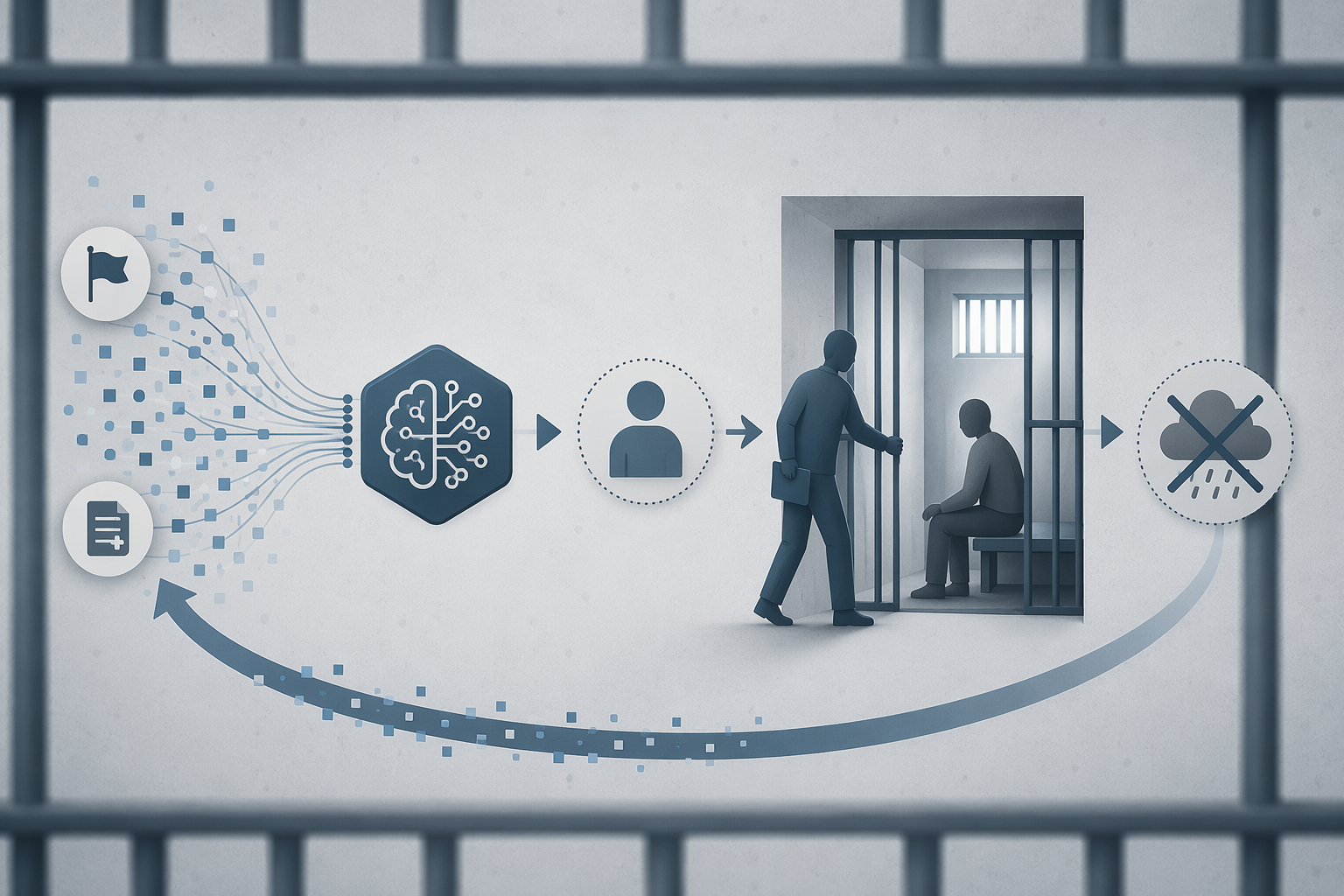
The validation problem is not a statistical quibble. If an AI system predicts that a detained person is at high risk of suicide, staff may increase observation, remove objects, transfer the person, initiate mental health review, or place the person in a safer cell. If the person does not die, the system may appear successful. But the intervention has also removed the very outcome that would have shown whether the prediction was accurate. Hogan et al. describe this kind of feedback-loop problem in suicide prediction: prevention changes the world against which the model is later evaluated.[4]
Inside detention, the problem has a second layer. The intervention itself can harm. A suicide flag may lead to constant observation, isolation-like conditions, loss of clothing or bedding, cell moves, or increased security attention. Some of those measures may be clinically necessary in an acute crisis. They are not ethically neutral. A false positive in this context is not just an anxious phone call or an extra appointment; it can become an intrusive custodial event imposed on a person who cannot leave.
The safeguard cannot be a vague promise that clinicians remain “in the loop.” Human review has to mean that a qualified clinician can see why the person was flagged, examine current clinical information, override the recommendation, document the reason, and choose a proportionate response. It also means the patient must have some meaningful way to contest downstream consequences when an AI-influenced label follows them through housing, observation, medication access, or disciplinary interpretation.
The most dangerous deployment would be one where the algorithm is treated as a staffing substitute: fewer assessments because the model watches everyone, fewer clinicians because dashboards appear to triage risk, fewer questions because the system seems precise. Efficiency is not a clinical outcome unless saved labor becomes better care. In a detention setting, saved labor can just as easily become thinner staffing around people whose distress has been converted into a risk score.
Diagnostic Imaging Has a Clearer Clinical Shape, but Not a Free Pass
Diagnostic imaging is a different kind of case. Tools such as Qure.ai’s chest X-ray interpretation for tuberculosis screening are often described as ways to identify disease faster in settings where radiology expertise is scarce and TB risk is elevated.[5] The clinical task is more bounded than suicide prediction: analyze an image, identify findings that may suggest TB, and route the patient for appropriate follow-up. That narrower task reduces some autonomy concerns because the tool is not predicting future behavior or inferring emotional state from a wide behavioral record.
This is the kind of AI use in detention healthcare that can be easier to justify, particularly when the alternative is delayed diagnosis in a crowded facility. A chest X-ray algorithm does not remove the need for consent, explanation, clinical judgment, microbiological confirmation where indicated, or treatment access. It can, however, help a clinician identify a communicable disease sooner. The ethical argument is stronger when the tool answers a defined medical question and its output leads to care rather than punishment.
The remaining safeguards are still practical and nonnegotiable. Image data should not become a general biometric or security resource. Positive findings must trigger clinical follow-up, not merely segregation or administrative labeling. Local validation matters because detention populations may differ by age, country of origin, prior treatment, comorbidities, and access to previous screening. If a system is deployed because it is faster than waiting for a radiologist, the institution must still explain who reviews uncertain outputs, who communicates results, and who ensures that diagnosis leads to treatment.
Therapy Chatbots and the Surveillance-Therapy Blur
Therapy chatbots and AI-supported telehealth tools arrive with a different promise: contact. Correctional healthcare organizations and vendors describe AI as a possible way to extend scarce clinical capacity, support triage, improve documentation, and connect patients with services in constrained environments.[3][6] Those are real pressures. A person waiting weeks for mental healthcare is not protected by a principled refusal to use technology.
But a chatbot offered in custody does not occupy the same ethical space as a consumer mental health app downloaded at home. The user may not know who can read the exchange, whether distress disclosures will be routed to custody staff, whether refusal affects access to care, or whether the conversation becomes part of a record used for classification, observation, or discipline. Even when a system is procured for care, the institution around it is built for control.
The concern is not that every therapeutic AI system is secretly a surveillance system. The available materials do not support that broad claim. The narrower and more defensible concern is that detention makes the boundary unusually fragile. Health data can be valuable to clinicians because it reveals fear, impulsivity, hallucinations, trauma, substance use, or suicidal thinking. The same data can be attractive to security functions because it appears to reveal volatility, vulnerability, or noncompliance. Governance has to decide in advance which uses are forbidden, not after a crisis invites exception.
Emotional dependency also deserves more attention in custody than it often receives in ordinary digital health debates. A detained person who has little privacy, limited family contact, and poor access to human therapy may disclose deeply to the only responsive interface available. If the system is not clinically supervised, if it cannot recognize deterioration, or if its scripts encourage trust without reciprocal accountability, the interaction may feel therapeutic while failing the obligations of therapy.
A responsible deployment would make the limits explicit: the tool is not a confidential human therapist, crisis disclosures may trigger defined clinical review, and data will not be used for discipline or general intelligence gathering. The patient should know when they are interacting with AI, what the system stores, who can access it, and how to reach a human clinician. Those disclosures are imperfect in custody because choice is constrained, but imperfection is not an excuse for opacity.
What Governance Has to Control
The governing question is not whether a detained patient technically clicked consent, heard a disclosure, or appeared on a dashboard. It is whether the institution has separated care from custody strongly enough that AI can serve a clinical purpose without becoming an instrument of control. WHO’s principles and the Council of Europe’s human-centered approach are useful because they force attention away from procurement claims and toward duties that can be audited.[1][2]
- Autonomy: the patient must be told when AI is used, what role it plays, and what choices remain available, while recognizing that consent in custody is structurally compromised.
- Well-being and safety: the intervention must improve clinical care, not merely institutional risk management or administrative efficiency.
- Transparency: clinicians and patients need understandable explanations of what the tool does, what data it uses, and where its evidence is uncertain.
- Accountability: a named clinical authority must be responsible for AI-influenced decisions, including overrides, errors, and downstream consequences.
- Equity and inclusiveness: performance must be examined across detained populations rather than assumed from community datasets or vendor summaries.
- Clinical independence: health data and clinical judgments must be protected from routine security, disciplinary, or immigration-enforcement repurposing.
Bias deserves a specific place in that list, but not as a detachable issue. Detention populations often include people who have already been filtered through unequal policing, prosecution, migration control, poverty, disability, and racialized disadvantage. A model trained on institutional records may learn the institution’s prior decisions as if they were clinical truth. That is the same regulatory problem seen in broader public health AI bias debates, intensified by confinement and reduced contestability. For a closer discussion of automated disparities outside detention, see algorithmic bias in public health AI.
Independent review is not satisfied by a vendor performance report. The Royal Society Open Science discussion of healthcare AI ethics and law underscores the broader need to address accountability, transparency, bias, and governance as AI systems enter clinical practice.[7] In detention, that review should include people who understand correctional healthcare operations, mental health crisis care, data protection, disability rights, and the specific legal authority under which people are confined.
A Narrower Standard for Justification
AI may have a place in detention healthcare. A tuberculosis screening tool that helps identify disease sooner in an overcrowded facility should not be dismissed because it is algorithmic. A suicide risk model that prompts a timely human assessment may be clinically valuable, even if its performance claims require careful caveating. Telehealth and digital triage may reduce delays when the alternative is no meaningful access at all.
The threshold is higher because the patient’s ability to refuse, verify, complain, and leave is lower. AI in detention healthcare is ethically defensible only where the clinical purpose is bounded, the evidence is transparent about validation limits, data use is separated from security and discipline, human review is guaranteed, and clinical independence is protected in practice. WHO 2021 and CM/Rec(2024)5 should be treated as minimum operating conditions, not aspirational language added after the system has already been purchased.
References
- Ethics and governance of artificial intelligence for health, World Health Organization, 2021.
- Recommendation CM/Rec(2024)5 of the Committee of Ministers to member States regarding the ethical and organisational aspects of the use of artificial intelligence and related digital technologies by prison and probation services, Council of Europe, 2024.
- The Promise and Peril of AI, National Commission on Correctional Health Care.
- Hogan et al., discussion of the feedback-loop validation problem in suicide prediction, Journal of the American Academy of Psychiatry and the Law, 2021.
- Between bars and Big Data: Artificial Intelligence and the digital right to health in prisons, Justice Trends.
- AI in Corrections: The Future of Care or Cause for Concern?, Fusion EHR.
- Ethical and legal considerations in healthcare AI, Royal Society Open Science, 2025.
Comments
Join the discussion with an anonymous comment.