
The uncomfortable fact about ai in physical therapy and paralysis recovery is that the most clinically important question is not whether an exoskeleton can learn. Some can. The question is whether the exoskeleton a clinic can buy, train staff on, schedule patients into, and document around is actually using AI in the control loop that governs movement.
A 2024 systematic review gives the cleanest reality check. Across 37 papers on AI methods in lower-limb exoskeletons, only 3 tested pathological populations, and the review found no commercially available exoskeletons integrating AI into their core clinical functioning.[1] That does not make the research unimportant. It does mean that a convincing lab controller and a deployable rehabilitation device are still different things.
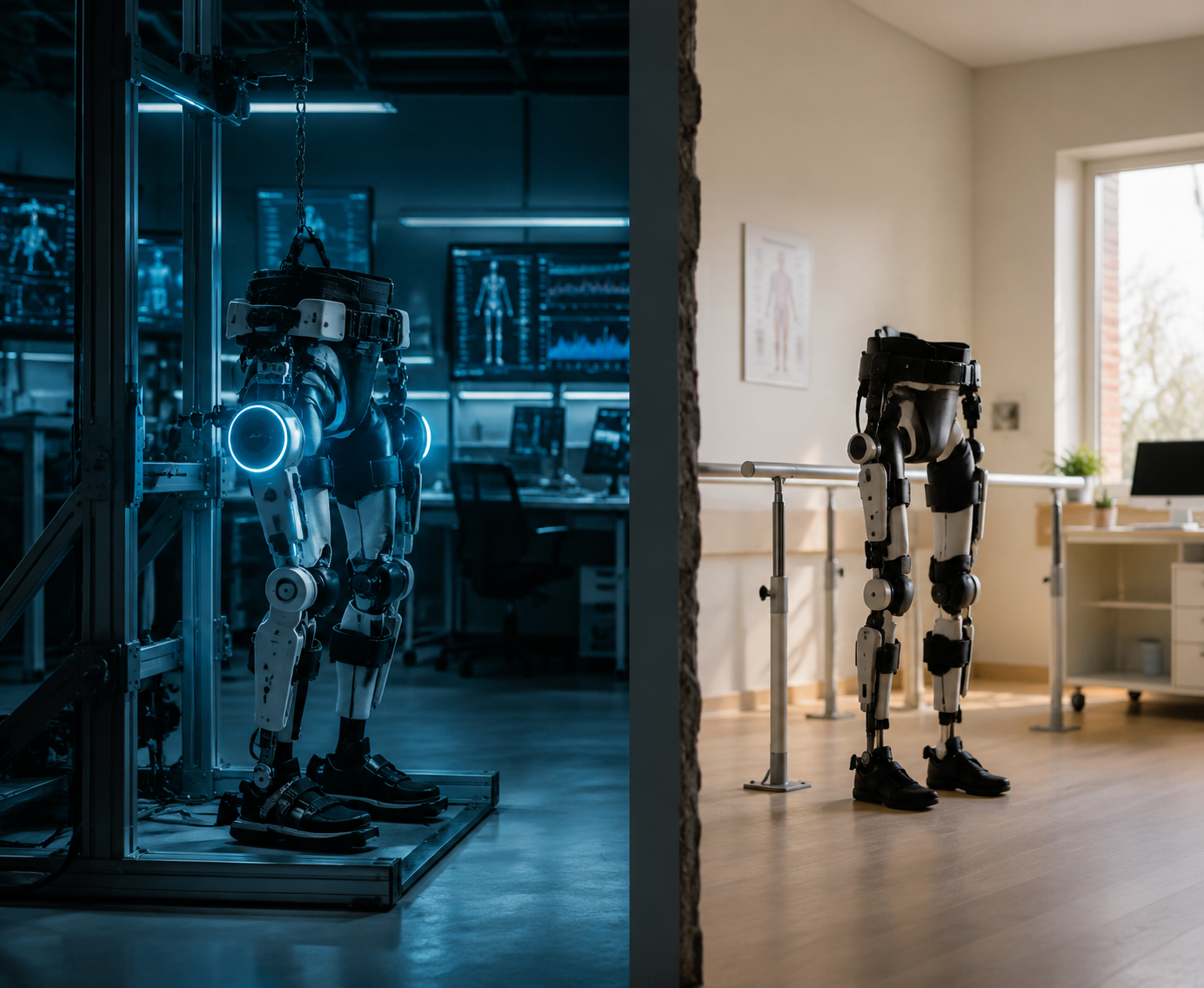
The Evidence Base Is Still Narrower Than the Marketing Language
The systematic review is useful because it separates the AI task from the clinical promise. Reinforcement learning appears most often in robot control, while neural networks perform strongly in joint trajectory prediction.[1] Those are meaningful technical achievements. In gait rehabilitation, better trajectory prediction and better control can reduce the awkward lag between a patient’s intended movement and the robot’s assistance.
But the population match matters. Healthy-subject testing can show whether a controller is stable, responsive, or computationally feasible. It cannot tell a rehabilitation team how the same controller behaves when spasticity, weakness, fatigue, asymmetric loading, cognitive load, or fluctuating tone enter the session. The review’s 3-of-37 pathological-population figure is therefore not a minor methods footnote. It is the part that determines how far a clinician should generalize the result.[1]
This is also where the phrase “AI-powered” starts to lose precision. An exoskeleton may use AI in simulation, in offline gait analysis, in trajectory prediction, in intent detection, or in the real-time controller that decides assistance during walking. Those are not interchangeable claims. For paralysis recovery and neurologic gait training, the control-loop claim is the one that changes clinical risk, calibration burden, staff training, and patient selection.
| Claim being made | What a clinic should ask |
|---|---|
| AI predicts joint trajectories | Was prediction tested on the target diagnosis, or mainly on healthy gait? |
| AI adapts assistance in real time | Is the AI inside the active control loop during patient walking? |
| AI was used in development or simulation | Does any AI component remain active in the cleared clinical device? |
| The exoskeleton is commercially available | Which functions are cleared, documented, and trainable in normal clinic workflow? |
Why the Georgia Tech Hip Exoskeleton Still Matters
The Georgia Tech work is exactly the kind of research that keeps the field worth watching. In a 2025 report on a robotic hip exoskeleton, the system learned individual gait patterns in 1 to 2 minutes, achieved more than 75% error reduction after only 10 calibration strides, and reduced gait-tracking error by about 70% in stroke patients.[2] Those numbers are not cosmetic. If they hold up across broader groups and harder walking conditions, they point toward less setup time and more responsive assistance during a therapy session.
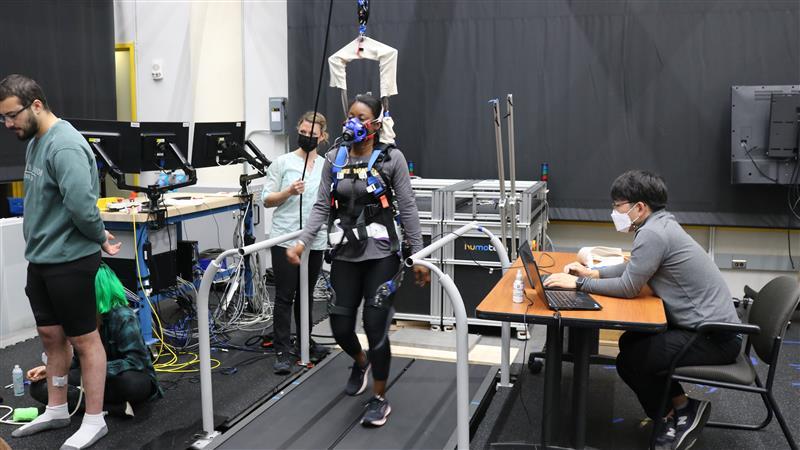
The rapid learning window is clinically interesting because calibration time is not an abstract engineering inconvenience. It is patient energy, therapist attention, treadmill time, transfer time, and documentation pressure. A controller that can reduce error after a small number of strides may fit rehabilitation reality better than one that needs a long individualized setup before useful walking begins.
The study also keeps the right endpoint in view: stride-by-stride improvement. For a patient relearning gait after stroke, assistance that updates as the person moves is more compelling than a device that applies a fixed pattern and asks the patient to conform to it. Adaptive control is not just a nicer interface; it can change who is doing the work at each moment of the step cycle.
The boundary is just as important as the result. This was a hip exoskeleton, not a multi-joint or full-body system.[2] A hip-only controller does not have to solve every interaction among pelvis, knee, ankle, trunk, balance recovery, foot clearance, and compensatory upper-body strategy. That does not diminish the finding. It prevents the wrong inference: a 70% tracking-error reduction in one research platform is not proof that full paralysis-recovery exoskeletons in routine clinics now have AI-controlled gait adaptation.
Commercial Deployment Is Real, but It Is Not the Same Claim
Wandercraft is the useful counterweight because it is not merely a research demo. Its Atalante X is deployed in more than 100 clinical sites, and patients using Wandercraft systems take more than 1 million steps per month, according to a company-focused NVIDIA report.[3] That is the kind of footprint rehabilitation leaders can take seriously: repeated use, multiple sites, real scheduling, real staff interaction, and enough volume to expose practical friction.
That footprint, however, answers a different question from the one raised by AI control. It supports the point that advanced exoskeletons can exist inside clinical rehabilitation programs. It does not, by itself, establish that AI is governing the active clinical control loop in the deployed Atalante X. The systematic review’s conclusion still matters here: commercially deployed exoskeletons had not crossed that AI-control threshold in the evidence it reviewed.[1]
For procurement and clinical leadership, this distinction is not semantic. If a device is commercially deployed but not AI-controlled in its core gait function, evaluation should focus on the capabilities it actually offers: supported stepping, therapist workflow, patient eligibility, safety procedures, session throughput, maintenance, and training. If a vendor also describes AI research or simulation work, that belongs in a separate readiness category until it is part of the cleared product behavior.
The Personal Exoskeleton Is a Trial-Stage Signal
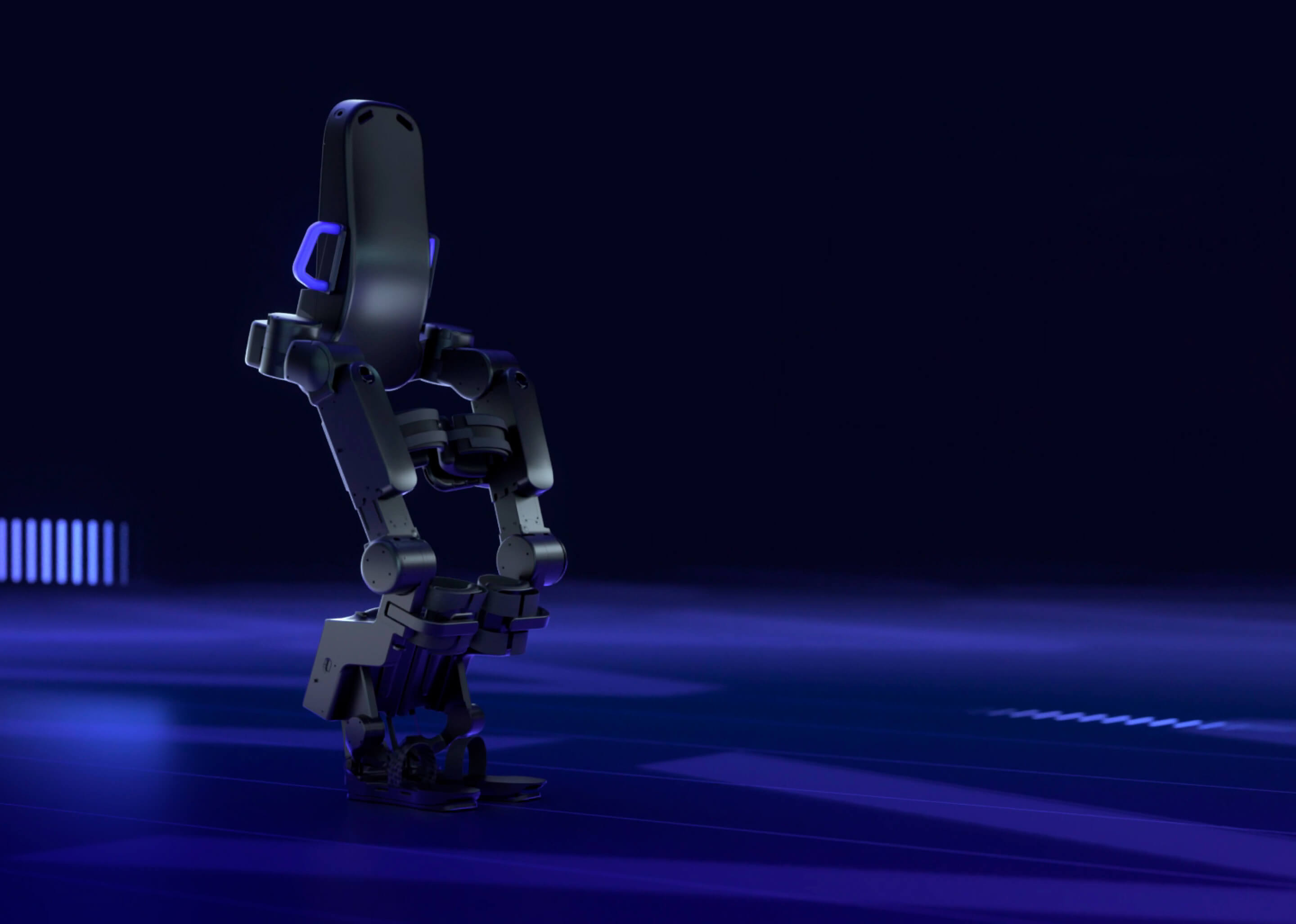
Wandercraft’s Personal Exoskeleton is the more direct AI story. The NVIDIA report describes a system using reinforcement learning trained on NVIDIA Isaac Sim, with the device still in clinical trials.[3] That places it in the right direction for adaptive, AI-informed mobility assistance, but not in the same category as a cleared, clinic-ready therapeutic platform.
Trial-stage systems deserve attention because they show where the control architecture is heading. They should not be treated as evidence that today’s commercially available rehabilitation exoskeletons already contain real-time AI control. A clinician can be optimistic about the trajectory and still insist on that distinction.
What This Means for Paralysis Recovery Programs Now
For current clinical programs, the safest interpretation is narrow and practical. AI-driven adaptive control has shown meaningful performance gains in research settings, including rapid gait adaptation in a stroke-tested hip exoskeleton.[2] Commercial exoskeleton deployment is also real, with systems such as Atalante X already present across a substantial number of sites.[3] The missing link is evidence that commercially available clinical exoskeletons are using AI inside the core control loop during routine patient care.[1]
That gap changes how an adoption conversation should run. The first question should not be “Does it use AI?” It should be “Where, exactly, is the AI used?” A credible answer should identify whether the model is used for offline planning, user-intent recognition, trajectory prediction, simulation, clinician-facing analytics, or real-time motor control. It should also state whether that function is part of the commercial clinical device or part of a development pipeline.
- Ask whether AI remains active during patient walking or was used only during design, training, or simulation.
- Ask which populations were tested: healthy participants, stroke patients, spinal cord injury patients, or mixed neurologic groups.
- Ask how long calibration takes and who performs it during a normal session.
- Ask what the control system optimizes: tracking error, metabolic cost, symmetry, speed, safety constraints, or therapist-selected goals.
- Ask whether the cleared clinical documentation matches the AI claims used in sales or investor materials.
The calibration question deserves special weight. In a busy neurorehabilitation setting, a system that needs extensive individualized tuning may be technically impressive and operationally difficult. The Georgia Tech result is striking partly because it compresses learning into a short window.[2] Until comparable behavior is demonstrated in commercial multi-joint systems and in the relevant patient populations, it remains a promising research benchmark rather than a procurement assumption.
Market Attention Is Not Clinical Readiness
The money is arriving before the clinical evidence is fully settled. One third-party market estimate projects the exoskeleton market growing from $590 million in 2025 to $1.79 billion in 2033.[4] That estimate helps explain why AI rehabilitation robotics is attracting attention, partnerships, and product language. It does not validate a control system, expand a trial population, or prove that a device can be staffed efficiently on a therapy floor.
For paralysis recovery, the procurement standard should stay closer to clinical work than to market language. A device can be valuable without being AI-controlled. A research prototype can be elegant without being ready for routine care. A company can have a real installed base and still be developing the AI functions that would matter most for adaptive assistance.
References
- Coser et al. 2024 systematic review of 37 papers on AI in lower-limb exoskeletons, Frontiers in Robotics and AI, 2024.
- Robotic Breakthrough Could Help Stroke Survivors Reclaim Their Stride, Georgia Tech Research, September 18, 2025.
- Physical AI Exoskeleton, NVIDIA Blog.
- US AI in Physical Therapy Market Sizing, Towards Healthcare.
Comments
Join the discussion with an anonymous comment.