
Facelift results are still often discussed through paired photographs, surgeon assessment, and a patient’s sense that the face looks “younger.” Those materials are clinically meaningful, but they are also easy to bend. Lighting changes. Facial expression changes. The viewer knows which image is postoperative. Reputation and expectation enter the room before anyone says a word. The practical question for AI in plastic surgery facelift outcomes is therefore narrower than whether a model can judge beauty: can it measure the same patient’s apparent age before and after surgery consistently enough to serve as a usable outcome endpoint?
The best current evidence points to a cautious yes for research measurement. In Zhang et al.’s 2021 facelift study, a convolutional neural network using FaceX estimated perceived age from standard facial photographs with approximately 96% accuracy, then detected a mean 4.3-year reduction in apparent age after facelift surgery. The same study reported that AI-estimated age reduction correlated with FACE-Q satisfaction measures, which is what keeps the number from becoming a technically neat but clinically empty endpoint.[1]

Elliott et al. added a second important signal in 2023. In a retrospective cohort of 226 facial rejuvenation patients, AI estimated a 3.5-year reduction in perceived age at 3 months, falling to 1.7 years at 12 months.[2] That time pattern matters. A single early postoperative photograph can capture swelling resolution, skin quality, makeup, expression, and the selected imaging moment. A follow-up metric that changes over time is not necessarily a failure of the model; it is a reminder that the endpoint needs a defined photography protocol and a defined postoperative timepoint.
The useful number is not the most flattering one
The most clinically useful finding is the distance between what the model saw and what patients felt. Across the cited facelift work, AI-detected apparent age reduction was in the range of 3.5 to 4.3 years, while patients self-reported a larger perceived age reduction of 6.7 years.[1][2] That gap should not be treated as proof that patients are wrong or that the AI is more truthful in some absolute sense. It is more useful as a translation problem.
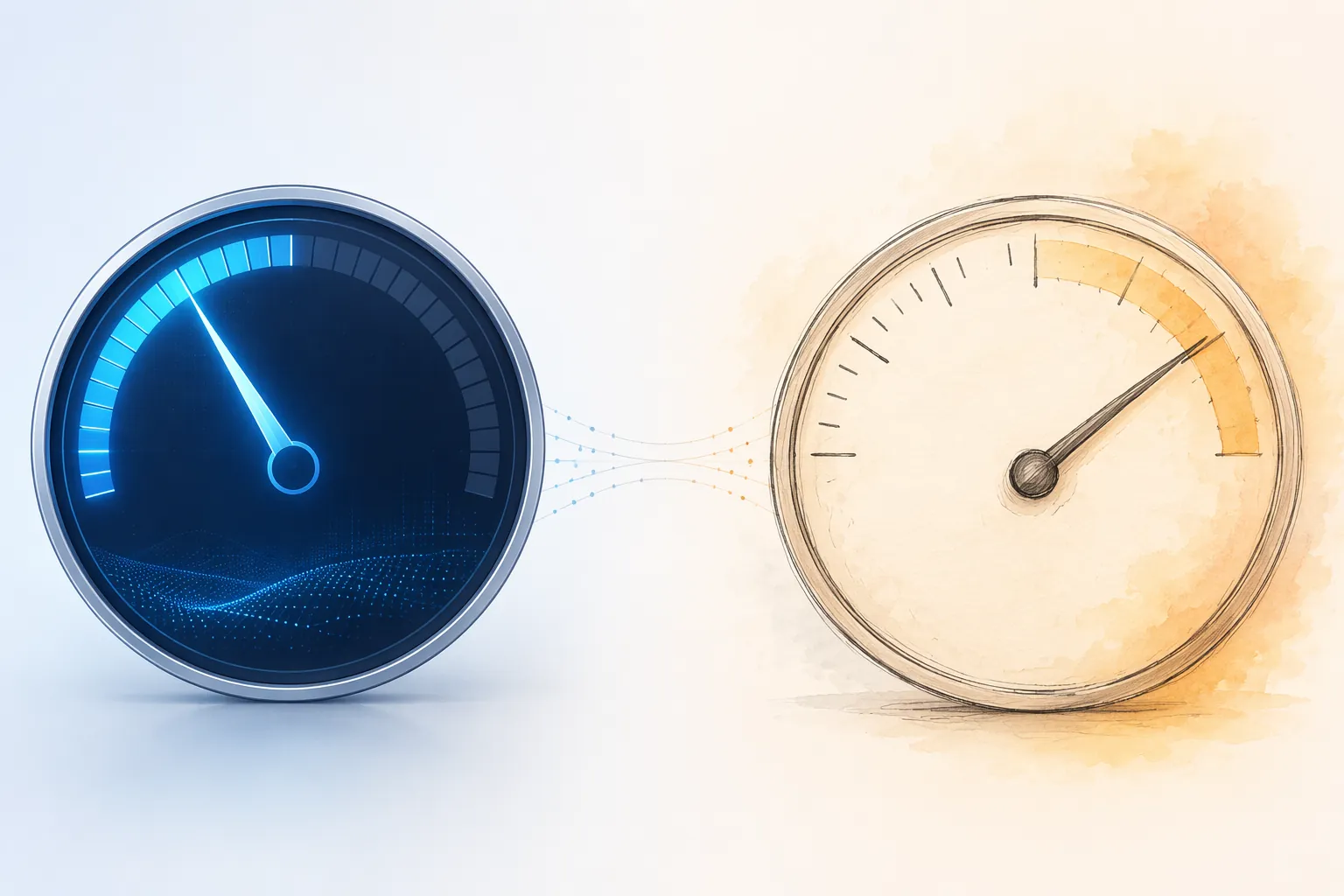
A patient asking how many years a facelift will “take off” is not asking for a computer vision endpoint. They are asking how they may look to others, how they may feel in photographs, and whether surgery will match the private image they carry of themselves. A CNN age estimate answers only one slice of that question: how much younger the face appears to an age-estimation system trained to infer perceived age from photographs. The patient-reported 6.7-year figure answers another slice: how the person experiences the outcome.
For expectation-setting, the discrepancy is probably more valuable than either number alone. If a surgeon tells patients that published AI studies show a mean apparent-age reduction of roughly several years, while patients often report a larger subjective sense of rejuvenation, the conversation becomes more honest. The model does not need to replace patient satisfaction to help preoperative counseling; it can make the promise of “years regained” less elastic.
Why the FACE-Q correlation matters
An objective endpoint earns more trust when it moves with something patients actually report. Zhang et al. found that AI-estimated age reduction correlated with FACE-Q satisfaction scores, including facial appearance at 75.1 ± 8.1, aging appearance at 79.3 ± 7.6, and quality of life at 82.4 ± 8.3, each on a 0–100 scale.[1] That does not prove that the AI measure causes satisfaction, nor does it mean apparent-age reduction fully explains satisfaction. It does show that the metric is not floating apart from validated patient-reported outcomes.
That distinction is important in aesthetic surgery research. A purely technical age estimate could be repeatable and still clinically irrelevant if patients with large AI-measured reductions did not feel better about their facial appearance. Conversely, patient satisfaction alone can be influenced by baseline expectations, surgeon rapport, cost, recovery experience, and social feedback. The FACE-Q correlation gives researchers a bridge: apparent-age reduction can be analyzed beside patient-reported appearance and quality-of-life measures rather than standing in for them.
| Measure | What it captures | Current evidence in facelift studies |
|---|---|---|
| AI-estimated age reduction | Change in perceived age from standardized facial photographs | Approximately 4.3 years in Zhang et al.; 3.5 years at 3 months and 1.7 years at 12 months in Elliott et al.[1][2] |
| Patient-reported age reduction | The patient’s own sense of years regained | Larger reported reduction of 6.7 years across the cited facelift evidence.[1][2] |
| FACE-Q satisfaction | Validated patient-reported satisfaction with appearance and quality of life | Correlated with AI-estimated age reduction in Zhang et al.[1] |
What the model can compare, and what it cannot decide
The existing studies support CNN age estimation as a measurement aid, not as an independent judge of surgical success. It can compare preoperative and postoperative photographs under study conditions. It can generate a quantifiable apparent-age endpoint. It can help researchers move beyond vague before-and-after language. Those are not small gains in a field where photographic assessment often carries more confidence than its methods justify.
The same evidence does not support using the model alone to tell an individual patient whether a facelift “worked.” A patient may value jawline contour, neck definition, naturalness, scar quality, or looking less tired more than looking a specific number of years younger. The CNN does not know which of those goals mattered most in the consultation. It also does not adjudicate whether an outcome was worth the recovery, cost, or risk from the patient’s point of view.
This is where role clarity matters. In a clinical study, the model can function as one endpoint among several: AI-estimated apparent age, FACE-Q scores, complication data, revision data, and blinded human ratings if used. In routine care, the same model should not be presented as a validated standalone score of facelift quality. A research endpoint and a clinical decision-maker are different instruments.
Technique comparisons should stay modest
The available facelift AI studies also reported no clear superiority of a single technique by AI-measured age reduction, including deep plane approaches, SMAS-plication, and fat grafting.[1][2] That finding is worth noting, but it should not be stretched into a ranking of surgical methods. Apparent-age reduction is only one outcome dimension, and these retrospective studies were not designed to settle technique debates.
For researchers, the more useful implication is methodological. If different techniques produce similar AI-measured apparent-age changes in retrospective datasets, future studies need enough power, standardized imaging, demographic reporting, and patient-reported outcomes to detect whether any subgroup or technique-specific difference is real. For surgeons, the finding should not override anatomy, goals, tissue quality, safety, or operative judgment.
The demographic problem is not a footnote
The strongest reason to narrow the claim is the study population. Zhang et al. included only women, with a mean age of 58.7 years.[1] Elliott et al.’s cohort was 93.4% female and 95.6% white/Caucasian.[2] A facelift outcome tool that has mostly been tested on white female faces cannot be treated as a general facial aging instrument.
This limitation is more than a routine call for diversity. Facial aging signs, skin tone, soft-tissue distribution, hairline visibility, pigmentation, and photographic contrast can all affect how a face is represented in an image. If age-estimation CNNs were trained or validated predominantly on lighter skin tones and narrow demographic groups, they may underperform when applied to broader facial phenotypes. The current facelift evidence does not establish representative performance across sex, race, ethnicity, or skin tone.
That does not erase the signal in the existing studies. It does mean the benchmark should stay attached to the population in which it was observed. A model that performs well in a homogeneous retrospective cohort may still be useful for hypothesis generation and controlled research; it is not yet a universal yardstick for facial rejuvenation.
Accuracy across plastic surgery is not the same as validation for facelift care
The broader plastic surgery AI literature is encouraging but uneven. A 2025 comprehensive review reported pooled AI accuracy of 88% across plastic surgery domains, with a 95% confidence interval of 0.85–0.90.[3] That figure should not be confused with the approximately 96% perceived-age estimation accuracy reported for FaceX in the facelift-specific study.[1] They answer different questions across different evidence bases.
The same review gives the readiness problem sharper edges: only 35% of AI studies in plastic surgery reported external validation, and none had conducted prospective clinical trials.[3] For a measurement tool, that matters. External validation asks whether the model still performs when it leaves the original dataset. Prospective testing asks whether it works when images, workflows, clinicians, and patients are collected forward in time rather than reconstructed after the fact.
Facelift AI outcome measurement therefore sits in an intermediate position. It is stronger than a speculative application because it has direct retrospective studies, a measurable apparent-age endpoint, and correlation with FACE-Q satisfaction. It is weaker than a deployable clinical tool because it lacks prospective multicenter validation, representative demographic testing, and evidence from real-world use.
A practical standard for use now
For current research, AI-based age estimation is credible as an objective endpoint when the study design is explicit about its limits. Investigators should specify the model, imaging protocol, postoperative timepoint, demographic distribution, and whether the analysis has external validation. They should report AI-estimated age reduction beside validated patient-reported outcomes rather than allowing the computer vision metric to stand alone.
- Reasonable current use: retrospective or prospective research endpoint for apparent-age change, paired with FACE-Q or other validated patient-reported measures.
- Potential counseling use: expectation-setting language that separates AI-estimated apparent-age reduction from the patient’s subjective sense of rejuvenation.
- Premature use: standalone clinical grading of an individual facelift result without demographic validation and prospective workflow testing.
- Necessary next evidence: multicenter prospective studies with standardized photography, external validation, and representative reporting by sex, race, ethnicity, age, and skin tone.
The strongest version of the evidence is also the most bounded. CNN-based age estimation can quantify a visible rejuvenation signal after facelift surgery, and that signal relates to patient satisfaction. The AI number is smaller than patients’ self-reported age reduction, which makes it useful rather than embarrassing: it gives surgeons and researchers a more disciplined way to discuss “years regained.” But the field should not mistake a promising retrospective endpoint for a validated clinical arbiter. Use it to design better studies now; do not present it as an independent judge of facelift success in routine care.
References
- Turning Back the Clock: Artificial Intelligence Recognition of Age Reduction after Face-Lift Surgery Correlates with Patient Satisfaction — PubMed, 2021.
- Artificial intelligence for objectively measuring years regained after facial rejuvenation surgery — ScienceDirect, 2023.
- The intelligent lift: Artificial Intelligence's growing role in plastic surgery - a comprehensive review — PMC, 2025.
Comments
Join the discussion with an anonymous comment.