
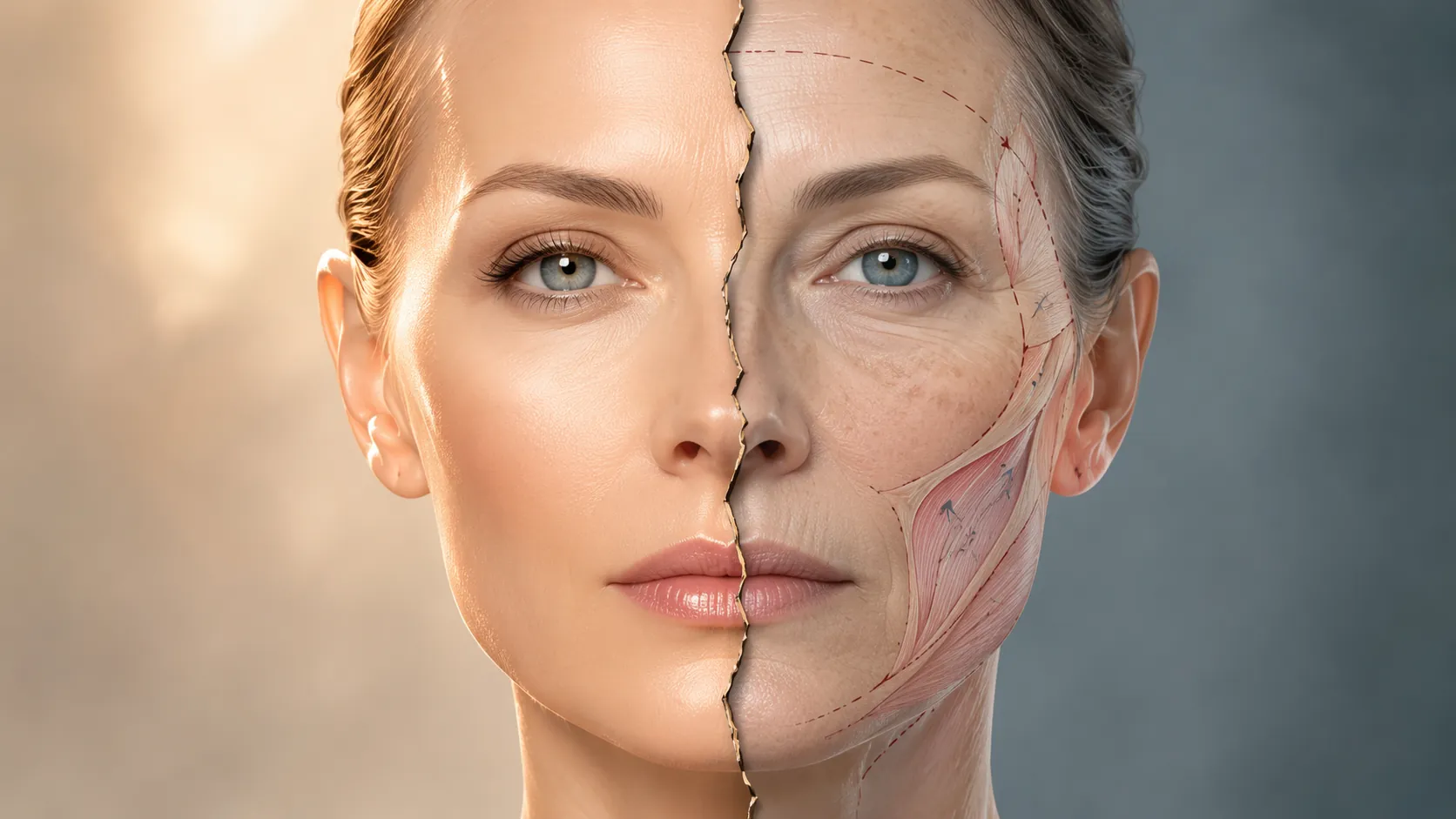
By the time a patient opens a phone and shows an AI-smoothed version of their face, the consultation has already inherited someone else’s visual argument. The image may have narrowed the jawline, lifted the midface, tightened the neck, brightened the skin, softened age markers, and adjusted the eyes in ways no facelift can reproduce. The surgeon is no longer starting with anatomy, scarring, tissue laxity, recovery, or risk. She is starting with a picture that looks specific enough to feel attainable.
That is the practical problem behind transparency in AI facelift surgery. The issue is not whether simulation can be helpful. A preview can help a patient name concerns that are otherwise hard to describe: jowling, neck contour, lower-face heaviness, or the difference between skin quality and tissue position. The trouble begins when a generated image fails to say what it is: an aesthetic visualization, not a surgical forecast.
The early evidence is already pointed in that direction. A 2024 Beth Israel Deaconess Medical Center survey, cited in Business Insider in 2026, found that patients who used AI image enhancers reported significantly higher expectations for surgical outcomes. The same reporting described surgeons seeing requests for exaggerated “Bratz doll” aesthetics after patients used AI tools to alter their appearance [1]. The finding does not prove that every enhancer causes unrealistic expectations, and it does not quantify the exact effect of a facelift-specific simulator. It does show something more clinically immediate: patients who arrive after AI-mediated self-editing may already be judging surgery against a different visual baseline.
The American Society of Plastic Surgeons has warned that AI-generated postoperative images can become de facto expectations even when disclaimers are present, increasing the risk of patient dissatisfaction [2]. That point deserves more weight than a generic warning about “misinformation.” In cosmetic surgery, the image is not background decoration. It can become the patient’s remembered version of the goal, the family member’s comparison point, and the unspoken standard by which the postoperative result is judged.
When the Preview Becomes the Promise
AI facelift simulations sit on a spectrum. At one end are casual tools: ChatGPT image tools, face filters, and AI enhancers that were not designed for surgical decision-making but can still create a compelling “after.” At the other end are clinic-adjacent or aesthetic platforms such as AEDIT, Banuba, and FaceTouchUp, which may be used closer to a treatment conversation. The clinical risk is not identical across those settings, but the same failure mode can appear in each: the tool produces an output without making its evidentiary status visible.
A facelift changes tissue position; it does not rewrite bone structure, eliminate all skin texture, guarantee symmetry, or deliver a generalized younger identity. Yet generative tools can edit all of those features in a single image. They may lift eyelids, change eye spacing, smooth nasolabial shadows, erase pores, compress a lower face, brighten complexion, and reduce perceived age at the same time. The patient sees one “after” image. The surgeon sees a stack of separate claims, some surgical, some nonsurgical, some dermatologic, some impossible.
Surgeons have started describing exactly that divide. The Guardian reported in May 2026 that UK and US surgeons were seeing patients arrive with AI-generated faces, including altered eye positions that are set in bone and cannot simply be moved by cosmetic surgery [3]. A request like that is not just an overambitious preference. It changes the consent conversation because the patient may believe the image has already demonstrated feasibility.
Disclaimers are weak in this setting because they ask a sentence to compete with a face. A line saying “results may vary” does not tell the patient whether the model changed bone-dependent anatomy, whether it generalized from faces unlike theirs, whether the output reflects any postoperative dataset, or whether a surgeon has reviewed the transformation. The more polished the preview, the easier it is for uncertainty to masquerade as planning.
That is why surgically impossible outputs should not be treated as ordinary product flaws. In a shopping app, a bad visualization may disappoint. In a facelift consultation, it can redirect clinical time away from evaluation and toward unlearning. The surgeon must explain why an apparent result is not anatomically available, why skin tension cannot be increased indefinitely without tradeoffs, why scars exist, why recovery changes appearance over time, and why a face cannot be safely made to match a synthetic composite.
The Missing Information Patients Need Before Consent
A patient cannot give meaningful consent to surgery by consenting to an image. But an image can still shape what the patient thinks the surgery is for. Before an AI-generated facelift preview is allowed to influence a surgical decision, it should disclose enough information for both patient and clinician to judge its reliability.
Dhawan et al. framed generative AI in plastic surgery through five WHO-adapted principles: data transparency, patient autonomy, safety, equity, and sustainability [4]. Those principles are broad, but in this corner of practice they translate into concrete disclosure duties. A facelift simulator should not merely say that it uses AI. It should say what kind of claim its image is making.

| Disclosure category | What should be made clear |
|---|---|
| Training data provenance | Whether the model was trained on real clinical photographs, synthetic images, stock-like beauty imagery, postoperative datasets, or an undisclosed mixture. |
| Demographic limitations | Whether the tool has been evaluated across age, sex, skin tone, facial structure, and other features relevant to aesthetic planning. |
| Accuracy benchmarks | Whether any measured comparison exists between generated previews and actual postoperative outcomes. |
| Intended use | Whether the tool is for patient education, aesthetic exploration, marketing, documentation, or clinical decision support. |
| Uncertainty labeling | Which parts of the output are speculative, unvalidated, or dependent on surgeon assessment. |
| Surgical feasibility boundary | Which visual changes are outside what a facelift can reasonably achieve. |
Training data provenance matters because a model trained on idealized, filtered, or nonclinical imagery may learn the visual language of beauty rather than the constraints of surgery. If the system has not been trained or validated against postoperative facelift outcomes, it should not be allowed to borrow the authority of surgical prediction. That distinction must be visible at the moment the image is shown, not hidden in a general terms-of-service page.
Demographic limitations matter for the same reason. A tool that performs convincingly on one group of faces may be less reliable on another. The current research record supports caution here, but not sweeping numerical claims about bias in facelift simulators. Some bias-related sources remain inaccessible or only partially verifiable from available text, so the honest standard is narrower: if a vendor cannot show how performance varies across relevant patient groups, clinicians should not assume the output is equally informative for every face.
Accuracy benchmarks are the hardest requirement and the easiest one to evade. A simulator can appear accurate because it creates a plausible face. That is not the same as predicting a surgical result. For facelift use, a meaningful benchmark would need to compare simulated previews with postoperative outcomes under defined conditions, while separating procedure effects from lighting, expression, skin treatment, weight change, injectables, and photo technique. The available material does not show that such benchmarking is standard across patient-facing facelift tools.
Intended use should also be explicit. A patient-education sketch and a surgical planning aid are different objects. So are a marketing image, a consultation prompt, and a medical device-like decision support tool. If a platform is only meant to help patients communicate preferences, it should say so in plain language. If it is being used to support clinical recommendations, it needs a much stronger evidentiary footing.
Uncertainty labeling is where many tools become most clinically useful or most misleading. A good disclosure would not just warn that outcomes vary. It would mark which transformations are aesthetic guesses, which are commonly associated with facelift techniques, which require other procedures, and which are not surgically feasible. The point is not to make the interface uglier. The point is to keep the image from silently outranking the surgeon’s explanation.
Why Opacity Warps the Consent Process
Informed consent is usually discussed as a conversation about risks, benefits, alternatives, and expectations. AI simulation complicates that sequence because expectation formation can happen before the medical visit. A patient may arrive believing they have already seen a version of the outcome. The clinician then has to pull the conversation back from a generated endpoint to the patient’s actual anatomy.
The harm is not limited to dissatisfaction after surgery. It can affect patient selection, procedure choice, and the decision not to operate. A patient fixated on an impossible preview may be a poor candidate for surgery at that time. Another patient may consent to a more extensive plan because the simulated image blended facelift effects with changes that would require eyelid surgery, skin resurfacing, fat grafting, injectables, or no available procedure at all. If the preview does not separate those elements, the patient is consenting in the shadow of an undisclosed mixture.
This is where patient autonomy and patient delight can diverge. A preview that reassures a patient may still weaken autonomy if it hides the basis of the reassurance. Patients often seek simulations because they are trying to reduce uncertainty, not because they are naïve. They want to know whether the face they imagine is close to the face a surgeon can safely help them reach. That is a reasonable wish. It deserves a better answer than a synthetic image with a vague warning attached.
Clinicians also need transparency to decide whether a tool belongs in the room. A surgeon reviewing an AI preview should know whether it came from a consumer filter, a general-purpose image model, or a platform built for aesthetic medicine. They should know whether the tool has any clinical validation, whether it preserves original facial proportions, and whether it logs or labels the edits it makes. Without that information, the surgeon is left reverse-engineering a black-box output during a visit that should be centered on diagnosis, goals, and safety.
Regulation Has Not Caught Up to the Image
The regulatory gap is stark. Dhawan et al. reported that no generative AI technology had received FDA review or approval for any surgical domain, and that only six AI/ML plastic surgery devices received FDA clearance from 2016 to 2024 [4]. That does not mean every cosmetic visualization tool is automatically illegal or that every app should be regulated in the same way. It does mean that the visual authority these tools carry in consultations is developing ahead of enforceable medical transparency requirements.
That gap looks different from better-established AI device pathways in other specialties. Radiology and cardiology, for example, have clearer histories of FDA-cleared AI tools for defined clinical tasks; the broader AI in healthcare specialty landscape shows how specialty, task definition, and validation shape the route to clinical use. Generative cosmetic simulation is murkier because it can be framed as education, marketing, communication, entertainment, or clinical support depending on where it appears and how a practice uses it.
Professional society guidance is therefore doing work that regulation has not yet done. The ASPS warning about generated postoperative images becoming de facto expectations is especially important because it recognizes the behavioral reality of consultation: patients may treat a picture as the plan even if the fine print says otherwise [2]. But guidance and warnings are not the same as enforceable standards. As of Q3 2026, the available sources do not show a mandated disclosure framework for AI facelift simulation tools.
The evidence base also has limits. “Transparency” is discussed qualitatively across the available sources rather than measured as a formal construct across facelift tools. Some performance and bias claims cannot be fully verified from primary text in the accessible materials. Certain age-reduction data have appeared through summaries rather than direct primary-paper review. Those limitations argue against overstating what is known. They do not erase the narrower, clinically relevant conclusion: vivid, opaque simulations are already entering expectation-setting conversations without a reliable way for patients or surgeons to judge what the image means.
What a Real Transparency Standard Should Require
A useful standard would not ask every patient to read a technical model card before discussing surgery. It would require the tool, vendor, or practice to disclose clinically meaningful limits in the place where the image is generated and reviewed. At minimum, the disclosure should make three separations visible: what the model knows, what it guesses, and what surgery can actually do.
- The tool should identify whether it is a consumer image editor, an aesthetic communication aid, or a clinically validated planning tool.
- The tool should disclose the general nature of its training data and whether real postoperative facelift outcomes were used for validation.
- The output should label speculative changes, non-facelift changes, and changes that require separate procedures or are anatomically infeasible.
- The tool should state whether performance has been assessed across relevant demographic groups and facial characteristics.
- The consultation record should preserve the original image, the generated image, and the disclosure shown to the patient.
The surgical feasibility boundary is the piece most likely to matter in the room. If an AI output raises the lateral brow, changes eye position, erases skin quality differences, sharpens the mandible, and tightens the neck, the patient should not have to infer which of those changes belong to a facelift. A transparent tool would distinguish facelift-relevant tissue repositioning from unrelated beautification. It would not let a global “after” image imply that every visible improvement belongs to the operation being discussed.
A professional society could make that boundary part of recommended practice. The FDA could also clarify when generative surgical simulation crosses from general wellness or communication into regulated clinical decision support. The exact regulatory route is a policy question. The clinical requirement is simpler: if a simulated result is used to influence consent, the patient and surgeon should be able to inspect the basis and limits of that result.
Voluntary disclaimers are not enough because they do not change the power imbalance between a vivid face and an opaque model. A patient does not need a paragraph of caution after the fantasy. They need the fantasy interrupted by clinically relevant truth: this part is estimated, this part is not validated, this part is not a facelift effect, this part may not be surgically possible for your anatomy.
AI facelift simulations do not need to disappear from aesthetic medicine. Used carefully, they can help patients articulate goals and help clinicians explain tradeoffs. But they should not enter a surgical consultation as polished, context-free images. They need enforceable transparency requirements that disclose what the model knows, what it cannot know, and what a surgeon can actually do.
References
- AI face is taking over — and driving plastic surgeons crazy, Business Insider, 2026
- ASPS guidance on AI-generated postoperative images and patient expectations, American Society of Plastic Surgeons, 2025
- You can't control everything, The Guardian, May 2026
- Ethical Considerations for Generative Artificial Intelligence in Plastic Surgery, PMC, 2025
Comments
Join the discussion with an anonymous comment.