
The strongest claim now circulating around AI fall prevention in assisted living is also the one that needs the most careful handling: reported fall reductions cluster around roughly 40% to 70%, yet the published evidence behind those numbers is not equally strong. For clinicians and operators asking how AI in assisted living facility operations should change staffing, surveillance, escalation, and resident safety, the answer depends less on whether a system is called AI than on what it senses, where it was tested, who measured the outcome, and whether the result has survived more than a single deployment.
One study currently carries more weight than the rest. CarePredict reported that its Tempo wearable was associated with a 69% reduction in falls and 39% fewer hospitalizations across 490 residents in six facilities over 24 months, in work published in JMIR in 2020.[1] That does not settle the question for every AI fall-prevention product. It does give the field a real benchmark: multi-site, peer-reviewed, longitudinal evidence in a population close to the one assisted living leaders actually serve.
The benchmark study is wearable, multi-site, and still unusually lonely
CarePredict Tempo matters because it links fall prevention to a broader care workflow rather than treating a fall as an isolated event. A wearable can track changes in activity, sleep, bathroom patterns, and other behavioral signals that may precede an acute decline. In an assisted living facility, that matters because many falls are not pure accidents. They often arrive after a resident has slept poorly, eaten less, started toileting more often, become weaker, or changed routines in ways that are obvious only after someone reconstructs the week.
The reported 69% fall reduction and 39% decrease in hospitalizations are therefore most persuasive when read as operational outcomes: fewer residents reached the point where a fall or transfer occurred, and the system was used long enough to observe patterns across multiple facilities.[1] The sample size and 24-month window are not cosmetic details. They reduce, though do not eliminate, the risk that a short-lived staffing change, a single unusually engaged executive director, or a temporary documentation push explains the result.
The limitation is just as important. This is evidence for one wearable-based approach, not proof that all AI fall-prevention systems work, or that a radar sensor and a skeletal computer-vision platform should be expected to reproduce the same outcome. A procurement packet that places this study beside a single-site vendor case report without distinction is flattening the very thing clinicians need to inspect.
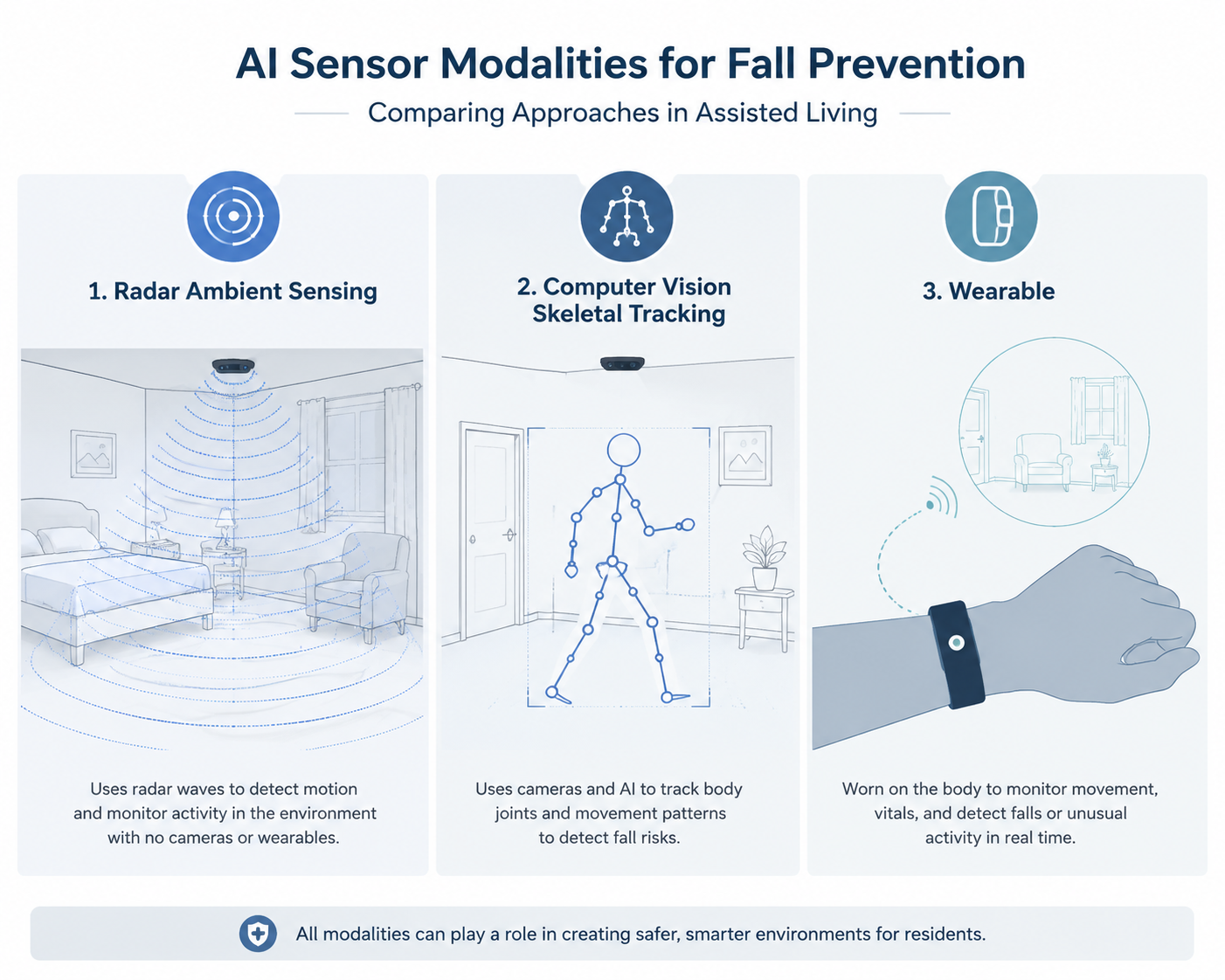
| Modality | What it usually asks residents to accept | What the evidence currently supports most clearly |
|---|---|---|
| Wearable sensing | A device worn consistently enough to generate useful behavior signals | The strongest published multi-site evidence, represented by CarePredict Tempo |
| Radar-based ambient sensing | Room-based monitoring without cameras or microphones | Promising real-world reports and a strong privacy argument, but less independent published validation |
| Computer-vision skeletal tracking | Visual sensing translated into movement or skeleton data, depending on system design | Operational signals on response time, alerts, and falls, mostly from vendor or deployment reports |
Radar systems have the clearest privacy advantage
Radar-based ambient sensing deserves serious attention because it addresses one of the hardest practical objections to monitoring in assisted living: residents do not want to feel filmed, listened to, or reduced to a set of alarms. A radar system that uses no cameras or microphones changes the family conversation. It does not remove the need for consent, governance, or data-use limits, but it avoids some of the most visible dignity costs of room monitoring.
PAUL, a radar-based AI sensor, has reported fall reductions in the 62% to 70% range across multiple sites, with a reported peak reduction of 78% in memory care.[2] Those are large numbers, especially in a population where nighttime wandering, impaired judgment, and toileting-related transfers can make prevention difficult. The result should be read as promising real-world evidence, not as the same kind of evidence as the CarePredict multi-site peer-reviewed study.
The more operationally interesting PAUL finding may be less dramatic than the fall-reduction percentage: in one 90-day deployment, the sensor flagged 486 condition changes, creating opportunities for staff to intervene before a fall occurred.[2] That is the kind of signal assisted living teams can use. A resident who begins getting up repeatedly overnight is not merely generating data. She is creating a staffing problem, a sleep problem, a medication-review question, and possibly an infection or delirium concern. If an AI system helps staff see that pattern earlier, it is doing more than detecting the moment of impact.
Still, condition-change flags create their own burden. Someone must decide whether a flag means a nurse assessment, a hydration check, a toileting plan, a family call, a primary-care message, or no action. In a building already running lean, a sensor that finds more problems can improve care only if the workflow has a place for those problems to go. The value of radar is not simply that it watches without a camera. It is that it may reveal deteriorating function early enough for a human team to act.
Computer vision is producing useful signals, but the proof is thinner
Computer-vision systems occupy a more complicated middle ground. Some products emphasize skeletal tracking rather than identifiable video, translating a person’s movement into a simplified body outline or posture signal. That can be less intrusive than conventional video, but it is not the same privacy proposition as radar. Families may accept a skeletal representation in a hallway more readily than a camera in a bedroom. Residents with cognitive impairment may not experience that distinction in such neat terms.
The reported performance numbers are striking. VCare has claimed 99% accuracy and a 99.8% reduction in false alarms, while Bristal reported a 40% decline in falls in vendor-reported materials.[3] These figures are useful as deployment signals, especially for operators trying to understand whether AI can reduce noise rather than add to it. They should not be treated as independently established clinical effect sizes unless the underlying design, comparator, measurement period, and adjudication process are available.
False alarms deserve more attention than they usually receive. In long-term care operations, an alert is not a neutral event. It can pull an aide away from a resident who is already on the toilet, interrupt medication assistance, or train staff to distrust the system if too many alarms lead nowhere. A lower false-alarm rate, if independently verified in the intended setting, could be a resident-safety outcome as much as a usability metric.
Inspiren’s AUGi platform adds another operational lens. The company reported an 83% reduction in 911 calls and a 90-second average response time, and Fierce Healthcare reported that Inspiren raised a $35 million Series A in 2025 and was in more than 150 communities.[4] The emergency-call reduction is clinically relevant if it reflects fewer avoidable escalations or faster in-building response. It is less reassuring if it reflects changed calling thresholds without equivalent safety outcomes. The published material, as summarized here, does not make that distinction fully visible.
That is not a reason to dismiss computer vision. It is a reason to ask better questions. Did the system reduce unwitnessed time on the floor? Did staff reach residents faster after a bed exit or bathroom event? Were emergency calls avoided because nurses had better information, or because staff were encouraged to manage more events internally? Were residents in memory care included, and were outcomes reported separately? A fall count alone cannot answer those questions.
Wearables have the best published study and a practical compliance problem
Wearable systems have an advantage in the current evidence base because the CarePredict Tempo study is the most substantial published example available. They also have a familiar operational weakness: the resident has to wear the device. That requirement may be manageable for some assisted living residents and fragile for others, especially when cognitive impairment, skin sensitivity, device charging, loss, or refusal enters the picture.
This compliance issue does not invalidate wearable AI. It changes the eligible population and the implementation burden. A wearable that works well for residents who tolerate devices may still miss the person who removes it before bed, the resident who leaves it charging during the riskiest hours, or the memory-care resident who finds it distressing. Ambient radar and vision systems avoid that specific failure mode, but they introduce different privacy, installation, and room-coverage questions.
The fairest reading is that wearables currently have the strongest published assisted-living-relevant evidence, while ambient systems may be better aligned with residents who cannot reliably participate in device use. That is a modality distinction, not a ranking that applies to every facility.
Why the literature feels promising and incomplete at the same time
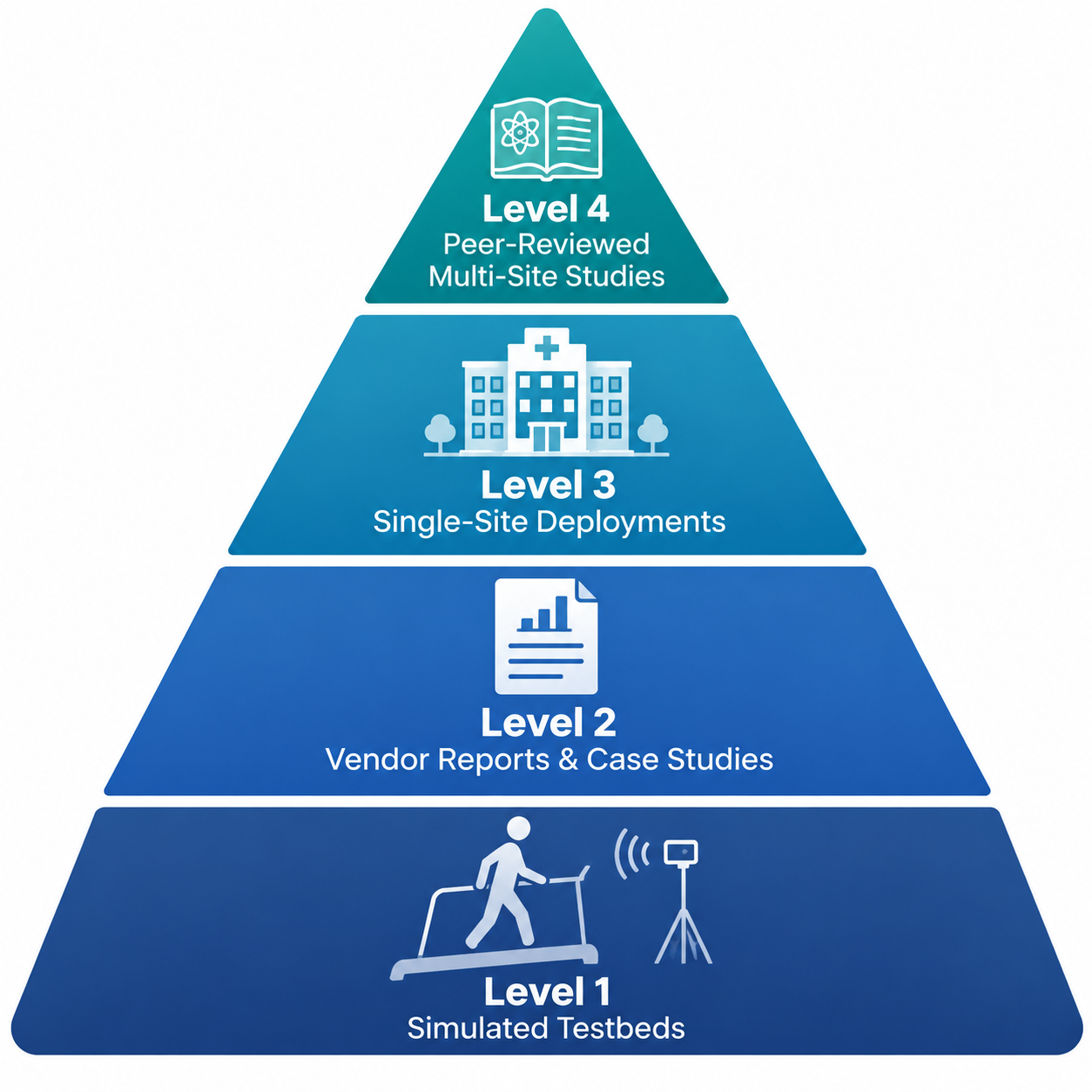
A 2024 scoping review indexed in PubMed examined 64 papers on AI in active assisted living for aging populations and found that 61% were published after 2020.[5] That surge explains why the field feels newly active. It also helps explain why administrators are seeing more product claims than mature comparative evidence.
The same review found that 50% of studies used simulated testbeds rather than real-world assisted living settings.[5] That detail should slow down any broad claim about AI preventing falls in assisted living. A simulated apartment, lab walkway, or instrumented test environment can be useful for developing algorithms. It cannot reproduce a short-staffed evening shift, a resident with fluctuating cognition, a roommate moving furniture, a walker left in the wrong place, or the way aides triage three alarms at once.
There is another boundary: the review covers active assisted living broadly, including aging-in-place contexts, not only institutional assisted living facilities.[5] That makes it relevant but not perfectly matched to the procurement question facing a nursing director or executive director. A sensor that performs well in a home environment may still need testing in a facility where staff response, documentation, liability, room turnover, and resident acuity are different.
This is the evidence-to-adoption problem in its most practical form. Facilities need better tools before all the best studies exist. But broader adoption is often what generates the operational data needed to produce those studies. Assisted living cannot wait for perfect randomized evidence on every device, yet it should not let urgency turn every vendor dashboard into clinical proof.
The procurement question is narrower than “Does AI prevent falls?”
The more useful question is which system fits which residents, in which rooms, under which staffing model, with what kind of evidence. A building with a large memory-care population may reasonably value ambient sensing that does not depend on resident compliance. A community facing repeated unwitnessed falls may prioritize time-to-response and event reconstruction. A facility under intense family privacy concerns may find radar easier to justify than room-based visual sensing. A health-system-affiliated operator may put more weight on hospitalization reduction than on alert accuracy alone.
Before a pilot, the outcome measures should be chosen with the same discipline used for medication safety or infection prevention. Falls per resident-day, unwitnessed time on floor, emergency transfers, hospitalization, staff response time, false alarms, nighttime interventions, and resident refusal are not interchangeable. If the vendor reports fall reduction and the facility cares most about avoidable 911 calls, the evaluation can succeed on paper and still fail operationally.
- Evidence quality: peer-reviewed multi-site data should carry more weight than single-site case reports, which should carry more weight than simulations or modeled ROI.
- Sensor modality: radar, computer vision, and wearables create different privacy, compliance, installation, and maintenance burdens.
- Workflow fit: an alert must map to a staff role, escalation path, documentation step, and response expectation.
- Outcome ownership: the facility should know whether results were measured by the vendor, the operator, an academic partner, or an independent evaluator.
- Resident dignity: consent, room location, cognitive status, family expectations, and opt-out procedures belong in the evaluation, not after contract signing.
The May 2026 bipartisan Senate request for a Government Accountability Office study on technology for fall prevention is a useful signal, not because federal attention proves effectiveness, but because policymakers are seeing the same gap that clinicians and operators see: adoption is moving faster than independent comparative evidence.[6] If future federal review pushes the field toward clearer outcome definitions and stronger validation, that would help facilities separate promising systems from polished claims.
A disciplined answer
AI can plausibly help prevent falls in assisted living, and the best available reports are not trivial. A 69% fall reduction and 39% fewer hospitalizations in a 490-resident, six-facility, 24-month wearable study deserve attention.[1] Radar reports showing 62% to 70% fall reductions and hundreds of condition-change flags deserve follow-up.[2] Computer-vision reports on response time, emergency calls, false alarms, and fall declines are operationally meaningful enough to study carefully.[3][4]
But “AI prevents falls” is too broad a conclusion. The defensible conclusion is narrower: some AI-enabled systems appear capable of identifying risk earlier, shortening response times, and supporting staff decisions in ways that may reduce falls and downstream hospital use. The confidence behind that statement varies sharply by modality and by evidence source. In 2026, the responsible comparison is not AI versus no AI. It is radar versus vision versus wearable, in a defined resident population, with explicit privacy trade-offs, measured outcomes, and a clear distinction between independent evidence and vendor-reported performance.
References
- New Research Shows CarePredict Improved Health Outcomes and Staff Engagement — CarePredict
- Paul AI Sensor Flags 486 Health Changes, Fall Risk Drops In 90 Days — NCH Stats
- AI adoption making inroads in senior living organizations — McKnight’s Senior Living
- Inspiren banks $35M to scale AI-powered senior living technology — Fierce Healthcare, 2025
- Application of AI in Active Assisted Living for Aging Population — PubMed
- Fall Prevention Advanced by Proposed Federal Study and AI Tool — LeadingAge, May 2026
Comments
Join the discussion with an anonymous comment.