
A patient walks in with a smartwatch alert, three months of resting heart rate graphs, and a sleep score that has drifted downward. The useful question is not whether the device is AI-powered; it is whether the signal survives contact with a clinical question.
Where validation is strongest
The strongest evidence for AI in fitness trackers for health monitoring is still atrial fibrillation detection. In the Fitbit Heart Study, 455,699 participants were enrolled; the algorithm's positive predictive value for concurrent AF was 98.2%, with sensitivity 67.6% and specificity 98.4% [1]. That is a meaningful level of validation, but it is also tightly bounded: it applies to a specific irregular-rhythm workflow, not to every score or graph the watch can generate.
The Apple Heart Study points in the same direction and also shows why clinicians should keep the signal and the follow-up separate. Among 419,297 participants, an irregular pulse notification had an 84% positive predictive value, but only 0.52% of participants received a notification, and 34% of those who returned an ECG patch had AF confirmed [2]. The alert can be useful, yet the yield is modest and the confirmation step still belongs to ECG-based evaluation rather than to the watch alone.
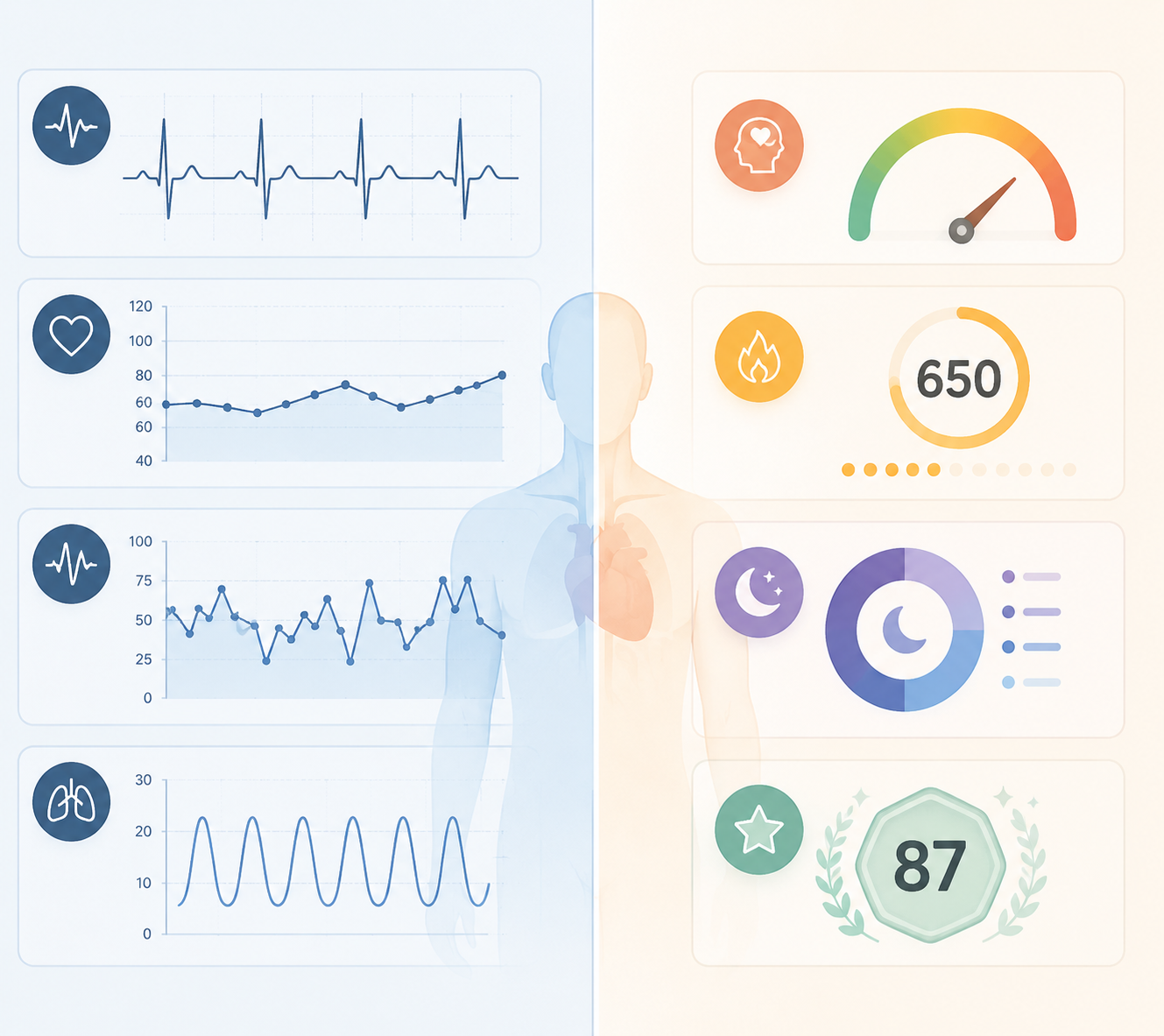
That distinction is the practical one in clinic. A wearable irregular-rhythm alert should be treated as a screening prompt that may justify confirmatory ECG testing. A resting trend in heart rate variability, by contrast, is usually a context signal: it can support suspicion that something changed, but it does not name the cause. A sleep score or stress score is even farther downstream from diagnosis unless the specific device, metric, and use case have been validated in a way that maps to an actual clinical question.
What longitudinal trends add
Where these devices become more interesting is not in a single dramatic alert, but in longitudinal drift. Resting heart rate, HRV, respiratory rate, and sleep timing can be read as a physiological backdrop for chronic disease monitoring or recovery tracking. A rise in resting pulse with a sustained fall in HRV and a higher respiratory rate does not diagnose an exacerbation on its own, but it can make a patient look less stable than a normal office visit would suggest.
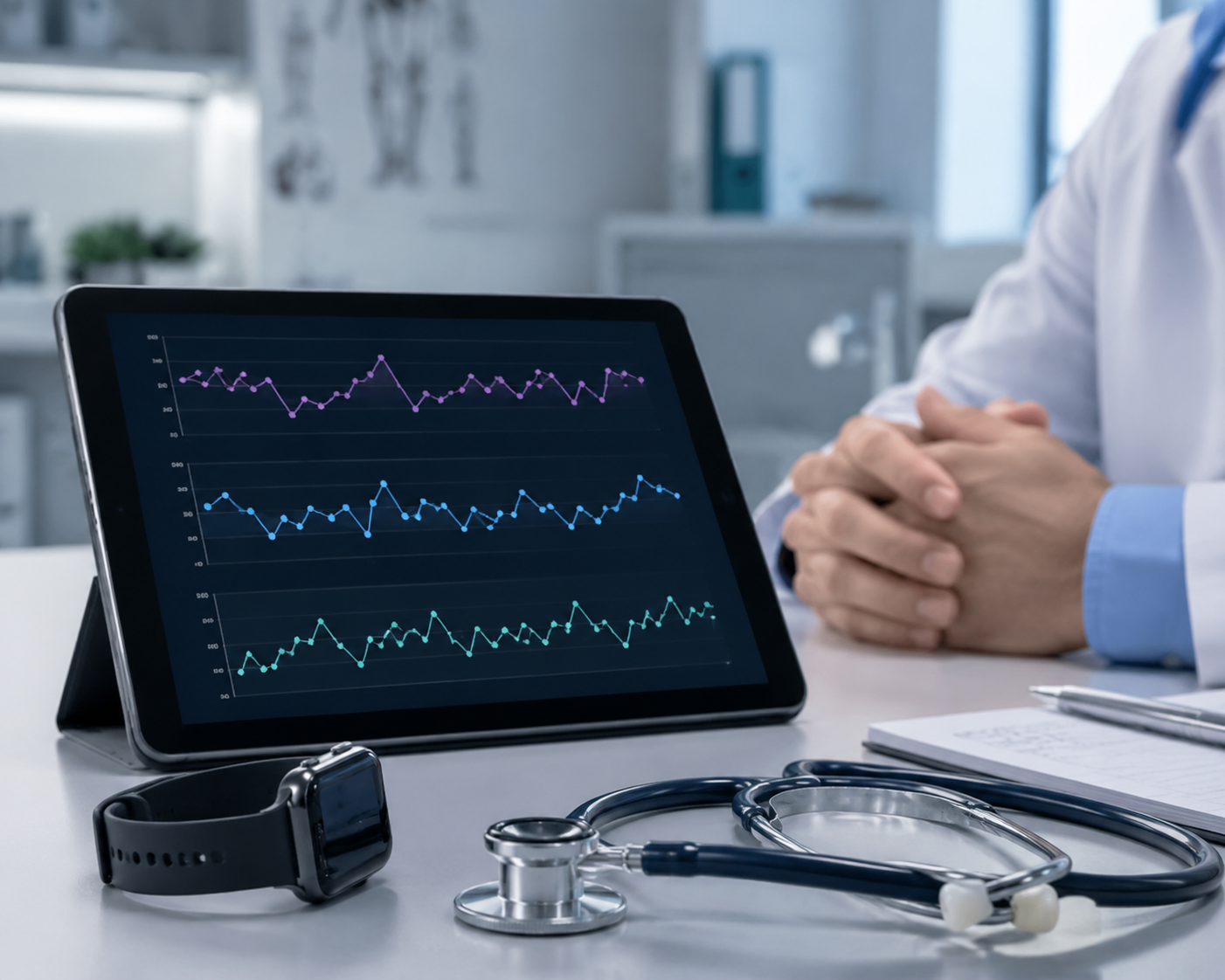
That is why trajectory data have been useful in acute illness surveillance and in chronic monitoring contexts: the signal is often less about a single number than about a change from baseline. The same logic can apply to sleep and recovery trends. Even non-wrist systems have shown that sleep can be measured with some validity, which matters because form factor alone does not determine whether a metric is clinically interpretable.
- Use the trend when the question is "has this patient changed from baseline?"
- Use the resting condition when motion, exercise, or other physiological noise would distort the reading.
- Use the wearable as context, not as a stand-alone diagnosis, when the output is a proprietary score.
Why the boundary matters in practice
The boundary gets blurry because consumer wearables mix substantially different kinds of output in the same interface. ECG and AF-related features sit much closer to clinical measurement than outputs such as SpO2 estimates, sleep staging, stress scores, calorie burn, or composite wellness badges. Those latter outputs may be useful to a patient trying to notice a pattern, but they should not be treated as if they carry the same evidentiary weight as an ECG feature or a validated irregular-rhythm algorithm.
The technical limits matter too. Performance can degrade with motion, at physiological extremes, and across different skin tones or other real-world conditions that do not resemble the validation environment. Most consumer devices are also black boxes from the clinician's perspective: the model, training data, and drift over time are usually not inspectable. That makes the handoff awkward. The patient sees months of data. The clinician sees a set of outputs with very different levels of trust.
- Irregular rhythm or ECG output: treat as a measurement that may need confirmation.
- Resting HR, HRV, and respiratory rate trends: treat as longitudinal context.
- Sleep stage labels, stress scores, calorie estimates, and proprietary composites: treat as wellness-level interpretations unless a specific validation case says otherwise.
That classification is becoming more urgent as commercial pressure grows around these products, but market expansion is not the same thing as clinical proof. There are still no hard-outcomes trials showing that wearable-based detection or monitoring, by itself, reduces stroke, hospitalization, or similar endpoints across broad populations. For now, the best use of these devices is as source-specific longitudinal signals that can sharpen suspicion, support follow-up, and enrich remote monitoring without pretending to replace validated clinical workflows.
Comments
Join the discussion with an anonymous comment.