
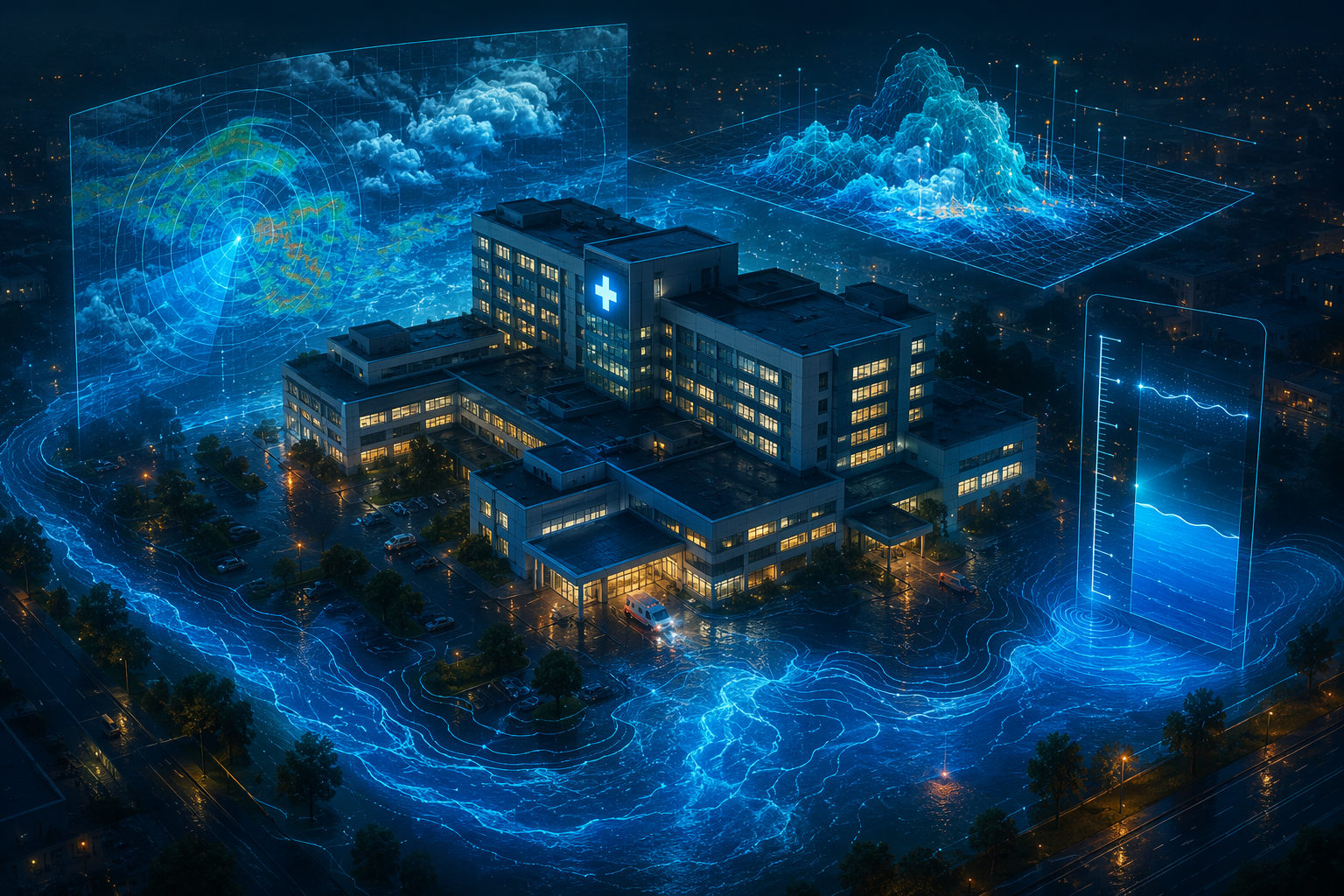
A flash flood alert that arrives 24 hours early matters only if it can be turned into a staffing, transport, generator, patient-movement, pharmacy, and agency-coordination decision before water reaches the campus. Google Flood Hub is relevant here because it is designed to forecast urban flash flood risk up to 24 hours in advance. [1]
The old baseline leaves hospitals guessing
The reason that lead time matters is that the legacy flood-intelligence stack is thin. Google’s own comparison with National Weather Service flash flood warnings put recall at about 22% and precision at about 44%, while FEMA flood maps cover only about 60% of the continental US, only about 19% of those maps are less than 10 years old, and only 33% of US streams have any flood hazard information. The American Society of Civil Engineers has estimated that the mapping gap costs $3.2B to $11.8B annually. [1]
That gap is not abstract for healthcare. A 2026 Fathom analysis of more than 7,000 US inpatient facilities identified at least 170 hospitals, or roughly 30,000 beds, facing major flood risk. About one-third were outside FEMA flood hazard zones, 39 were inland, and 21 were critical access hospitals averaging 25 miles from the nearest alternative facility. [2]
The readiness picture is thinner than the exposure picture. Harvard Medicine reported that climate change increased damage risk to US hospital physical infrastructure by 38% between 1990 and 2020, and that only about 20% of US health systems had assessed climate threats to infrastructure. That combination explains why a better forecast is useful, but not sufficient. [3]
What AI flash flood forecasting adds, and where it still stops
Google Flood Hub uses an RNN/LSTM architecture trained on news-extracted ground truth and global weather inputs including NASA IMERG, ECMWF IFS, and Google’s weather model. It runs at 20×20 km resolution, prioritizes places with population density above 100 people per km², and the March 2026 Google paper reported equivalent precision in data-sparse Global South regions and instrumented high-income regions. That is operationally interesting, but it is still self-reported and too coarse to tell a hospital whether a loading dock, tunnel, or basement entrance is at risk. [1]
For rural systems, the coverage gap matters as much as the precision claim. If the model is built to prioritize denser areas, critical-access hospitals outside those thresholds may still be waiting on local forecasters, county emergency management, or neighboring health systems rather than on an AI alert. [1][2]
Where the alert has to land
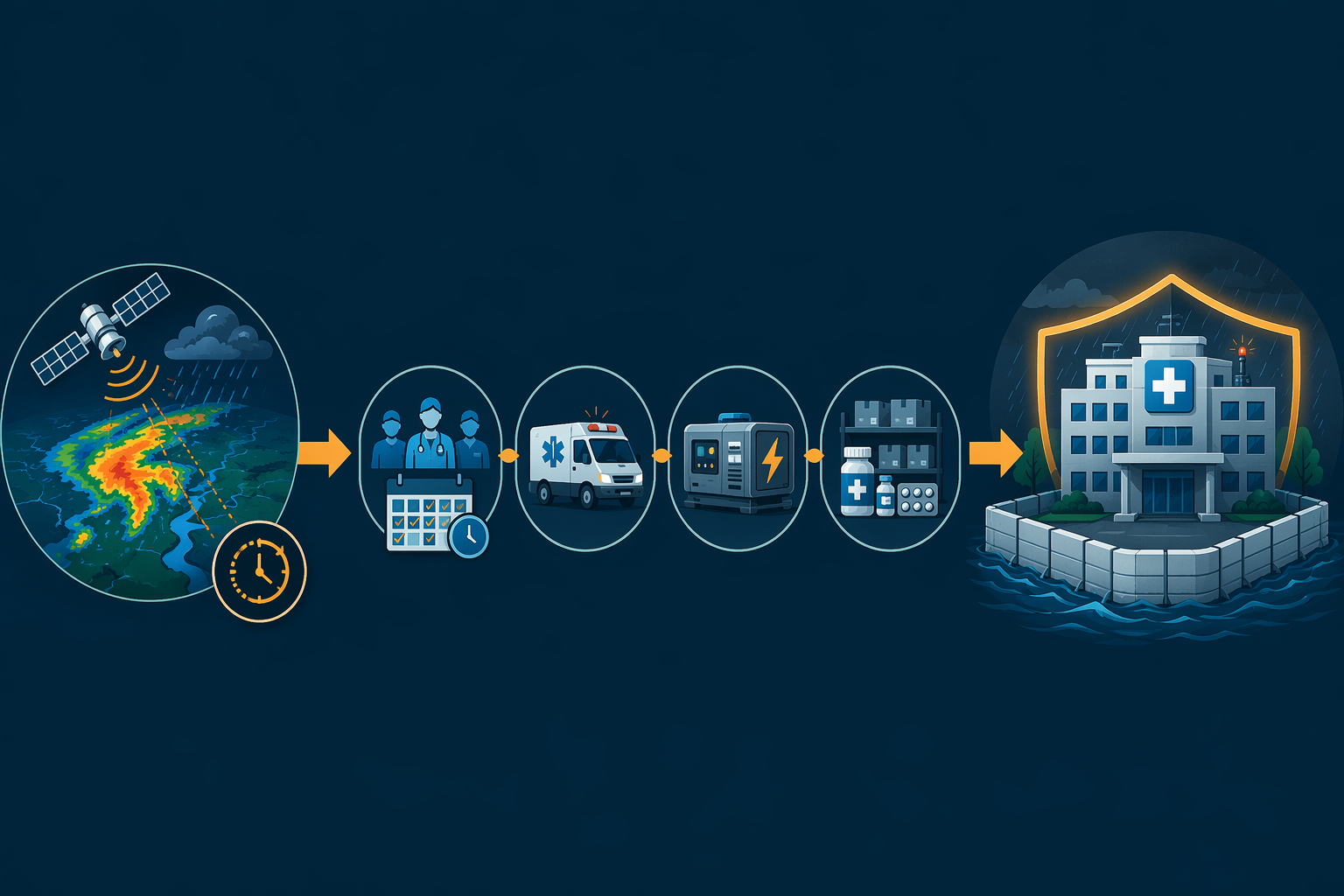
For hospitals, the forecast is not the product. The product is the sequence of actions it can start. If the warning is credible and the trigger is agreed in advance, a preparedness manager can begin a call tree, move overnight staffing, check generators and fuel, stage pharmacy inventory, coordinate ambulance rerouting, review transfer options, and decide whether elective admissions or nonurgent procedures need to pause.
- Staffing: who is called in, who is sent home, and who stays overnight.
- Patient movement: which units can move first, and where fragile patients can safely wait.
- Transport: whether ambulances, transfer coordinators, and external facilities need to be lined up before roads fail.
- Utilities and supplies: whether generators, fuel, water, dialysis-related support, and pharmacy stock are staged early.
- External coordination: which local emergency managers, public health officials, and neighboring hospitals need to hear the same message at the same time.
That handoff has to be written before the storm, not invented during it. The alert threshold, the call tree, the authority to move patients, and the stand-down rule all need to be pre-agreed, or a 3 a.m. warning just creates noise. Early-warning and anticipatory-action frameworks such as the UN Early Warnings for All approach are built around that exact problem: forecast, trigger, action, and coordination that are ready before the event. [4]
False alarms are not a minor annoyance in this setting. If staff repeatedly wake up for alerts that do not translate into visible risk, trust erodes quickly. That is one reason model coverage, local calibration, and explicit escalation rules matter more than a polished dashboard.
The institutional gap is the limiting factor
There is still no authoritative evidence that flash flood forecasts are routinely integrated into hospital EHRs or clinical decision support, so the near-term use case is emergency operations, not automated bedside guidance. The more practical task is still climate-risk assessment, emergency operations planning, and rehearsing who does what when a warning arrives.
That also means the most useful decision may happen long before the alert. A health system that has not assessed its flood exposure, utility vulnerabilities, transfer dependencies, and rural backup options will not convert better forecasting into safer care just by subscribing to another feed.
The clinical upside is still indirect but meaningful: more time to sequence evacuations, protect transport routes, coordinate with neighboring facilities, and anticipate downstream infection-control problems when water intrusion disrupts sterilization, sheltering, or dialysis support.
What next-generation hydrology can contribute
Penn State’s differentiable hydrologic model improved streamflow prediction accuracy by 30% across roughly 4,000 USGS gauge stations and can generate 40-year high-resolution simulations in hours on a single GPU system, instead of weeks on the supercomputers used for the NOAA National Water Model. That points to a more capable forecasting stack, but it is still a candidate for future operations, not proof that hospital workflows are ready today. [5]
AI flash flood forecasting is now operationally relevant for hospital emergency preparedness, but its value depends on institutional readiness. For most US health systems, the near-term win is not automated clinical integration. It is climate-risk assessment, emergency operations planning, pre-agreed triggers, and disciplined coordination before the water arrives.
References
- Protecting cities with AI-driven flash flood forecasting — Google Research
- Hospital flood risk and resilience — Fathom Global
- Creating climate-resilient hospitals — Harvard Medicine — May 2025
- AI for early warning systems and anticipatory action — NCDP Perspectives, Columbia Climate School
- Improving predictions of flood severity, place and time with AI — Penn State Engineering
Comments
Join the discussion with an anonymous comment.