
What the strongest post-flood study actually showed
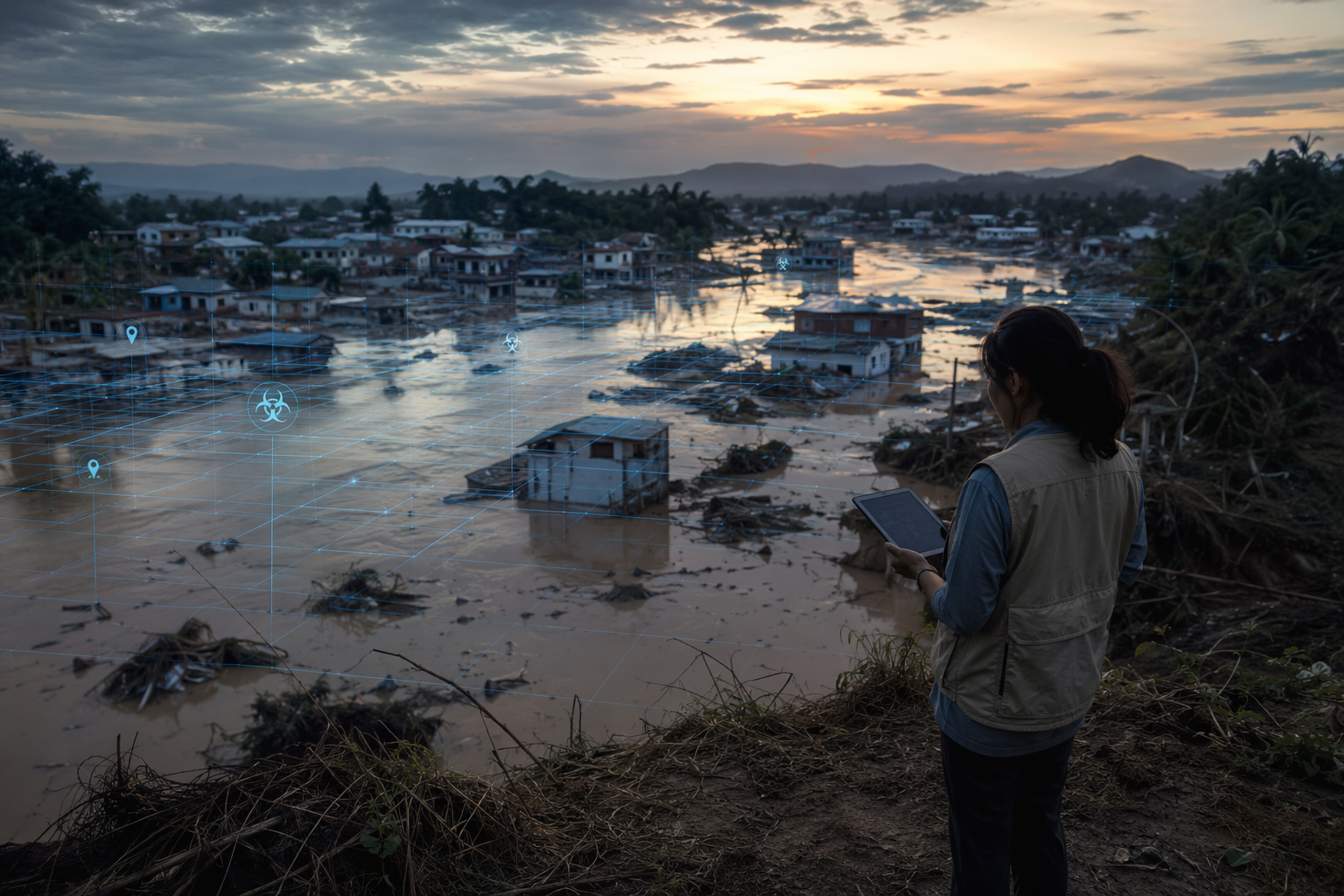
After floodwaters recede, the practical question is not whether outbreaks can happen. It is whether an algorithm can help a strained surveillance team decide where to look first. The most concrete evidence comes from a retrospective pre–post cohort study in an Iranian flood-affected region that linked EHR data to post-flood infectious disease incidence and found prevalence rose from 39.5% to 47.3% (OR 1.38, 95% CI 1.09–1.75) [1].
| Model | AUC |
|---|---|
| Random Forest | 0.76 [1] |
| Gradient Boosting | 0.74 [1] |
| ANN | 0.72 [1] |
| SVM | 0.71 [1] |
| Logistic Regression | 0.69 [1] |
Random Forest led the comparison, but the ceiling stayed modest. An AUC of 0.76 is useful for prioritization, not a green light for standalone deployment. The design matters here: the study was single-region, retrospective, and built on only four predictor variables [1]. That is enough to say the model may help rank attention after a flood, but not enough to say it will travel cleanly to another district, another health system, or another disaster cycle.
The age finding is the kind of detail that should make people slow down instead of simplify. In this cohort, younger adults had higher post-flood disease rates than older adults, with mean ages of 51 and 58 respectively [1]. That does not rewrite disaster vulnerability planning, but it does resist the easy habit of assuming age will sort risk in the same way in every flood response.
What the broader AI literature adds
A 2025 systematic review of 67 studies found that machine learning, deep learning, and natural language processing systems integrated with epidemiological, climate, web, and wastewater data can improve early outbreak detection and prediction accuracy [2]. That matters because it shows the post-flood result is not an isolated curiosity. It does not, however, erase the limits of the cohort study. The review still points to recurring barriers in data quality, model transparency, and integration into real workflows, and its search was limited to Semantic Scholar [2].
Those limits are not minor. In a flood response, the problem is rarely whether a model can output a score. The problem is whether the score arrives when case definitions are still shifting, whether the inputs are complete enough to trust, and whether the output fits the surveillance routine that already exists. A black-box improvement that cannot be audited or absorbed into reporting practice may look impressive in a paper and remain awkward in the field.
Where AI fits in post-flood surveillance
AI can serve as a second set of eyes for triage and prioritization inside existing epidemiological surveillance, especially when teams need to decide which clinics, districts, or signals deserve attention first. It is not ready to replace public health judgment.
References
- Predicting infectious disease incidence after floods using machine learning: a retrospective pre–post cohort study — Health Science Reports, 2025, https://pmc.ncbi.nlm.nih.gov/articles/PMC12592683/
- Artificial intelligence in infectious disease early warning systems: a systematic review — Frontiers in Public Health, 2025, https://www.frontiersin.org/journals/public-health/articles/10.3389/fpubh.2025.1609615/full
Comments
Join the discussion with an anonymous comment.