The most important question about ai in flood prediction and public health response is not whether a model can see water coming. It is whether anyone downstream has enough time, staffing, authority, and local trust to turn that signal into fewer infections, fewer clinic visits, and lower costs for households.
That is why the Bihar finding matters. In an evaluation referenced by PreventionWeb, communities receiving Google Flood Hub AI-driven early warnings had 30% lower medical costs than comparable unserved areas.[1] The result is not a final verdict on AI flood forecasting as a global health intervention. The original IDinsight evaluation report was not independently reviewed here, and a single evaluation cannot settle general effectiveness. But it moves the discussion into the right unit of measurement: not model elegance, not forecast novelty, but money not spent on illness after flooding.
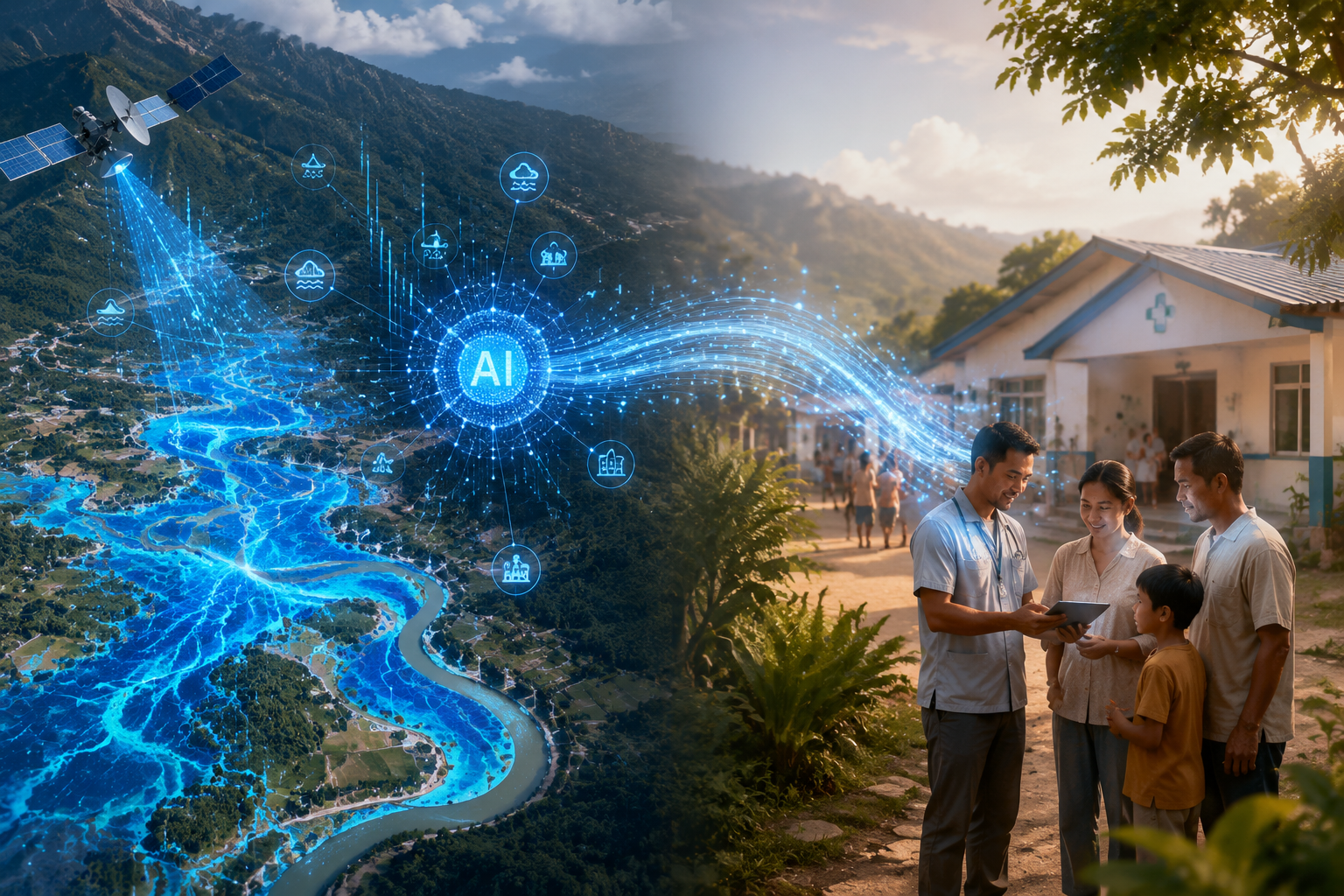
A flood warning can reduce health burden only if it changes what happens before and after the water arrives. A household may move medicines, avoid contaminated routes, protect drinking water, or delay travel. A clinic may pre-position oral rehydration supplies, check cold-chain vulnerabilities, prepare for injury visits, or warn community health workers. A district surveillance team may watch for fever, diarrhea, leptospirosis-like presentations, vector-borne risk, or care disruptions in the days after inundation. If none of that occurs, lead time becomes another impressive dashboard metric sitting above a thin public health system.
Lead Time Is Useful Only If It Buys Action
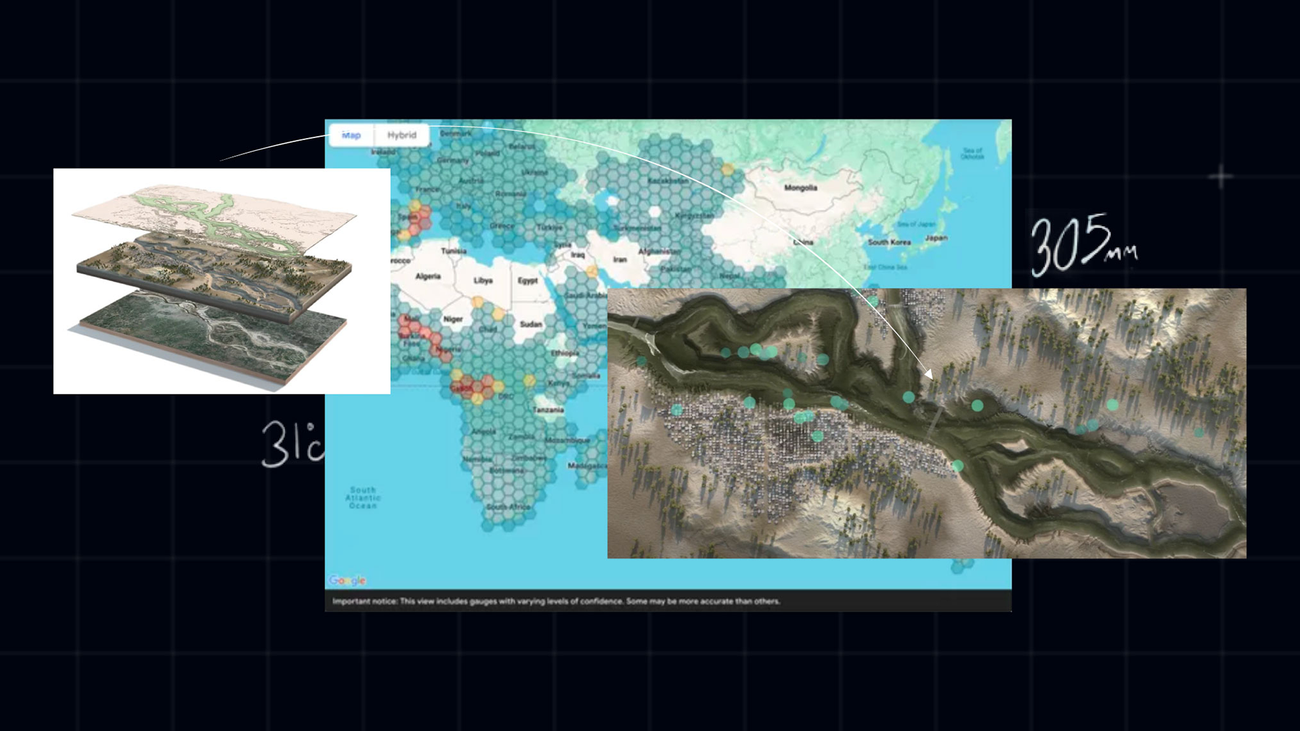
Flood forecasting has become operational enough that health planners can reasonably pay attention. Google’s Flood Hub has expanded to more than 150 countries and provides forecasts with up to a seven-day lead time.[2] The underlying Nature work combined hydrologic modeling with inundation mapping and reported performance gains over the GloFAS baseline, including an extension of reliable global nowcasts from zero to five days.[2] Those are not small technical details for emergency preparedness. An extra few days can be the difference between telling people to evacuate and merely documenting their exposure.
The technical improvement is still only the first half of the story. Health systems do not experience a flood as a water-depth curve. They experience it as blocked roads, interrupted dialysis trips, displaced families, damaged latrines, contaminated wells, crowded shelters, medication loss, wound infections, and a surveillance signal that may arrive after the window for prevention has already narrowed.
Bihar is therefore valuable less because it proves a universal effect than because it tests a more relevant chain of consequences. The claimed 30% reduction in medical costs suggests that warning information may have translated into behavior or service changes large enough to be visible at household level.[1] It does not tell us, from the available reporting, which exact actions drove the cost reduction, whether effects differed by income, distance from care, age, or warning channel, or how much local preparedness work sat behind the alert. Those missing details matter. They are also the details that future evaluations should stop treating as background.
The Post-Flood Health Signal Is Messier Than the Forecast
A forecast may identify where water is likely to go. Public health still has to identify who becomes sick, when they present, and what pattern is abnormal enough to trigger response. Safari et al.’s 2025 study in Firuzkuh County, Iran, is useful precisely because it enters that more complicated period after the flood, using electronic health record data to predict infectious disease risk in a retrospective pre-post cohort of 939 people.[3]
The study found that infectious disease prevalence increased by about 7.8 percentage points in the 30-day post-flood window, with an odds ratio of 1.38 and a 95% confidence interval of 1.09 to 1.75.[3] That is not a cinematic outbreak narrative. It is a measured increase in an aggregate infectious disease category after a defined exposure. For health departments, that kind of signal can still be operationally important, especially when the affected area is also dealing with damaged infrastructure and disrupted access to care.
The modeling results were moderate rather than magical. Random Forest reached an AUC of 0.76, Gradient Boosting reached 0.74, and an artificial neural network reached 0.72, with ensemble methods outperforming linear approaches.[3] That pattern fits what many public health teams are learning across surveillance applications: flexible models can detect nonlinear combinations better than traditional tools, but moderate discrimination still requires human review, local triage rules, and a clear threshold for action.
| Evidence point | What it supports | What it does not prove |
|---|---|---|
| Bihar early-warning evaluation | Communities receiving AI-driven flood warnings had 30% lower medical costs than unserved areas | A globally generalizable causal pathway from forecast to health savings |
| Safari et al. Iran cohort | Post-flood infectious disease prevalence rose, and ML models showed moderate predictive performance using EHR data | A deployable surveillance system validated across settings |
| Google Flood Hub expansion | AI flood prediction is operating at large geographic scale with meaningful lead time | That health agencies can automatically absorb and act on every alert |
| WEATHER project | Integrated flood-risk, outbreak-monitoring, mobile-alert, SMS, and response architecture is being built | Measured effectiveness, because outcomes are not yet available |
The most interesting Safari finding is not the AUC table. It is the age pattern. Younger adults, with a mean age of 51, appeared at higher risk than older adults, whose mean age was 58.[3] The authors interpreted this as plausibly related to exposure during cleanup activities.[3] That should slow down anyone tempted to build a flood-health response plan around generic vulnerability categories alone.
Older adults may be clinically vulnerable during disasters, but exposure is not distributed only by frailty. It is also distributed by who wades into damaged homes, clears debris, restores water systems, travels for work, cleans contaminated surfaces, and helps relatives move belongings. A locally trained or locally calibrated model can surface those patterns; a generic checklist may miss them. The Iran study does not establish a universal younger-adult flood risk rule, and it should not be read that way. It does show why post-flood surveillance needs observed local data rather than assumptions imported from another hazard plan.
From Hydrology Model to Health Trigger
A useful flood-health system has to connect at least three layers. The first is the physical hazard: expected river rise, inundation, timing, and location. The second is exposure: which settlements, clinics, roads, water points, and shelters are likely to be affected. The third is health response: what threshold causes whom to send an alert, open a surveillance watch, reposition supplies, contact clinics, or message households.
Most public discussion still spends too much time on the first layer. That is understandable; hydrologic prediction is technically difficult, especially in ungauged basins. It is also incomplete as a public health intervention. A district epidemiologist does not only need to know that a river may overtop. She needs to know whether the alert changes the next morning’s worklist: which clinics to call, which syndromic indicators to watch, which communities need water safety messages, and when to escalate from monitoring to field investigation.
The research trajectory is moving in that direction. Cornell researchers reported in January 2026 that hybrid AI-physics models outperformed traditional models for both current accuracy and climate-change projection reliability across six model classes in a virtual hydrolab study.[4] That kind of improvement matters because unreliable hazard inputs can waste scarce response capacity. If a health department repeatedly mobilizes for alerts that do not fit local experience, alert fatigue becomes a public health risk of its own.
On the disease side, Inam’s 2025 review in Systematic Reviews concluded that deep learning approaches, including LSTM, CNN, transformer, and hybrid mechanistic-AI models, consistently outperformed traditional forecasting approaches such as ARIMA and SIR across vector-borne, water-borne, and zoonotic disease prediction.[5] That does not mean disease forecasts should be accepted without scrutiny. It does mean the methods are no longer exotic side projects. They are becoming part of the ordinary toolkit for anticipating infectious disease risk.
The Integration Layer Is Still Being Built
The WEATHER project in South Africa is one of the clearest examples of what integration is supposed to look like. Funded by the NIHR with £2 million and running from 2025 to 2028, the University of Portsmouth-led project is developing an AI early warning system that explicitly links flood risk prediction with disease outbreak monitoring and health system response through a mobile app and SMS architecture.[6]
That design choice matters. Mobile app and SMS channels acknowledge the practical reality that warnings have to reach people and services in formats they can use. An integrated system can, in principle, send different signals to households, community health workers, clinics, and emergency managers. A flood-risk alert for residents may emphasize safe movement, water protection, or evacuation. A parallel alert for health teams may flag expected catchment disruption, likely shelter locations, or syndromic surveillance priorities.
The project should not be credited with outcomes it has not yet produced. It is ongoing, and the supplied materials do not report measured reductions in disease, costs, time to response, or missed cases.[6] Its importance is architectural. It treats flood prediction, disease monitoring, messaging, and health system response as one chain rather than separate dashboards.
Broader public health intelligence systems are also becoming more AI-enabled. WHO’s EIOS 2.0, launched in October 2025, uses AI-powered automated analysis for all-hazard public health threat detection and is used by more than 110 member states.[7] EIOS is not a flood-health response system by itself. It is better understood as part of the intelligence environment into which flood-related outbreak signals, media reports, official alerts, and unusual disease patterns could feed.
This distinction matters for administrators. A broad event-based surveillance platform can improve awareness, but awareness is not the same as response. A flood-health system still needs local protocols: who reviews the alert after hours, who validates it against clinic reports, who can authorize outreach, and which agency is responsible when the forecast crosses a threshold but no one has transport, staff, or supplies to act.
What Stronger Evidence Would Have to Show
The current evidence supports a qualified yes to integrating AI flood prediction into public health preparedness. The qualification is important. We have operational flood prediction at global scale, early health-economics evidence from Bihar, a clinically textured EHR study from Iran, improving hybrid flood models, broader disease-forecasting evidence, and active attempts to build integrated warning-response systems. We do not yet have a repeated, multi-geography demonstration that an AI flood forecast triggers specific public health actions and then produces documented reductions in disease burden and costs.
The Safari study illustrates both promise and constraint. Its EHR-based approach is exactly the kind of data bridge public health agencies need after flooding, but it was retrospective, single-region, and based on four predictor variables: age, sex, visit date, and flood exposure.[3] It used a 30-day post-flood window and a single aggregate infectious disease category.[3] Those choices are defensible for an early analysis, but they limit what can be generalized. A district with different housing, sanitation, occupational exposure, baseline disease seasonality, or clinic access could see a different pattern.
A stronger evaluation would follow the chain prospectively. It would record the forecast, the lead time, the warning channel, the exposed population, the action taken, the health service response, and the outcome. It would compare against existing human-led processes rather than assuming AI is the counterfactual improvement. It would also measure failures: alerts that did not arrive, messages not understood, clinics not reached, supplies not moved, and communities warned without feasible options.
RAND’s 2025 emergency management commentary points in this direction, emphasizing narrow tasking, pilot testing, human-AI comparison, and ethical guardrails for AI implementation.[8] Those principles are especially relevant in flood-health work because the consequences of error are unevenly distributed. A false sense of security can leave households exposed; repeated false alarms can drain trust; biased data can under-serve informal settlements or remote communities; and automated triage can quietly shift responsibility away from agencies that are already under-resourced.
Coverage is another constraint. UNU-EHS notes that WMO reports one-third of the world still lacks early warning coverage.[9] AI cannot reduce health inequity through flood prediction if the people most at risk remain outside the warning system, receive alerts in unusable formats, or live in places where a warning offers no practical route to safer water, transport, shelter, or care.
The Practical Standard
For health systems, the useful standard is not whether AI can forecast floods better than older models in isolation. The standard is whether earlier warning becomes earlier prevention. Bihar suggests that the answer can be yes, at least in one evaluated setting where medical costs were lower among warned communities.[1] Safari et al. show that post-flood infectious disease risk can be measured and modeled from EHR data, while also reminding us that local exposure patterns may complicate standard assumptions about who is most vulnerable.[3]
The next test is implementation, not enthusiasm. Flood-health AI systems need to prove that they can close the loop from forecast to targeted public health action to documented reduction in disease burden and costs across more than one geography. Until then, the evidence is promising and incomplete: strong enough to justify serious pilots, not strong enough to treat the alert itself as the intervention.
References
- AI-powered flood forecasting in India significantly reduces health costs, finds IDinsight study, PreventionWeb.
- Global prediction of extreme floods in ungauged watersheds, Nature, 2024.
- Machine learning-based prediction of infectious diseases following floods using electronic health records, PMC, 2025.
- Hybrid AI-physics models improve flood prediction and climate projection reliability, Cornell University, January 2026.
- Artificial intelligence in infectious disease forecasting: a systematic review, Systematic Reviews, 2025.
- WEATHER project, University of Portsmouth, 2025.
- EIOS 2.0, World Health Organization, October 2025.
- Artificial Intelligence in Emergency Management, RAND, August 2025.
- 5 Ways AI Can Strengthen Early Warning Systems, United Nations University Institute for Environment and Human Security.
Comments
Join the discussion with an anonymous comment.