
The hard question is not whether AI can issue a sharper flood warning in Texas. It is whether that warning changes what happens on a dark road, inside a county emergency operations center, in an EMS supervisor’s queue, or at a facility with residents who cannot self-evacuate.
The July 2025 Hill Country flood is the right place to start because it was exactly the kind of event that makes abstract forecast performance feel insufficient. CBS News, in a one-year retrospective, reported 137 deaths, making it the second-deadliest flood in Texas history; earlier accounts from AP and NPR used lower, still-evolving counts such as “at least 120” or “more than 100,” so the most recent figure should be treated as an updated count rather than a settled lesson in system performance. In that same disaster, the Guadalupe River rose 26 feet in 45 minutes.[1]
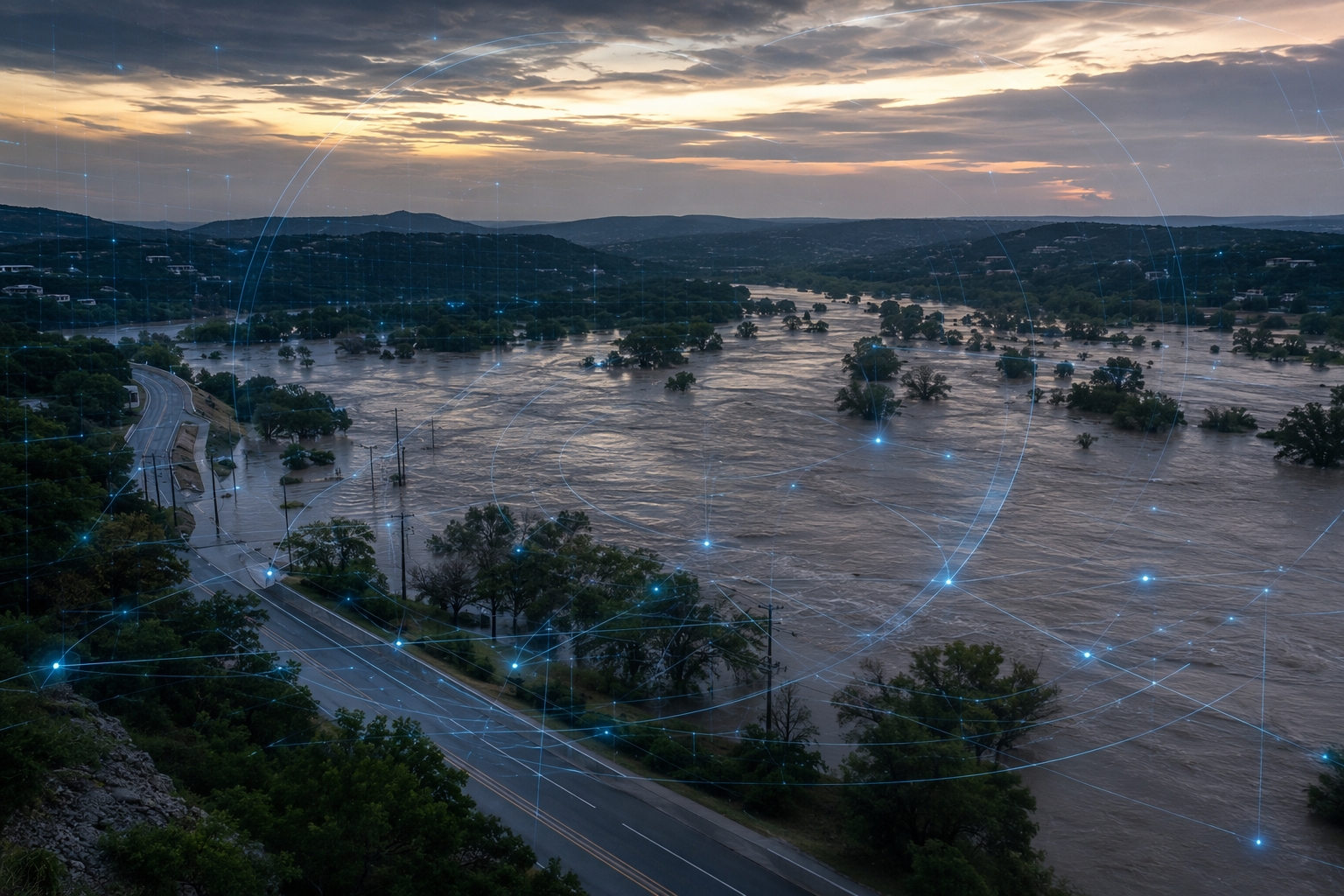
That 45-minute rise matters more for health systems than a general claim about earlier prediction. Forty-five minutes is not much time to wake staff, locate buses, decide which roads are passable, move medically fragile residents, or stage ambulances where they will not be trapped. A forecast that arrives faster is valuable only if the people receiving it already know what authority it activates.
The event also exposed a model-performance problem that should be kept in view without turning the entire discussion into an AI-versus-traditional-weather-model contest. After the flood, Scientific American reported expert assessments that AI weather models from Google, ECMWF, and Huawei’s Pangu-Weather did not perform as well as NOAA’s traditional high-resolution HRRR model for the rare, hyper-local precipitation pattern involved. The cited explanation was not that AI forecasting is useless; it was that out-of-sample extreme precipitation remains difficult because events like this are poorly represented in the training data.[2]
For emergency planning, that distinction is important. A rare failure mode does not invalidate every AI flood tool. It does mean that no hospital, county, nursing home operator, dialysis provider, or EMS agency should treat AI output as an autonomous trigger for safe action unless the downstream response pathway has been built, rehearsed, and assigned to named decision-makers.
The deaths AI would have to prevent
Texas is not a marginal test case for flood mortality. AP News, citing a 2021 study by Hatim Sharif and colleagues in Water, reported that Texas had 1,069 flood deaths from 1959 through 2019, nearly one-fifth of the U.S. total. The same account reported that 86% of the deaths involved driving or walking into floodwater, 58% were vehicle-related, more than half occurred at night, and 62% of those who died were male.[3]
Those numbers are a useful antidote to vague enthusiasm. If AI warnings are going to reduce flood-related deaths in Texas, they have to interrupt movement into water, not merely improve a forecast archive. The most common fatal scenario is not a clinician reading a model dashboard in daylight. It is a person making a bad or desperate travel decision under time pressure, often in darkness, often with incomplete information about a road that may have been safe an hour earlier.
That is why road-level alerts, barricade decisions, siren activation, law enforcement routing, EMS staging, and family communication belong in the same conversation as machine learning. A county can receive a sophisticated warning and still lose the most important minutes if the next steps depend on informal phone trees, unclear authority, or staff who are themselves trying to get through flooded streets.
The long-term mortality pattern also changes how vulnerable-population planning should be judged. A nursing home administrator does not need only a flood probability. She needs a transport threshold, a receiving-site agreement, staff call-back authority, and a way to know whether the road between the facility and the destination is still usable. A dialysis provider needs to know which patients will miss treatment if roads close. A hospital command center needs to know whether the warning is likely to create ED arrivals, transfer requests, staff shortages, or all three.

Texas deployments are moving from forecast to alert
The most concrete Texas example as of Q3 2026 is Galveston County. Route Fifty reported in June 2026 that the county had gone live in April 2026 with a system using radar sensors costing less than $10,000 per site, Axonis Decision Intelligence software, automated text alerts, and siren triggers. The same reporting described it as the first U.S. county to integrate AI sensor data with automated alert infrastructure.[4]
That architecture deserves attention because it does not stop at model output. Sensor data can feed automated public alerting and siren activation without waiting for a slow human chain of calls. Smart Cities World also described the Galveston County deployment as connecting flood sensors with automated alerting infrastructure.[5] For a county exposed to coastal and rainfall flooding, that is a meaningful operational advance.
It is still not mortality evidence. The system had been live for less than four months by July 19, 2026. No available source reports a reduction in flood deaths, near-miss rescues, vehicle entries into floodwater, EMS response times, or hospital surge outcomes attributable to the Galveston platform. Its value should be framed as a stronger input into response, not proof that AI has already reduced mortality.
Bexar County is the larger funded bet, but it is less mature operationally. Texas Public Radio reported that in August 2025 the county approved a $20 million Next Generation Flood Warning System with AI, improved gauges, and proactive alerts for first responders.[6] That is the kind of investment counties need if warnings are going to become field decisions. But a system under development cannot yet answer whether alerts reached the right supervisor, closed the right road, or changed the timing of an evacuation.
Texas A&M’s UrbanResilience.AI Lab sits closer to the research frontier. Texas A&M described work led by Dr. Ali Mostafavi using 20 years of storm data and real-time sensors to predict flooding at ZIP-code level, with field testing during the July 2025 floods. The same account described a partnership with Meta on an LLM-based Disaster Management Companion AI and quoted Mostafavi’s projection that AI could become standard in emergency management within three to five years.[7]
ZIP-code-level prediction is attractive because public health work is rarely done at the scale of a river basin alone. ZIP codes can map more naturally to home health caseloads, medically vulnerable registries, dialysis catchments, school districts, and shelter planning. But the available material does not show published outcome evidence from the Texas A&M tools, and it does not show that a disaster companion can reliably move an emergency plan from awareness to staffed execution.
What frontier models can and cannot settle
Google’s global flood forecasting work is useful as a benchmark, especially for showing how far AI-enabled hydrology has moved. Google Research describes riverine flood predictions up to seven days ahead across more than 80 countries, covering 460 million people.[8] Google has also described flash flood predictions up to 24 hours ahead at 20-kilometer resolution and the Groundsource dataset of 2.6 million news records processed with Gemini to improve flood information.[9]
Those are impressive capabilities, and they matter for countries and regions that previously had little warning coverage. But the Texas mortality problem includes sudden, local, road-level danger. A 20-kilometer flash-flood grid and a 24-hour horizon do not by themselves decide which low-water crossing should close, which EMS unit should relocate, or whether a long-term care facility has enough time to move residents before staff routes are cut off.
NOAA’s own AI work should be read in that same practical way. Scientific American reported that NOAA is developing AI versions including WoFSCast and HRRRCast, with speed and cost advantages, while noting that these tools do not yet establish superior accuracy for events like the July 2025 Hill Country flood.[2] Faster model runs are welcome in emergency management; they are not the same thing as an actionable evacuation system.
There is also a policy risk behind the technical discussion. Scientific American reported proposed $2.2 billion cuts to NOAA’s FY2026 budget that could threaten the National Severe Storms Laboratory, where AI weather models are developed.[2] If public agencies are expected to validate, compare, and operationalize AI flood tools, weakening the public forecasting infrastructure would make the validation problem harder rather than easier.
Texas is also funding planning work. The Texas Water Development Board lists a $155,000 AI roadmap project with Texas A&M running from March 2025 through May 2027.[10] That project should not be cited as evidence of results; as of Q3 2026, the available material is a project summary, not a completed evaluation.
Hybrid physics-AI approaches may become important because they do not force agencies to choose between physical modeling and learned patterns. Northeastern University has described a hybrid model, published in npj Climate and Atmospheric Science and being tested on the Tennessee Valley Authority’s operational system, that combines traditional physics with AI-learned patterns.[11] That is promising architecture, but it is not yet a Texas mortality study.
The handoff after the warning
For health systems and public health agencies, the missing middle is not mysterious. It is the chain between a warning and an action that someone is authorized, staffed, and resourced to carry out. The weak link may be clinical notification, facility evacuation, EMS deployment, hospital surge management, or public communication. In a fast flood, any one of those can be the place where useful intelligence stops being useful.
| Operational layer | What an AI warning would need to trigger |
|---|---|
| County emergency management | Named authority to activate sirens, issue targeted alerts, close roads, and request mutual aid |
| EMS | Staging changes, responder safety limits, and transport routing before roads fail |
| Hospitals | Command center activation, staffing decisions, diversion planning, and expected ED surge preparation |
| Long-term care and assisted living | Evacuation thresholds, transport contracts, receiving sites, and overnight administrator notification |
| Dialysis and home health | Patient outreach, schedule adjustments, and identification of people stranded by road closures |
| Families and the public | Road-specific warnings that arrive before the decision to drive into floodwater |
Clinical notification is especially underbuilt. A county alert can warn the public, but a hospital command center needs a different message: expected geography, timing, confidence, road impacts, likely access issues for staff, and whether neighboring facilities may request transfers. None of the available sources indicate that current Texas AI flood warning systems are integrated with hospital EMRs, clinical decision support, or automated hospital incident command workflows.
The same gap appears in EMS. A forecast can identify danger, but EMS dispatch optimization would require live routing, unit location, call demand, road closure data, and responder safety rules. No available source shows that Texas AI flood warning deployments are currently integrated with EMS dispatch optimization. That matters because EMS is often asked to absorb the consequences of delayed public action: water rescues, inaccessible patients, delayed transfers, and responders placed in the same flood environment as the public.
Long-term care facilities and other vulnerable-population sites are another unresolved test. A warning that reaches a county dashboard does not automatically wake the person who can authorize evacuation at 2 a.m. Even when that person is awake, evacuation is not a single decision. It requires vehicles, staff, destination beds, medications, records, oxygen, durable medical equipment, and a route that remains passable long enough to complete the move.
Hospitals face a different but related problem. Flood warnings may increase demand before they decrease harm: patients arrive early for oxygen, dialysis, medication refills, injuries, or shelter; staff may be unable to reach the hospital; transfers may be requested from smaller facilities; roads may affect supply deliveries. That is why AI flood intelligence belongs inside surge-capacity planning, not beside it. The hospital question is not simply “Will it flood?” but “Which services, staff, access routes, and partner facilities will be stressed, and when?”
This is also where the comparison with hospital weather preparedness is useful. The same operational issue appears in AI hurricane forecasting: better lead time helps only when it is tied to evacuation timing, staffing, supplies, and command decisions. For a broader discussion of that parallel, see AI hurricane forecasts and hospital preparedness.
Where AI could matter most
The strongest near-term case for AI in Texas flood mortality reduction is not a general claim that models will predict every extreme event. It is targeted operational compression: shortening the time from sensor detection to public alert, from warning to road closure, from geographic risk to facility notification, and from forecast confidence to EMS staging.
Galveston County’s automated text and siren pathway is important for that reason. If a sensor network can move from detection to alert without waiting for sequential manual calls, it can preserve minutes that matter. The question for the next evaluation is whether those minutes change behavior and operations: fewer vehicles entering water, faster barricade placement, fewer rescue calls, earlier facility actions, and less avoidable strain on emergency departments.
The Texas fatality baseline suggests that road-specific interventions deserve particular attention. Because 86% of flood deaths involved driving or walking into floodwater, AI-targeted road closure alerts could theoretically address the largest mortality mechanism.[3] But that should be described as a future opportunity, not a current proven capability. The available sources do not show a deployed Texas system that has demonstrated reduced deaths by automatically targeting road closures or changing driver behavior at scale.
For clinical and public health leaders, the evaluation standard should therefore be concrete. Did the alert reach the person who could act? Did it arrive before the action window closed? Did it specify geography at a level useful for roads, facilities, and patient populations? Did it trigger a rehearsed protocol rather than an improvised meeting? Did the receiving system have capacity to absorb the action the warning demanded?
As of Q3 2026, the evidence does not support saying that AI flood warning systems in Texas have reduced flood-related mortality. Galveston County is live, Bexar County is building, and Texas A&M is testing advanced tools; none has published mortality outcome data. No available source shows integration with EMRs, clinical decision support, or EMS dispatch optimization. The technical systems are becoming faster and more local, but the clinical and public health handoff remains the part that will decide whether warnings become saved lives.
That is a cautious judgment, not a pessimistic one. AI flood warnings in Texas are becoming promising inputs to disaster preparedness systems. They are not yet independently validated mortality-reduction interventions.
References
- Texas Hill Country flood one-year retrospective, CBS News, July 2026.
- AI Weather Models Missed the Texas Floods. Could They Predict the Next One?, Scientific American, 2025.
- Texas leads the US in flood deaths, and most victims are swept away in vehicles, AP News.
- Galveston County launches AI flood warning system, Route Fifty, June 2026.
- Galveston County integrates AI flood sensors with automated alerts, Smart Cities World.
- Bexar County approves $20 million next generation flood warning system, Texas Public Radio, August 2025.
- Texas A&M researchers use AI to improve flood prediction and disaster management, Texas A&M Stories.
- Flood Forecasting, Google Research.
- Improving global flood forecasting with AI, Google Blog.
- Artificial Intelligence Roadmap for Flood Planning, Texas Water Development Board, March 2025-May 2027.
- Hybrid physics-AI model for flood forecasting is tested on TVA operational system, Northeastern News.
Comments
Join the discussion with an anonymous comment.