
Food recall guidance usually fails in the space between a public notice and a kitchen decision. A recall may be posted by a federal agency, circulated by a retailer, taped to a store shelf, mentioned in local news, emailed to a loyalty-card account, or embedded in a product page. None of that means the person who bought the food knows whether the container in the refrigerator is affected, whether it has already been served, or whether a vulnerable household member needs to avoid it tonight.
That is the real test for ai for food recall consumer guidance. The useful question is not whether an app, scanner, chatbot, QR code, or voice assistant can make recall information more visible. Some already can. The harder question is which part of the recall-response chain has actually been measured: detection of a relevant notice, matching to a consumer’s product, comprehension of the required action, behavior before exposure, or a downstream change in foodborne illness.
The recall pathway consumers are asked to navigate
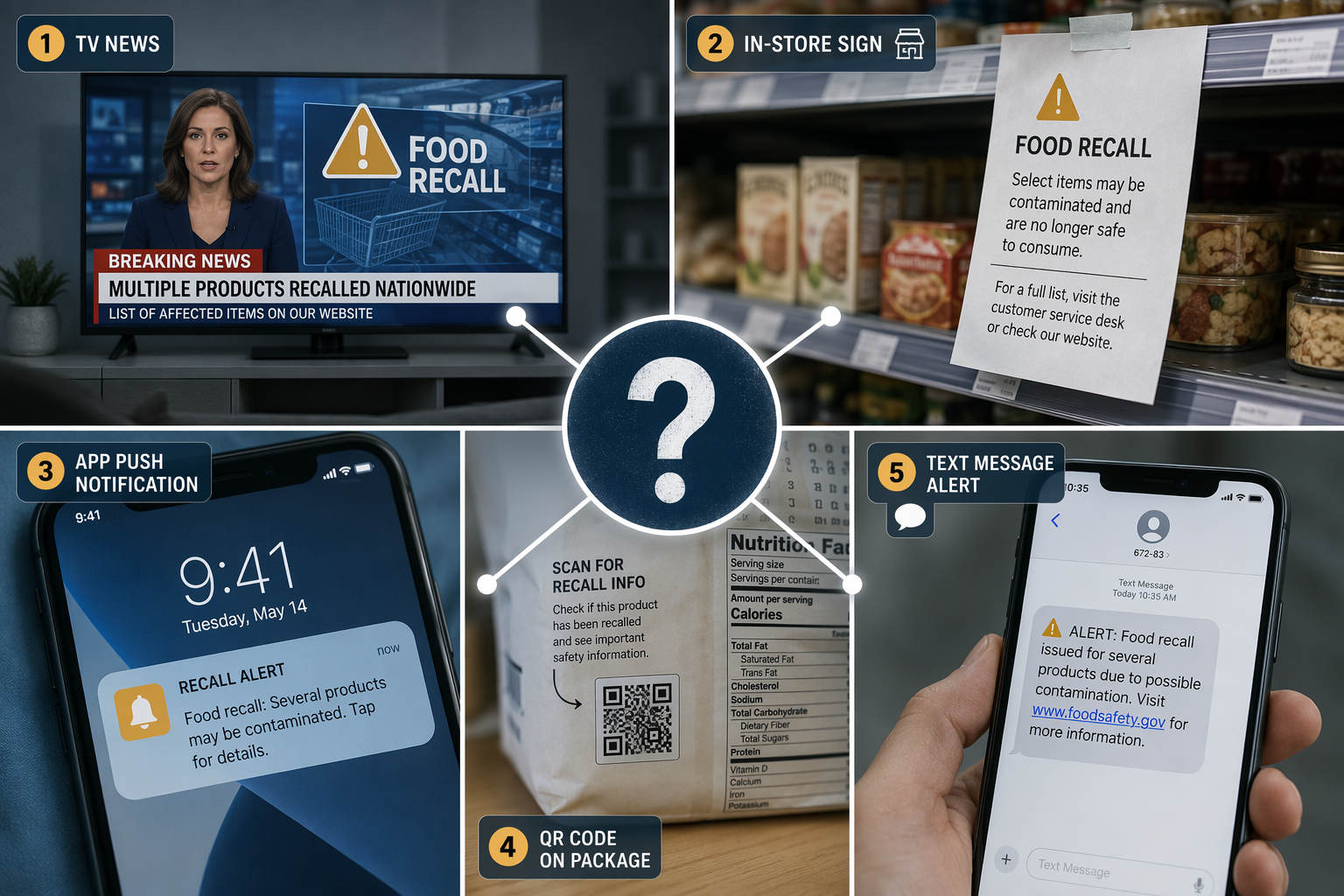
The United States does not have a single consumer recall channel that reliably follows food from the point of sale into the home. U.S. PIRG’s 2026 analysis counted 320 food recalls in 2025, and it highlighted a more uncomfortable pattern: among 28 foodborne illness outbreaks reviewed, 17 had no recall announced. The same analysis described delays from first illness to recall that could stretch from months to years, depending on the outbreak and investigation path.[1]
A separate U.S. PIRG guide describes how consumers currently find out about recalls through a patchwork of store notices, company announcements, FDA and USDA channels, email lists, media reports, and product-specific information sources.[2] This fragmentation matters clinically. A transplant recipient, pregnant person, older adult, dialysis patient, or parent of a young child does not experience “a recall” as a database entry. They experience it as a recognition task under uncertainty: Is this the right brand? The right lot? The right date? Was it bought before or after the recall? Is it still in the freezer?
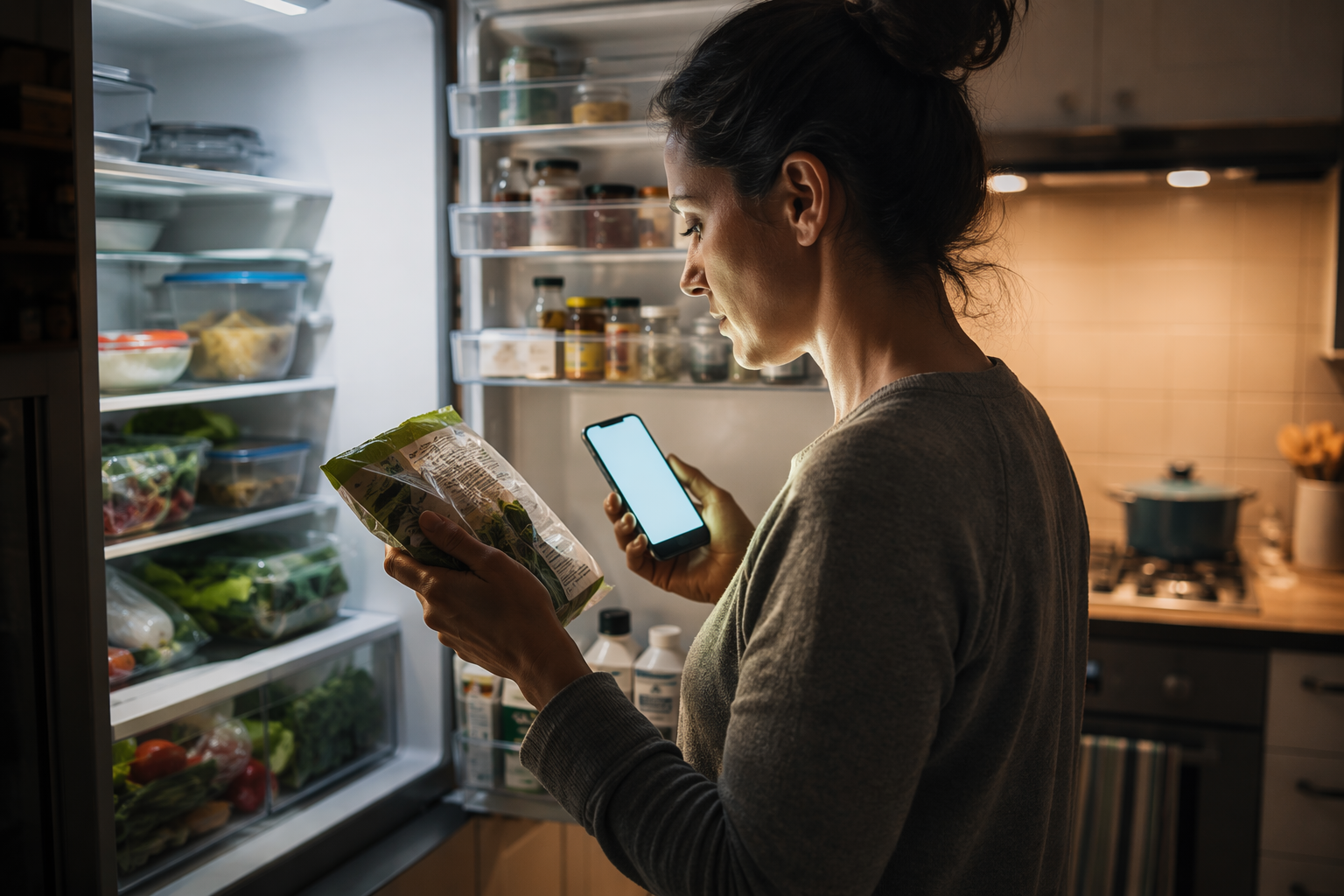
AI-enabled consumer tools are entering this broken pathway with a plausible promise: reduce the lookup burden. The practical appeal is obvious. If a tool can monitor recall feeds, translate agency language into plain instructions, scan a barcode, check a pantry inventory, or answer a spoken question, it may remove several steps that currently fall on the consumer.
But a shorter lookup is not the same as safer eating. A notification is still upstream from behavior, and behavior is still upstream from health outcomes.
The emerging consumer tool landscape
The current ecosystem is no longer hypothetical. It includes consumer alert apps with chatbot features, barcode and pantry-scanning products, QR-code recall communication systems, and voice-assisted recall lookup prototypes. The claims vary, and so does the evidence behind them.
| Tool or approach | Claimed consumer function | Source of claim | Evidence status |
|---|---|---|---|
| Food Recalls & Alerts app | Consumer recall alerts and an AI-powered chatbot for food safety questions; Google Play listing reports 250K+ users | Google Play Store listing | Adoption and feature claims; no published prospective outcome study identified |
| See Produce | AI expiry date prediction and recall monitoring against scanned food inventory, including cross-checking against FDA recall information | Company marketing materials | Commercial claim; no independent validation of database coverage, matching accuracy, or consumer response impact identified |
| SmartLabel recall alerts | QR-code-based product information and recall communication; Consumer Brands Association reports deployment on 100K+ products | Consumer Brands Association industry report | Industry-reported implementation and case example; not peer-reviewed or independently replicated |
| Voice-assisted recall lookup | Spoken recall queries using a voice assistant interface | Peer-reviewed NIH/PMC usability study | Direct consumer-tool usability evidence; does not measure real-world recall response or illness reduction |
| AI unsafe-food signal detection | Modeling consumer reviews to identify unsafe-food signals and recalled products | Peer-reviewed JAMIA Open study | Evidence for AI-assisted detection from consumer-generated data; not a consumer guidance intervention |
That table is intentionally uneven because the evidence is uneven. A download count tells us a tool has reached users. A QR-code scan count tells us consumers interacted with a code. A chatbot feature tells us a product has a conversational interface. None of those measurements, by itself, tells us whether a contaminated food was removed before being eaten.
What peer-reviewed evidence actually exists
The strongest direct evidence for a consumer-facing AI recall guidance tool is a 2025 peer-reviewed voice-assistant usability study available through NIH/PMC. The study included 40 participants and tested voice-assisted food recall queries in a controlled setting. In the reported results, 65% of young adults and 60% of older adults preferred the voice assistant over a web-based recall approach. Mean task success was 96.4% and 88.6% per meal session.[3]
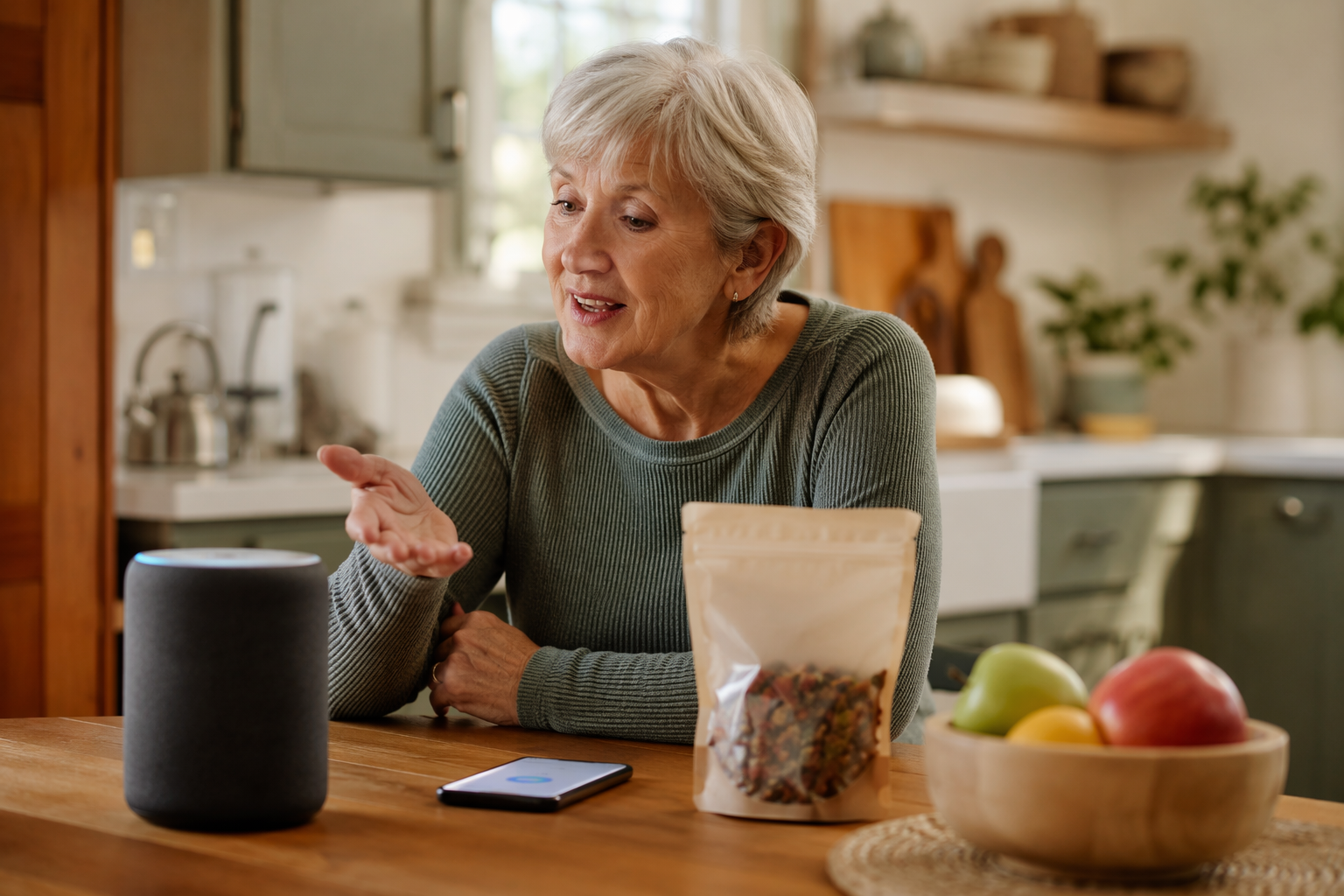
Those are meaningful usability findings. Voice can reduce the burden of typing, searching, and navigating agency pages, especially for people who are more comfortable asking a direct question than parsing a recall notice. The study also does something many product claims do not: it tests whether people can complete recall-related tasks, rather than merely asserting that a feature is available.
Its limits are just as important. The study was small, lab-based, and focused on task completion and preference. It did not test whether households acted faster during real recalls, whether they correctly identified actual products in their homes under time pressure, whether vulnerable consumers benefited more than others, or whether illness incidence changed. Preference is not adherence. Task success in a study session is not removal of a recalled food from a real refrigerator.
The other peer-reviewed pillar sits upstream from consumer guidance. A 2019 JAMIA Open study from Boston University School of Public Health used a BERT-based model on 1.3 million Amazon reviews to detect reports of unsafe foods and identify recalled products. The model achieved 74% accuracy in identifying recalled products.[4]
That work supports a different part of the chain: AI-assisted signal detection from consumer-generated data. It suggests that product reviews may contain usable safety signals and that language models can help surface them. It does not show that consumers who receive AI-generated recall guidance behave differently, nor does it establish that review-based detection can replace formal outbreak investigation or recall systems.
Together, these studies make a narrow but useful evidence base. One shows that a consumer-facing voice interface can help users complete recall lookup tasks in a study environment. The other shows that AI can detect unsafe-food signals in a large corpus of consumer reviews. Neither closes the loop from alert to household action to reduced illness.
Commercial tools solve plausible problems, but mostly report earlier-chain metrics
The Food Recalls & Alerts app is one of the clearest examples of a consumer-facing tool with meaningful reach. Its Google Play listing describes food recall alerts and an AI-powered chatbot for food safety questions, and it reports 250K+ users.[5] That matters because consumer guidance tools cannot help if no one installs them. Reach is a prerequisite.
Still, app adoption is not effectiveness. A public health evaluator would want to know whether the app detects all relevant recalls, how quickly alerts appear after federal or company announcements, how well the chatbot handles ambiguous consumer questions, and whether users take the recommended action. The listing is useful for understanding the market, not for concluding that the app prevents exposure.
See Produce presents a different mechanism. Its consumer-facing materials describe AI expiry date prediction and recall monitoring against scanned inventory, including cross-referencing food items against FDA recall information.[6] The inventory angle is promising because it addresses a concrete weakness in recall communication: consumers often must remember what they bought and then manually compare a recall notice with products at home.
The unmeasured part is the matching layer. A pantry scanner is only as useful as its product identification, lot and date handling, database freshness, and recall-source coverage. The available materials support the existence of the claimed function, not independent conclusions about comprehensiveness or accuracy.
SmartLabel sits closer to product packaging and retail communication. The Consumer Brands Association reports that SmartLabel is deployed on more than 100K products and describes a Salmonella recall case in which a SmartLabel alert went live within minutes and was scanned by hundreds of thousands of consumers.[7] As an operational anecdote, it is vivid. A recall alert attached to the product’s digital identity can move faster than a printed store sign and can meet consumers while they are holding the package.
It should be treated as an industry-reported case, not as independent evidence of public health effect. The case does not establish how many scanners owned the affected product, how many changed behavior, how many would otherwise have eaten the product, or whether illness was prevented. It does show why packaging-linked communication is attractive: the consumer does not have to start at an agency website and work backward.
What needs to be measured before these tools can be called effective
The most common evidence problem in this area is substituting activity for outcome. The distinction is not academic. Each metric answers a different question.
| Metric | What it can show | What it cannot show by itself |
|---|---|---|
| App users or downloads | A tool has consumer reach | That users received, understood, or acted on a relevant recall |
| Push notifications sent | A message was delivered or attempted | That the affected food was present in the home or removed before consumption |
| QR-code scans | A consumer interacted with product-linked information | That the scanner owned the recalled lot or changed behavior |
| Chatbot availability | A conversational interface exists | That answers are complete, current, safe, and appropriate for vulnerable users |
| Task success in a study | Users can complete defined recall lookup tasks under study conditions | That real-world response time or illness incidence improves |
| Model accuracy | An AI system can classify or detect signals in a dataset | That consumer guidance is timely, specific, or behavior-changing |
A stronger evaluation would follow the chain more completely. Did the tool ingest the recall quickly? Did it identify the right product variant, lot, date, and geography? Did it reach the right consumer before consumption? Did the consumer understand whether to discard, return, avoid serving, or seek care? Did the tool reduce the time between recall publication and household action?
For healthcare professionals, the vulnerable-population question is especially underdeveloped. Consumer tools are generally marketed directly to the public. The available materials do not establish integration with EHRs, transplant clinics, dialysis centers, obstetric practices, oncology programs, or public health case-management workflows. That does not make the tools irrelevant to high-risk patients. It means there is little published evidence about whether they are reaching the people for whom a recall delay may carry the highest consequence.
These consumer tools depend on upstream data quality
Consumer guidance tools inherit the strengths and weaknesses of upstream recall infrastructure. If a recall is delayed, incomplete, inconsistently formatted, or not issued at all, a downstream app may have little to work with. This is why consumer AI should not be evaluated apart from the FDA, USDA, manufacturer, retailer, and traceability systems that feed it.
FDA leadership has signaled interest in more digitized recall documentation that could support AI-assisted analysis. A July 2025 FDA commissioner letter encouraged food industry leaders to streamline and enhance product recall communications and described long-term digitization goals for recall documentation.[8] That type of infrastructure could make consumer-facing tools more reliable, but it is upstream capacity, not proof that any specific consumer product improves outcomes.
This same dependency runs through broader AI food safety infrastructure. ClinicalMind has covered how regulatory agencies are using AI in testing and inspection in How the FDA Uses AI in Food Safety Testing and Inspection, how traceability and recall tools are evolving after cyclosporiasis in How AI Tools Are Reshaping Food Recall Management After Cyclosporiasis, and why faster detection has an economic case in The Economic Return of AI in Food Safety Recall Detection. Consumer recall guidance is the household-facing edge of that larger system.
Privacy and trust are evaluation gaps, not side issues
A recall guidance app may ask for location, purchase behavior, scanned inventory, pantry contents, app activity, or food preferences. Those data can improve relevance. They can also create a sensitive picture of household routines, dietary restrictions, infant feeding, chronic disease management, religious dietary practice, or economic vulnerability.
The available materials do not include published privacy audits or data-security assessments for the named consumer tools. That limits what can be responsibly concluded. It is fair to ask how data are stored, shared, retained, and used for model improvement. It is not fair, on the available record, to rank products by privacy performance without independent evidence.
Consumer trust is also not guaranteed by technical convenience. A 2024 Ingredient Communications survey found that 83% of consumers wanted disclosure when AI is used in food products.[9] That survey concerns consumer attitudes, not recall-tool behavior, but it is a useful reminder: people may welcome practical AI assistance and still expect transparency about where it is operating.
How health professionals should read the current evidence
A cautious reading does not require dismissing these tools. The recall pathway is fragmented enough that even partial improvements may be valuable. A barcode scan that helps a caregiver identify a recalled product, a voice assistant that lowers the search burden for an older adult, or a QR-linked alert that appears while someone is holding a package can be practically useful without yet having a prospective outcomes trial behind it.
The responsible stance is to separate use cases from proof. A health professional can say that some tools may help patients monitor recall information and interpret notices. They should not say that these tools have been shown to reduce foodborne illness, protect immunocompromised patients, or shorten real-world recall response times unless such evidence is published.
For evaluation, the first questions should be operational rather than promotional:
- Which recall sources does the tool monitor, and how quickly are updates incorporated?
- Can it distinguish brand, product size, lot, date code, geography, and recall class when those details matter?
- Does the tool explain the action in plain language, including when to discard food, return it, avoid serving it, or seek medical advice?
- Has the tool been tested with older adults, caregivers, limited-English users, or medically vulnerable households?
- Does the vendor report behavior-linked outcomes, such as time from recall posting to confirmed household action, rather than only users, scans, or alerts?
- Are privacy practices, data retention, and third-party sharing clear enough for a patient to make an informed choice?
As of Q3 2026, consumer-facing AI recall guidance is real but incompletely evaluated. The best-supported evidence shows usability for voice-assisted lookup and AI capability for unsafe-food signal detection. Commercial apps, pantry scanners, and QR-code systems address genuine communication failures, and some have reached meaningful audiences. What has not been published is prospective evidence that these tools reduce foodborne illness incidence or improve real-world consumer recall response times.
References
- Food for Thought 2026. U.S. PIRG Education Fund. 2026.
- How to Find Out About Food Recalls. U.S. PIRG Education Fund.
- Voice-assisted Food Recall using Voice Assistants. NIH/PMC. 2025.
- Detecting Reports of Unsafe Foods in Consumer Product Reviews. JAMIA Open. 2019.
- Food Recalls & Alerts. Google Play Store.
- See Produce. See Produce.
- Modernizing Recall Communications: Reaching Consumers Where They Are. Consumer Brands Association.
- FDA Encourages Food Industry Leaders to Streamline, Enhance Product Recall Communications With Public and FDA. U.S. Food and Drug Administration. July 2025.
- Ingredient Communications 2024 Survey. Ingredient Communications. 2024.
Comments
Join the discussion with an anonymous comment.