
The useful way to read AI for food recall management and surveillance is not as one technology category. It is a chain of handoffs. A camera sees a defect. A surveillance system detects a signal. A model estimates where contamination may be moving. A regulator or firm decides whether to recall. A traceability system proves which lots, stores, and consumers are affected.
The Institute of Food Technologists’ 2026 framing is useful because it separates those jobs into five functions: sense, detect, predict, decide, and prove.[1] The imbalance appears as soon as the pipeline is laid out. Adoption is strongest where inputs are visible, frequent, and close to the production line. It is weaker where the system must infer rare contamination events from fragmented surveillance, purchasing, inspection, laboratory, and traceback data.
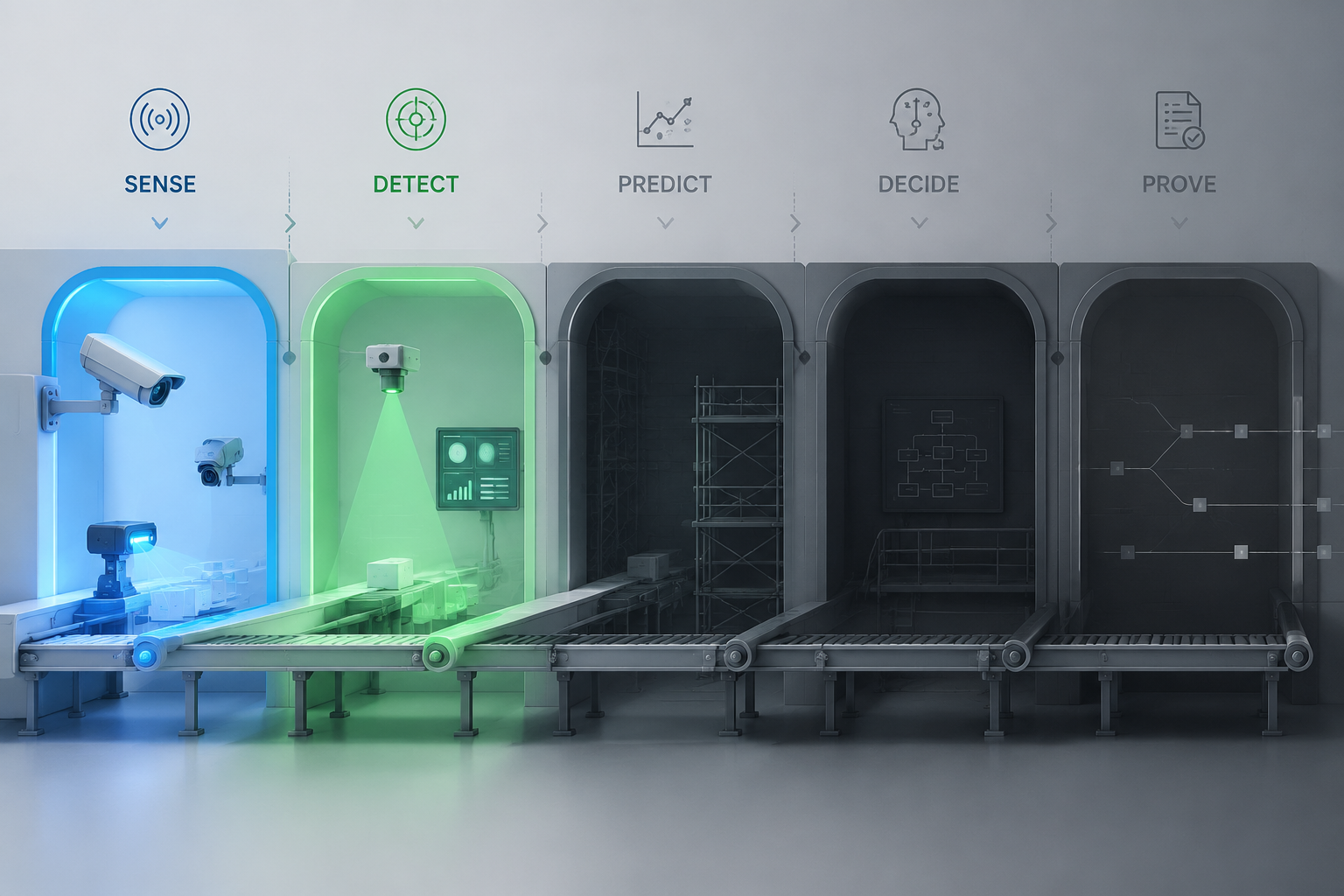
| Function | What AI is asked to do | Current maturity |
|---|---|---|
| Sense | Collect machine-readable signals from cameras, sensors, production equipment, labels, inspections, or environmental data. | Most practical when the target is visible or measurable at high frequency. |
| Detect | Flag defects, anomalies, contamination indicators, complaints, or outbreak signals. | The most active deployment layer, especially in computer vision inspection. |
| Predict | Estimate which products, lots, sites, or populations are at elevated risk before confirmation arrives. | Promising in research, but constrained by rare-event data and validation limits. |
| Decide | Support recall scope, public warnings, inspection prioritization, or product disposition. | High public health value, high evidentiary burden. |
| Prove | Connect records across supply chains to confirm source, distribution, and affected lots. | Advancing through traceability and data consolidation, but dependent on interoperable records. |
That distinction matters because food recall failure is often not a failure to imagine risk. It is a failure to identify the contaminated food with enough confidence to act. PIRG reported that 17 of 28 U.S. foodborne illness outbreaks in 2025 had no recall announced because the contaminated food could not be identified.[2] That is the pressure point. Better inspection is valuable, but the public health question is whether a signal can travel far enough through the system to shorten exposure and narrow the recall.
Where AI Is Already Doing Work
The clearest operational use cases are in sense and detect. In food manufacturing, IFT reported that more than 60% of AI adoption in 2025 was concentrated in real-time quality inspection and contamination detection, and more than 70% of food businesses reported either implementing or planning AI.[1] Those figures say something important about adoption, but not about public health effectiveness. They show where firms can most readily justify deployment: repetitive inspection, visible variation, and high-volume production environments.
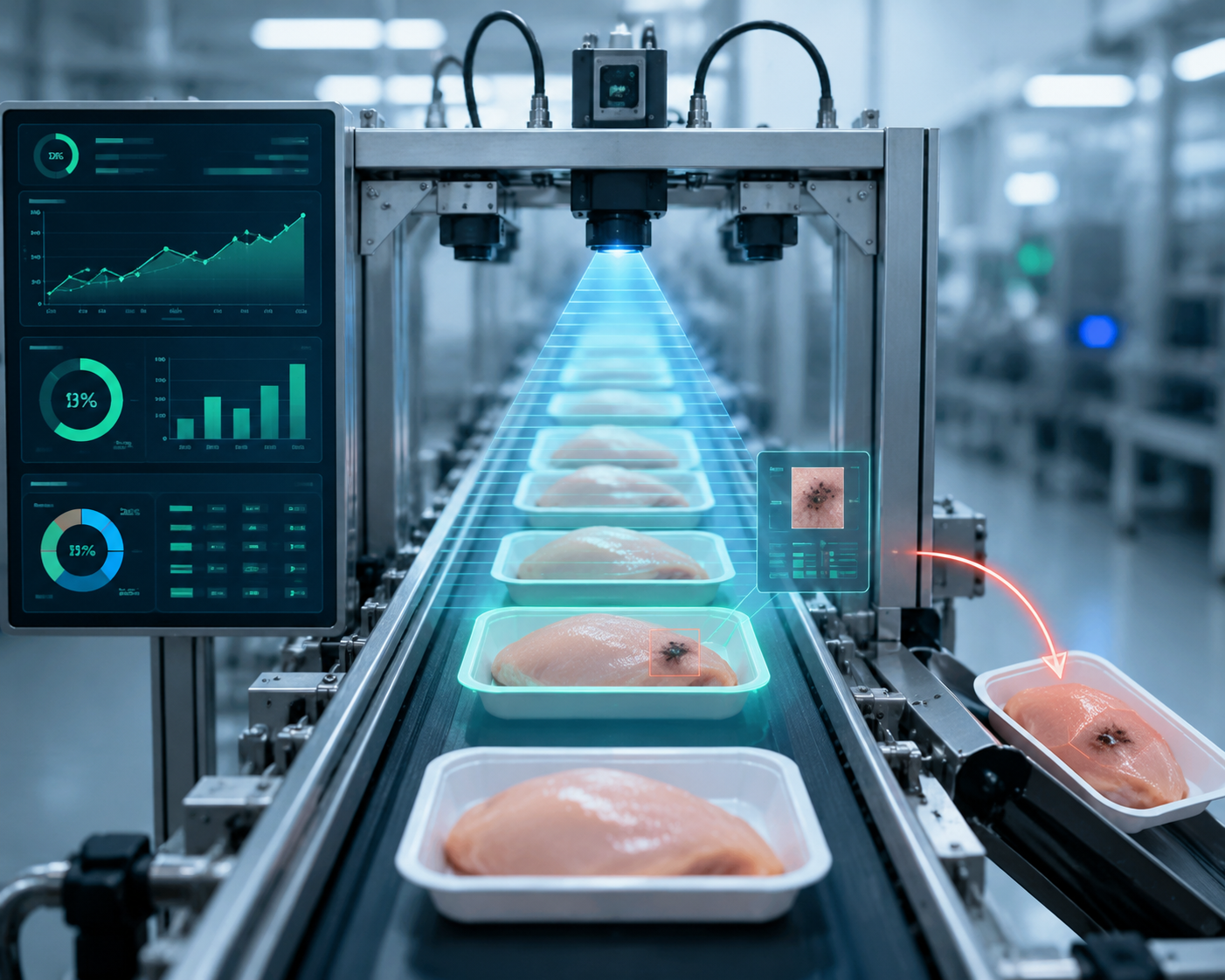
Computer vision fits that environment. A model can inspect packaging, surface defects, foreign material indicators, fill levels, label placement, or product appearance at a speed and consistency that manual inspection teams cannot sustain indefinitely. The input is abundant; the outcome is immediate; the cost of a false positive is often a diverted item or a human review rather than a national warning.
The strongest deployment examples should still be read in their proper category. IONI AI reports that Nestlé reduced manual quality checks by 80%, and that PepsiCo achieved 95% defect detection accuracy in an AI inspection application.[3] Those are operationally meaningful claims, but they are company- or vendor-reported results, not independent measures that a foodborne illness surveillance program can simply generalize to outbreak prevention.
The distinction is not pedantic. A defect detector answers a bounded question: does this item, image, package, or production moment look wrong? Recall management asks a different question: which product should be removed, from which locations, based on evidence strong enough to justify action? One system can reduce inspection burden without solving the other problem.
The peer-reviewed literature shows the same center of gravity. A June 2026 systematic review in npj Science of Food analyzed 161 studies and found that AI food safety research grew from 1 publication in 2012 to 46 in 2023; deep learning methods increased from 22% to 43% of papers across 2019–2023.[4] The review is not a live deployment registry, and its literature cutoff means it cannot capture every 2025–2026 commercial or agency implementation. It is still a stronger guide to technical evidence than market estimates because it shows where methods have actually been tested in the research record.
For readers comparing this broad map with commodity-specific recall work, AI improves food recall tracking for iceberg lettuce safety is a narrower example of how traceback, contamination risk, and recall scope become operational rather than abstract once the product category is fixed.
Detection Is Not the Same as Recall Intelligence
A good detection model can still leave a public health team with an unresolved recall question. A complaint cluster may point to a meal, not a lot. A genomic match may link patients, not a distributor. A social media signal may surface symptoms, not an exposure vehicle. A production-line anomaly may never reach the agency record system where outbreak investigators are working.
This is where the food safety AI problem becomes less glamorous and more important. Models trained on routine food safety data are usually surrounded by safe examples. The npj Science of Food review identified severe class imbalance as the primary technical barrier: most data reflect safe conditions, while the contamination events that matter most are rare.[4] A model can look strong on aggregate accuracy and still miss the unusual event that should have triggered escalation.
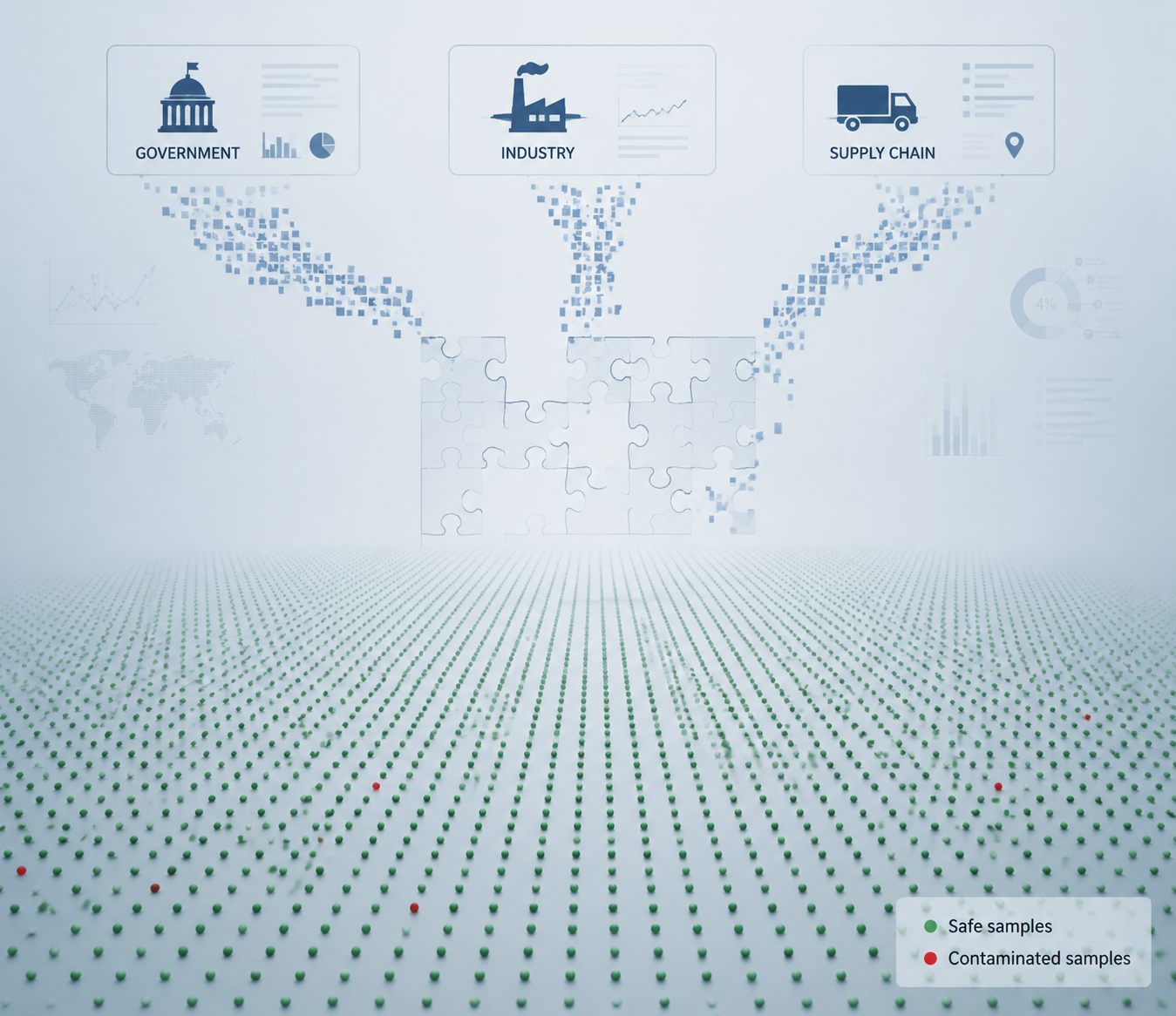
Class imbalance is not only a modeling nuisance. It changes what evidence is persuasive. In a factory inspection setting, repeated imaging may generate enough borderline cases to tune thresholds. In outbreak prediction, the target event may be sparse, delayed, and partially observed. The label itself may be uncertain because the contaminated food was never identified. That is exactly the problem PIRG’s 2025 outbreak figure exposes.[2]
Fragmentation compounds the issue. Food recall management depends on signals that live in different places: clinical reports, laboratory subtyping, consumer complaints, inspection findings, import records, retail loyalty data, distribution logs, supplier certificates, environmental monitoring, and firm-held batch records. Each source may be useful on its own. The recall decision depends on how quickly they can be joined without losing provenance.
This is why NLP-based surveillance and outbreak-detection AI should be treated as adjacent to, not identical with, recall management. NLP can mine complaints, call-center notes, inspection narratives, or public reports for possible signals. Genomic and epidemiologic models can help detect clusters or generate hypotheses. The clinical and public health surveillance side is covered more directly in How AI Detects Foodborne Illness Outbreaks and AI for Foodborne Outbreak Detection: What the Evidence Shows. The recall layer starts when those signals must support a product-specific action.
The Decide Layer Carries the Highest Burden
Decision support is the tempting phrase, but recall decisions are not dashboard preferences. They determine whether products are pulled, whether public warnings are issued, whether firms absorb losses, and whether consumers continue to eat food that may be contaminated. A model that helps rank inspection priorities faces a different burden from a system that recommends the scope of a recall.
FDA’s agency-wide AI work belongs in this context. The agency launched Elsa in June 2025 as an internal AI tool intended to help staff work with information more efficiently.[5] In May 2026, FDA announced expanded AI capabilities and completion of HALO data platform consolidation across more than 40 data sources.[6] These efforts do not, by themselves, validate automated recall decision-making. They matter because the decide layer cannot mature without agency infrastructure that can retrieve, compare, and preserve data across programs.
The same distinction applies to firm-side tools. A platform can speed document review, surface prior inspection patterns, or connect product records. Those functions may reduce dead time. They are not equivalent to a validated public health decision engine unless its recommendations are tested against relevant outcomes: earlier source identification, narrower recall scope without missed products, faster consumer notification, or reduced exposure time.
Market growth does not answer that validation question. Industry estimates place the AI food safety market at $2.7–3.1 billion and project $13.7 billion by 2030.[3] Those numbers explain why vendors are entering the space. They do not tell an epidemiologist whether a model can handle incomplete exposure histories, changing distribution routes, or a pathogen signal that appears after products have moved through multiple retail channels.
For health technology teams evaluating value, this is also where economic claims need to be tied to workflow. A production-line detector may have a straightforward return through labor reduction, waste reduction, or fewer rejected lots. A recall intelligence system has a more complex value case because the desired event is rare and the avoided harm is distributed across agencies, firms, retailers, clinicians, and consumers. That distinction is explored further in The Economic Return of AI in Food Safety Recall Detection.
Proving the Path of a Product
The prove layer is where recall management becomes concrete. Once a plausible contaminated food is identified, investigators and firms need to know where it came from, where it went, which lots are implicated, and which products can safely remain on shelves. Precision recall is not just a modeling problem; it is a records problem.
The widely cited Walmart/IBM Food Trust example sits here. IONI AI reports that the system reduced produce traceback from 7 days to 2.2 seconds, enabling recalls to focus on affected products rather than broader removals.[3] The claim is operational and vendor-reported, but it points to a real architectural need: AI-driven recall management is only as useful as the traceability layer that can confirm product movement.
Traceability also changes the role of prediction. A predictive model that suggests a likely source is much more actionable if distribution and lot records can be queried quickly. Without that prove layer, the prediction may remain a hypothesis waiting for manual reconstruction. With it, the same hypothesis can be checked against shipments, suppliers, stores, and dates while products are still in commerce.
That is why regulatory data consolidation should be read as more than back-office modernization. HALO’s consolidation of more than 40 FDA data sources is relevant because fragmented records make it difficult to move from signal to accountable action.[6] The useful endpoint is not a more impressive portal; it is a shorter path from suspected hazard to defensible scope.
Governance Determines Whether the System Can Be Trusted
Food safety AI also has to travel across uneven institutional capacity. FAO’s global governance work reviewed 141 papers and included 1,023 participants from 107 countries; it found that many authorities face data scarcity and capacity constraints, and emphasized AI literacy and human oversight as prerequisites.[7] That matters for recall management because cross-border food supply chains do not respect the boundaries of the best-resourced data systems.
Human oversight is not a ceremonial checkbox here. Someone has to decide whether the evidence supports a recall, whether a public warning should name a product, whether the model’s confidence is meaningful under class imbalance, and whether missing data might be hiding an affected lot. The more consequential the recommendation, the more important it becomes to preserve the source, timing, and uncertainty of each input.
This is a familiar pattern in public health AI outside food safety as well. Models that translate environmental data into health risk estimates face similar handoff problems: the analytic signal has to be interpretable enough for agencies, clinicians, and communities to act on it. The broader surveillance challenge is discussed in How AI Translates Air Quality Data Into Health Risk Estimates.
A Readiness Map for Food Recall AI
The current evidence supports a narrowed assessment. AI is already reshaping food recall management and surveillance, but mainly at the front of the workflow and in the infrastructure that may eventually support more precise action.
| Layer | Readiness assessment | What still needs proof |
|---|---|---|
| Sense | Practical use is strong where cameras, sensors, and production systems generate frequent inputs. | Generalizability across foods, facilities, lighting, equipment, and operating conditions. |
| Detect | Computer vision and anomaly detection are the most mature operational use cases. | Independent validation and evidence that detection improvements change recall or illness outcomes. |
| Predict | Research activity is growing, but rare contamination events limit training and evaluation. | Performance under severe class imbalance, delayed labels, and incomplete exposure data. |
| Decide | Agency and firm tools can support information retrieval and prioritization. | Accountable validation for recommendations that affect recall scope, warnings, and product disposition. |
| Prove | Traceability and data consolidation are advancing the ability to reconstruct product movement. | Interoperability, provenance, and speed across firms, agencies, suppliers, and retail systems. |
The strongest case today is not that AI will prevent recalls. It is that AI can reduce manual inspection burden, improve real-time defect detection, accelerate information retrieval, and make traceability records more usable. The harder case is whether AI can reliably identify rare contamination signals early enough, connect them to the correct food, and support a recall decision narrow enough to avoid unnecessary disruption without leaving unsafe products in circulation.
That is the line researchers and informaticians should keep visible. Sense and detect are entering practical use. Prove is advancing through traceability and data consolidation. Predict and decide remain constrained by rare-event data, fragmented surveillance systems, and validation frameworks that have not yet caught up with the consequences of automated recommendation.
References
- How AI Is Reshaping Food Safety, Institute of Food Technologists, June 2026.
- Food for Thought 2026, PIRG Education Fund, 2026.
- How AI is Transforming Food Safety, IONI AI.
- Artificial intelligence in food safety: a systematic review, npj Science of Food, June 2026.
- FDA Launches Agency-Wide AI Tool to Optimize Performance for the American People, U.S. Food and Drug Administration, June 2025.
- FDA Expands AI Capabilities and Completes Data Platform Consolidation, U.S. Food and Drug Administration, May 2026.
- AI for food safety: FAO publication highlights real-world applications and regulatory considerations, Food and Agriculture Organization of the United Nations.
Comments
Join the discussion with an anonymous comment.