
The strongest published case for AI in food safety outbreak detection does not start with a chatbot, a genomic model, or a generic promise to “predict outbreaks.” It starts with a practical nuisance: deciding which restaurants are worth sending an inspector to when the available signal is indirect.
Google’s FINDER system used search queries suggestive of foodborne illness, combined with users’ location histories, to infer restaurants that might have been linked to illness. In validation across Chicago and Las Vegas, FINDER-guided inspections found unsafe restaurants at 3.1 times the baseline rate. Of 132 inspections prompted by the system, 52.3% identified unsafe restaurants, compared with 24.7% in the baseline inspections; the reported odds ratio was 3.06 with a 95% confidence interval of 2.14 to 4.35. The model’s ROC AUC was 0.85, and in Chicago it was reported as 68% more effective than the city’s complaint-based system at identifying unsafe restaurants.[1]
Those are not abstract classification scores. They describe a change in inspection targeting. A local health department had a list of restaurants it could inspect, and the AI-assisted list produced more actionable findings than usual. That is why FINDER remains the most important published example in this space: it connects a weak digital signal to a recognizable public health action.

Why FINDER Is the Benchmark—and Why It Is Still a Narrow One
FINDER’s design is appealing because it works around a known reporting gap. Many people who develop gastrointestinal symptoms do not file a complaint with a health department. Some search for symptoms, remedies, or food poisoning information instead. If those searches can be linked, probabilistically and with privacy controls, to recent restaurant visits, they may identify facilities that complaint systems miss.
The system’s output also has the right shape. It does not merely say that illness-related searches increased. It produces restaurant leads that can be inspected. That matters because an outbreak signal has to enter a workflow: someone has to decide whether to call, inspect, interview, sample, or wait. A high-performing alert that cannot be assigned to a place, product, time window, or follow-up action is much less useful than a modest signal that sends an inspector to the right door.
FINDER’s limitations are just as operational. The validation involved 132 inspections across two U.S. cities.[1] That is a meaningful field test, but it is not enough to assume similar performance in rural jurisdictions, smaller cities, different restaurant density patterns, or places where search behavior and location history coverage differ. The system also depends on proprietary Google search and location data. The underlying model code and datasets are not publicly available, so independent teams cannot rerun the analysis or stress-test the method in their own data environment.
That does not make the result weak. It makes the deployment claim narrower. FINDER shows that search and location signals can improve inspection targeting in at least two urban settings when a platform has access to the relevant data streams. It does not show that public health agencies, vendors, or researchers can reproduce the same gain without that data access.
This distinction is familiar in clinical AI as well: a model can be technically impressive and still have a limited evidence base for real-world adoption. The same evidence-quality questions that apply to deployed healthcare AI systems—external validation, workflow fit, and reproducibility—also apply here, even when the endpoint is an unsafe restaurant rather than a patient outcome. For related framing, see ClinicalMind’s discussion of the ML healthcare evidence gap.
Social Media NLP Finds Illness Language Before It Finds Outbreaks
Social media surveillance is attractive for the same reason as search surveillance: people talk about illness before they talk to public health. Unlike search logs, however, public posts often contain messy narrative fragments. A useful system has to do more than identify that a sentence sounds like food poisoning. It has to extract who got sick, what food was implicated, where it was eaten or purchased, and whether the post is a firsthand report, a joke, a news share, or a complaint about something unrelated.
That gap appears clearly in the BERTweet dual-task work by Tao and colleagues. The model reached an F1 score of 0.87 for sentence classification, but only 0.61 for entity extraction.[2] The classification result says the model can recognize illness-relevant language fairly well in the studied corpus. The entity extraction result says the harder job—pulling out the food, location, symptom, and exposure details needed for follow-up—is much less reliable.
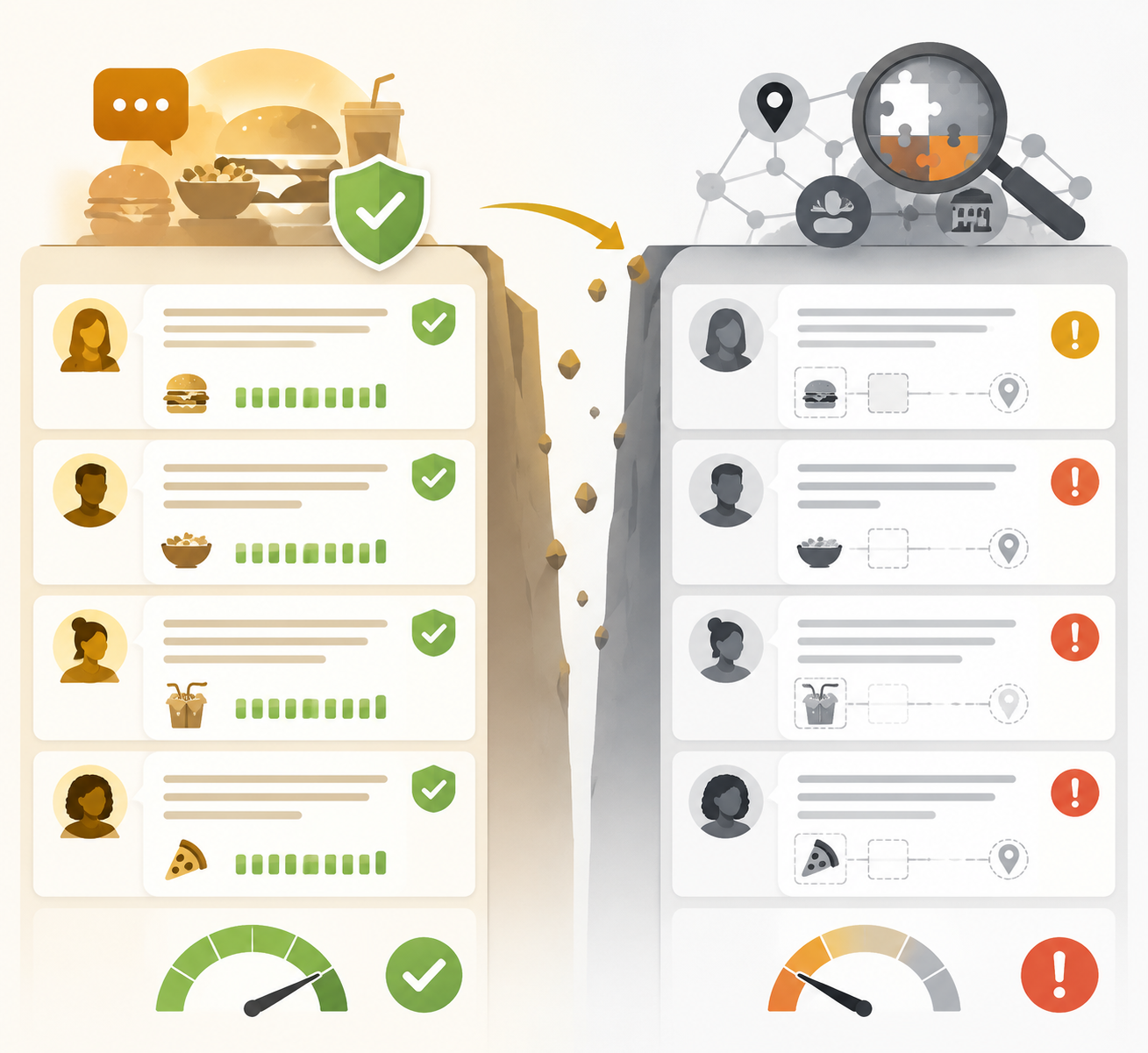
For outbreak detection, the extraction score is not a minor technical footnote. If a system can flag “I got sick after dinner” but cannot reliably connect the report to a restaurant, food item, or location, the burden moves back to analysts. They have to read, interpret, and triage posts manually. That may still be worthwhile for a small stream of high-priority leads, but it is not the same as automated outbreak detection.
A later Twitter-based surveillance pipeline from Tao and colleagues processed about 430,000 geolocated tweets, identified roughly 110,000 positives, and reported logistic regression accuracy of 0.80. The study also compared food category distributions with CDC National Outbreak Reporting System reports and found that the distributions matched in broad ways. But only about 1% of tweets had usable location inference.[3]
That last number changes the public health meaning of the result. Matching food category distributions suggests that social media can reflect some of the same foodborne illness landscape seen in official outbreak reporting. It does not mean the system can routinely identify actionable local clusters. A category-level signal—more posts about chicken, seafood, or leafy greens—does not tell an inspector where to go. Sparse location data mean that the apparent scale of the tweet corpus can shrink quickly when the surveillance question becomes local and operational.
| Method | What the metric shows | What still limits public health use |
|---|---|---|
| FINDER search and location signals | Improved targeting of restaurant inspections in two cities | Proprietary data, limited geography, 132-inspection validation sample |
| BERTweet social media NLP | Strong sentence classification in the study corpus | Lower entity extraction performance, making leads harder to verify |
| Twitter surveillance pipeline | Large-scale illness-language detection and food category comparison | Only about 1% usable location inference; category match is not cluster detection |
| YOLOv4 optical imaging | High lab precision for detecting E. coli on romaine lettuce | Romaine-only and lab-only evidence |
| LLM review analysis | Exploratory classification of GI-related restaurant reviews | Qualitative evidence, access constraints, and misattribution risk |
Restaurant Reviews and LLMs Add Signal, but Not Yet a Proven Surveillance Layer
Restaurant reviews are a natural place to look for missed gastrointestinal illness reports. They often include venue names, dates, dishes, and descriptions of symptoms. They also contain exaggeration, delayed posting, secondhand claims, ambiguous attribution, and demographic skew. People who write online reviews are not a random sample of people who become ill after eating.
The UK Health Security Agency’s 2025 pilot with Yelp reviews is best read as an exploratory step rather than a validated detection system. In the pilot, 1,148 of 3,000 manually annotated Yelp reviews were classified as gastrointestinal-related. The agency highlighted real-time data access and misattribution as continuing challenges.[4]
The review format gives language models more context than a short post, but context does not solve attribution. A reviewer may blame the last restaurant visited when exposure occurred elsewhere. A cluster of similar reviews may reflect an outbreak, a viral rumor, a popular dish, or a local reviewing pattern. Before this kind of system can support routine public health action, it needs evidence that model output improves triage without overwhelming staff with cases that cannot be verified.
Optical AI Is Closer to Inspection Technology Than Outbreak Surveillance
Not every AI method in food safety is trying to infer illness from human behavior. Some systems aim to detect contamination directly in food or processing environments. The UC Davis YOLOv4 work, for example, used AI-assisted imaging to detect E. coli on lettuce within 3 hours, compared with days for culture-based methods, and reported 94% precision distinguishing E. coli from seven other species.[5]
That is an important laboratory result, especially because time matters when contaminated product may still be moving through distribution. But the boundary is tight: the work described was on romaine lettuce under laboratory conditions.[5] It does not yet establish performance across naturally occurring low-level contamination, mixed food matrices, field conditions, processing environments, or the many organisms and products that matter in routine surveillance.
For outbreak detection, optical systems sit in a different part of the workflow from FINDER or social media NLP. They may eventually help producers, inspectors, or laboratories find contaminated products faster. They do not, on the current evidence, replace syndromic surveillance, complaint intake, epidemiologic interviewing, laboratory confirmation, or traceback. Their most plausible near-term role is targeted detection inside food-safety operations, not population-level outbreak discovery.
The Metrics Are Not Interchangeable
It is tempting to line these systems up by their best number: 3.1 times better inspection targeting, F1 0.87, accuracy 0.80, 94% precision. That comparison would be misleading. The systems are measuring different things: unsafe restaurant inspection outcomes, sentence classification, tweet classification, entity extraction, food category distributions, and bacterial discrimination under laboratory conditions.
The 2026 systematic review in npj Science of Food makes the same problem explicit at the literature level. Across 161 papers, the share of food-safety AI papers using deep learning rose from 22% in 2019 to 43% in 2023. But the review concluded that model performance could not be systematically compared across studies because datasets, evaluation protocols, and positive-case availability were too heterogeneous.[6]
Sparse positives are not a small inconvenience in food safety. Most observations in a food system reflect safe or non-outbreak conditions. That class imbalance can make a model look good on common cases while still struggling with the rare events that matter most. A surveillance tool that performs well in a curated dataset may behave very differently when positives are rare, labels are delayed, and staff have limited time to investigate weak signals.
This is why adoption and effectiveness have to be kept separate. More deep learning papers do not prove better outbreak detection. A high F1 score does not prove field readiness. A laboratory contamination detector does not prove outbreak surveillance value. Each result should be judged against the decision it supports.
Where These Methods Fit Today
The common deployment pattern is not replacement. It is earlier cueing. AI can help decide which restaurant complaint deserves faster review, which search-and-location pattern warrants inspection, which posts deserve analyst attention, or which product sample should receive faster testing. That is useful, but it is still a supplement to established investigation.
Industry-facing food safety discussions are moving in a similar direction. Jeff Varcoe of J.M. Smucker Co. has described AI as experimental for internal plant use but becoming operational for external risk monitoring, while advocating its use as an early-warning indicator within existing HACCP-style frameworks.[7] That framing is more credible than treating AI as a stand-alone outbreak authority. A warning indicator can raise attention; the control system still has to verify, document, and act.
For public health teams, the deployment questions are concrete. Does the tool generate leads with enough location and exposure detail to investigate? Does it improve the yield of inspections or interviews compared with current triage? Can analysts see why a signal was generated? Can the system be evaluated outside the developer’s data environment? Does it reduce delay without creating a queue of unverifiable alerts?
On those questions, FINDER has the strongest published field evidence, but also the clearest reproducibility constraint. Social media NLP has useful classification evidence, but its operational value weakens when entity extraction and location inference fail. Review-based LLM work is plausible but still exploratory. Optical imaging may accelerate contamination detection in defined settings, but its outbreak surveillance role remains indirect.
The practical answer, then, is restrained but not dismissive: current AI methods can improve early warning and triage for foodborne outbreak detection in narrow settings. No method is yet supported well enough to replace complaint systems, laboratory confirmation, epidemiologic investigation, traceback, or HACCP-style controls.
References
- Machine-learned epidemiology: real-time detection of foodborne illness at scale — npj Digital Medicine, 2018
- Crowdsourcing and machine learning approaches for extracting entities indicating potential foodborne outbreaks from social media — PMC, 2021
- A Novel Foodborne Illness Detection and Web Application Tool Based on Social Media — PMC, 2023
- AI could help detect and investigate foodborne illness outbreaks — GOV.UK, 2025
- How Artificial Intelligence May Improve Food Safety — UC Davis
- Artificial intelligence in food safety — systematic review — npj Science of Food, 2026
- AI as an Early Warning System — IFT Food Technology Magazine
Comments
Join the discussion with an anonymous comment.