
A U.S. food recall is often described as a food-company problem until the cost migrates. Emergency departments see anxious patients and confirmed infections. Public health teams spend scarce time tracing exposure. Retailers and suppliers absorb disruption. Payers and health systems deal with the downstream consequences of a preventable failure that may have started days or weeks earlier in a supply chain file, a sanitation log, or a lot-code trail.
That is why the often-cited estimate that a food recall costs a company an average of $10 million in direct costs is a useful doorway into AI in food safety recall detection, but not a number to treat casually. The figure originates from an older Grocery Manufacturers Association estimate and is repeated across industry discussions; it should be used as an anchor for scale, not as fresh ground truth for every recall category, company size, or outbreak pattern.[1]
For healthcare-side budget holders, the more important question is not whether every recall costs exactly that much. It is whether earlier detection, faster trace-back, and predictive prevention can change the timing of action before avoidable harm becomes a public-health and claims-cost event.
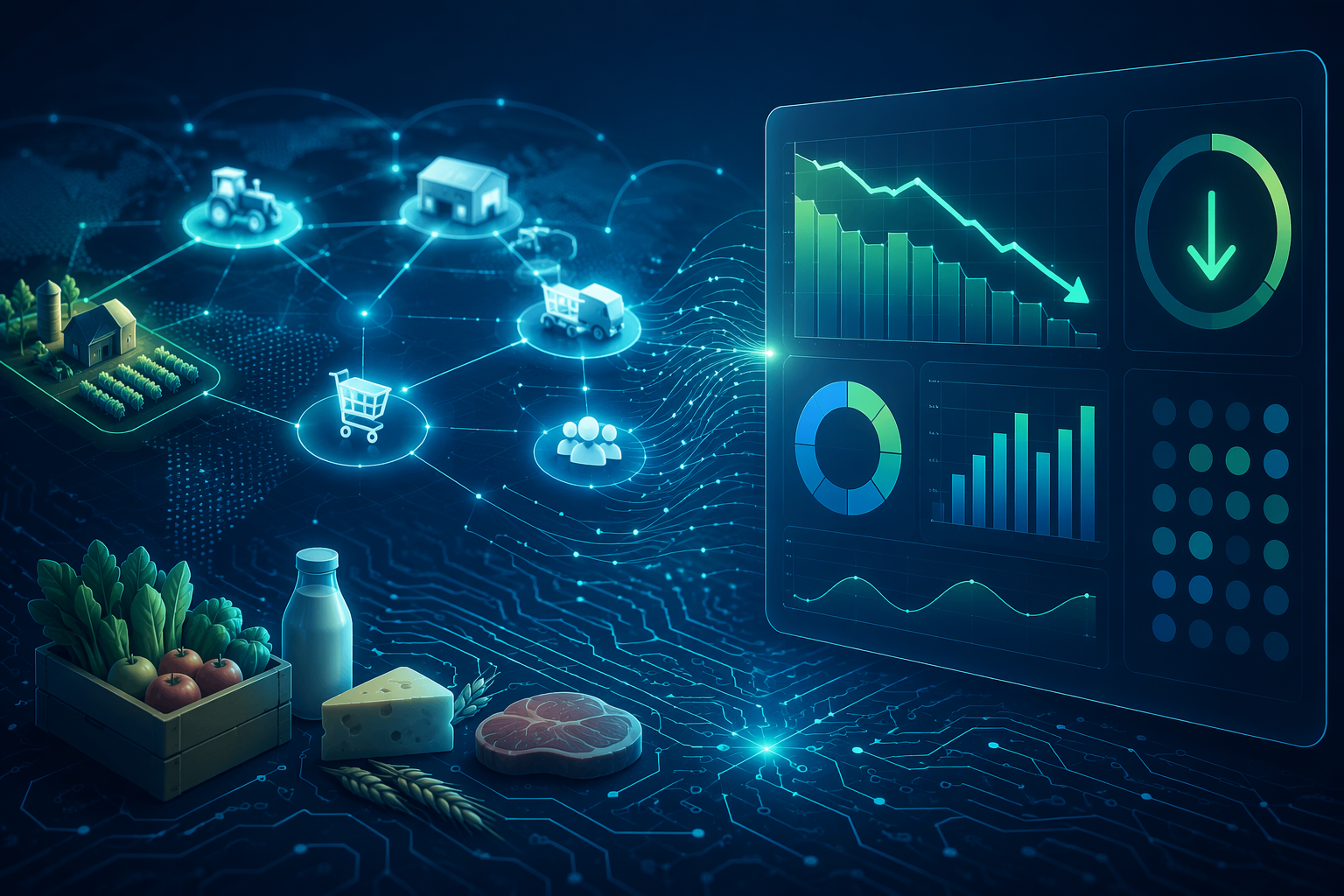
The Recall Baseline Is Not Small
The operational baseline is large enough to matter outside food-company finance departments. An analysis of FDA recall data reported 1,576 FDA recalls in 2025. In June of that year, a single cucumber supplier was associated with a cascade of 258 recalls.[2]
That kind of cascade is the budget-relevant part. A recall does not stay as one line item when the affected ingredient has already moved through distributors, processors, retailers, institutional kitchens, and households. Each extra hour of uncertainty can widen the population that needs notification, the number of downstream products that require investigation, and the administrative load on public agencies and healthcare organizations.
This is also where AI belongs in the conversation, if it belongs at all. A model that produces a sleeker dashboard but does not shorten the path from signal to intervention is hard to defend as prevention infrastructure. A system that moves detection upstream, compresses trace-back, or reduces manual review burden is different. It changes when people can act.
Readers who want the regulatory and technical background can pair this economic view with ClinicalMind’s coverage of FDA Elsa and recall detection or its comparison of AI-powered outbreak detection platforms. The return-on-investment question is narrower: what evidence shows that these tools reduce cost, time, or preventable exposure?
The Strongest ROI Claims Come From Large Enterprises
The most compelling evidence is not yet a broad, independently replicated public-health evaluation. It is a set of enterprise case studies. That distinction matters. Case studies can reveal where money and labor move; they cannot, by themselves, prove that every producer or jurisdiction will achieve the same return.
| Organization | Reported AI-related result | Budget relevance |
|---|---|---|
| Cargill | 41 incidents avoided over 18 months | Closest to predictive prevention, but conference-reported rather than independently peer-reviewed |
| Walmart | Trace-back reduced from 7 days to 2.2 seconds | Compresses exposure investigation time and limits downstream uncertainty |
| PepsiCo | 95% defect detection | Suggests inspection accuracy gains in high-volume production |
| Nestlé | Manual checks reduced by 80% | Signals a workflow and labor-allocation change, not just a scoring layer |
Cargill: Prevention, With an Evidence Caveat
Cargill’s Hazard Alert System is the case that comes closest to the prevention argument. Food Processing reported that Cargill’s global vice president of food safety presented at the Food Safety Summit in May 2026 that the system helped avoid 41 incidents over 18 months.[3]
For a finance strategist, “avoided incidents” is a more meaningful claim than “improved visibility.” It implies that a signal reached decision-makers early enough to prevent a downstream event, not simply describe one after it occurred. If that is what happened, the economic value is not limited to recall expenses. It includes avoided investigations, avoided shipment holds, avoided customer disruption, avoided brand exposure, and potentially avoided clinical encounters.
The caveat is just as important as the claim. This is a conference-reported case described by an industry publication, not an independently peer-reviewed evaluation with public methods, denominators, false-positive rates, or counterfactual analysis. The responsible conclusion is not that Cargill proves AI prevention ROI across the food system. It is that large enterprises with enough operational data may already be seeing economically meaningful prevention signals.
That still deserves attention from health systems and payers. Prevention technologies often struggle for budget because their best outcome is an event that does not occur. A reported 41 avoided incidents gives procurement committees something more concrete to interrogate: What counted as an incident? Who validated avoidance? How often did the system alert without consequence? What action changed because of the alert? What was the cost of the human review layer needed to make the alert useful?
Walmart: The Economics of Seconds Instead of Days
Walmart’s reported traceability improvement is easier to translate into operating terms: trace-back fell from 7 days to 2.2 seconds in an AI-blockchain traceability implementation.[4]
The point is not the label attached to the technology. Whether the architecture is described as AI, blockchain-enabled traceability, or a combined data system matters less to healthcare readers than the time compression. Seven days is long enough for a contaminated product to move through kitchens, households, retail shelves, and institutional procurement channels. Seconds change the posture from broad uncertainty to targeted containment.
That compression has several economic consequences. Fewer lots may need to be treated as suspect. Fewer downstream partners may need urgent manual reconciliation. Public-health investigators may reach a narrower exposure map sooner. Healthcare organizations may receive clearer guidance about whether a food-service operation, supplier, or patient population is implicated.
For recall detection ROI, traceability speed is not a cosmetic metric. It measures how quickly an organization can stop guessing.
PepsiCo and Nestlé: Workflow Evidence, Not Systemwide Proof
PepsiCo’s reported 95% defect detection and Nestlé’s reported 80% reduction in manual checks point to a different part of the return story: inspection and labor allocation.[5][6]
These examples are less direct than Cargill’s avoided-incident claim and less dramatic than Walmart’s trace-back compression. They still matter because much of food safety work depends on repetitive review, inspection, sampling, and escalation. If AI can reduce the manual burden while maintaining or improving detection, the return is partly a staffing story. Skilled people spend less time on low-yield checking and more time on exceptions that require judgment.
The open question is whether these workflow gains reliably translate into fewer recalls, fewer illnesses, or lower public-health burden. A defect-detection percentage and a manual-check reduction are operational performance indicators. They are not, by themselves, population-health outcomes.
The Market Is Following the Operational Problem
Market growth projections make more sense after the operational evidence, not before it. BCC Research has projected the AI food safety market to grow from roughly $3 billion to $13.7 billion by 2030, with a 30.9% compound annual growth rate.[7]
That is proprietary market intelligence, not neutral proof of public-health effectiveness. It should not be used as evidence that the tools work everywhere. It does, however, show that buyers and vendors see an expanding commercial category around a real operational pain point: the food system generates more data than legacy recall processes can review at the speed expected during a safety event.
Healthcare AI investors should recognize the pattern. The first wave of spending often follows large enterprises that can absorb integration costs, maintain data infrastructure, and hire the technical staff needed to turn models into workflow. That is where the early ROI story is strongest. It is also where the equity problem begins.
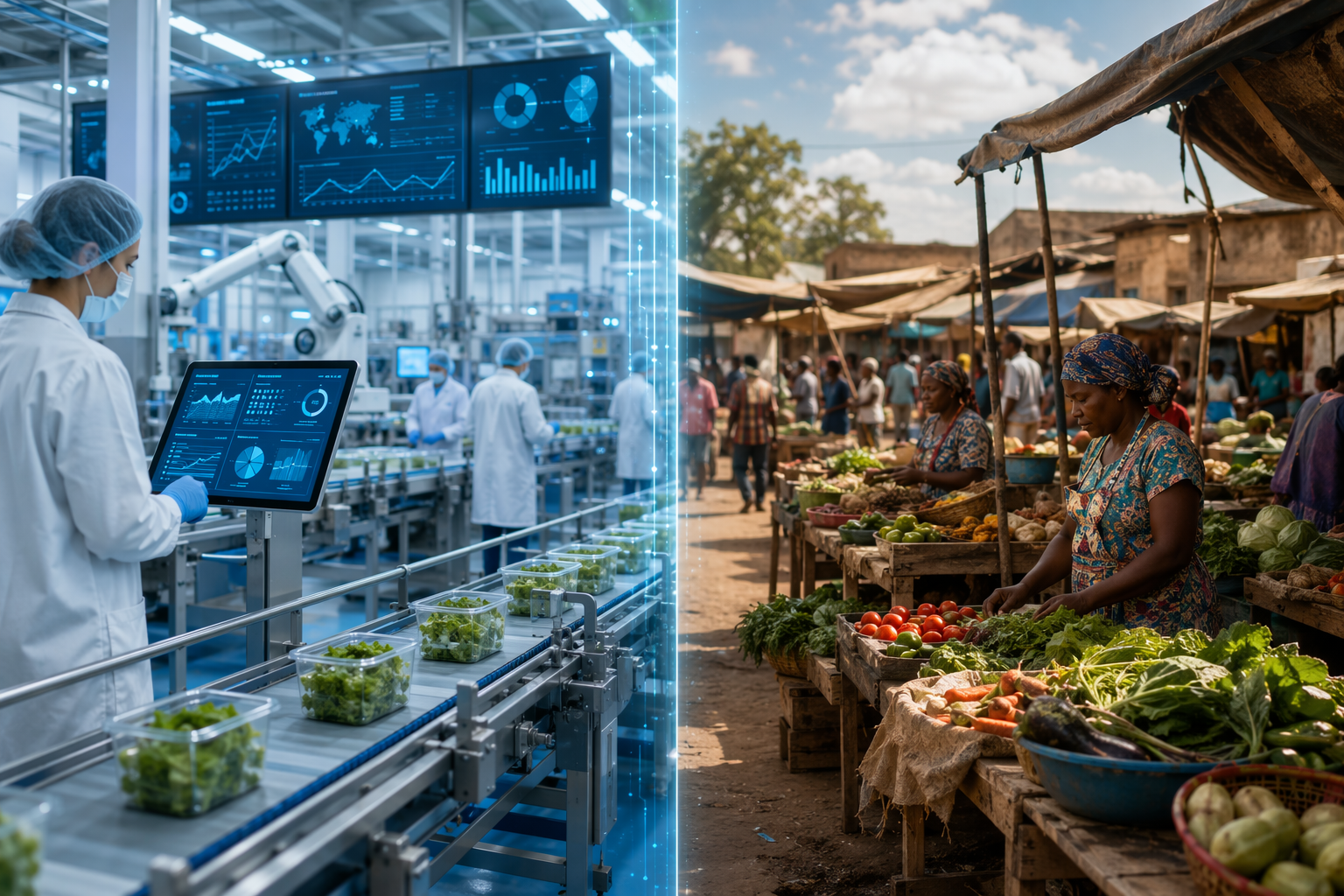
Where the ROI Story Becomes Uneven
The strongest case studies come from companies with scale, data density, supply-chain visibility, and the budget to integrate AI into existing operations. Those conditions are not universal. Smaller producers may face the same recall exposure without the same ability to buy enterprise infrastructure, clean historical data, or support model governance.
The mismatch is sharper in low- and middle-income countries. A 2025 Discover Food review by Abdi and colleagues reported that 78% of LMICs lack cloud infrastructure while these countries bear 90% of the global foodborne disease burden.[8]
Those figures should be treated as a serious warning, with one methodological caution: the review is a secondary synthesis, so the infrastructure and disease-burden claims should be traced through its underlying citations before they are used for program design or financing decisions. Even with that caution, the direction of the problem is hard to ignore. The places with the greatest public-health burden may be least positioned to benefit from the tools now producing the strongest enterprise ROI stories.
That does not make AI recall detection irrelevant to low-resource settings. It does mean the return calculation changes. A large multinational can justify AI through avoided incidents, faster trace-back, lower manual review, and brand protection. A small producer or public agency may first need shared data infrastructure, affordable cloud access, standards for participation, and support for human review capacity. Without those conditions, a technology sold as prevention can become another unfunded mandate.
What This Means for Health System AI Budgets
Food safety recall detection will not sit on most hospital AI roadmaps beside ambient documentation, imaging triage, revenue-cycle automation, or patient-flow tools. That is understandable. Hospitals do not run national food supply chains. But they do absorb some of the consequences when recall detection is slow, outbreak signals are missed, or contaminated products remain in circulation.
The procurement-facing question is therefore not whether a health system should buy every food safety AI product. It is whether healthcare leaders should track this category as prevention infrastructure, especially where they operate food service, long-term care facilities, population-health programs, or partnerships with public-health agencies.
A practical evaluation should separate four claims that are often blended together:
- Detection claim: Does the system identify contamination signals, defects, or anomalous patterns earlier than current processes?
- Traceability claim: Does it shorten the time required to identify affected lots, suppliers, facilities, or distribution paths?
- Workflow claim: Does it reduce manual review while preserving human accountability for escalation?
- Outcome claim: Does it reduce recalls, illnesses, investigations, waste, or cost in a way that can be independently assessed?
Most available evidence is stronger on the first three than on the fourth. That is not a reason to dismiss the category. It is a reason to price uncertainty honestly. A buyer can value trace-back compression and labor reduction without pretending that every vendor metric is a proven public-health outcome.
ClinicalMind’s related coverage of Taylor Farms recall tracking, Cyclospora tracking tools, and Cyclospora prevention education reliability can help readers place this ROI discussion beside outbreak surveillance and communication risks.
The Procurement Conclusion
AI in food safety recall detection has a credible economic case for large enterprises. The best-supported value is not abstract intelligence; it is changed timing: incidents reportedly avoided, trace-back reduced from days to seconds, defects detected at higher rates, and manual checks reduced enough to alter workflow.
The case is weaker when stretched beyond those conditions. ROI is not yet proven for smaller producers, fragmented supply chains, or low-resource settings where infrastructure is limited and disease burden is high. For healthcare decision-makers, that should lead to budget attention rather than blind adoption: evaluate AI recall detection as a prevention technology, demand evidence that distinguishes operational efficiency from health outcomes, and ask who has the infrastructure to benefit before assuming the return will travel.
References
- Grocery Manufacturers Association recall cost estimate, Grocery Manufacturers Association.
- FDA recall data analysis, Mergen AI.
- Cargill’s Hazard Alert System conference report, Food Processing, May 2026.
- Walmart AI-blockchain traceability case, Walmart.
- PepsiCo defect detection case, PepsiCo.
- Nestlé manual checks reduction case, Nestlé.
- AI food safety market projection, BCC Research via IONI AI.
- Discover Food review on AI, infrastructure, and foodborne disease burden, Discover Food, 2025.
Comments
Join the discussion with an anonymous comment.