
Using AI for foodborne illness symptom tracking starts from an uncomfortable surveillance fact: the formal case count is only the visible portion of illness. CDC estimates that foodborne diseases cause about 48 million illnesses in the United States each year, and the agency notes that many illnesses are never diagnosed or reported.[1] Before a stool test, case interview, restaurant inspection, or outbreak notice exists, a person may search “food poisoning symptoms,” post about vomiting after dinner, leave a one-star review mentioning diarrhea, or do none of those things in a way public health can see.

That gap explains the interest in non-traditional data streams. It does not, by itself, prove that every digital trace is useful. A symptom search is not a case. A tweet is not an exposure history. A restaurant review is not a laboratory-confirmed pathogen. The useful question is narrower: which AI signals have enough evidence, context, and operational maturity to help surveillance teams look in the right places without being mistaken for surveillance itself?
| Approach | What the system ingests | AI task | Strongest reported signal | Deployment maturity | Main caveat |
|---|---|---|---|---|---|
| Search-query classifiers | Anonymized search and location patterns related to foodborne illness symptoms | Identify likely foodborne illness episodes and candidate restaurants | FINDER achieved 52.3% precision versus 22.7% for routine inspections; identified restaurants were 3.1x more likely to be unsafe in a Chicago/Las Vegas deployment.[2] | Prospective, inspection-linked deployment | Attribution is weak when people blame the last restaurant; in 38% of FINDER illness reports, the last restaurant was not the cause.[2] |
| Social media NLP | Posts mentioning symptoms, foods, places, or illness narratives | Classify relevance and extract entities | A dual-task BERTweet model reported F1 0.87 for relevance classification and 0.61 for entity extraction.[3] | Peer-reviewed model evaluation, less directly tied to inspection action | Sparse usable geolocation, informal language, platform access changes, and weaker extraction performance |
| LLM review analysis | Restaurant reviews, including Google Reviews in the cited SAFEGUARD result | Classify review text for possible foodborne illness signals | SAFEGUARD using GPT-4.0 Mini reportedly achieved 93.9% accuracy on Google Reviews.[4] | Promising but less independently established in the available evidence | Reported through a systematic review with restricted full-text access; workflow validation is less transparent |
Why FINDER Matters More Than a Benchmark
FINDER is the strongest case because it did not stop at classifying text. In its prospective deployment in Chicago and Las Vegas, the system used search-query patterns to identify restaurants associated with possible foodborne illness. Those leads were sent into an inspection workflow, and the resulting inspections were compared with routine inspections.[2]
That operational link changes the evidentiary standard. A model that labels a complaint as relevant may be useful; a model that sends an inspector to a restaurant must be judged by whether it improves the yield of field work. In the FINDER study, 52.3% of FINDER-prompted inspections found restaurants that were unsafe, compared with 22.7% of routine inspections. FINDER-identified restaurants were 3.1 times more likely to be unsafe, with a 95% confidence interval of 2.14 to 4.35.[2]
Those are not just model scores. They describe a downstream public health action: someone reviewed a lead, an inspection occurred, and the inspected site was more likely to have a problem. For local health departments that have limited inspection capacity, that is a meaningful difference. It suggests that search behavior can surface risk that routine scheduling may not prioritize.
Search queries are also operationally different from general symptom chatter. A person who searches for gastrointestinal symptoms is not necessarily making a public claim, naming a restaurant, or even understanding the cause. FINDER’s value comes from combining symptom-related query behavior with location and restaurant exposure inference. That makes it less dependent on whether someone publicly posts, uses the right words, or includes a place name.
The same design also creates the central weakness. FINDER’s attribution problem is not a minor technical footnote; it is a behavioral confound at the heart of foodborne illness reporting. In the study, 38% of cases in which people identified the last restaurant they visited did not involve the last restaurant as the cause.[2] People remember the most recent meal. Pathogens have incubation periods. Symptoms can appear after a delay. A lead can therefore be operationally useful even when the individual’s implied causal story is wrong.
That distinction matters. FINDER evidence supports the use of search-query classifiers as a lead-generation tool for inspections. It does not support treating a search-derived restaurant association as proof of transmission, proof of an outbreak, or a substitute for epidemiological interviews. The proper unit of value is not “the model found the cause.” It is “the model helped select inspections that found unsafe restaurants at a higher rate.”
For readers who want a deeper walkthrough of the search-query approach, the FINDER deployment is also a useful companion to an operational discussion of AI syndromic surveillance for foodborne outbreak detection. The important point here is that FINDER’s evidence is unusually concrete because the model’s output entered a real inspection pathway.
The Evidence Base Is Thinner Than the Performance Numbers Suggest
The broader literature is much less settled than a list of model metrics can make it appear. A 2025 systematic review by Salaris and colleagues examined 31 studies on foodborne event detection and found that most were rated as high or unclear risk of bias using PROBAST.[5] That finding should sit beside every reported F1 score, accuracy figure, or classification result in this space.
PROBAST risk of bias does not mean a model is useless. It means the study design, validation approach, participant or sample selection, predictors, outcomes, or analysis may not support broad confidence in the reported performance. In foodborne illness symptom tracking, those weaknesses matter because the target phenomenon is already messy: symptoms are nonspecific, exposures are uncertain, and reporting behavior varies by platform, age, language, geography, and time.
This is where deployed systems and offline model evaluations part ways. A high-performing classifier in a retrospective dataset may still fail to deliver usable leads if posts lack location, if review access changes, if restaurant names are ambiguous, if inspection teams cannot act quickly, or if public health staff cannot audit why a lead was generated. The model can be statistically impressive and operationally awkward at the same time.
The evidence hierarchy is therefore not simply “newer model equals better system.” FINDER’s search-query classifier is older than many LLM approaches, but it has prospective evidence tied to inspection yield. Social media NLP has peer-reviewed model results that show promise and limitations in the same experiment. LLM review analysis has an attention-grabbing accuracy figure, but the cited evidence available through the systematic review is less transparent for independent workflow appraisal.
Social Media NLP Can Find Symptom Talk, But Actionability Is Harder
Social media systems are attractive because people sometimes describe illness close to when it happens and in their own words. The challenge is that public health does not need only a relevant sentence. It needs enough context to decide whether the signal should be ignored, monitored, linked to other complaints, or escalated.
The BERTweet work shows that split clearly. The dual-task model reported an F1 score of 0.87 for relevance classification, which suggests it could distinguish foodborne-illness-related posts from irrelevant ones reasonably well in the evaluated setting. But the same model reported F1 0.61 for entity extraction, the task of pulling out useful details such as foods, locations, organizations, or other named entities.[3]
That gap is not cosmetic. A stream of relevant posts may tell an analyst that people are talking about vomiting, diarrhea, or a suspected meal. A usable surveillance lead usually needs more: where the exposure may have occurred, whether multiple people describe the same venue or product, whether the timing makes sense, and whether a complaint can be connected to an existing jurisdiction. Relevance classification is a filter. Entity extraction is one of the bridges from filtered text to field action.
Geolocation is another structural constraint. Studies in this area have found that only about 1% of social media posts have usable geolocation. Without location, a post may still be useful for broad situational awareness, but it is harder to route to a local health department or inspection team. A model may correctly identify a symptom complaint and still leave the analyst asking which jurisdiction, which establishment, and whether anyone can act on it.
Platform access makes the problem less stable. Twitter/X API policy changes after 2023 threaten the reproducibility of Twitter-based systems, especially when studies depend on data streams that later become restricted, expensive, incomplete, or unavailable. This is not just an inconvenience for academic replication. Surveillance tools built on unstable access can become brittle exactly when public health teams need continuity.
Social media NLP therefore remains useful as a signal-extraction approach, particularly for early awareness and hypothesis generation. The evidence is strongest when the claim stays at that level. It is weaker when a relevance score is treated as if it already contains location, exposure attribution, and operational readiness.
Restaurant Reviews Are Tempting Because They Already Name a Venue
Restaurant reviews solve one problem that social media often leaves open: the venue is usually attached to the text. A complaint in a review may name the restaurant by default, include timing clues, and sit inside a platform that already organizes establishments. That makes reviews appealing for foodborne illness symptom tracking, especially for inspection teams that think in terms of facilities rather than abstract symptom streams.
The SAFEGUARD result points to that potential. A system using GPT-4.0 Mini reportedly achieved 93.9% accuracy on Google Reviews for foodborne illness signal detection, as cited in a Frontiers in Public Health systematic review.[4] The number is promising, but it should be read carefully. The result arrives indirectly through the review, and the underlying full text was not available for direct appraisal. That limits what can be assessed about sampling, labeling, validation, error patterns, and operational integration.
Accuracy is also a blunt summary for a surveillance use case. A model can achieve high accuracy if the dataset has many easy negatives. For public health triage, the more painful questions are usually different: how many true signals are missed, how many false alarms create work for inspectors, whether the model performs across cuisines and neighborhoods, whether it handles sarcasm or vague complaints, and whether staff can see enough rationale to trust or reject a lead.
LLMs may help with messy review language because they can process longer, less standardized text. But “understanding language” is not the hard endpoint. The hard endpoint is whether review-derived signals can be validated, audited, deduplicated, routed, and acted on without overwhelming local teams or creating unfair attention on establishments with more online reviewers.
Compared with FINDER, LLM review analysis is therefore less mature as evidence for field surveillance. It may become useful, especially where review access is reliable and health departments can build a clear triage process. The current public claim should remain modest: review analysis can identify possible foodborne illness complaints in venue-linked text, but the available evidence does not yet establish it as a replacement for inspection judgment or outbreak investigation.
What Breaks When a Signal Enters Public Health Operations
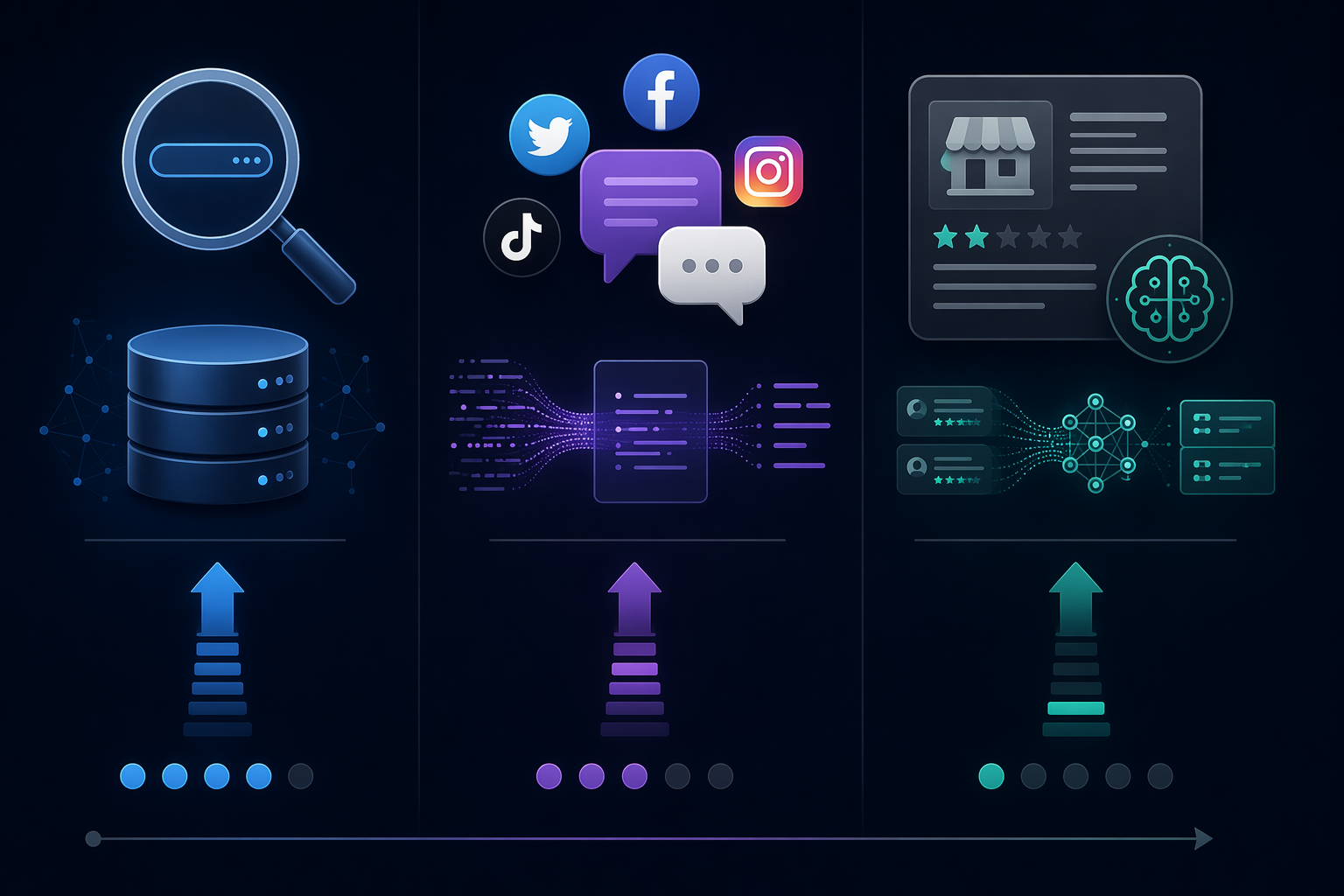
The practical failure points are not the same for all three approaches. Search-query systems must wrestle with inferred exposure and private behavior. Social media systems must extract place and entity detail from short, informal, unevenly geolocated posts. Review systems start with venue context but face platform access, sampling bias, and validation transparency problems.
- Attribution: gastrointestinal symptoms may appear hours or days after the true exposure, so the most recent restaurant or most memorable meal may be wrong.
- Routing: a signal without reliable location or jurisdiction may be interesting but difficult to assign.
- Workload: false positives are not abstract errors; they become staff review time, inspection decisions, and possible burden on establishments.
- Access: platforms can restrict APIs, alter search visibility, change review formats, or limit historical data.
- Validation: models need evaluation against outcomes that matter to public health, not only internal labels.
The operational question is not whether AI can detect symptom language. It can. The question is what happens after detection. Does a trained reviewer examine the lead? Is the lead combined with complaint data, syndromic surveillance, inspection history, or laboratory signals? Is there a threshold for dispatch? Does the system preserve enough information to support after-action review when a lead was right, wrong, or merely unresolvable?
This is also where AI symptom tracking connects to outbreak workflow rather than sitting apart from it. In a formal gastrointestinal outbreak response, detection is only one step. Confirmation, case definitions, interviews, specimen collection, environmental assessment, product tracing, public communication, and control measures still require human and institutional judgment. For a workflow view, it is useful to compare these AI signals with how AI fits into each step of CDC's GI outbreak protocol.
A Practical Reading of the Three Approaches
Search-query classifiers currently have the strongest real-world deployment case for foodborne illness symptom tracking. FINDER’s inspection-linked evidence shows that AI-generated leads can improve the yield of restaurant inspections compared with routine inspections, while its own attribution limitation keeps the claim honest.[2] The system is best understood as a way to prioritize attention, not to identify confirmed sources of illness.
Social media NLP offers useful early signal extraction, especially when the goal is to filter large volumes of symptom-related language. The BERTweet results show strong relevance classification and weaker entity extraction, which is exactly the split that matters for public health action.[3] The approach becomes more fragile when location is missing, language is informal, or platform access changes.
LLM-based restaurant review analysis is intriguing because reviews often attach complaint text to a specific establishment. The SAFEGUARD accuracy result suggests potential, but the evidence available here is less mature and less transparent than FINDER’s prospective deployment evidence.[4] Before such systems can be treated as operational surveillance tools, they need clearer validation, reproducibility, and workflow testing.
The most defensible position is neither dismissal nor enthusiasm. AI can help point investigators toward hidden illness patterns that passive reporting misses. It can also create a false sense of certainty if a probabilistic signal is handled like a confirmed case. The boundary should stay visible: these tools can augment surveillance, but they do not replace traditional epidemiological surveillance, laboratory confirmation, case interviews, inspection judgment, or outbreak protocols.
References
- Burden of Foodborne Illness: Findings, CDC, https://www.cdc.gov/foodborneburden/index.html
- Machine-learned epidemiology: real-time detection of foodborne illness at scale, npj Digital Medicine, 2018, https://www.nature.com/articles/s41746-018-0045-1
- A multi-task learning framework for extracting foodborne illness-related information from Twitter, Scientific Reports, 2021, https://www.nature.com/articles/s41598-021-00766-w
- Artificial intelligence for food safety: a systematic review, Frontiers in Public Health, 2025, https://www.frontiersin.org/journals/public-health/articles/10.3389/fpubh.2025.1609615/full
- Foodborne Event Detection in the Era of Artificial Intelligence: A Systematic Review, PMC, 2025, https://pmc.ncbi.nlm.nih.gov/articles/PMC11764790/
Comments
Join the discussion with an anonymous comment.