
The strongest claim for AI for air quality health alerts is not that they can make polluted air clinically simple. It is narrower and more useful: several machine-learning systems can identify days when a person with asthma is more likely to deteriorate before the emergency department becomes the next stop. In large asthma encounter datasets, models have reached AUC values in the 0.85–0.90 range for predicting asthma-related hospital or encounter risk, and one study reported exacerbation detection three days ahead with 90% sensitivity and 83% specificity.[1]
That is enough to take seriously. It is not enough to say that the alerts prevent hospitalizations. Prediction and prevention are adjacent only if something reliable happens between the alert and the flare: a patient receives the warning, understands it, trusts it, can act on it, and has a care plan that changes the trajectory. Pulmonary clinics already know how often that chain breaks.
Two Different Predictions Often Get Blended Together
Air quality forecasting and patient-specific exacerbation prediction are related, but they are not the same clinical product. An AQI model estimates the environmental condition: particulate matter, nitrogen dioxide, volatile organic compounds, ozone-related patterns, meteorology, and category shifts over time. An asthma risk model estimates whether a particular patient, or a defined patient population, is likely to have a clinically relevant event.
The environmental side has become technically impressive. A 2026 hybrid CNN-LSTM model for air quality prediction reported an approximately 91% F1-score for AQI category prediction, outperforming standalone CNN and LSTM models that reached 86.7% and 87.9%, respectively.[2] A 2025 systematic review of 65 Q1 journal articles on AI in air pollution monitoring and forecasting reported that Random Forest methods reached up to 98.2% accuracy in some included studies.[3]
Those results matter because asthma risk systems often need a good environmental signal. But an accurate AQI category is still upstream from the question a respiratory therapist or parent has to answer: should this child avoid outdoor practice today, start a pre-agreed rescue plan, check peak flow more frequently, contact the clinic, or simply continue routine care?
There is also a geography problem. Much of the AQI prediction literature summarized in recent reviews comes from Asian city contexts, including India, China, Malaysia, and Korea.[3] These studies can show that AI methods work well on dense environmental time series, but they do not automatically establish transportability to U.S. urban neighborhoods with different emission sources, housing stock, wildfire smoke patterns, traffic exposure, indoor infiltration, school schedules, and health care access.
What the Asthma Prediction Studies Actually Validate
The clinical evidence becomes more relevant when the outcome is no longer “tomorrow’s AQI” but asthma-related utilization or exacerbation risk. In the Cleveland Clinic study by Zein and colleagues, a gradient boosting model was developed on a dataset of approximately 60,000 patients to predict asthma hospitalizations and reached an AUC of 0.85.[1] In the University of Washington study by Tong and colleagues, a model using approximately 82,000 patients reached an AUC of 0.90 for asthma hospital encounters.[1]
Those are not trivial numbers. In a disease where symptoms fluctuate with viral infections, allergens, smoke, medication access, work schedules, school attendance, and housing exposures, AUC values in that range suggest that clinically meaningful signal is present in the data. They support risk stratification. They support the idea that a care team might identify a higher-risk interval before the patient arrives in respiratory distress.
The Zhang study moves closer to the timing clinicians want from an alert: it reported logistic regression detection of asthma exacerbations three days ahead with 90% sensitivity and 83% specificity.[1] A three-day window is clinically plausible. It is long enough to modify exposure, intensify monitoring, confirm inhaler access, review an action plan, or arrange a nurse call. It is also short enough that patients may still recognize the warning as connected to their lived symptoms and environment.
| Study or evidence stream | What was predicted | Key result | What it does not prove |
|---|---|---|---|
| Zein et al., Cleveland Clinic | Asthma hospitalization risk | Gradient boosting model, n=60,000, AUC 0.85 | That alerts based on the model reduce admissions |
| Tong et al., University of Washington | Asthma hospital encounters | n=82,000, AUC 0.90 | That performance transfers unchanged to other populations or workflows |
| Zhang et al. | Exacerbations three days ahead | 90% sensitivity, 83% specificity | That patients or clinicians can act reliably on every warning |
| AQI prediction literature | Air quality categories or pollutant patterns | Hybrid CNN-LSTM around 91% F1-score; some Random Forest studies up to 98.2% accuracy | That environmental prediction alone is patient-specific respiratory decision support |
The gap is the familiar one in clinical AI: discrimination is not outcome improvement. A model may separate high-risk from low-risk days very well and still fail to reduce exacerbations if alerts arrive too late, go to the wrong person, lack a linked protocol, or produce so many false alarms that families and clinics stop responding.
For pulmonologists, the missing endpoint is not cosmetic. Hospitalization reduction, fewer emergency department visits, less systemic steroid exposure, fewer missed school or work days, and improved symptom control are the outcomes that would move these systems from promising decision support into proven care improvement. The current evidence base is stronger for prediction than for those downstream outcomes.
AirPredict Shows What Deployment Really Asks of Patients
The AirPredict platform is useful because it does not treat “air quality alert” as a single background data feed. It combines an Atmotube PRO air quality monitor, a Fitbit Charge 6, and a MIR SmartOne spirometer, then routes data through a mobile app and cloud backend to generate personalized inhaled dose estimates and alerts.[4]
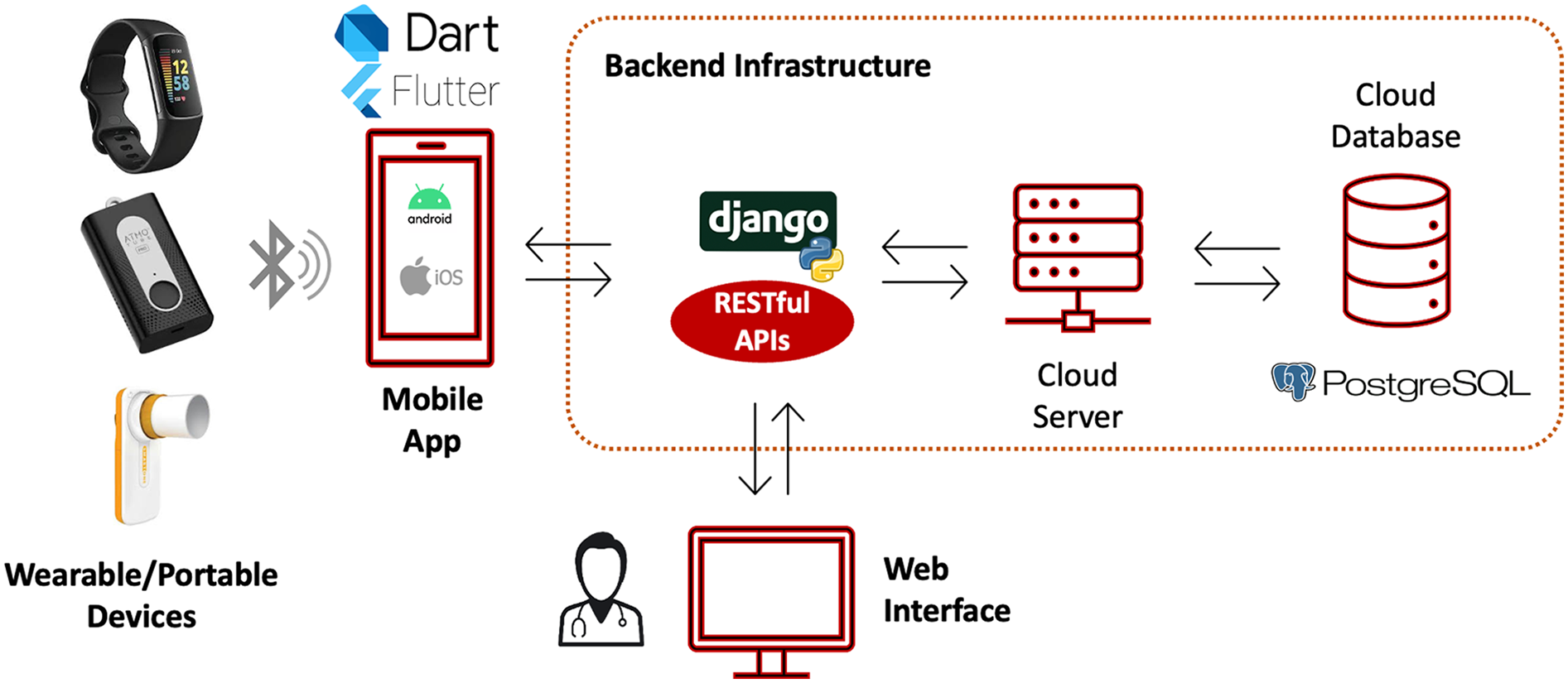
That architecture is clinically more interesting than a generic AQI push notification. The Atmotube PRO measures particulate matter, volatile organic compounds, and nitrogen dioxide; in the AirPredict feasibility report, its measurements showed R² values of 0.79–0.94 compared with Federal Equivalent Method reference instruments.[4] The Fitbit contributes heart-rate data for ventilation estimation, and the MIR SmartOne adds spirometry. The goal is not just to say the neighborhood air is worse today, but to estimate what a specific patient may have inhaled while breathing at a specific intensity.
This is exactly where the promise becomes operationally fragile. A patient who is coughing, wheezing, rushing to school, or managing a child’s nocturnal symptoms is being asked to keep multiple devices charged, paired, worn, synchronized, and used correctly. A clinician is being asked to interpret another stream of data in a specialty that already runs on uneven adherence histories, inhaler technique checks, pharmacy gaps, and environmental counseling that may exceed what families can control.
The feasibility numbers reflect that asymmetry. In AirPredict’s 16-participant feasibility study, System Usability Scale scores were 63 for patients and 81 for clinicians, pointing to multi-device synchronization and patient-side usability as adoption barriers rather than minor interface polish.[4] The forthcoming BREATHE project is planned with 100 participants, but the available AirPredict evidence remains small and single-site.[4]
The Alert Has to Land Somewhere
A risk score that appears on a dashboard is not the same thing as a respiratory intervention. The deployment design has to specify who receives the alert first. A patient-facing alert may support self-management if it is tied to a clear asthma action plan. A parent-facing alert may help with outdoor activity decisions or medication checks. A clinic-facing alert may be appropriate for high-risk patients, but only if someone is assigned to triage it and there is a defined response threshold.
Without that routing, the alert can create two opposite harms. It can generate anxiety without action, especially when air quality is poor but the patient feels well. Or it can create false reassurance when a low-risk prediction conflicts with early symptoms that should be treated. Asthma care cannot outsource symptom judgment to an environmental model.
Personal Exposure Is More Clinically Plausible Than Citywide AQI Alone
Citywide AQI is a blunt instrument for asthma management. It may miss indoor exposures, commuting routes, classroom conditions, cooking emissions, local traffic corridors, occupational irritants, and wildfire smoke infiltration. Personal sensors and wearable-linked ventilation estimates are an attempt to make exposure closer to the patient’s actual airway dose.
That does not make the measurement simple. Low-cost sensors can drift, fail, lose synchronization, or measure one pollutant more reliably than another. Wearable heart rate is an imperfect proxy for ventilation. Spirometry quality depends on patient technique. A cloud backend can only integrate what arrives accurately and on time.
Still, the direction is clinically sensible. Asthma exacerbations are not triggered by outdoor AQI alone; they emerge from exposure, susceptibility, airway inflammation, medication patterns, and behavior. A system that combines environmental readings, physiologic estimates, and lung function has a better chance of producing a meaningful warning than one that simply maps the nearest monitoring station to a ZIP code.
The Bias Question Is Not Only Demographic
Population validity in AI for air quality health alerts has several layers. The usual demographic concerns apply: age, race, ethnicity, language, income, insurance status, comorbidities, and access to controller medication can all affect both observed risk and the likelihood that an alert leads to action. But environmental AI adds another layer: the model may be trained in one atmospheric and built-environment context and deployed in another.
A model trained where traffic, industrial sources, seasonal pollution, humidity, housing ventilation, and public monitoring density have one pattern may not behave the same way in a U.S. city affected by wildfire smoke, older rental housing, indoor mold, or different school transportation routines. The issue is not whether Asian city studies are valuable; they are. The issue is whether their performance estimates should be read as local clinical validation for U.S. pulmonary practice. They should not.
Dataset bias also affects the outcome labels. Hospital encounters are not pure measures of asthma biology. They reflect access to outpatient care, thresholds for seeking emergency treatment, clinician coding, transportation, insurance, and prior experiences with the health system. A model that predicts hospital utilization may partly predict social and system pathways into the hospital. That may still be useful for risk stratification, but it should not be mistaken for a direct physiologic exacerbation detector.
Regulatory Status Depends on What the Alert Claims to Do
The regulatory question is not a bureaucratic afterthought. No FDA-cleared device specifically for AI air quality health alerts in asthma care was identified in the available sources. The classification may depend on intended use: a general awareness notification about poor air quality is different from a patient-specific recommendation to change medication, seek care, or escalate an asthma action plan.
That distinction matters operationally. If a tool is marketed as wellness guidance, clinicians may have limited assurance about validation, monitoring, post-market performance, or liability boundaries. If it is positioned as clinical decision support, health systems will ask harder questions about transparency, auditability, integration with the electronic health record, safety monitoring, and whether clinicians can independently review the basis for the recommendation.
For a pulmonary clinic, ambiguity can become workflow risk. Staff may be asked to respond to alerts without knowing whether the system has been validated for their population, whether thresholds are adjustable, whether missed alerts are tracked, or whether the vendor’s performance claims come from internal testing, retrospective datasets, feasibility studies, or prospective outcome trials.
Where These Tools Fit Today
The most defensible current use is as an adjunct for anticipatory monitoring and risk stratification, not as a proven hospitalization-reduction intervention. A clinic could reasonably evaluate these systems for high-risk asthma populations, patients with repeated environment-associated flares, or care management programs that already have staff and protocols for outreach. The tool is less convincing if it merely adds another untriaged inbox.
The evidence supports asking precise questions before adoption:
- What outcome was predicted: AQI category, symptom worsening, exacerbation, ED visit, hospitalization, or a composite encounter label?
- Was performance tested in a population that resembles the clinic’s patients, geography, housing context, and exposure profile?
- Who receives the alert, and who is responsible for acting on it?
- What action is linked to each alert level: self-management, medication check, exposure avoidance, spirometry, nurse outreach, or urgent evaluation?
- Has the system shown improved clinical outcomes, or only predictive performance?
- How are false positives, false negatives, device failures, and synchronization gaps monitored?
That last distinction should remain visible. A high-performing model can buy time. It can help a care team see risk before the patient is in extremis. It can make environmental exposure a more concrete part of asthma management. But until prospective studies show fewer exacerbations, emergency visits, hospitalizations, or other patient-centered benefits, AI for air quality health alerts should be treated as promising clinical decision support rather than proven preventive care.
The evaluation standard is therefore practical: not only whether the alert predicts risk, but who receives it, what action follows, and whether that action has been shown to improve outcomes.
References
- Artificial Intelligence in the Management of Asthma: A Review — PMC, 2025.
- Hybrid deep learning model for air quality prediction and its impact on healthcare — Nature Scientific Reports, 2026.
- Application of artificial intelligence in air pollution monitoring and forecasting: A systematic review — Environmental Modelling & Software / ScienceDirect, 2025.
- AirPredict: an eHealth platform for asthma management — Frontiers / PMC, 2026.
Comments
Join the discussion with an anonymous comment.