
A Code Orange day is easy to miss inside routine ambulatory work. The air quality index has moved into a range where sensitive groups are expected to take precautions, but the patient in the exam room may be there for medication refills, prenatal care, diabetes follow-up, or a school form. Unless someone checks local conditions, connects them to the chart, and decides whether a message, medication review, or escalation is warranted, the alert remains outside the clinical workflow.
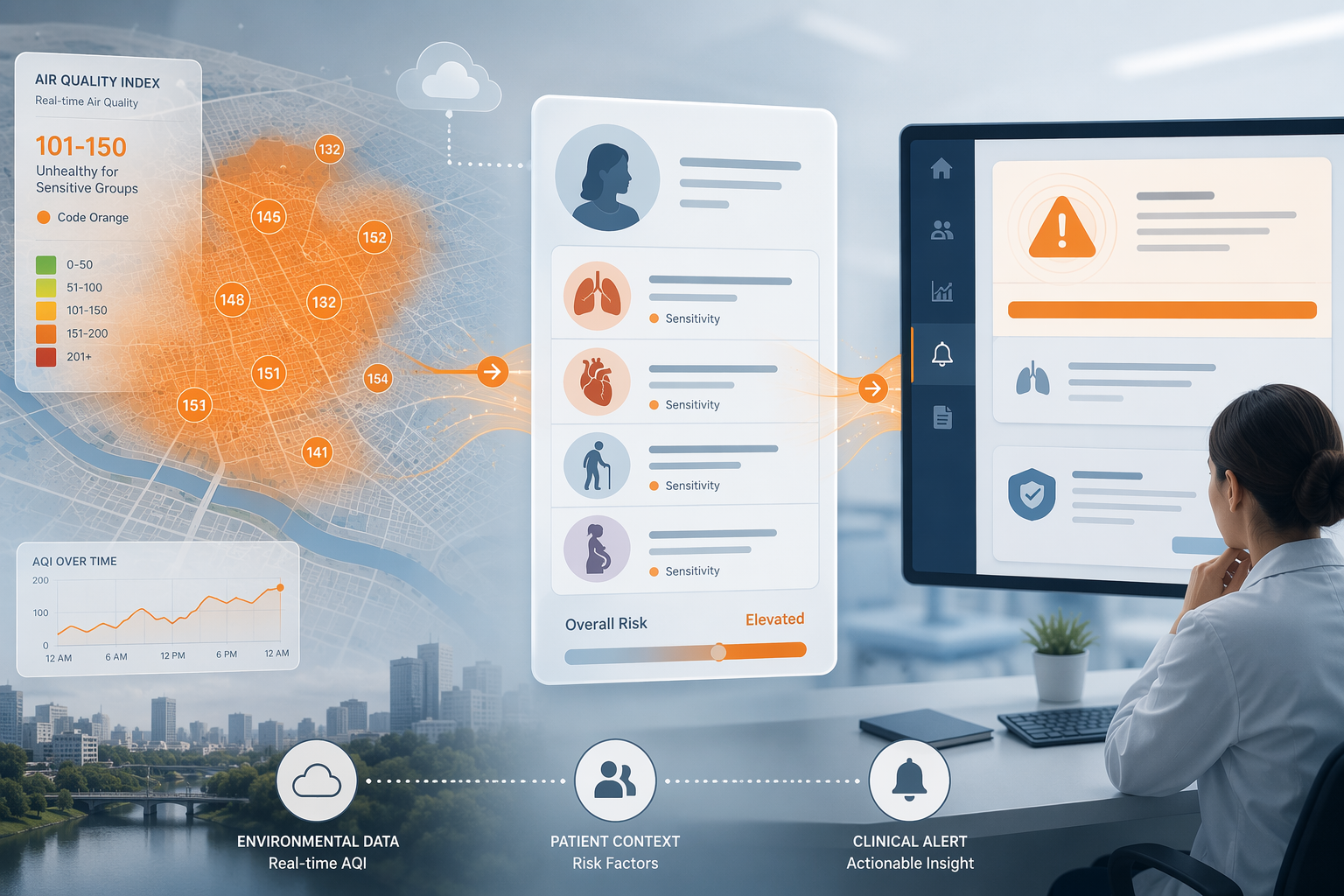
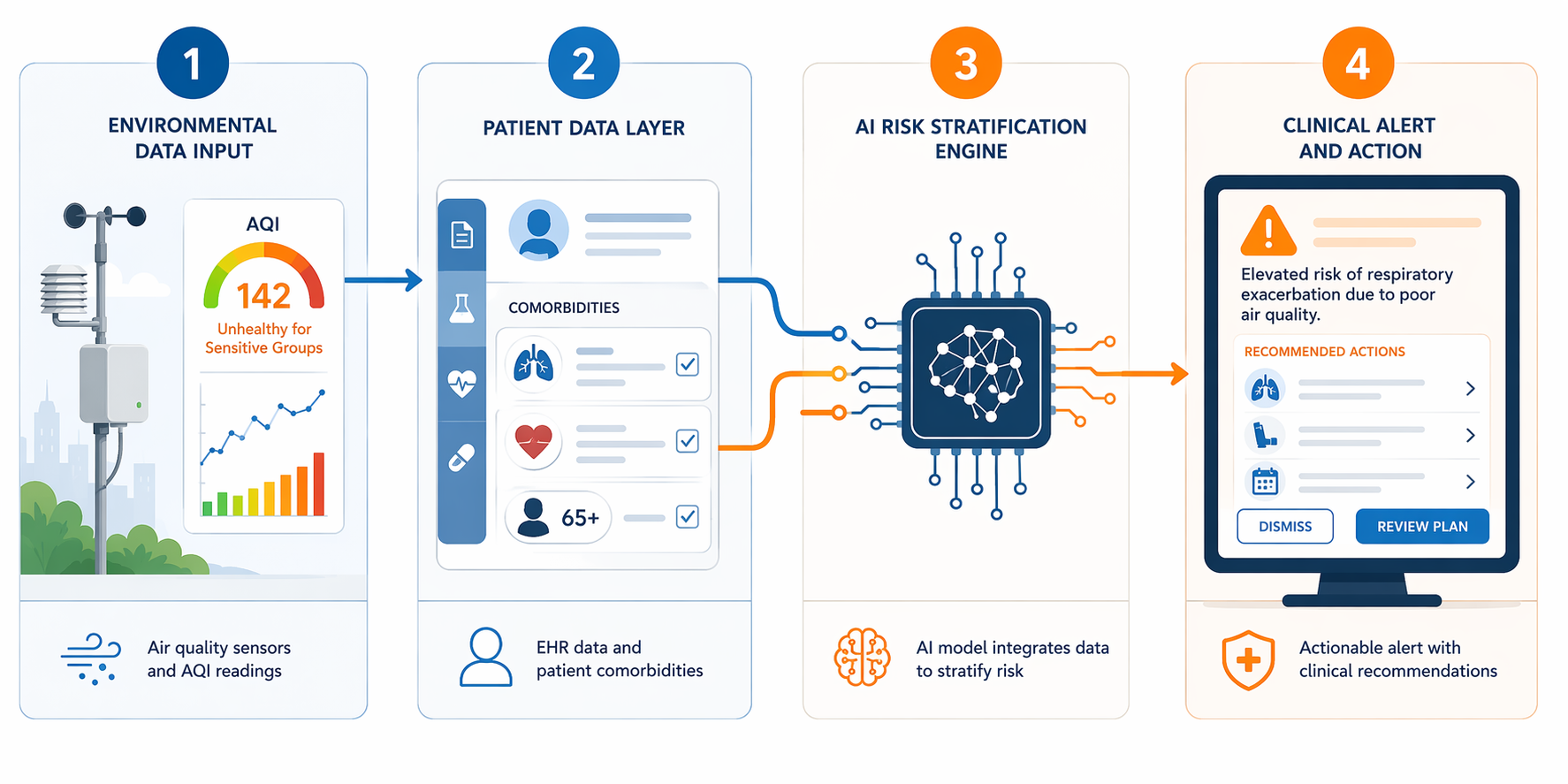
That is the real promise behind AI for air quality health precautions during Code Orange alerts: not a generic banner saying the air is poor, but a clinical decision support prompt that recognizes which patients are more likely to be harmed, what action is appropriate for their role and setting, and whether that action can be documented without creating another undifferentiated queue.
The Missing Link Is Not the AQI Feed
Health systems can already display external data. The harder problem is deciding when an environmental signal belongs in clinical care. A Code Orange alert, AQI 101–150, does not carry the same clinical meaning for every patient. It is most relevant for sensitive groups, including children, adults over 65, pregnant individuals, and patients with asthma, COPD, heart disease, or diabetes.
The 2024 JACI review on artificial intelligence in air pollution and health research is useful because it does not treat this as a dashboard problem. It identifies AI’s potential to integrate environmental datasets into clinical decision support systems, while also warning that algorithms used for resource allocation can reproduce or intensify bias if the underlying data and deployment choices are not examined carefully.[1]
That distinction matters. A weather-style alert can tell a city that ozone or particulate conditions are worsening. A clinical prompt has to decide whether a specific patient needs an inhaler plan reviewed, an outdoor-activity message sent, a care manager task opened, or no action at all. If the system cannot make those distinctions, it is not decision support; it is another notice.
What an AI-CDSS Would Actually Have to Do
A plausible Code Orange clinical decision support workflow starts before the clinician opens the chart. The system ingests local AQI or pollutant data, maps it to the patient’s location or care site, checks the EHR for diagnoses and risk modifiers, and decides whether the alert should surface to a clinician, nurse, care manager, patient portal, or population health team.
| Workflow element | What it must determine | Why it matters clinically |
|---|---|---|
| Environmental ingestion | Whether local AQI or pollutant data are timely and geographically relevant | A regional alert may not match the patient’s actual exposure |
| Patient risk identification | Whether the chart shows asthma, COPD, heart disease, diabetes, pregnancy, older age, or pediatric status | Code Orange precautions are not equally urgent for all patients |
| Prompt generation | Which action fits the patient and care context | A portal message, nurse call, medication review, or escalation task are different interventions |
| Routing | Who receives the prompt and who owns follow-up | Unowned alerts become hidden labor |
| Audit and evaluation | Whether the prompt was seen, acted on, deferred, or overridden | Feasibility is not the same as improved outcomes |
For a patient with asthma, the alert logic might resemble the evidence pathway discussed in AI for Air Quality Health Alerts in Asthma Care: environmental exposure is treated as a possible contributor to respiratory risk, not as a standalone diagnosis. The CDSS would need to recognize whether the patient has a controller medication, recent exacerbations, rescue inhaler use, or other risk signals available in structured or semi-structured chart data.
For cardiology and primary care, the action may be less obvious. A Code Orange prompt for an older patient with heart disease should not automatically behave like a pulmonary alert. It may be more appropriate to route precautions, check whether symptoms have been reported, or flag the issue during a scheduled encounter. The design question is not whether AI can classify risk; it is whether the classification leads to a safe and proportionate action.
Code Orange Precautions Need Risk Stratification, Not Alarm Escalation
Code Orange sits in an awkward zone for clinical operations. It is meaningful for sensitive groups, but it is not the same as a Code Red or hazardous air event. If a system treats every Code Orange alert as urgent, clinicians will learn to ignore it. If it never reaches the chart, the patients most likely to benefit from precautions may never hear about them.
The useful version of AI here is selective. It can look across the chart and local environment to decide whether the patient belongs in a higher-attention group. It can also modulate the prompt: a pediatric asthma patient with recent symptoms may warrant outreach, while a low-risk adult might receive no clinical alert at all. That selectivity is what separates patient-specific support from a public health announcement pasted into the EHR.
Pollution context matters as well. Wildfire smoke, for example, can create exposure patterns and indoor infiltration issues that differ from a routine Code Orange day. Work on AI and wildfire smoke health risk is relevant because it shows how machine learning can sharpen exposure estimation, but wildfire-specific evidence should not be casually generalized to all Code Orange alerts.
The Mechanisms Are Plausible, but the Boundaries Are Clear
Several adjacent technical frameworks make this use case plausible. The JACI review describes AI methods for linking air pollution data with health information and clinical decision support, but it frames these as opportunities for research and implementation, not as proven clinical interventions.[1]
Yang and colleagues’ 2021 Applied Energy work is a useful analogy because it used deep reinforcement learning to balance indoor air quality, thermal comfort, and energy use.[2] That kind of optimization logic could inform clinical environmental management in facilities or home-based care programs. But the original work was designed around smart home HVAC control, not EHR alerts, medication guidance, or patient outreach. It supports technical imagination, not clinical effectiveness.
CalEnviroScreen offers another precedent, this time at the population level. It combines environmental, demographic, and land-use indicators to identify communities carrying higher cumulative burdens.[3] A health system could adapt that style of layered risk scoring when deciding which patients should receive more proactive Code Orange outreach. Still, CalEnviroScreen is a public health screening tool, not a point-of-care CDSS. Translating it into clinical routing rules would require validation, governance, and attention to whether the resulting workflow improves access or simply labels already underserved patients as higher risk.
A 2025 machine-learning framework for real-time air quality assessment and predictive environmental health risk mapping points in the same direction, but its pilot used synthetic data pending real-world validation.[4] Synthetic data can help test architecture and privacy-preserving methods. It cannot show that real patients receive better care when an alert appears in a real clinic.
Where the Prompt Lands Is a Safety Issue
The most common failure mode for this kind of system is not technical. It is operational. A model can correctly identify that a patient is in a sensitive group during a Code Orange alert and still fail clinically if the task lands in an already saturated inbox, if the responsible role is undefined, or if the recommended action is too vague to document.
A useful prompt should answer four questions at the point of delivery: why this patient, why now, what action is expected, and who owns it. “Poor air quality today” is weak. “Code Orange AQI in patient’s area; asthma on problem list; consider sending outdoor-activity and rescue-medication precautions through approved template” is closer to something a team can use. Even then, it needs local policy around who sends the message and when escalation is appropriate.
The deployment issues are familiar from broader AI clinical decision support in primary care: alert fatigue, uneven adoption, unclear accountability, workflow mismatch, and the temptation to count alert delivery as success. Environmental health CDSS adds another layer because the exposure is external to the visit, varies by place and time, and may affect patients who are least likely to have easy access to portal messaging or rapid follow-up.
Equity Cannot Be Added After the Model Is Built
The JACI review’s caution about bias and resource allocation deserves more than a sentence in the limitations section.[1] Environmental exposure, chronic disease burden, housing quality, work conditions, and access to care are not evenly distributed. If an AI-CDSS identifies high-risk patients but the health system has no outreach capacity, the prompt may document risk without reducing it.
The patient most vulnerable to Code Orange conditions may also be less likely to have a stable address in the record, a working portal account, flexible work hours, indoor air filtration, or rapid appointment access. A model that depends on clean location data and digital messaging may perform best for patients who are already easiest to reach.
That does not argue against building these tools. It argues for measuring who receives the alert, who receives the intervention, who responds, and who is left in the denominator. Without that audit trail, environmental CDSS can look sophisticated while quietly widening the gap between recognized risk and available help.
What Evidence Would Justify Broader Use?
As of Q3 2026, the evidence base supports feasibility and conceptual fit, not outcome-proven deployment. The materials reviewed here do not identify published randomized controlled trials showing that AI-generated Code Orange clinical prompts reduce emergency department visits, hospitalizations, exacerbations, cardiovascular events, or mortality.
A serious pilot would therefore need to measure more than whether the model fires. At minimum, it should track alert accuracy, override rates, task completion, time burden, patient reach, message comprehension, equity of outreach, and downstream utilization. For respiratory populations, symptom control, rescue medication use, and exacerbation-related care may be more realistic early endpoints than mortality. For cardiometabolic groups, the appropriate endpoints may differ and should not be borrowed uncritically from asthma workflows.
The builder landscape will likely include EHR vendors, population health platforms, remote monitoring companies, environmental data firms, and clinical AI developers. A broad healthcare AI companies landscape can help place those categories, but the more important question is local: can the tool be governed, monitored, and evaluated as a clinical intervention rather than installed as an informational widget?
The most defensible position is cautious piloting. AI-integrated CDSS can plausibly connect real-time Code Orange data with patient-specific risk and role-appropriate prompts. That is worth testing. But widespread deployment should wait for prospective validation showing that the alerts improve care, reach the intended patients, and do not merely add another signal to an already crowded EHR.
References
- Opportunities for using artificial intelligence in air pollution and health research. Journal of Allergy and Clinical Immunology. 2024.
- Deep reinforcement learning for balancing indoor air quality, thermal comfort, and energy use. Applied Energy. 2021.
- CalEnviroScreen. California Office of Environmental Health Hazard Assessment.
- Machine learning framework for real-time air quality assessment and predictive environmental health risk mapping. 2025.
Comments
Join the discussion with an anonymous comment.