
The evidence for AI-enabled geriatric health monitoring is now too substantial to dismiss as a collection of prototypes, but it is not evenly distributed. Some applications have been tested against clinically recognizable endpoints in large populations. Others report promising discrimination in narrower datasets, where the real question is whether the model will hold up when the patient is older, multimorbid, cognitively impaired, recently discharged, or moving between care settings.
That distinction matters because monitoring is not a diagnosis in isolation. An atrial fibrillation alert, a fall-risk score, a readmission warning, or a speech-based cognitive signal becomes meaningful only when someone can act on it. The more useful question is therefore not whether AI can find patterns in older adults’ data. It is where those patterns have been validated strongly enough to influence clinical confidence.
The pressure to answer that question is not abstract. The proportion of people aged 60 years and older is projected to double from 11% to 22% by 2050, increasing demand for scalable ways to notice deterioration earlier across home, clinic, hospital, and post-acute settings.[1] But demographic pressure is not evidence of effectiveness. The evidence has to be read domain by domain.
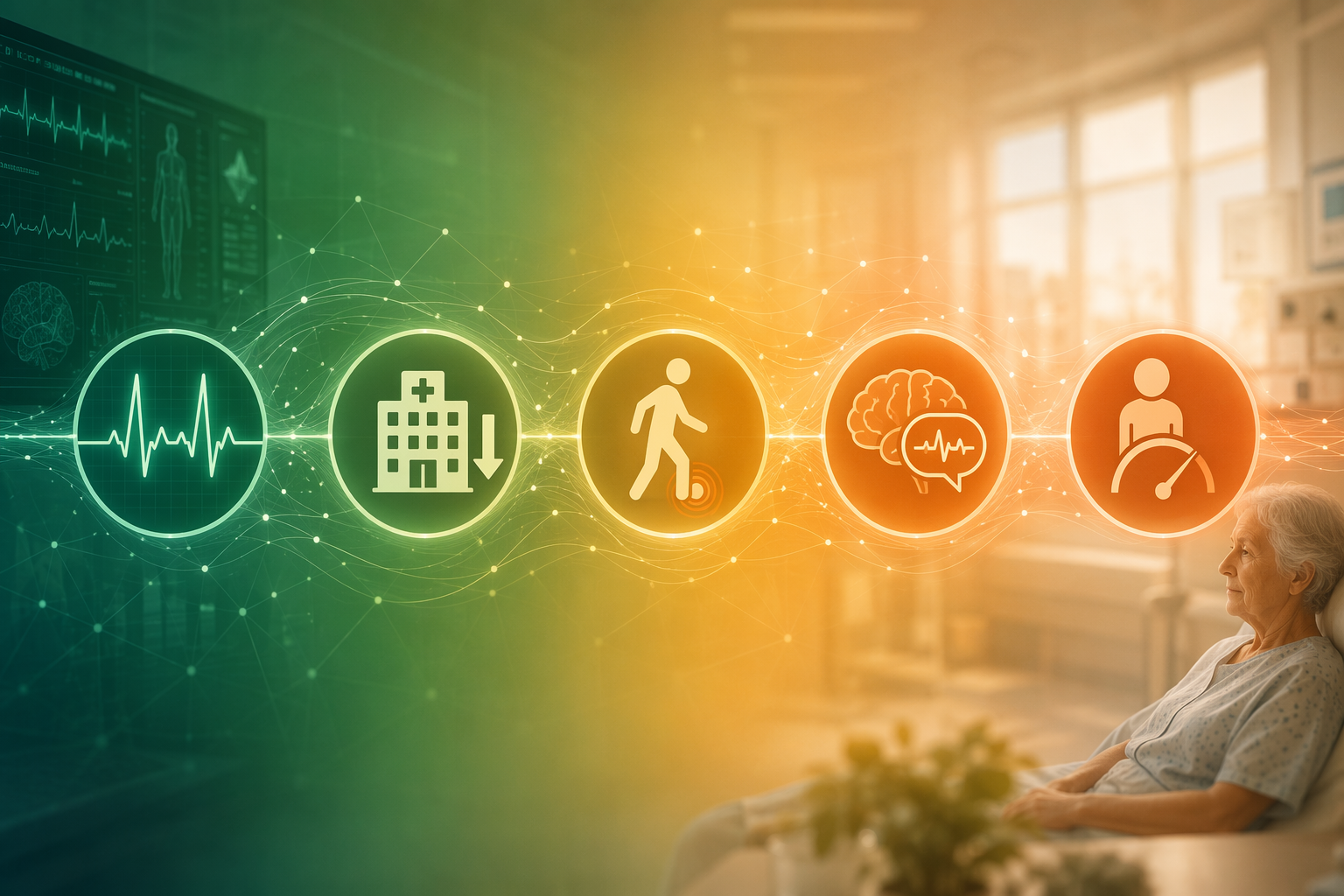
The Evidence Is Strongest Where the Endpoint Is Clear
Across the available studies, cardiovascular monitoring and readmission-related decision support stand out for different reasons. The cardiovascular evidence is compelling because the reported discrimination is high in a very large patient sample. The readmission evidence is compelling because it reports a change in patient outcomes, not only a model-performance statistic.
| Clinical domain | Reported evidence | What the result supports | Main caution |
|---|---|---|---|
| Cardiovascular monitoring | Occult atrial fibrillation detection from sinus rhythm ECGs: AUC 0.90; sensitivity 82.3%; specificity 83.4%; n=180,922 | Strong discrimination for a clinically actionable arrhythmia signal | Performance still depends on population, ECG context, and downstream confirmation |
| Hospital readmission reduction | Unplanned readmissions reduced from 11.4% to 8.1%; 25% relative reduction; p<0.001; n=2,460 hospitalizations | Evidence of outcome improvement with AI-based decision support | Implementation context may drive part of the observed effect |
| Cognitive decline detection | Speech analysis distinguished cognitively impaired from normal older adults: AUC 0.93; accuracy 88.4%; sensitivity 87.5%; specificity 89.2% | High reported classification performance | Speech-based models may be sensitive to setting and population differences |
| Fall prediction | Nursing home models: ROC-AUC 0.710–0.750 using balance, grip strength, fatigue, fall history, age, and comorbidity | Moderate risk stratification for a high-consequence geriatric event | Generalizability beyond studied nursing home populations remains uncertain |
| Frailty screening | Machine-learning models using electronic frailty indexes from EHR data support earlier identification of at-risk older adults | Workflow-adjacent screening direction | Evidence for improved clinical outcomes remains emerging |
Cardiovascular Monitoring Has the Cleanest Signal
The cardiovascular case is the easiest to take seriously on conventional validation terms. An AI-enabled ECG algorithm detected occult atrial fibrillation from sinus rhythm ECGs with an AUC of 0.90, sensitivity of 82.3%, and specificity of 83.4% in a study of 180,922 patients.[2] For geriatric monitoring, that combination is notable: a common condition in older adults, a clinically familiar data source, a large sample, and metrics that map to an actionable diagnostic pathway.
AUC alone is not enough, but here it is attached to a task where discrimination has practical meaning. Occult atrial fibrillation can be intermittent and clinically consequential. A model that flags sinus rhythm ECGs as higher likelihood for hidden atrial fibrillation is not making a final therapeutic decision; it is potentially changing who receives closer rhythm evaluation. That is a reasonable use of prediction, provided the alert is treated as a triage signal rather than a diagnosis.
The sensitivity and specificity also matter because geriatric monitoring often fails at both extremes. A low-sensitivity system misses the older adult whose deterioration is subtle. A low-specificity system burdens clinicians and caregivers with false alarms, which can erode trust quickly in busy care environments. Reported values above 80% for both sensitivity and specificity do not solve the implementation problem, but they make the clinical conversation more serious than it would be for a model reporting only a favorable accuracy figure.[2]
The remaining caution is familiar: the strength of this evidence does not automatically transfer to every older adult population. ECG availability, comorbidity mix, care setting, and follow-up pathways affect how useful the signal becomes. The study supports strong model discrimination for occult atrial fibrillation detection; it does not, by itself, prove that every deployment will reduce stroke, hospitalization, or treatment delay.
Readmission Reduction Shows the Outcome Evidence Clinicians Usually Want
The readmission evidence deserves nearly equal weight for a different reason. In a study of 2,460 hospitalizations, an AI-based clinical decision support system reduced unplanned hospital readmissions from 11.4% to 8.1%, a 25% relative reduction with p<0.001.[2] Unlike a pure classification result, this is an outcome measure that patients, families, clinicians, and health systems all recognize.
That outcome orientation is especially important in geriatrics. Readmission risk is rarely a single-disease problem. It may reflect medication complexity, functional decline, caregiver capacity, frailty, poor nutrition, delirium risk, unresolved symptoms, or inadequate follow-up. A useful model in this space does not need to explain every causal pathway if it helps the care team identify who needs additional discharge planning, medication review, home support, or earlier outpatient contact.
Still, readmission reduction is not the same kind of evidence as ECG discrimination. The reported improvement reflects a system of prediction plus clinical response. The model may identify risk, but nurses, physicians, discharge planners, and case managers determine what happens next. That makes the result clinically valuable, but also more context-dependent. A hospital with different staffing, discharge workflows, post-acute capacity, or follow-up access may not reproduce the same effect simply by installing a risk score.
This is where outcome evidence can be both stronger and harder to generalize than an AUC. The reported 25% relative reduction indicates that AI-supported decision-making was associated with fewer unplanned readmissions in the studied hospitalizations.[2] It does not isolate which intervention carried the effect, nor does it prove that the same reduction will occur across all geriatric care settings. But as evidence for clinical usefulness, it is more persuasive than another leaderboard-style model comparison.
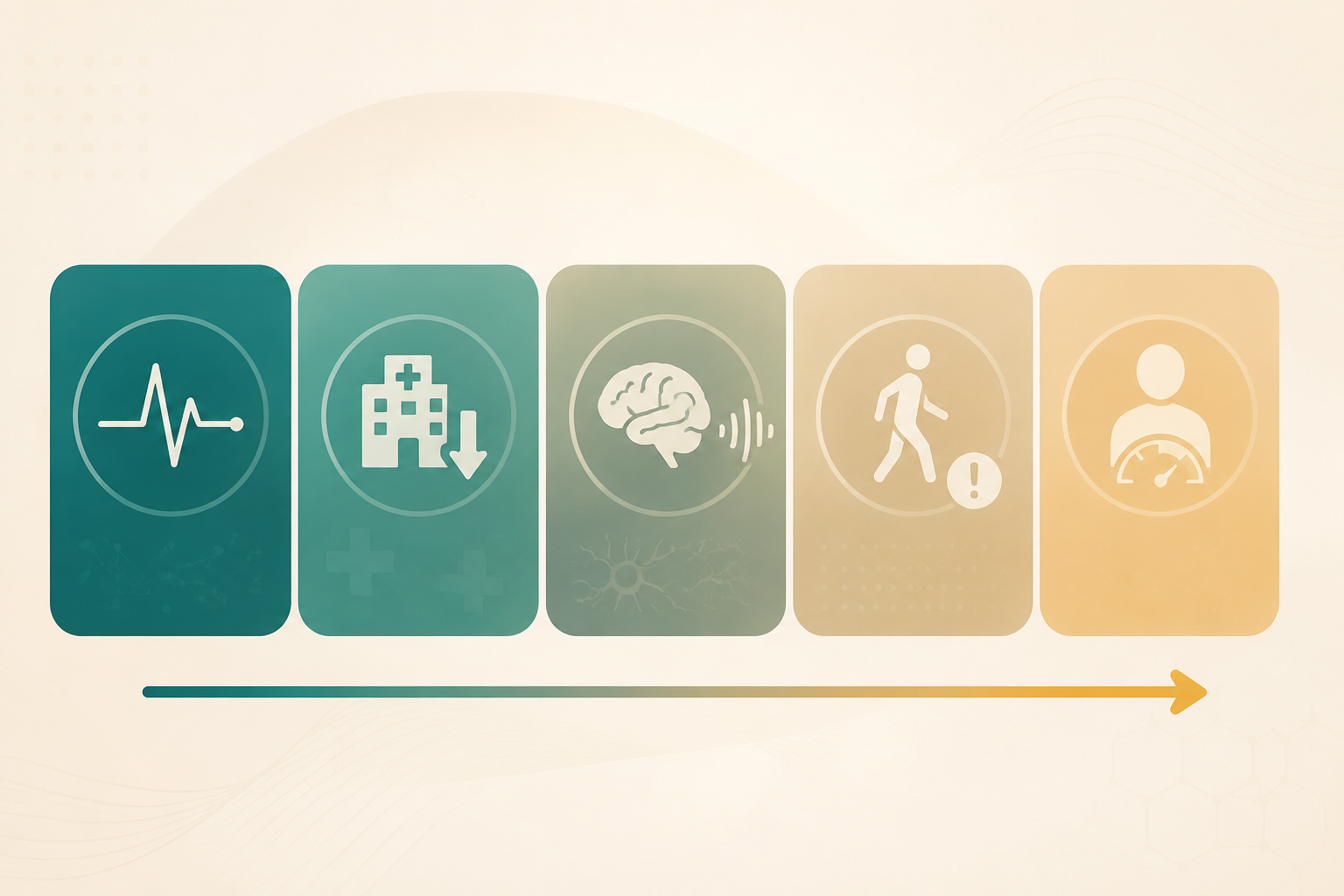
Fall Prediction Is Clinically Interesting Even With Moderate AUCs
Fall prediction sits in a more cautious middle ground. Machine-learning models for nursing home residents achieved ROC-AUC values of 0.710 to 0.750 using six predictors: balance, grip strength, fatigue, fall history, age, and comorbidity.[3] Those are not spectacular discrimination values. They are also not trivial.
The six predictors are clinically plausible. Balance and grip strength reflect physical function. Fatigue may capture reserve and activity tolerance. Fall history is one of the most direct signals available. Age and comorbidity add background vulnerability. None of this suggests a mysterious algorithm discovering an invisible geriatric truth; it suggests a model combining familiar risk signals into a stratified estimate.
AUCs in the 0.710 to 0.750 range should not be sold as definitive individual prediction.[3] For a resident standing at the bedside at night, the model cannot say with certainty what will happen. But fall prevention is not always an all-or-nothing decision. Moderate stratification may still help decide who receives a medication review, strength and balance intervention, closer toileting support, environmental adjustment, or a more urgent therapy assessment.
The limitation is that nursing home fall risk is intensely setting-dependent. Staffing patterns, mobility assistance, room layout, dementia prevalence, medication practices, and documentation quality can all affect both risk and measurement. The available result supports moderate predictive performance in the studied nursing home context. It should not be stretched into a general claim that fall prediction models are ready for reliable use across all older adults living at home, in assisted living, or after hospital discharge.
Speech-Based Cognitive Monitoring Looks Strong, but Fragile
Automated speech analysis is one of the more impressive-looking areas by reported metrics. In the cited evidence, speech analysis distinguished cognitively impaired from normal older adults with an AUC of 0.93, accuracy of 88.4%, sensitivity of 87.5%, and specificity of 89.2%.[4] On paper, those values are stronger than the fall-risk models and comparable in headline discrimination to the cardiovascular result.
The clinical appeal is obvious. Speech can carry information about word retrieval, fluency, organization, latency, and other features relevant to cognition. If measured reliably, it could support earlier identification of older adults who need formal cognitive assessment rather than waiting for a crisis, missed medication, financial error, or caregiver report.
But speech is also a less stable substrate than an ECG. The reported AUC does not eliminate concerns about how a model performs across languages, dialects, education levels, sensory impairment, recording conditions, acute illness, depression, fatigue, or unfamiliar testing environments. Those concerns are not objections to the field; they are reasons to ask for validation that resembles the populations and settings where the tool would actually be used.
The narrow conclusion is that speech-based cognitive analysis has high reported classification performance in the available evidence.[4] It is promising as a monitoring and triage aid, particularly if it prompts appropriate cognitive evaluation. It is not yet enough to assume that a speech model trained or tested in one population will remain equally reliable across the full heterogeneity of older adults.
Frailty Screening Is Close to Workflow, Farther From Proven Impact
Frailty is an appealing target for AI because it is clinically important, often underrecognized, and already partially visible in routine records. Machine-learning models using electronic frailty indexes from EHR data have been described as a way to identify at-risk older adults earlier.[5] That makes frailty screening one of the more workflow-adjacent directions: the data may already exist, and the output could fit into risk review, care planning, or population health workflows.
The evidence should be kept in that frame. Early identification is useful only if it leads to a change in management: medication simplification, nutrition support, rehabilitation, fall prevention, advance care planning, caregiver support, or closer monitoring. The available material supports frailty identification as an emerging AI application. It does not establish that EHR-based frailty models improve outcomes for older adults once deployed.
Frailty also tests the limits of routinely collected data. EHR variables can reflect who receives care, who has access, who is documented thoroughly, and who has problems that fit structured fields. A frailty score built from those records may help clinicians see risk earlier, but it may also miss function, caregiver strain, nutrition, cognition, or social vulnerability when those elements are poorly captured.
The Same Metric Does Not Mean the Same Clinical Thing
Comparing AUCs across geriatric monitoring domains is useful only up to a point. An AUC of 0.90 for occult atrial fibrillation detection is attached to a relatively bounded physiological signal and a clear confirmatory pathway.[2] An AUC of 0.93 for speech-based cognitive classification is impressive, but the input is more socially and contextually variable.[4] A fall-risk AUC of 0.710 to 0.750 may be less striking numerically, yet still clinically relevant if it allocates prevention resources to residents most likely to benefit.[3]
Outcome measures complicate the comparison further. A readmission reduction from 11.4% to 8.1% is not a model-discrimination statistic; it is a patient-care result observed in a specific decision-support context.[2] It tells us that the AI-supported process was associated with fewer unplanned readmissions, but it also asks us to examine what clinicians did after the alert. A risk score that no one acts on is a measurement artifact. A risk score tied to the right workflow can change care.
This is why the strongest evidence is not simply the highest number. It is the pairing of task, population, validation design, metric, and consequence. For older adults, that pairing is especially important because disease-specific signals often coexist with frailty, polypharmacy, sensory impairment, cognitive change, caregiver limitations, and transitions between care settings.
What Still Limits Clinical Confidence
The main limitation across this evidence base is not that the models are weak. It is that many findings remain bounded by study context. Across domains, recurring concerns include single-center designs, smaller samples in some areas, limited diversity in training populations, and few prospective validations across heterogeneous geriatric populations. Those are not minor technicalities when the intended users include older adults with multiple chronic conditions, functional limitations, varied language backgrounds, and uneven access to monitoring technology.
Bias and the digital divide sit inside that same problem. If a model is trained mostly on patients who are already well represented in a health system’s data, it may perform less reliably for those with poorer access, sparse records, different communication patterns, or less consistent device use. Privacy concerns also intensify when monitoring extends into homes, wearables, speech, or caregiver-mediated data collection. These issues do not negate the evidence, but they affect how far the evidence can travel.
Clinician trust is another evidentiary issue, not just an implementation preference. A geriatrician or nurse does not need a model to be perfect, but they need to know what the alert is calibrated to do, which population it was validated in, how false positives and false negatives behave, and what action is expected. Without that information, even a statistically impressive model can become another unranked interruption.
Clinical Evidence Readiness by Domain
On the current evidence, AI-enabled geriatric monitoring is closest to clinical validation in cardiovascular monitoring and readmission-related decision support. The atrial fibrillation ECG result combines a large population with strong discrimination, sensitivity, and specificity.[2] The readmission study reports an outcome improvement that is directly meaningful to older adults and care teams.[2]
Cognitive decline detection and fall prediction are promising but less settled. Speech analysis reports high performance, but its likely sensitivity to population and setting differences warrants careful external validation.[4] Fall prediction shows moderate discrimination in nursing home residents using clinically plausible predictors, but the result should remain anchored to that context until broader validation is available.[3]
Frailty screening remains earlier in the evidence pathway. EHR-based electronic frailty index models may help identify at-risk older adults sooner, but the available support is stronger for screening feasibility than for proven downstream clinical benefit.[5]
The field is becoming clinically credible. The credibility, however, depends on validation across the diverse, multimorbid, real-world older adult populations these tools are meant to monitor.
References
- The Emergence of AI-Based Wearable Sensors for Digital Health Technology: A Review. PMC.
- Smart aging: integrating AI into elderly healthcare. BMC Geriatrics. 2025.
- The Applications of Artificial Intelligence for Assessing Fall Risk. JMIR. 2024.
- Prospects for the application of artificial intelligence in geriatrics. PMC.
- Use of Artificial Intelligence in the Identification and Diagnosis of Frailty Syndrome in Older Adults: Scoping Review. JMIR. 2023.
Comments
Join the discussion with an anonymous comment.